
Carboxymethyl Chitosan Mushroom: Properties, Water Solubility & Applications
- All
- Microplastics
- Water Soluble
- All
- Native Chitosan
- Black Soldier Fly Chitosan
- Chitosan Oligosaccharide Hydrochloride
- Chitosan Oligosaccharide
- Chitosan Hydrochloride
- Carboxymethyl Chitosan
- Quaternary Chitosan
- Trimethyl Chitosan
- Sulphonated Chitosan
- Phosphorylated Chitosan
- Biochar
- Home Cleaning System
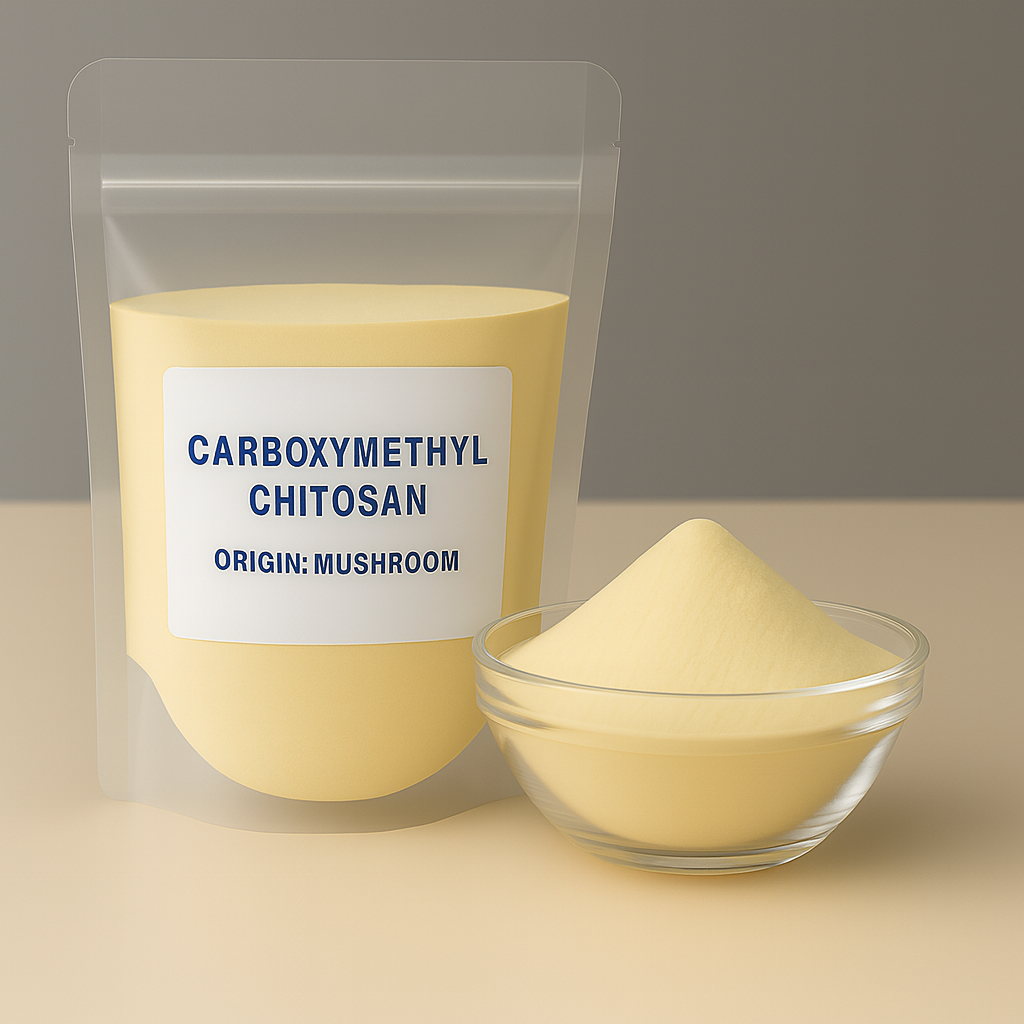
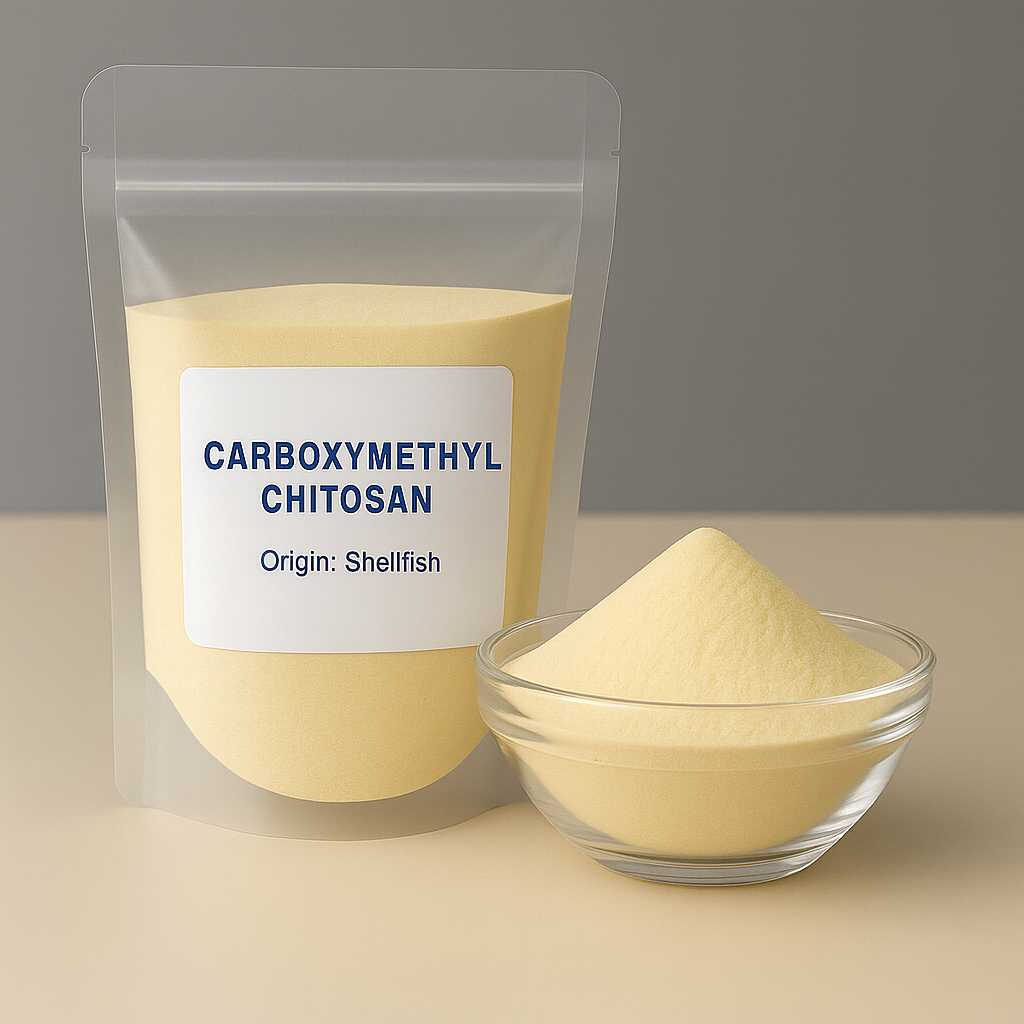
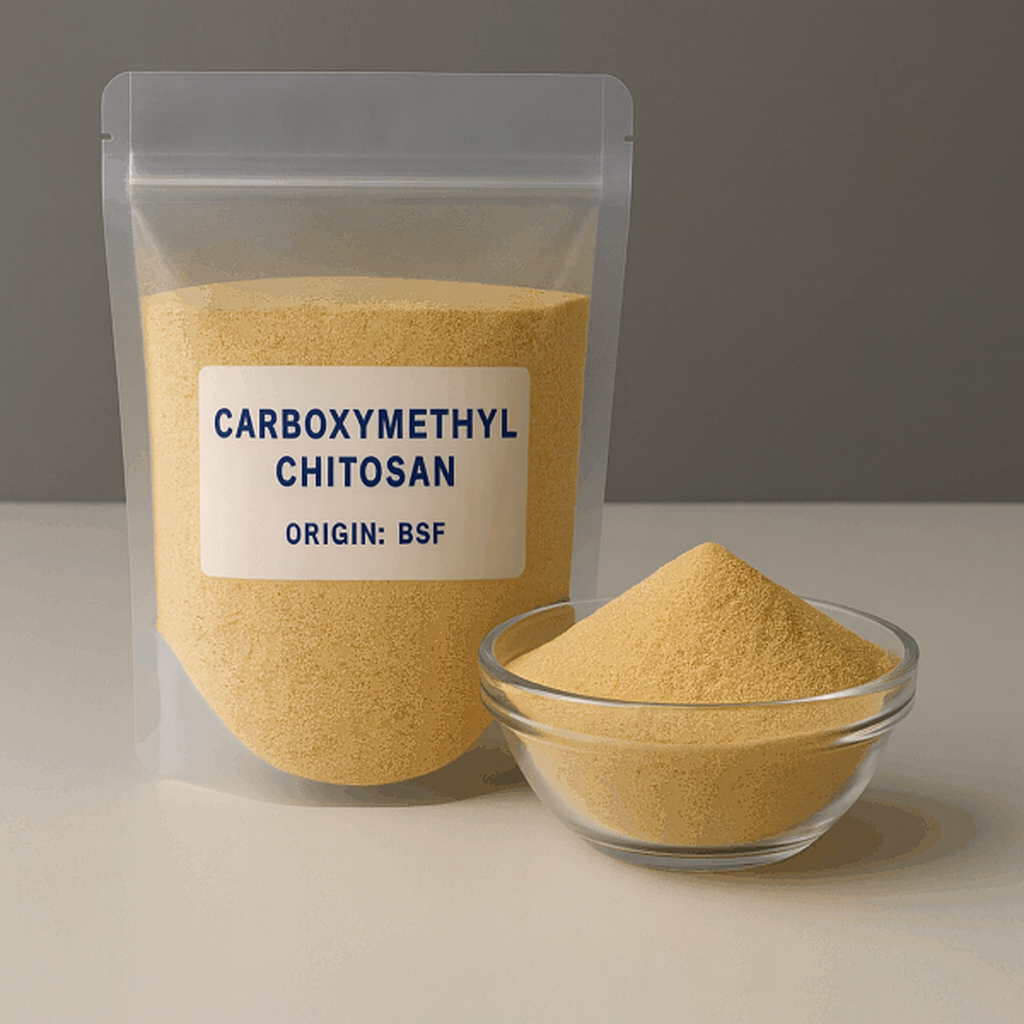
Every water-soluble chitosan route on this shop solves the acid problem differently – the salt adds charge, the oligosaccharide cuts the chain. Carboxymethyl chitosan (mushroom) does something neither can: it rewires the polymer so it holds both positive and negative groups at once. That amphoteric character – the defining trait of carboxymethyl chitosan mushroom grades – is why CMCh stays compatible across a broader pH window, why it pairs with anionic ingredients that would crash a plain chitosan solution, and why the documented batch carries a substitution ratio of 90.2% – the figure that governs all of it. This guide maps the derivative completely: what carboxymethylation actually does, why two grades sharing the name can behave differently, the documented mushroom batch figures, how it compares against the salt and native forms, and the evaluation plan that turns a datasheet into a qualified ingredient.
Request a 25 g sample | Review current specifications and the batch COA
Mushroom carboxymethyl chitosan (mushroom CMCh) is a chemically modified chitosan derivative developed for projects that require greater compatibility with aqueous formulation systems: during carboxymethylation, carboxymethyl groups are introduced onto the chitosan polymer, adding ionizable functionality that broadens the conditions under which it can be dispersed or dissolved. The documented batch tests at 90.2% substitution (spec 90%), pH 6.8 (spec 6.0-8.0), viscosity 60 mPa·s, loss on drying 7.7%, total ash 0.5% – Ph. Eur. 3A microbiology, shellfish-free by origin. The exact behavior still depends on substitution pattern, molecular weight, concentration, ionic environment, and the other ingredients in the system.
Question 1: What Exactly Is Carboxymethyl Chitosan (Mushroom)?
The problem this section solves: “carboxymethyl chitosan” is not one universally interchangeable material – and the reasons why are chemical, not marketing.
Native chitosan contains amino and hydroxyl groups that influence charge, solubility, and interaction with surrounding molecules. Introducing carboxymethyl groups adds ionizable functionality to the polymer and can broaden the conditions under which it can be dispersed or dissolved. Depending on where substitution occurs, the material may be described as O-carboxymethyl, N-carboxymethyl, or N,O-carboxymethyl chitosan – and that positional detail is one reason two grades may share the same general name while behaving differently in viscosity, hydration, film formation, charge balance, or compatibility with salts and other polymers. The degree and position of substitution are therefore important formulation variables, not minor analytical details.
A peer-reviewed review of O-carboxymethyl chitosan in biomedicine discusses how chemical structure and material properties influence its research uses, and a broader review of chitosan properties and applications explains why chemical modification is widely studied as a way to address the processing limitations of native chitosan. The documented mushroom batch, for reference: substitution ratio 90.2% (spec 90%), white or light-yellow powder, pH 6.8 (spec 6.0-8.0), viscosity 60 mPa·s, loss on drying 7.7%, total ash 0.5%, heavy metals controlled (As ≤2.0 ppm, Pb ≤1.0 ppm, Cd ≤0.5 ppm, Hg ≤0.5 ppm), microbiology tested against Ph. Eur. Category 3A (TPC 129 CFU/g) – batch CC0251028, figures on the product page.
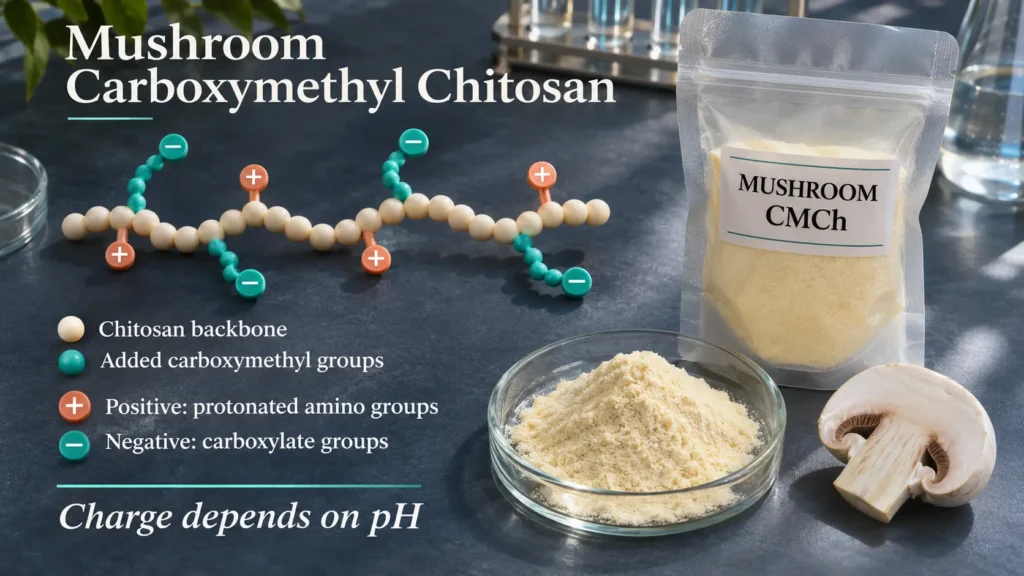
Question 2: Why Does Carboxymethyl Chitosan Mushroom Amphoteric Character Matter to Formulators?
The problem this section solves: the property that separates CMCh from every salt-form and short-chain option – and the compatibility trap that comes with it.
Carboxymethylation gives formulators another route when the limitations of native chitosan do not suit the intended process: conventional chitosan is generally processed under acidic conditions, while CMCh’s added ionizable groups allow dispersion across a broader pH window – including near-neutral systems – and, crucially, compatibility with anionic ingredients that would complex-and-crash a plain chitosan solution.
The trap: small-scale screening is especially important when CMCh is combined with anionic ingredients or multivalent ions. Polyelectrolyte interactions may be useful in some delivery, coating, or separation systems, but they can also cause unexpected thickening, complex formation, or precipitation. Bench testing should reproduce the intended water source, pH, and ingredient order as closely as possible. Formulation behavior to evaluate before scale-up: hydration or dissolution time; solution clarity, color, and undissolved material; viscosity at intended concentration and temperature; pH stability across processing and storage range; compatibility with salts, surfactants, proteins, and other polymers; film formation, adhesion, or moisture response where relevant; stability after heating, cooling, shear, and freeze-thaw exposure; and microbiological control for water-based systems.
Question 3: Why Mushroom Origin – and What Origin Does Not Guarantee?
The problem this section solves: the origin question answered with its honest boundaries.
For many buyers, origin is part of the material-selection decision. A fungal feedstock may be preferred when a project has non-crustacean sourcing requirements, vegan product-development goals, or supplier policies that distinguish fungal inputs from marine raw materials. Fungal raw materials are also not tied to the same marine supply chain as shrimp- or crab-derived chitin – though consistency must still be demonstrated with appropriate specifications and batch records, not assumed from origin alone.
The boundaries: product names alone should not replace source declarations, allergen assessments, quality agreements, or the regulatory review required for the intended market. Claims such as “food grade,” “pharmaceutical grade,” “vegan,” “shellfish-free,” “halal,” or “kosher” should be supported by the documents required by the buyer and destination market. For the broader fungal sourcing category: the vegetal-origin chitosan resource.
Question 4: Carboxymethyl Chitosan Mushroom vs HCl vs Native – Which Route Fits?
The problem this section solves: three water-compatible routes, three different tools – the decision before the purchase.
| Route | Mechanism | What You Keep | What You Trade |
|---|---|---|---|
| Carboxymethyl chitosan | Carboxymethyl groups added (substitution) | Amphoteric behavior – works with anionic ingredients; broad pH window; film and hydrogel capability | Substitution-ratio control replaces MW as the key variable; more processing steps |
| Chitosan hydrochloride | Amino groups pre-protonated (salt form) | Long chains + direct water solubility | Chloride considerations in sensitive biomedical contexts; not amphoteric |
| Native chitosan | No modification | Cleanest processing history; free amine reactivity | Acid-activation required; pH window limited |
Neither is universally better: a drug-delivery platform needing anionic compatibility points to CMCh; a film-casting process already running in acid points to native; a neutral-pH mucoadhesive system without anionic complexity points to the hydrochloride. The focused comparisons: carboxymethyl chitosan vs chitosan hydrochloride and carboxymethyl chitosan vs native chitosan. If carboxymethylation is not the best match, other derivatives offer different balances: mushroom chitosan hydrochloride, quaternary chitosan, mushroom-derived chitosan oligosaccharide, and native mushroom chitosan. The family map: types of chitosan.
Question 5: Where Is Carboxymethyl Chitosan (Mushroom) Used?
The problem this section solves: matching the amphoteric profile to its documented application areas – and where mushroom-origin carboxymethyl chitosan specifically fits.
- Hydrogel and biomedical research – CMCh-based systems are an active hydrogel research area, with the amphoteric backbone supporting gel networks and polyelectrolyte complexation: carboxymethyl chitosan for hydrogels
- Drug-delivery research – delivery matrices, polymer-active interactions, and nanoparticle systems: carboxymethyl chitosan for drug delivery
- Food preservation and coatings – chitosan-derivative coating and preservation research, now in a water-compatible derivative: carboxymethyl chitosan for food preservation
- Cosmetics and personal care – conditioning and film roles where neutral-pH compatibility matters
- Industrial systems – rheology modification, surface interaction, moisture management, and composite support
Scientific context without approval claims: current reviews discuss carboxymethyl chitosan-based systems in biomedical hydrogel research (PMC11433660) and chitosan derivatives in cosmetic formulation research (PMC9959028) – these sources provide context, not approval for a finished product.
Question 6: How Should a Buyer Qualify It?
The problem this section solves: the evaluation plan that connects analytical data to actual application performance.
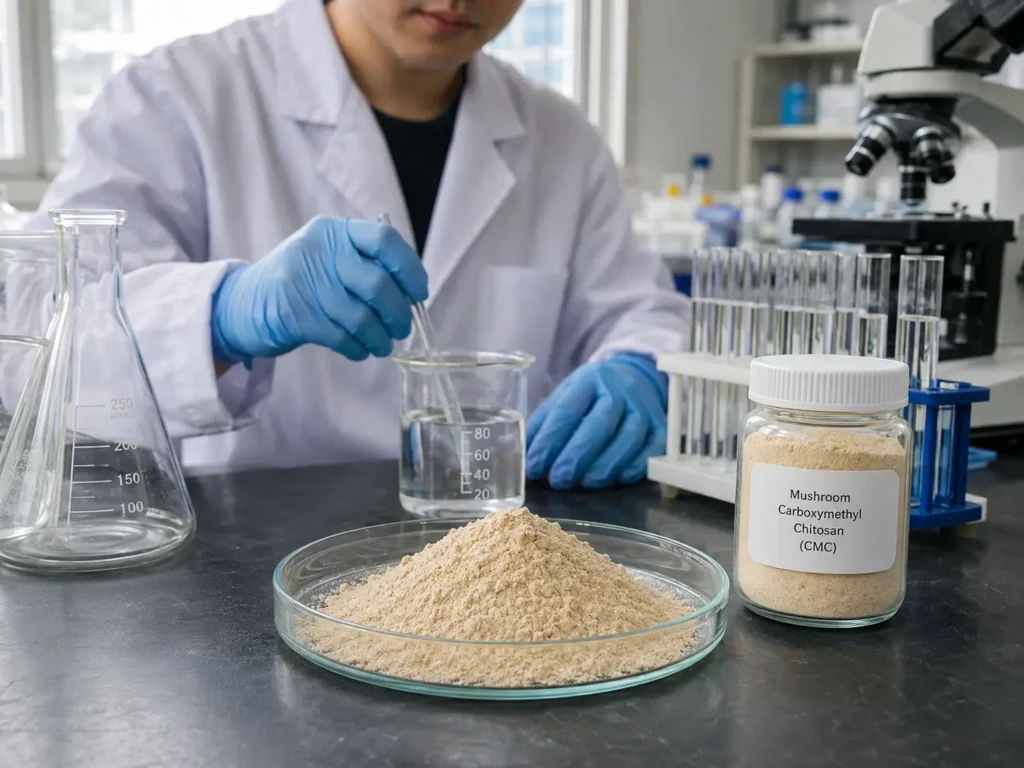
Begin by defining the function the polymer is expected to provide – film formation, rheology modification, surface interaction, moisture management, or support within a composite material – then identify measurable acceptance criteria before testing begins. For an initial laboratory screen, prepare a small concentration series instead of relying on a single trial; record mixing time, temperature, pH, appearance, and viscosity at consistent intervals; include a control formulation without CMCS and, where appropriate, a reference grade already understood by the laboratory. This makes it easier to distinguish a true material effect from normal batch or process variation.
The next stage should test compatibility under realistic use conditions: food-contact, cosmetic, agricultural, pharmaceutical, biomedical, and industrial projects have different performance and compliance requirements – research literature can guide experimental design, but it cannot establish that a particular commercial batch is suitable for a regulated use.
Documentation and regulatory due diligence: commercial qualification should start with the batch-specific documentation shown on the product page. Where a method or test condition is not stated (the current COA leaves several test methods unstated), the buyer should request clarification before treating two supplier results as directly comparable. Depending on the market, additional documentation may include a source declaration, composition statement, allergen statement, manufacturing-flow information, contaminant limits, residual-solvent data, stability information, or a regulatory-status assessment. Facility registration does not automatically approve an ingredient – U.S. developers should review the applicable FDA food-ingredient requirements, while EU developers should determine sector-specific requirements.
Question 7: How Does the Mushroom CMCh Compare – and Where Do You Buy It?
Buyers comparing the same derivative from different feedstocks can review carboxymethyl chitosan from shellfish and carboxymethyl chitosan from black soldier fly – the most useful comparison considers batch specifications, source documentation, process compatibility, regulatory needs, supply continuity, and total delivered cost, not origin alone.
From sample evaluation to commercial supply: start with a representative sample and a written evaluation plan, test in the intended formulation, compare against predefined acceptance criteria, and repeat with pilot-scale equipment before approving routine purchasing. The ordering pathway: wholesale pricing, or contact the technical team to discuss your formulation, required documents, target quantity, and destination market. The water-solubility mechanics specific to this derivative: why carboxymethyl chitosan is water soluble, and supplier qualification criteria: carboxymethyl chitosan supplier.
Frequently Asked Questions
What is mushroom carboxymethyl chitosan?
A chemically modified chitosan derivative from fungal biomass: carboxymethyl groups are introduced onto the chitosan polymer, adding ionizable functionality that broadens its compatibility with aqueous formulation systems. The documented batch tests at 90.2% substitution with pH 6.8.
Why is carboxymethyl chitosan water soluble?
The added carboxymethyl groups are ionizable, giving the polymer both positive and negative sites (amphoteric behavior) – which broadens the pH conditions under which it disperses or dissolves, beyond native chitosan’s acid-only window.
What does the substitution ratio mean?
It measures how completely carboxymethyl groups were grafted onto the polymer – the variable that governs hydration, charge balance, and formulation behavior. The documented batch tests at 90.2% against a 90% specification.
Is CMCh compatible with anionic ingredients?
Often, and that is one of its main advantages over plain chitosan – but polyelectrolyte interactions with anionic ingredients or multivalent ions can also cause unexpected thickening, complex formation, or precipitation, so bench testing in your actual matrix is required before scale-up.
Is mushroom carboxymethyl chitosan shellfish-free?
The raw material is fungal rather than crustacean, so it is shellfish-free by origin – but finished-product claims (vegan, allergen-free, halal, kosher) should be supported by the documents required for your market, not assumed from the source.
How is it different from chitosan hydrochloride?
The hydrochloride salt keeps long chains and adds charge through pre-protonation; CMCh adds whole carboxymethyl groups, creating amphoteric behavior and broader pH compatibility. The focused comparison: CMCh vs chitosan hydrochloride.
Can I request a sample and COA?
Yes – a 25 g sample and the batch-specific COA (batch CC0251028 documented) are available via the product page.
You May Also Like
- All
- Native Chitosan
- Phosphorylated Chitosan
- Sulphonated Chitosan
- Quaternary Chitosan
- Chitosan Oligosaccharide Hydrochloride
- Chitosan Hydrochloride
- Carboxymethyl Chitosan
- Chitosan Oligosaccharide
Get in Touch
Technical & Custom Solutions
Abhinav Chauhan, PhD – Application Scientist
Stephen Nice – Application Scientist