
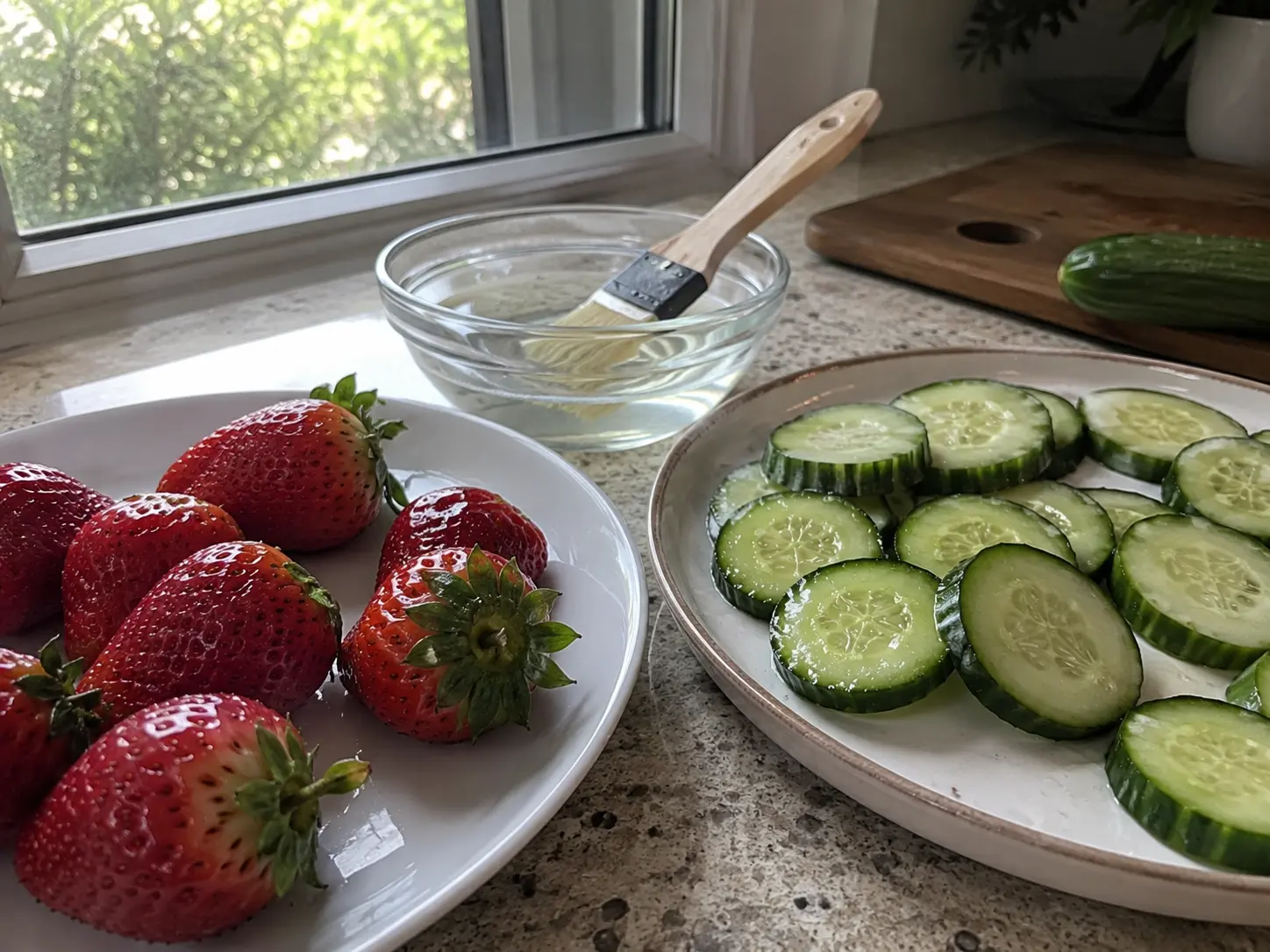
A strawberry does not suddenly spoil.
An apple does not lose freshness in one moment.
A piece of seafood does not change quality all at once.
Food deterioration usually happens gradually through moisture loss, oxygen exposure, microbial activity, oxidation, temperature, and storage conditions.
That is exactly why food scientists are interested in materials that can create a thin protective environment around food without relying only on conventional plastic packaging.
One material being actively studied for this purpose is Carboxymethyl Chitosan (CMC or CMCS).
CMC is a modified form of chitosan designed to provide broader water compatibility and additional functional groups. These properties make it particularly interesting for research involving:
- edible coatings;
- biodegradable films;
- active packaging;
- fresh produce preservation;
- seafood and poultry packaging;
- composite food films; and
- smart packaging systems.
But the interesting part is not simply that “CMC forms films.”
The real question is:
Can CMC help create a better micro-environment around food during storage?
That is where food-preservation research becomes much more interesting.
Developing a Food Coating or Packaging Film?
If you are testing Carboxymethyl Chitosan for a coating, film, or packaging formulation, begin with the actual material rather than relying only on published studies.
Order a 25 g Mushroom Carboxymethyl Chitosan Sample
Start small, review the current specification and available COA, then evaluate CMC under your own food, storage, and formulation conditions.
For a broader material overview, visit the Mushroom Carboxymethyl Chitosan guide.
Imagine a Thin Invisible Layer Around Fresh Food
Think about a freshly picked strawberry.
Its surface is exposed to:
moisture loss,
oxygen,
handling,
microorganisms,
temperature changes,
and the surrounding atmosphere.
Now imagine placing an extremely thin polymer coating over that surface.
The coating is not intended to make the strawberry permanent.
Instead, researchers investigate whether it can slow some of the processes that reduce quality during storage.
That is the basic idea behind edible-coating research.
Carboxymethyl Chitosan is interesting because it can be formulated into water-based systems and applied as part of that thin protective layer.
Depending on the complete formulation, researchers may evaluate whether the coating helps influence:
- moisture exchange;
- surface drying;
- oxygen exposure;
- texture loss;
- microbial growth;
- color changes; and
- overall storage quality.
The coating essentially becomes a controlled interface between the food and its environment.
Why Modify Chitosan in the First Place?
Native chitosan has already been widely studied for food coatings.
So why use Carboxymethyl Chitosan?
One reason is processing.
Native chitosan generally needs an acidic environment to dissolve properly.
For some formulations, that is perfectly acceptable.
For others, acid-dependent processing may complicate:
- ingredient compatibility;
- pH control;
- coating preparation;
- sensitive additives; or
- manufacturing workflow.
Carboxymethylation changes the polymer structure.
By introducing carboxymethyl groups, CMC can provide broader aqueous solubility and different ionic behavior.
In practical terms, this can make CMC easier to investigate in some water-based coating and film systems.
Want to understand the chemistry?
Read Why Carboxymethyl Chitosan Is Water Soluble.
For formulation-focused information, see Water-Soluble Carboxymethyl Chitosan.
Three Ways CMC Enters Food-Preservation Research
Instead of thinking of CMC as one finished preservation product, think of it as a polymer platform.
Researchers can build different systems around it.
1. Edible Coatings
The liquid coating is applied directly to the surface of food.
It may be sprayed, dipped, brushed, or otherwise deposited depending on the research process.
After drying, a thin polymer layer remains.
The objective is often to modify the interaction between the food and surrounding environment.
2. Packaging Films
CMC can also be incorporated into a separate film.
Instead of coating the food directly, researchers create a flexible polymer layer that can potentially be used as part of packaging.
The challenge here becomes more demanding.
The film must not simply exist—it may need acceptable:
- strength;
- flexibility;
- moisture behavior;
- gas-barrier properties;
- appearance;
- handling; and
- stability.
3. Active or Composite Packaging
This is where things become especially interesting.
CMC can be combined with other materials to create multifunctional packaging.
For example:
CMC + another polymer + plasticizer + active ingredient
Now the packaging is no longer just a barrier.
The system may be designed to provide additional functionality.
Why Pure CMC Is Often Only the Starting Point
One polymer rarely does everything perfectly.
A material may form a good film but be brittle.
Another may improve flexibility but have poor moisture resistance.
Another component may provide antimicrobial or antioxidant functionality.
That is why food-packaging researchers often develop composite systems.
A simplified formulation could look like:
CMC
provides the polymer matrix
another biopolymer
adjusts structure or mechanical behavior
plasticizer
improves flexibility
functional ingredient
adds a specific active property
The final film is therefore better understood as an engineered system.
This is important because claims like “CMC extends shelf life” can oversimplify what actually happened in a study.
Often, the performance comes from the complete formulation, not from CMC alone.
Fresh Fruit Is One of the Most Visual Applications
Fruit preservation is easy to understand because quality changes are visible.
Take strawberries.
During storage, researchers might observe:
- surface moisture loss;
- softening;
- visible microbial growth;
- color change;
- weight loss.
A coating experiment may compare:
Uncoated fruit
versus
CMC-containing coated fruit
under the same storage conditions.
Researchers can then measure whether the coating formulation changes the rate of deterioration.
Similar approaches have been explored with different fruits and vegetables.
But there is an important lesson here:
A coating that works well on one fruit cannot automatically be assumed to work equally well on another.
Strawberries, apples, tomatoes, cucumbers, and citrus fruits all have different:
- surfaces;
- respiration rates;
- moisture characteristics;
- storage requirements.
The food itself becomes part of the formulation problem.
Vegetables Create a Different Preservation Challenge
Vegetables can lose quality through dehydration, respiration, texture changes, and microbial spoilage.
A thin coating may be investigated as a way to modify moisture and gas exchange around the surface.
Researchers may track factors such as:
- weight loss;
- firmness;
- visual quality;
- color;
- microbial counts;
- storage time.
This is why food preservation cannot be reduced to one number like:
“CMC increases shelf life by X days.”
The result depends heavily on the specific food, coating formulation, and storage environment.
Seafood and Poultry Raise the Stakes
Fresh seafood and poultry are very different from apples or tomatoes.
They can undergo rapid quality changes during refrigerated storage.
Here, researchers may evaluate CMC-containing systems for parameters such as:
- microbial growth;
- lipid oxidation;
- odor;
- texture;
- moisture;
- appearance;
- refrigerated storage stability.
CMC may form part of a coating or packaging film, often combined with additional functional ingredients.
The objective is not simply to “wrap the food.”
It is to design a packaging environment that helps protect product quality for as long as practical under the test conditions.
Can CMC Packaging Be Antimicrobial?
This is one of the most interesting and most easily exaggerated areas of the topic.
CMC is frequently included in experimental films that demonstrate antimicrobial effects.
But there is an important distinction.
Sometimes the antimicrobial activity comes largely from additional components such as:
- plant extracts;
- essential oils;
- antimicrobial compounds;
- metallic or mineral nanoparticles;
- other functional polymers.
CMC may act as the carrier matrix that holds or distributes those ingredients.
So instead of saying:
“CMC kills bacteria.”
a more technically accurate statement is:
CMC can be used as part of antimicrobial food-packaging systems, particularly when combined with additional active ingredients.
That distinction matters for both scientific accuracy and commercial claims.
From Passive Packaging to Active Packaging
Traditional packaging mainly separates food from the outside environment.
Active packaging is designed to do more.
Researchers can incorporate functional ingredients into CMC-based matrices to investigate packaging that may interact with the food environment.
For example, a film could contain:
- antioxidant compounds;
- plant extracts;
- antimicrobial agents;
- natural pigments;
- indicator compounds.
This turns the film into more than a passive sheet.
It becomes part of the preservation strategy.
What About Smart Packaging?
Smart packaging adds another layer.
Instead of only helping protect food, a package may also be designed to indicate changes occurring inside the package.
Researchers have explored natural pigments and responsive compounds that change appearance according to environmental factors such as pH.
A CMC-containing film can potentially act as part of the matrix supporting these indicator systems.
Think of it as:
Packaging that not only surrounds the food but potentially communicates information about its condition.
This remains an active research field rather than a universal property of standard CMC.
CMC vs Native Chitosan for Food Preservation
The choice between native chitosan and CMC often comes down to what the formulation actually needs.
| Factor | Native Chitosan | Carboxymethyl Chitosan |
|---|---|---|
| Polymer form | Base chitosan | Modified chitosan derivative |
| Neutral-water processing | Generally limited | Broader for appropriate grades |
| Acid dissolution | Commonly needed | Can often be reduced or avoided |
| Functional groups | Amino + hydroxyl | Additional carboxymethyl groups |
| Film research | Extensive | Growing strongly |
| Edible coating research | Extensive | Increasing |
| Composite systems | Common | Common |
| Best choice | When conventional chitosan chemistry fits | When broader aqueous processing or additional functionality is useful |
Neither is automatically better.
Read the full Carboxymethyl Chitosan vs Native Chitosan comparison before deciding.
A Good Film in the Beaker Can Still Fail on Real Food
This is an important reality of food-packaging development.
A polymer formulation can look excellent in the laboratory.
It may be:
clear,
smooth,
easy to cast,
easy to dry,
and mechanically stable.
Then it is applied to actual food—and behaves differently.
Why?
Because the food surface introduces new variables.
Oil.
Moisture.
Waxes.
Proteins.
Irregular texture.
Natural microorganisms.
Temperature.
Humidity.
That is why food preservation testing needs to move through stages.
Polymer solution → Film → Food contact → Storage trial → Pilot process
Skipping those stages can lead to misleading conclusions.
What Should You Measure?
A useful CMC food-preservation development program may evaluate several groups of properties.
Before Making the Film
Check:
- dissolution;
- hydration;
- pH;
- viscosity;
- mixing behavior.
After Film Formation
Evaluate:
- thickness;
- flexibility;
- strength;
- transparency;
- adhesion;
- drying behavior.
On the Actual Food
Depending on the project:
- weight loss;
- firmness;
- color;
- microbial counts;
- oxidation;
- moisture changes;
- sensory quality.
During Storage
Track what happens over time.
Because preservation is fundamentally a time-dependent question.
Degree of Substitution Can Change the Result
Not all Carboxymethyl Chitosan materials are identical.
CMC can vary in:
- molecular weight;
- degree of substitution;
- substitution pattern;
- DDA;
- viscosity;
- purity.
Degree of Substitution, or DS, is particularly relevant because it indicates the extent of carboxymethyl modification.
Changes in DS can influence:
- water interaction;
- ionic behavior;
- viscosity;
- compatibility;
- film behavior.
So if a scientific paper uses one CMC grade and your formulation uses another, the results may not reproduce exactly.
The product name alone is not enough.
A Research Paper Is Not a Commercial Specification
Suppose a paper reports that a CMC film successfully preserved strawberries.
Before reproducing the result, ask:
Which CMC?
What molecular weight?
What degree of substitution?
What polymer concentration?
Was a plasticizer used?
What other active ingredients were added?
How was the coating applied?
What temperature was used?
How long was the food stored?
Those details matter.
Scientific literature tells you what is possible under specific experimental conditions.
Your supplier specification tells you what material you are actually buying.
Your own trial tells you whether it works for your product.
Food Research Does Not Automatically Mean Food Approval
CMC may appear in food-packaging and preservation research, but scientific use should not be confused with regulatory permission.
Commercial food and food-contact applications can require evaluation of:
- grade;
- purity;
- source;
- intended use;
- concentration;
- migration;
- processing;
- local regulations;
- jurisdiction-specific requirements.
A material described as “food grade” also should not automatically be interpreted as approved for every possible edible coating or packaging use.
Qualification must match the actual application.
Start With a 25 g Mushroom CMC Sample
A small laboratory sample can answer a much more important question than a large product description:
Does this particular CMC work in our preservation system?
Order a 25 g Mushroom Carboxymethyl Chitosan Sample
Test it using your actual:
- food;
- concentration;
- storage temperature;
- humidity;
- drying method;
- second polymer;
- plasticizer;
- active ingredients.
Then compare the results against an untreated control.
That is where meaningful food-preservation data begins.
Frequently Asked Questions
What is Carboxymethyl Chitosan used for in food preservation?
CMC is studied as a polymer component in edible coatings, packaging films, composite packaging, active packaging, and other food-storage systems.
Can CMC be applied directly to fruit?
CMC has been investigated in edible-coating research involving fruits and vegetables. Commercial use depends on the exact formulation, grade, regulatory requirements, and intended market.
Does CMC extend food shelf life?
CMC-containing coatings and films have been investigated for their potential to slow certain quality changes during storage. Results vary according to food type, formulation, storage conditions, and additional ingredients.
Why use CMC instead of Native Chitosan?
CMC can offer broader aqueous processing because of its carboxymethyl modification. This may make some coating or film formulations easier to develop.
Is CMC antimicrobial?
CMC has been used in packaging systems that demonstrate antimicrobial effects, but many of those formulations contain additional active ingredients. Performance should be evaluated for the complete formulation.
Can CMC be used for smart packaging?
CMC has been investigated as part of polymer matrices for responsive or indicator-based packaging systems. Smart functionality usually comes from additional responsive compounds incorporated into the film.
What specifications matter when buying CMC?
Depending on the application, buyers may evaluate molecular weight, degree of substitution, DDA, viscosity, purity, solubility, moisture, source, and batch documentation.
Can I test CMC before ordering bulk?
Yes. Start with a 25 g Mushroom Carboxymethyl Chitosan sample, evaluate it in your food-packaging system, and scale after successful testing.
The Future of Food Packaging May Begin With a Very Thin Layer
Food preservation does not always require making food chemically different.
Sometimes the goal is simply to better manage the environment around it.
That is why Carboxymethyl Chitosan is interesting.
It can provide a platform for developing:
thin edible coatings
flexible biodegradable films
active packaging
composite materials
smart packaging systems
But CMC is not the finished preservation technology.
It is one piece of the system.
The final performance comes from:
the polymer + formulation + food + packaging design + storage conditions.
Explore the related CMC resources:
Mushroom Carboxymethyl Chitosan — Complete Guide
Mushroom Carboxymethyl Chitosan — 25 g Sample
Why Carboxymethyl Chitosan Is Water Soluble
Water-Soluble Carboxymethyl Chitosan
Carboxymethyl Chitosan vs Native Chitosan
Carboxymethyl Chitosan vs Chitosan Hydrochloride
Carboxymethyl Chitosan Supplier
Carboxymethyl Chitosan for Hydrogels
Carboxymethyl Chitosan for Drug Delivery
Start small. Coat real food. Compare it with a control. Measure what changes. Then scale what works.