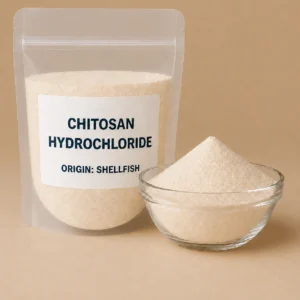
Mushroom Chitosan Hydrochloride — Green-Process, Vegan, Water-Soluble Chitosan HCl for Pharmaceutical, Nutraceutical & Cosmetic Formulation
Mushroom Chitosan Hydrochloride is a 98.5% pure, fully water-soluble chitosan hydrochloride salt derived exclusively from cultivated fungal (mushroom) chitin never from shellfish and manufactured with a green process rather than the conventional (original) chemical route used for same-name mushroom grades. For formulators, researchers, and procurement teams who need a non-animal, non-allergenic, batch-consistent alternative to crustacean-sourced chitosan hydrochloride, our mushroom-derived grade delivers the same rapid dissolution, low viscosity, and high bioactivity that water-soluble chitosan is known for without the seasonal supply variability or shellfish-allergen risk inherent to marine sourcing.
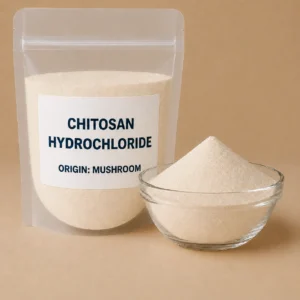
Supplied as an off-white to cream, free-flowing powder with a viscosity of just 1.3 cS, This grade is ideal wherever uniform dispersion, fast hydration, and minimal particle residue are critical. It is widely selected for dietary supplements, functional foods, cosmetic and personal care formulations, agricultural inputs, and laboratory and research use including drug delivery systems and nanoparticle formulation research.
Why Choose Mushroom-Sourced Chitosan Hydrochloride?
Most chitosan hydrochloride on the market is extracted from shrimp, crab, or lobster shell waste. While effective, marine sourcing carries three structural limitations: dependence on seasonal fishing yields, batch-to-batch variation driven by crustacean diet and species mix, and shellfish-allergen exposure risk that excludes the material from many vegan, halal, kosher, and hypoallergenic product lines.
Fungal biomass primarily cultivated mycelium offers a controlled, reproducible alternative. Because fungal cultivation takes place in a closed, monitored bioprocess rather than a wild harvest, the resulting chitin (and the chitosan hydrochloride derived from it) shows tighter specification consistency, batch after batch. This is the core reason mushroom chitosan hydrochloride is gaining share across pharmaceutical, nutraceutical, and premium cosmetic formulation, versus its marine-derived counterpart:
- 100% vegan and non-animal — suitable for plant-based and allergen-free product claims
- No shellfish allergens — eliminates a major formulation liability for food, supplement, and cosmetic brands
- Consistent, reproducible specifications — from a controlled fermentation source rather than seasonal wild harvest
- Comparable or superior degree of deacetylation versus marine chitosan, supporting strong cationic charge density and bioactivity
- Green-process manufacturing — reduced caustic consumption and lower effluent load than the conventional (original) processing route
- Aligns with ESG and sustainable-sourcing requirements increasingly demanded by pharma and CPG buyers
Green-Process Manufacturing: How This Mushroom Chitosan Hydrochloride Is Made
Production begins with chitin extracted from cultivated fungal biomass. Where the conventional (original) route relies on strong-acid demineralization and high-concentration caustic deproteinization and deacetylation steps, the green process used for this grade is engineered to reduce harsh-chemical input and to lower water consumption and effluent load across the extraction and deacetylation stages. The purified chitin is then deacetylated under controlled conditions to convert it into chitosan, increasing the proportion of free amine groups along the polymer backbone.
Because the free amine groups in chitosan are soluble only under acidic conditions, the chitosan is reacted with hydrochloric acid to form a stable, water-soluble chitosan hydrochloride salt. This salt formation is what allows the finished powder to dissolve readily across a broader pH range than free-base chitosan, which is only soluble below approximately pH 6. Every production batch is quality-tested for purity, solubility, and viscosity before release, and a Certificate of Analysis (CoA) is issued for each lot to confirm conformance to specification.
Green Process vs. Original Process
Both grades deliver the same end chemistry a water-soluble chitosan hydrochloride salt but they differ in how the chitin is converted into chitosan:
- Original process (conventional route): the proven, widely used chemical extraction suited to broad food, agriculture, and industrial applications available as the Chitosan Hydrochloride – Mushroom grade
- Green process (this grade): reduced caustic and acid consumption, lower wastewater and effluent load, and a smaller process footprint positioned for medical, pharmaceutical, and industrial buyers with sustainability or ESG procurement targets
Key Benefits of Mushroom Chitosan Hydrochloride
- Rapid, uniform dissolution in water — minimizes lumping and shortens mixing time in production
- Low viscosity (1.3 cS) keeps process equipment running efficiently at high concentration
- Vegan and non-allergenic — opens formulation into shellfish-free and plant-based product lines
- High purity (98.5%) supports pharmaceutical, nutraceutical, and cosmetic-grade applications
- Naturally cationic charge supports mucoadhesion, film formation, and antimicrobial activity
- Documented biodegradability and biocompatibility for sustainable, research-friendly use
- Batch-to-batch consistency from controlled fermentation sourcing, reducing reformulation risk
Mushroom Chitosan Hydrochloride vs. Related Chitosan Derivatives
Choosing the right chitosan derivative depends on the charge profile, solubility range, and functional groups your application requires. The table below positions this grade against the most commonly compared Chitosan Global products.
For lower-molecular-weight applications such as rapid absorption and oral delivery research, see Chitosan Oligosaccharide Hydrochloride – Mushroom and Chitosan Oligosaccharide – Mushroom.
| Derivative |
Charge Profile |
Solubility Range |
Best Fit Applications |
| Mushroom Chitosan Hydrochloride (this product) |
Cationic (amine-based) |
Water-soluble, broad pH |
Supplements, functional foods, cosmetics, general formulation, research |
| Carboxymethyl Chitosan – Mushroom |
Amphoteric/anionic |
Water-soluble across wide pH |
Hydrogels, wound care, controlled-release matrices |
| Trimethyl Chitosan – Mushroom |
Permanently cationic (quaternized) |
Water-soluble, pH-independent |
Oral drug delivery, mucoadhesive systems, absorption enhancement |
| Quaternary Chitosan – Mushroom |
Permanently cationic |
Water-soluble, pH-independent |
Antimicrobial coatings, preservative systems, personal care |
| Chitosan Oligosaccharide – Mushroom |
Cationic, low MW |
Highly water-soluble |
Rapid-absorption supplements, prebiotic/fiber applications |
For cationic mucoadhesive comparisons relevant to oral delivery, see our guide on Trimethyl Chitosan for Oral Delivery; for hydrogel-focused formulation, see Carboxymethyl Chitosan for Hydrogels; and for antimicrobial system design, see Quaternary Chitosan for Antimicrobial Systems.
Grades, Sourcing, and Application Resources
This grade is part of a broader, single-source chitosan portfolio spanning water-soluble, food-contact, industrial, and research grades. If you are comparing materials or evaluating a specific use case, these resources are the fastest route to the right grade: our water-soluble chitosan supplier overview, food-grade chitosan supplier page, and industrial chitosan manufacturer page, plus detailed guidance on chitosan in cosmetics and chitosan in food industry applications.
Why Choose Chitosan Global?
Chitosan Global is a specialized chitosan derivatives supplier sourcing and producing high-performance chitosan and chitosan salts from fungal, insect, and shellfish origins. Our fungal-sourced materials are selected for batch consistency and full specification transparency — every lot ships with a CoA, and MSDS documentation is available on request. Our team works directly with pharmaceutical formulators, nutraceutical manufacturers, cosmetic chemists, and university research groups to match the right chitosan grade to the application, from sample-scale trials to bulk production volumes.
Request Your Sample, COA, or Bulk Quote
Ready to evaluate Mushroom Chitosan Hydrochloride in your formulation or research program? Request a free 25 g sample, download the batch-specific Certificate of Analysis, or contact our team directly at steve@chitosanglobal.com for bulk pricing, custom specifications, and international shipping options. Our technical team is ready to help you select the right chitosan derivative across our full derivatives line for your exact application.