
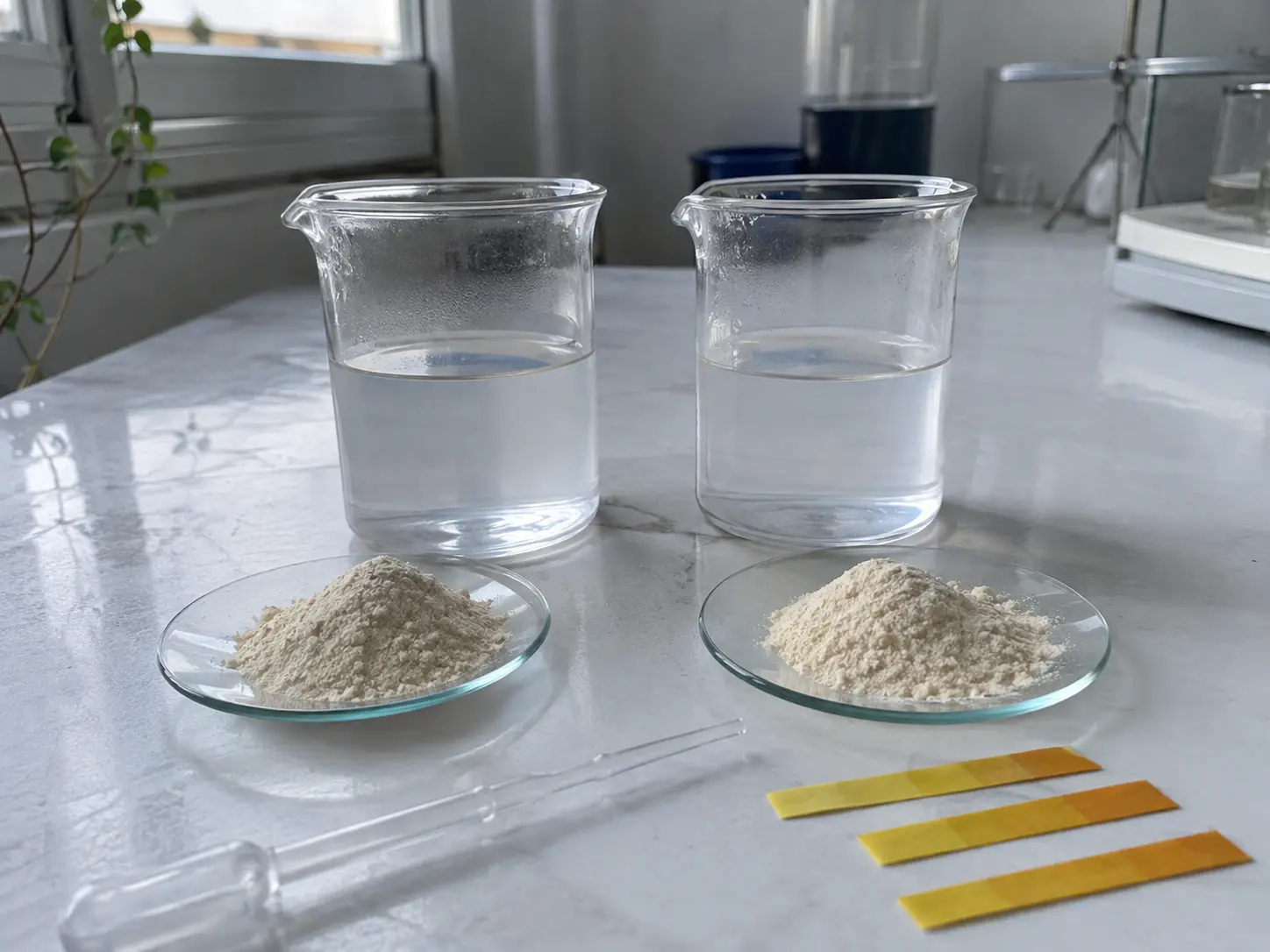
When native chitosan does not fit an aqueous formulation, two alternatives often appear on the shortlist:
Carboxymethyl Chitosan (CMC) and Chitosan Hydrochloride (Chitosan HCl).
Both can make chitosan easier to work with in water-based systems, but choosing between them based only on “water solubility” misses the most important difference.
Carboxymethyl Chitosan changes the functionality of the polymer. Chitosan Hydrochloride changes chitosan into a salt form.
That distinction affects charge behavior, formulation interactions, processing, and ultimately which derivative makes more sense for a particular application.
This comparison is designed to help formulators, researchers, and technical buyers decide which material deserves the first bench test.
Already Comparing Materials? Test Before You Scale
Specifications can narrow the choice, but your formulation should make the final decision.
For mushroom-derived CMC, review the current specification and start with a 25 g laboratory sample before moving to pilot or bulk quantities.
View Mushroom Carboxymethyl Chitosan & Order a 25 g Sample
You can also review the Mushroom Carboxymethyl Chitosan technical guide for broader information on the derivative.
The Difference in One Minute
The easiest way to distinguish these materials is to ask what happened to the original chitosan molecule?
Carboxymethyl Chitosan
CMC is produced by introducing carboxymethyl groups into chitosan.
Depending on the synthesis route, substitution can occur at amino and/or hydroxyl sites. The resulting polymer contains both amino and carboxyl functionality, giving CMC an amphoteric character and broader aqueous behavior than native chitosan.
Chitosan Hydrochloride
Chitosan HCl takes a different route.
Instead of introducing carboxymethyl groups, chitosan is converted into its hydrochloride salt. Protonation of amino groups improves aqueous handling compared with native chitosan.
The underlying distinction is therefore:
CMC = chemically functionalized chitosan derivative
Chitosan HCl = hydrochloride salt of chitosan
That difference is more useful for material selection than simply labeling both products “water-soluble chitosan.”
CMC vs Chitosan HCl: Quick Comparison
| Property | Carboxymethyl Chitosan | Chitosan Hydrochloride |
|---|---|---|
| Material Type | Carboxymethylated chitosan derivative | Hydrochloride salt of chitosan |
| Key Functional Groups | Amino + introduced carboxymethyl groups | Protonated amino groups associated with HCl |
| Charge Character | Amphoteric; behavior varies with pH and substitution | Predominantly cationic under relevant aqueous conditions |
| Aqueous Processing | Designed for broader water compatibility | Easier aqueous handling than native chitosan |
| Need for Separate Acid Dissolution | Often avoided with appropriately specified grades | Generally avoided because chitosan is supplied as the HCl salt |
| Important Selection Variables | DS, substitution pattern, MW, DDA, pH, viscosity | DDA, MW, concentration, pH, viscosity |
| Common Research Direction | Hydrogels, delivery matrices, films, coatings, food materials | Cationic formulations, delivery research, cosmetics, agriculture, coatings |
| Best Selection Method | Specification + COA + formulation test | Specification + COA + formulation test |
The table is a selection guide rather than a universal specification. Commercial grades can differ considerably.
The Real Decision: Do You Need Solubility or New Functionality?
This is where the comparison becomes useful.
Suppose your problem is simple:
“Native chitosan requires an acidic dissolution step, but I need easier incorporation into an aqueous formulation.”
A Chitosan Hydrochloride grade may deserve evaluation because converting chitosan to its HCl salt addresses that processing constraint without introducing the carboxymethyl functionality characteristic of CMC.
Now consider a different requirement:
“I need an aqueous chitosan derivative with amino and carboxyl functionality for a hydrogel, polymer network, coating, or delivery matrix.”
In that case, Carboxymethyl Chitosan may be the more logical material to investigate.
So the first decision should not be:
Which one dissolves better?
It should be:
What polymer behavior does the finished system require after dissolution?
Water Solubility: Similar Goal, Different Chemistry
Both materials are considered when native chitosan’s limited neutral-water solubility becomes inconvenient.
But they reach improved aqueous processability through different chemical routes.
How CMC Approaches the Problem
Carboxymethyl groups increase hydrophilic and ionizable functionality within the chitosan structure.
The degree and position of substitution can influence the resulting polymer’s aqueous behavior.
This is why “CMC” should not be treated as one perfectly uniform material.
For a formulation-focused discussion, see Water-Soluble Carboxymethyl Chitosan.
If you want the chemistry behind the behavior, read Why Carboxymethyl Chitosan Is Water Soluble.
How Chitosan HCl Approaches the Problem
Chitosan Hydrochloride is supplied with the amino groups protonated as the hydrochloride salt, making aqueous incorporation easier than with conventional native chitosan.
It can therefore be useful when the formulator wants to retain a strongly cationic chitosan character while avoiding a separate acid-dissolution step.
However, “water soluble” should never be interpreted as “behaves identically in every formulation.”
Concentration, molecular weight, pH, ionic strength, and interacting ingredients still matter.
Charge Behavior May Be the Bigger Difference
For many formulations, charge matters more than the initial dissolution step.
CMC contains amino and carboxyl functionality.
As environmental pH changes, the ionization of those groups can change. That gives the polymer amphoteric behavior and creates opportunities for pH-responsive interactions, complex formation, and polymer-network design.
Chitosan HCl retains the amino-based cationic character associated with protonated chitosan.
This distinction can become important when the formulation also contains:
- negatively charged polymers;
- proteins;
- surfactants;
- salts;
- active compounds;
- crosslinking agents; or
- other ionic ingredients.
A material that dissolves beautifully in pure water can behave very differently once it encounters the rest of the formulation.
Do not select the derivative from a solubility test alone.
When Carboxymethyl Chitosan May Be the Better Starting Point
CMC deserves consideration when the carboxymethyl functionality itself contributes to the formulation strategy.
1. Hydrogel Development
Carboxymethyl Chitosan has been widely investigated as a building block for hydrogel systems.
Its functional groups provide multiple possibilities for polymer interactions and crosslinking strategies, while aqueous processability can make hydrogel preparation more convenient.
Researchers evaluate CMC-based hydrogels for properties such as swelling, mechanical behavior, adhesion, encapsulation, and controlled release.
Explore this application in Carboxymethyl Chitosan for Hydrogels.
2. Drug-Delivery Research
CMC has also been investigated in polymeric delivery systems, including hydrogels, nanoparticles, and other carrier architectures.
The attraction is not simply that it enters water. Its functional groups can participate in interactions that are useful when designing a delivery matrix.
Read the dedicated Carboxymethyl Chitosan for Drug Delivery guide for the research context.
3. Films and Food-Preservation Research
Water-compatible polymer processing can be useful when preparing films and coatings.
CMC has consequently been investigated in food-packaging and preservation systems, often in combination with other polymers or functional ingredients.
See Carboxymethyl Chitosan for Food Preservation.
4. Formulations Requiring Amphoteric Behavior
When both amino and carboxyl functionality are relevant to the intended polymer interactions, CMC offers chemistry that Chitosan HCl does not reproduce simply by being water soluble.
When Chitosan Hydrochloride May Make More Sense
CMC is not automatically an upgrade from Chitosan HCl.
Sometimes carboxymethylation adds functionality that the project simply does not need.
1. You Mainly Want Easier Aqueous Processing
If the principal objective is to avoid separately dissolving native chitosan in acid, the HCl salt can provide a more direct route to a water-compatible chitosan form.
2. Cationic Character Is Important
Applications that depend strongly on protonated amino groups or cationic polymer interactions may make Chitosan HCl the more logical candidate.
3. You Want a Salt Form Rather Than a Carboxymethyl Derivative
A formulation may specifically call for Chitosan Hydrochloride rather than a derivative carrying additional carboxyl functionality.
4. Existing Research or Formulation Data Uses Chitosan HCl
If your validated process, published protocol, or previous development work specifically uses Chitosan HCl, substituting CMC simply because both are water compatible could change the system.
In that situation, changing derivatives should be treated as reformulation, not simple supplier substitution.
For a fungal-origin option, review the Mushroom Chitosan Hydrochloride product.
CMC vs Chitosan HCl for Hydrogels
This is one application where choosing only by water solubility can lead to the wrong conclusion.
Both materials can participate in aqueous polymer systems, but their functional chemistry differs.
CMC provides carboxyl as well as amino functionality. This creates additional possibilities for ionic interactions, crosslinking, conjugation, and network formation.
Chitosan HCl provides a readily aqueous, cationic chitosan salt and may be useful where positively charged chitosan behavior is central to the hydrogel design.
Therefore:
Need carboxyl-containing, amphoteric functionality? → Start by evaluating CMC.
Need a water-compatible cationic chitosan salt? → Evaluate Chitosan HCl.
The final hydrogel properties will still depend on molecular weight, polymer concentration, crosslinker, pH, other polymers, and processing conditions.
CMC vs Chitosan HCl for Drug-Delivery Research
There is no universal winner here either.
The correct material depends on the delivery architecture.
CMC may be investigated where researchers want:
- functionalized polymer networks;
- pH-responsive behavior;
- hydrogel matrices;
- conjugation possibilities; or
- controlled-release systems.
Chitosan HCl may be investigated where researchers prioritize:
- cationic polymer behavior;
- aqueous processing;
- interaction with negatively charged components; or
- formulations already designed around protonated chitosan.
Neither material should be assumed to be approved for pharmaceutical use simply because similar polymers appear in biomedical literature.
Research application ≠ regulatory approval of a commercial grade.
Product documentation and application-specific regulatory requirements must be evaluated separately.
CMC vs Chitosan HCl for Food and Coating Systems
For films and coatings, ask what happens after the solution is prepared.
CMC may be attractive for systems where carboxymethyl functionality, polymer blending, film formation, or water-compatible processing is desirable.
Chitosan HCl may be useful where cationic interactions and straightforward aqueous incorporation are more important.
But neither ingredient operates alone.
A real coating formulation may also contain:
CMC or Chitosan HCl + Plasticizer + Second Polymer + Active Ingredient + Salt/Buffer + Water
Those additional ingredients can alter viscosity, clarity, ionic interactions, film formation, and stability.
Bench testing therefore matters more than choosing a derivative from an application list.
What About Molecular Weight and DDA?
Derivative type is only the first level of selection.
Once you choose between CMC and Chitosan HCl, you still need to choose the right grade.
Two CMC grades can have different:
- molecular weights;
- degree of substitution;
- DDA;
- viscosities;
- purity;
- solution behavior; and
- biological sources.
Likewise, two Chitosan HCl grades can differ in molecular weight, DDA, viscosity, concentration behavior, and source.
This is why the product name alone cannot serve as a complete purchasing specification.
Before purchasing, review:
Derivative → Source → MW → DDA → DS where applicable → Solubility → Viscosity → Purity → COA
For buyers sourcing CMC commercially, the Carboxymethyl Chitosan Supplier page explains the qualification and procurement process in more detail.
Mushroom CMC vs Mushroom Chitosan HCl
When both products come from mushroom-derived chitosan, biological origin no longer answers the selection question.
The decision becomes primarily about derivative chemistry and grade specifications.
Choose Mushroom CMC for evaluation when:
You specifically want carboxymethyl functionality, amphoteric behavior, or a material being investigated for hydrogel, delivery-matrix, film, or coating systems.
Choose Mushroom Chitosan HCl for evaluation when:
You primarily need a water-compatible chitosan salt while retaining predominantly cationic amino-based behavior.
For CMC, review the Mushroom Carboxymethyl Chitosan product.
For the HCl alternative, review Mushroom Chitosan Hydrochloride.
Where Does Native Chitosan Fit?
There is also a third possibility:
You may not need either derivative.
If the formulation is already acidic, or if acid dissolution fits comfortably within the manufacturing process, native chitosan can remain a practical choice.
Native chitosan should therefore remain in the material-selection conversation rather than automatically being replaced by a water-soluble derivative.
For a direct comparison with CMC, see Carboxymethyl Chitosan vs Native Chitosan.
The choice becomes:
Native Chitosan
When conventional chitosan chemistry and acid-based processing fit the system.
Chitosan Hydrochloride
When easier aqueous handling plus cationic chitosan character is desired.
Carboxymethyl Chitosan
When broader aqueous processing plus carboxymethyl functionality is useful.
A Better Way to Choose Between CMC and Chitosan HCl
Instead of beginning with the derivative name, begin with five formulation questions.
Question 1: What pH must the finished system maintain?
Do not evaluate only the pH of the initial polymer solution.
Question 2: What charge behavior do you need?
Decide whether amphoteric functionality or predominantly cationic behavior better matches the system.
Question 3: Are carboxymethyl groups functionally useful?
If not, there may be no reason to introduce CMC simply to gain aqueous processability.
Question 4: Which other ingredients will interact with the polymer?
Consider salts, surfactants, proteins, active ingredients, buffers, and other polymers.
Question 5: What does the final material need to do?
Dissolve?
Form a film?
Build a hydrogel?
Carry another compound?
Interact with a charged surface?
Control viscosity?
The answer can quickly change which derivative deserves testing first.
Start With 25 g of Mushroom CMC
If your requirements point toward Carboxymethyl Chitosan, you do not need to begin with a commercial quantity.
Start with a 25 g Mushroom Carboxymethyl Chitosan sample and evaluate it under the same conditions your finished formulation will encounter.
Test the relevant:
- concentration;
- pH;
- mixing conditions;
- temperature;
- salts;
- other polymers;
- active ingredients; and
- storage conditions.
Order a 25 g Mushroom Carboxymethyl Chitosan Sample
For larger requirements after qualification, use the Carboxymethyl Chitosan Supplier resource to move from sample testing toward commercial sourcing.
Frequently Asked Questions
Is Carboxymethyl Chitosan the same as Chitosan Hydrochloride?
No. CMC is a carboxymethylated derivative of chitosan, while Chitosan Hydrochloride is the hydrochloride salt of chitosan. Their functional groups and ionic behavior are therefore different.
Are both CMC and Chitosan HCl water soluble?
Both are used when improved aqueous processability compared with native chitosan is required. Actual solubility and solution behavior should still be verified for the specific grade, concentration, pH, and formulation.
Which is better: CMC or Chitosan Hydrochloride?
Neither is universally better. CMC may be more appropriate when carboxymethyl functionality or amphoteric behavior is useful, while Chitosan HCl may be preferable when a readily aqueous, predominantly cationic chitosan salt is required.
Which is better for hydrogels?
CMC is widely investigated in hydrogel systems because its carboxyl and amino functionality can support different polymer-network strategies. Chitosan HCl can also be used in aqueous polymer research when cationic chitosan behavior is desirable. The complete hydrogel design determines the appropriate choice.
Which is better for drug-delivery research?
It depends on the carrier architecture, charge requirements, molecular weight, formulation pH, and desired polymer interactions. Neither derivative should be selected solely from the application name.
Does CMC require acid to dissolve?
Appropriately specified CMC grades can provide aqueous processing without the separate acid-dissolution step normally associated with native chitosan. Read Why Carboxymethyl Chitosan Is Water Soluble for the underlying chemistry.
Can I substitute CMC directly for Chitosan HCl?
Not necessarily. They are chemically different materials. Replacing one with the other can alter charge interactions, viscosity, solution behavior, polymer compatibility, and final performance. Treat the change as a formulation modification and test it accordingly.
Can I test CMC before ordering bulk?
Yes. For mushroom-derived CMC, start with the 25 g Mushroom Carboxymethyl Chitosan sample and review current technical documentation before scaling.
CMC or Chitosan HCl? Let the Formulation Decide
If the only question is “Which one is water soluble?”, you are comparing the materials too early in the decision process.
Instead ask:
Do I need carboxymethyl functionality and amphoteric behavior or a water-compatible cationic chitosan salt?
Then verify the answer experimentally.
For CMC:
Explore Mushroom Carboxymethyl Chitosan
Review the Current CMC Product & Order a 25 g Sample
Source CMC for R&D or Bulk Requirements
For application-specific research:
Carboxymethyl Chitosan for Drug Delivery