
Outside the USA? Contact us for international shipping rates.

Carboxymethyl Chitosan vs Native Chitosan: When Is Modification Actually Worth It?

Chitosan Science Research, applications and technical insight

Native chitosan is where the material starts.

Carboxymethyl Chitosan (CMC) is what happens when that starting polymer is deliberately modified to solve different formulation problems.

That makes the choice between Carboxymethyl Chitosan vs Native Chitosan more interesting than a simple comparison of two powders.

The real question is:

Does your formulation actually need the additional functionality of CMC—or can native chitosan already do the job?

For some applications, native chitosan is the simpler and more appropriate material. For others, its acid-dependent solubility becomes a processing limitation, and carboxymethylation can open a different formulation route.

This guide compares the two materials from a practical selection perspective: chemistry, solubility, processing, charge behavior, formulation requirements, applications, and sourcing.

Testing CMC for a New Formulation?

If neutral-water processing is one of the reasons you are considering CMC, test the actual material before moving to production volume.

Start with a 25 g Mushroom Carboxymethyl Chitosan sample, review the current specification and COA, then evaluate it under your formulation conditions.

Order a 25 g Mushroom Carboxymethyl Chitosan Sample

For the complete CMC overview, see the Mushroom Carboxymethyl Chitosan pillar guide.


Start With the Polymer: What Changes During Carboxymethylation?

Native chitosan is produced by deacetylating chitin.

Its polymer chain contains amino and hydroxyl groups that contribute to the characteristic behavior of chitosan.

Carboxymethyl Chitosan starts with that chitosan structure but introduces carboxymethyl groups through additional chemical modification.

In simplified form:

Chitin → Deacetylation → Native Chitosan

Then:

Native Chitosan → Carboxymethylation → Carboxymethyl Chitosan

This extra step does more than change the product name.

It alters the polymer’s functional-group profile and can substantially change how the material behaves in an aqueous formulation.

So CMC should not simply be considered “better chitosan.”

It is a different derivative designed for different formulation requirements.


Carboxymethyl Chitosan vs Native Chitosan at a Glance

Factor Native Chitosan Carboxymethyl Chitosan
Polymer Form Base/unmodified chitosan Chemically modified chitosan derivative
Key Groups Primarily amino and hydroxyl groups Amino, hydroxyl and introduced carboxymethyl functionality
Neutral-Water Solubility Generally limited Broader aqueous solubility for appropriately specified grades
Typical Dissolution Route Usually requires dilute acidic conditions Can allow direct aqueous processing depending on grade
Ionic Character Primarily cationic when amino groups are protonated Amphoteric behavior from amino and carboxyl functionality
Important Specifications DDA, MW, viscosity, purity DS, substitution pattern, MW, DDA, viscosity, purity
Processing Complexity Acid dissolution may be required Can simplify some water-based formulation workflows
Cost/Processing Generally simpler derivative state Additional chemical modification required
Material Selection Useful when conventional chitosan behavior fits Useful when added water compatibility/functionality is required

The table describes general material differences. Actual performance should always be confirmed from the specification and batch documentation of the grade being evaluated.


The Biggest Practical Difference: What Happens When the Powder Meets Water?

This is often where the decision begins.

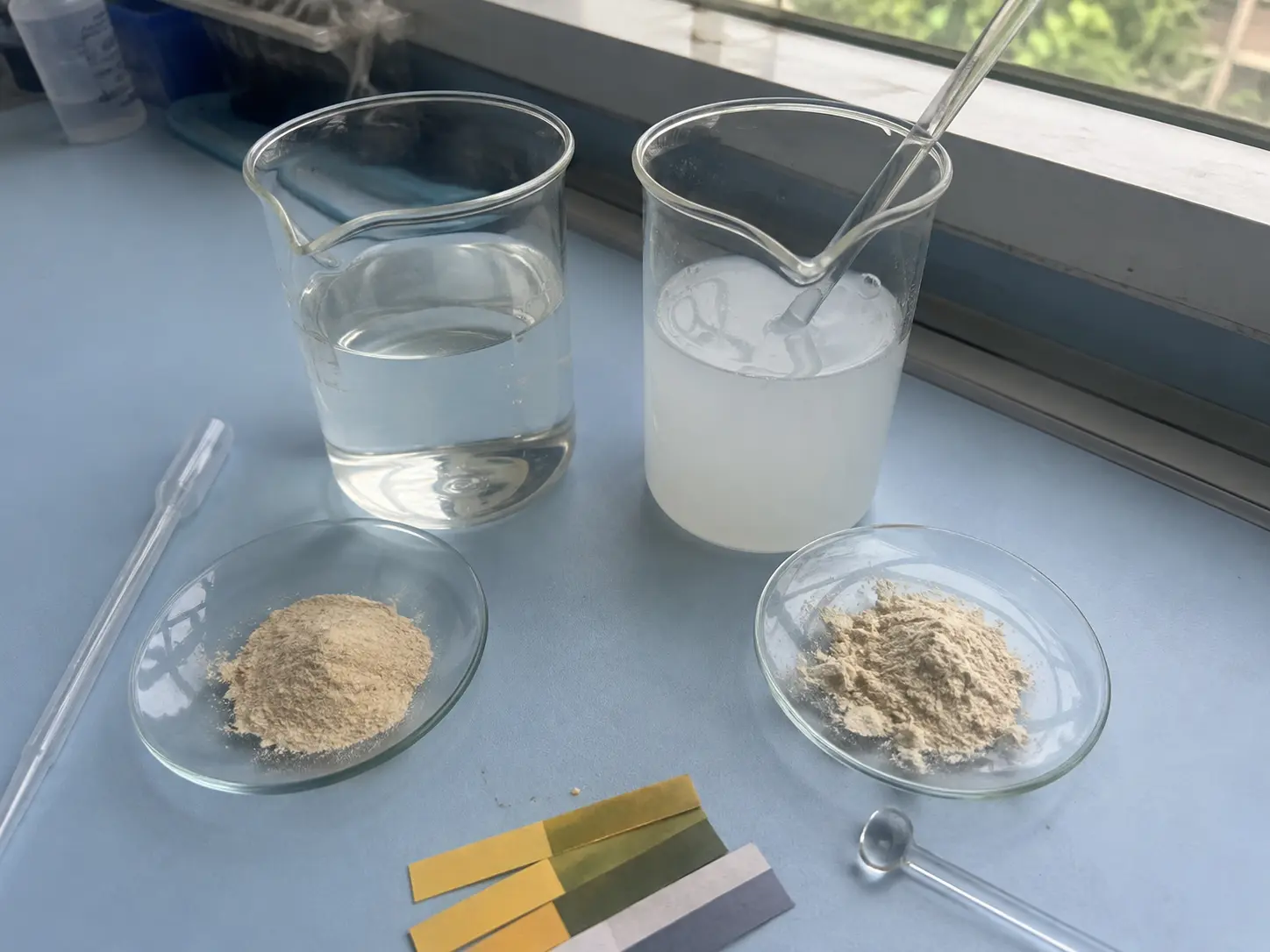
Imagine two beakers on an R&D bench.

One contains purified water and Native Chitosan.

The other contains purified water and an appropriately specified Carboxymethyl Chitosan grade.

The difference can become immediately relevant.

Native Chitosan

Native chitosan is generally not directly soluble in neutral water.

Its amino groups become protonated under acidic conditions, which enables dissolution. Formulators therefore commonly use dilute organic or mineral acid systems when preparing native chitosan solutions.

A simplified workflow may look like:

Native Chitosan → Acidified Water → Mixing/Hydration → Dissolution → Further Formulation

This is not necessarily a disadvantage.

If your process already operates under compatible acidic conditions, native chitosan may work perfectly well.

Carboxymethyl Chitosan

Carboxymethylation introduces additional hydrophilic and ionizable groups into the polymer.

Appropriately specified CMC grades can therefore offer much broader aqueous processability than native chitosan.

The workflow can become:

CMC → Water → Hydration/Dissolution → Formulation

For a detailed formulation discussion, read Water-Soluble Carboxymethyl Chitosan.

For the underlying mechanism, see Why Carboxymethyl Chitosan Is Water Soluble.


But Is Easier Water Solubility Enough Reason to Choose CMC?

Not always.

This is an important purchasing distinction.

If your formulation already contains an acidic aqueous phase and native chitosan dissolves successfully, changing to CMC may introduce complexity without solving a meaningful problem.

Ask:

Does acid interfere with another ingredient?

If yes, broader aqueous processability may make CMC worth investigating.

Must the finished formulation remain near neutral pH?

CMC may offer an advantage depending on the grade and complete formulation.

Does the process already use acidic conditions?

Native chitosan may remain entirely practical.

Do you specifically need carboxyl functionality?

Then CMC provides something native chitosan does not.

Are you changing materials only because “water soluble” sounds better?

That alone is not enough.

The best derivative is the one that removes a real formulation constraint.


Charge Behavior: CMC Is Not Simply Soluble Native Chitosan

Water solubility receives most of the attention, but functional-group chemistry may be more important.

Native chitosan contains amino groups that can become protonated.

Under appropriate acidic conditions, this gives chitosan its characteristic cationic behavior.

Carboxymethyl Chitosan introduces carboxyl-containing groups while retaining other functional groups from the chitosan backbone.

As pH changes, these different groups can ionize differently.

CMC can therefore exhibit amphoteric behavior.

That matters when the polymer is expected to interact with:

  • another charged polymer;
  • proteins;
  • ions;
  • active compounds;
  • crosslinkers;
  • particles;
  • surfaces; or
  • biological molecules in research systems.

If those interactions are central to your application, selecting between CMC and native chitosan becomes a polymer-functionality decision, not just a solubility decision.


When Native Chitosan May Be the Smarter Choice

Derivative development often creates a temptation to assume that greater modification means greater performance.

That is not how material selection works.

Native chitosan can remain the better starting point in several situations.

1. Your Process Already Works Under Acidic Conditions

If acidification is compatible with the formulation and manufacturing process, native chitosan’s dissolution requirements may not create a significant obstacle.

Why pay for functionality you do not need?

2. You Specifically Need Conventional Chitosan Chemistry

Some applications and established formulations are designed around the protonated amino functionality of native chitosan.

Changing the polymer may alter those interactions.

3. You Are Reproducing Existing Research

If a validated research protocol uses native chitosan with a defined DDA, molecular weight and dissolution method, replacing it with CMC creates a new formulation variable.

4. Simpler Material Processing Is Preferred Upstream

CMC requires an additional derivatization step after the base chitosan has been produced.

Projects that do not benefit from that modification may prefer the native material.

5. Cost Is Important

When both materials meet the technical requirement, native chitosan can be economically attractive because it does not require the additional carboxymethylation step.

The current Chitosan Global catalog includes Native Mushroom Chitosan for laboratory evaluation and larger-volume requirements.

For broader technical information, see the Native Mushroom Chitosan guide.


When CMC May Be Worth the Extra Modification

CMC becomes more compelling when modification solves a specific problem.

1. Neutral or Broader Aqueous Processing Matters

This is one of the clearest reasons to evaluate CMC.

If acidification complicates the process or conflicts with the intended formulation, a suitable CMC grade may offer a more convenient aqueous route.

2. You Need Carboxymethyl Functionality

Carboxymethyl groups introduce chemistry that native chitosan does not possess.

This can be useful in polymer networks, composite materials and other systems where specific functional-group interactions matter.

3. You Are Developing Hydrogels

CMC is widely investigated in hydrogel research because its functional groups can participate in different crosslinking and network-building strategies.

Variables such as substitution, molecular weight, polymer concentration and crosslinking method can influence the resulting gel.

Explore the application in Carboxymethyl Chitosan for Hydrogels.

4. You Are Investigating Delivery Matrices

CMC has been studied in drug-delivery research as part of hydrogels, particles, films and other polymeric carrier systems.

Its value in these systems involves more than water solubility; polymer interactions and functionalization can also matter.

See Carboxymethyl Chitosan for Drug Delivery.

5. You Need an Aqueous Film or Coating System

CMC has also been investigated for films, coatings and food-preservation materials.

When acid processing is undesirable, aqueous-compatible CMC can create a different formulation route.

Read Carboxymethyl Chitosan for Food Preservation.


Native Chitosan vs CMC for Hydrogels

Both materials appear in hydrogel research.

But they do not enter the formulation with identical chemistry.

Native chitosan-based hydrogel systems may take advantage of amino functionality, pH-responsive behavior and interactions with other polymers or crosslinkers.

CMC adds carboxymethyl functionality and broader aqueous processability, expanding the range of possible ionic and chemical interactions.

So instead of asking:

“Which one makes better hydrogels?”

ask:

“Which polymer architecture does my hydrogel require?”

Important variables include:

  • polymer concentration;
  • molecular weight;
  • DDA;
  • degree of substitution for CMC;
  • pH;
  • crosslinking chemistry;
  • second polymer;
  • swelling target;
  • mechanical requirements; and
  • intended research application.

Native Chitosan vs CMC for Drug-Delivery Research

The same principle applies to delivery systems.

Native chitosan has been extensively investigated because of its cationic character under appropriate conditions and its ability to interact with negatively charged materials.

CMC introduces different ionic behavior and additional functional groups.

Researchers may therefore select CMC when they want to explore:

  • modified polymer carriers;
  • hydrogel delivery systems;
  • pH-responsive systems;
  • conjugated materials;
  • polymer complexes; or
  • controlled-release matrices.

However, biomedical research involving a polymer does not automatically establish regulatory approval of a commercial grade for pharmaceutical use.

The exact grade, purity, documentation and intended use require separate qualification.


Native Chitosan vs CMC for Films and Food Preservation

Films and coatings demonstrate why processing conditions matter.

A native chitosan coating may be prepared using an acidic chitosan solution.

That can be entirely suitable when:

  • the food or substrate tolerates the formulation;
  • the active ingredients remain stable;
  • the process accepts the pH; and
  • the desired film properties are achieved.

CMC may become interesting when broader aqueous compatibility or different polymer interactions are required.

Researchers have investigated CMC in films and composite packaging materials, frequently alongside other polymers, plasticizers and active compounds.

For a focused overview, visit Carboxymethyl Chitosan for Food Preservation.


Don’t Forget Degree of Substitution

Native chitosan buyers frequently focus on:

DDA + Molecular Weight + Viscosity + Purity

CMC introduces another important variable:

Degree of Substitution (DS).

DS helps describe the extent of carboxymethyl substitution.

Depending on how CMC is produced, substitution pattern and degree can affect characteristics such as aqueous behavior and ionic properties.

This means two CMC powders may not perform identically even when both are called “Carboxymethyl Chitosan.”

When comparing commercial products, consider:

Native Chitosan Carboxymethyl Chitosan
DDA DDA
Molecular Weight Molecular Weight
Viscosity Viscosity
Purity Purity
Moisture Moisture
Particle Size Particle Size
Source Source
Degree of Substitution
Substitution Pattern where relevant

Always connect these values to the current product specification or batch COA rather than assuming values from published literature apply to the material being purchased.


What If Both Materials Are Mushroom-Derived?

Then biological source is no longer the main difference.

You are comparing:

Native Mushroom Chitosan

versus

Carboxymethylated Mushroom Chitosan

Both begin from fungal-origin material, but the CMC undergoes additional modification.

That allows a useful material-selection sequence:

Need fungal-origin chitosan and acid processing is acceptable?

Start by evaluating Native Mushroom Chitosan.

Need fungal-origin chitosan but neutral-water processing is important?

Evaluate Mushroom Carboxymethyl Chitosan.

Need carboxymethyl functionality for the polymer system?

CMC is the more relevant candidate.

Not sure which one will perform better?

Test both under identical conditions.

Origin tells you where the polymer came from.

Derivative chemistry tells you what the polymer can do in your formulation.


CMC Is Also Not the Only Water-Soluble Alternative

Suppose native chitosan fails your formulation because of aqueous processing.

That still does not automatically mean CMC is the correct replacement.

Other chitosan derivatives can solve different problems.

For example, Chitosan Hydrochloride provides another route to improved aqueous handling while retaining a different chemical profile from CMC.

If your project has reached this stage, read Carboxymethyl Chitosan vs Chitosan Hydrochloride before selecting solely on the phrase “water-soluble chitosan.”

Think of the decision as:

Native Chitosan → conventional base polymer

Chitosan HCl → water-compatible salt form

Carboxymethyl Chitosan → water-compatible functionalized derivative

The right branch depends on what happens after the material dissolves.


A Simple Selection Framework

Still unsure?

Use the formulation itself to narrow the choice.

Choose Native Chitosan for initial testing when:

  • acid dissolution is acceptable;
  • conventional chitosan chemistry is required;
  • an existing formulation already uses native chitosan;
  • carboxymethyl functionality offers no clear advantage; or
  • simplicity and cost are important.

Evaluate CMC when:

  • direct aqueous processing is important;
  • acidification creates formulation problems;
  • broader pH compatibility is required;
  • carboxymethyl functionality is useful;
  • amphoteric behavior matters;
  • hydrogel or polymer-network development requires additional functional groups; or
  • existing research specifically calls for CMC.

Then move from theory to testing.


Compare Samples, Not Just Product Descriptions

The most reliable comparison happens on your own bench.

Prepare a test protocol using the conditions that matter to your application.

Compare:

1. Dispersion

How easily does each powder enter the liquid?

2. Dissolution

What conditions are required to produce a usable solution?

3. pH

Does dissolution force the formulation outside its desired range?

4. Viscosity

How does the solution behave at the intended polymer concentration?

5. Compatibility

What happens after salts, actives, proteins or other polymers are added?

6. Stability

Does the formulation remain homogeneous over the required period?

7. Final Performance

Does the resulting coating, film, hydrogel or other system actually meet the target?

Only then does “CMC vs Native Chitosan” become a meaningful comparison.

Start With a 25 g CMC Sample

If CMC appears to solve a real problem in your formulation, test that hypothesis before scaling.

Order a 25 g Mushroom Carboxymethyl Chitosan Sample

Compare the sample against native chitosan using your actual:

  • pH;
  • concentration;
  • mixing procedure;
  • temperature;
  • other ingredients; and
  • final performance requirements.

The objective is not to prove that CMC is universally superior.

The objective is to find out whether modification creates a measurable advantage in your formulation.


Frequently Asked Questions

What is the main difference between Carboxymethyl Chitosan and Native Chitosan?

Native chitosan is the base chitosan polymer, while CMC is produced by introducing carboxymethyl groups into chitosan. This modification changes its functional-group profile and can significantly broaden aqueous processability.

Is Carboxymethyl Chitosan more water soluble than Native Chitosan?

Appropriately specified CMC grades generally provide broader water solubility than native chitosan, which is typically dissolved under acidic conditions.

Does Native Chitosan dissolve in neutral water?

Native chitosan is generally not directly soluble in neutral water. Protonation of its amino groups under acidic conditions facilitates dissolution.

Is CMC always better than Native Chitosan?

No. If acid processing is acceptable and native chitosan already provides the desired functionality, switching to CMC may offer little practical benefit.

What is degree of substitution in CMC?

Degree of substitution describes the extent to which carboxymethyl groups have been introduced into the polymer. It is an important CMC characterization parameter and can influence material behavior.

Which is better for hydrogels?

Both have been investigated in hydrogel systems. The appropriate choice depends on the required functional groups, pH, crosslinking strategy, polymer interactions and target hydrogel properties.

Can I replace Native Chitosan with CMC without changing my formulation?

Not necessarily. CMC is chemically different from native chitosan. A direct substitution may change solution behavior, ionic interactions, viscosity and final performance, so reformulation testing is recommended.

Can I test Mushroom CMC before ordering bulk?

Yes. Start with a 25 g Mushroom Carboxymethyl Chitosan sample, review the current specification and COA, and validate the material before commercial scale-up.


Native Chitosan or CMC? Modify Only When Modification Solves a Problem

Carboxymethylation can provide valuable functionality.

But additional modification should have a reason.

If your process works with acid-soluble native chitosan and its chemistry provides the required performance, native chitosan may be all you need.

If acid-dependent processing becomes a limitation or if carboxymethyl functionality creates useful new interactions CMC becomes a strong candidate for evaluation.

Explore the next step:

Mushroom Carboxymethyl Chitosan — Complete Guide

Water-Soluble Carboxymethyl Chitosan

Why Carboxymethyl Chitosan Is Water Soluble

Carboxymethyl Chitosan vs Chitosan Hydrochloride

Carboxymethyl Chitosan Supplier

Carboxymethyl Chitosan for Hydrogels

Carboxymethyl Chitosan for Drug Delivery

Carboxymethyl Chitosan for Food Preservation

Need to evaluate CMC? Start with 25 g, compare it against your current material, and scale only after the formulation proves the advantage.

Technical Consultation

Need Help Applying Chitosan to Your Project?

Speak with our technical team about product selection, formulation, origin, molecular weight, DDA, samples, documentation, bulk pricing and commercial supply.

Product Selection Technical Guidance Sample & Bulk Support
Free Initial Discussion

Book a Consultation

Select a convenient time to discuss your application and purchasing requirements.

Carboxymethyl Chitosan vs Native Chitosan: When Is Modification Actually Worth It?

Carboxymethyl Chitosan vs Native Chitosan: When Is Modification Actually Worth It?

Native chitosan is where the material starts.

Carboxymethyl Chitosan (CMC) is what happens when that starting polymer is deliberately modified to solve different formulation problems.

That makes the choice between Carboxymethyl Chitosan vs Native Chitosan more interesting than a simple comparison of two powders.

The real question is:

Does your formulation actually need the additional functionality of CMC—or can native chitosan already do the job?

For some applications, native chitosan is the simpler and more appropriate material. For others, its acid-dependent solubility becomes a processing limitation, and carboxymethylation can open a different formulation route.

This guide compares the two materials from a practical selection perspective: chemistry, solubility, processing, charge behavior, formulation requirements, applications, and sourcing.

Testing CMC for a New Formulation?

If neutral-water processing is one of the reasons you are considering CMC, test the actual material before moving to production volume.

Start with a 25 g Mushroom Carboxymethyl Chitosan sample, review the current specification and COA, then evaluate it under your formulation conditions.

Order a 25 g Mushroom Carboxymethyl Chitosan Sample

For the complete CMC overview, see the Mushroom Carboxymethyl Chitosan pillar guide.


Start With the Polymer: What Changes During Carboxymethylation?

Native chitosan is produced by deacetylating chitin.

Its polymer chain contains amino and hydroxyl groups that contribute to the characteristic behavior of chitosan.

Carboxymethyl Chitosan starts with that chitosan structure but introduces carboxymethyl groups through additional chemical modification.

In simplified form:

Chitin → Deacetylation → Native Chitosan

Then:

Native Chitosan → Carboxymethylation → Carboxymethyl Chitosan

This extra step does more than change the product name.

It alters the polymer’s functional-group profile and can substantially change how the material behaves in an aqueous formulation.

So CMC should not simply be considered “better chitosan.”

It is a different derivative designed for different formulation requirements.


Carboxymethyl Chitosan vs Native Chitosan at a Glance

Factor Native Chitosan Carboxymethyl Chitosan
Polymer Form Base/unmodified chitosan Chemically modified chitosan derivative
Key Groups Primarily amino and hydroxyl groups Amino, hydroxyl and introduced carboxymethyl functionality
Neutral-Water Solubility Generally limited Broader aqueous solubility for appropriately specified grades
Typical Dissolution Route Usually requires dilute acidic conditions Can allow direct aqueous processing depending on grade
Ionic Character Primarily cationic when amino groups are protonated Amphoteric behavior from amino and carboxyl functionality
Important Specifications DDA, MW, viscosity, purity DS, substitution pattern, MW, DDA, viscosity, purity
Processing Complexity Acid dissolution may be required Can simplify some water-based formulation workflows
Cost/Processing Generally simpler derivative state Additional chemical modification required
Material Selection Useful when conventional chitosan behavior fits Useful when added water compatibility/functionality is required

The table describes general material differences. Actual performance should always be confirmed from the specification and batch documentation of the grade being evaluated.


The Biggest Practical Difference: What Happens When the Powder Meets Water?

This is often where the decision begins.

Imagine two beakers on an R&D bench.

One contains purified water and Native Chitosan.

The other contains purified water and an appropriately specified Carboxymethyl Chitosan grade.

The difference can become immediately relevant.

Native Chitosan

Native chitosan is generally not directly soluble in neutral water.

Its amino groups become protonated under acidic conditions, which enables dissolution. Formulators therefore commonly use dilute organic or mineral acid systems when preparing native chitosan solutions.

A simplified workflow may look like:

Native Chitosan → Acidified Water → Mixing/Hydration → Dissolution → Further Formulation

This is not necessarily a disadvantage.

If your process already operates under compatible acidic conditions, native chitosan may work perfectly well.

Carboxymethyl Chitosan

Carboxymethylation introduces additional hydrophilic and ionizable groups into the polymer.

Appropriately specified CMC grades can therefore offer much broader aqueous processability than native chitosan.

The workflow can become:

CMC → Water → Hydration/Dissolution → Formulation

For a detailed formulation discussion, read Water-Soluble Carboxymethyl Chitosan.

For the underlying mechanism, see Why Carboxymethyl Chitosan Is Water Soluble.


But Is Easier Water Solubility Enough Reason to Choose CMC?

Not always.

This is an important purchasing distinction.

If your formulation already contains an acidic aqueous phase and native chitosan dissolves successfully, changing to CMC may introduce complexity without solving a meaningful problem.

Ask:

Does acid interfere with another ingredient?

If yes, broader aqueous processability may make CMC worth investigating.

Must the finished formulation remain near neutral pH?

CMC may offer an advantage depending on the grade and complete formulation.

Does the process already use acidic conditions?

Native chitosan may remain entirely practical.

Do you specifically need carboxyl functionality?

Then CMC provides something native chitosan does not.

Are you changing materials only because “water soluble” sounds better?

That alone is not enough.

The best derivative is the one that removes a real formulation constraint.


Charge Behavior: CMC Is Not Simply Soluble Native Chitosan

Water solubility receives most of the attention, but functional-group chemistry may be more important.

Native chitosan contains amino groups that can become protonated.

Under appropriate acidic conditions, this gives chitosan its characteristic cationic behavior.

Carboxymethyl Chitosan introduces carboxyl-containing groups while retaining other functional groups from the chitosan backbone.

As pH changes, these different groups can ionize differently.

CMC can therefore exhibit amphoteric behavior.

That matters when the polymer is expected to interact with:

  • another charged polymer;
  • proteins;
  • ions;
  • active compounds;
  • crosslinkers;
  • particles;
  • surfaces; or
  • biological molecules in research systems.

If those interactions are central to your application, selecting between CMC and native chitosan becomes a polymer-functionality decision, not just a solubility decision.


When Native Chitosan May Be the Smarter Choice

Derivative development often creates a temptation to assume that greater modification means greater performance.

That is not how material selection works.

Native chitosan can remain the better starting point in several situations.

1. Your Process Already Works Under Acidic Conditions

If acidification is compatible with the formulation and manufacturing process, native chitosan’s dissolution requirements may not create a significant obstacle.

Why pay for functionality you do not need?

2. You Specifically Need Conventional Chitosan Chemistry

Some applications and established formulations are designed around the protonated amino functionality of native chitosan.

Changing the polymer may alter those interactions.

3. You Are Reproducing Existing Research

If a validated research protocol uses native chitosan with a defined DDA, molecular weight and dissolution method, replacing it with CMC creates a new formulation variable.

4. Simpler Material Processing Is Preferred Upstream

CMC requires an additional derivatization step after the base chitosan has been produced.

Projects that do not benefit from that modification may prefer the native material.

5. Cost Is Important

When both materials meet the technical requirement, native chitosan can be economically attractive because it does not require the additional carboxymethylation step.

The current Chitosan Global catalog includes Native Mushroom Chitosan for laboratory evaluation and larger-volume requirements.

For broader technical information, see the Native Mushroom Chitosan guide.


When CMC May Be Worth the Extra Modification

CMC becomes more compelling when modification solves a specific problem.

1. Neutral or Broader Aqueous Processing Matters

This is one of the clearest reasons to evaluate CMC.

If acidification complicates the process or conflicts with the intended formulation, a suitable CMC grade may offer a more convenient aqueous route.

2. You Need Carboxymethyl Functionality

Carboxymethyl groups introduce chemistry that native chitosan does not possess.

This can be useful in polymer networks, composite materials and other systems where specific functional-group interactions matter.

3. You Are Developing Hydrogels

CMC is widely investigated in hydrogel research because its functional groups can participate in different crosslinking and network-building strategies.

Variables such as substitution, molecular weight, polymer concentration and crosslinking method can influence the resulting gel.

Explore the application in Carboxymethyl Chitosan for Hydrogels.

4. You Are Investigating Delivery Matrices

CMC has been studied in drug-delivery research as part of hydrogels, particles, films and other polymeric carrier systems.

Its value in these systems involves more than water solubility; polymer interactions and functionalization can also matter.

See Carboxymethyl Chitosan for Drug Delivery.

5. You Need an Aqueous Film or Coating System

CMC has also been investigated for films, coatings and food-preservation materials.

When acid processing is undesirable, aqueous-compatible CMC can create a different formulation route.

Read Carboxymethyl Chitosan for Food Preservation.


Native Chitosan vs CMC for Hydrogels

Both materials appear in hydrogel research.

But they do not enter the formulation with identical chemistry.

Native chitosan-based hydrogel systems may take advantage of amino functionality, pH-responsive behavior and interactions with other polymers or crosslinkers.

CMC adds carboxymethyl functionality and broader aqueous processability, expanding the range of possible ionic and chemical interactions.

So instead of asking:

“Which one makes better hydrogels?”

ask:

“Which polymer architecture does my hydrogel require?”

Important variables include:

  • polymer concentration;
  • molecular weight;
  • DDA;
  • degree of substitution for CMC;
  • pH;
  • crosslinking chemistry;
  • second polymer;
  • swelling target;
  • mechanical requirements; and
  • intended research application.

Native Chitosan vs CMC for Drug-Delivery Research

The same principle applies to delivery systems.

Native chitosan has been extensively investigated because of its cationic character under appropriate conditions and its ability to interact with negatively charged materials.

CMC introduces different ionic behavior and additional functional groups.

Researchers may therefore select CMC when they want to explore:

  • modified polymer carriers;
  • hydrogel delivery systems;
  • pH-responsive systems;
  • conjugated materials;
  • polymer complexes; or
  • controlled-release matrices.

However, biomedical research involving a polymer does not automatically establish regulatory approval of a commercial grade for pharmaceutical use.

The exact grade, purity, documentation and intended use require separate qualification.


Native Chitosan vs CMC for Films and Food Preservation

Films and coatings demonstrate why processing conditions matter.

A native chitosan coating may be prepared using an acidic chitosan solution.

That can be entirely suitable when:

  • the food or substrate tolerates the formulation;
  • the active ingredients remain stable;
  • the process accepts the pH; and
  • the desired film properties are achieved.

CMC may become interesting when broader aqueous compatibility or different polymer interactions are required.

Researchers have investigated CMC in films and composite packaging materials, frequently alongside other polymers, plasticizers and active compounds.

For a focused overview, visit Carboxymethyl Chitosan for Food Preservation.


Don’t Forget Degree of Substitution

Native chitosan buyers frequently focus on:

DDA + Molecular Weight + Viscosity + Purity

CMC introduces another important variable:

Degree of Substitution (DS).

DS helps describe the extent of carboxymethyl substitution.

Depending on how CMC is produced, substitution pattern and degree can affect characteristics such as aqueous behavior and ionic properties.

This means two CMC powders may not perform identically even when both are called “Carboxymethyl Chitosan.”

When comparing commercial products, consider:

Native Chitosan Carboxymethyl Chitosan
DDA DDA
Molecular Weight Molecular Weight
Viscosity Viscosity
Purity Purity
Moisture Moisture
Particle Size Particle Size
Source Source
Degree of Substitution
Substitution Pattern where relevant

Always connect these values to the current product specification or batch COA rather than assuming values from published literature apply to the material being purchased.


What If Both Materials Are Mushroom-Derived?

Then biological source is no longer the main difference.

You are comparing:

Native Mushroom Chitosan

versus

Carboxymethylated Mushroom Chitosan

Both begin from fungal-origin material, but the CMC undergoes additional modification.

That allows a useful material-selection sequence:

Need fungal-origin chitosan and acid processing is acceptable?

Start by evaluating Native Mushroom Chitosan.

Need fungal-origin chitosan but neutral-water processing is important?

Evaluate Mushroom Carboxymethyl Chitosan.

Need carboxymethyl functionality for the polymer system?

CMC is the more relevant candidate.

Not sure which one will perform better?

Test both under identical conditions.

Origin tells you where the polymer came from.

Derivative chemistry tells you what the polymer can do in your formulation.


CMC Is Also Not the Only Water-Soluble Alternative

Suppose native chitosan fails your formulation because of aqueous processing.

That still does not automatically mean CMC is the correct replacement.

Other chitosan derivatives can solve different problems.

For example, Chitosan Hydrochloride provides another route to improved aqueous handling while retaining a different chemical profile from CMC.

If your project has reached this stage, read Carboxymethyl Chitosan vs Chitosan Hydrochloride before selecting solely on the phrase “water-soluble chitosan.”

Think of the decision as:

Native Chitosan → conventional base polymer

Chitosan HCl → water-compatible salt form

Carboxymethyl Chitosan → water-compatible functionalized derivative

The right branch depends on what happens after the material dissolves.


A Simple Selection Framework

Still unsure?

Use the formulation itself to narrow the choice.

Choose Native Chitosan for initial testing when:

  • acid dissolution is acceptable;
  • conventional chitosan chemistry is required;
  • an existing formulation already uses native chitosan;
  • carboxymethyl functionality offers no clear advantage; or
  • simplicity and cost are important.

Evaluate CMC when:

  • direct aqueous processing is important;
  • acidification creates formulation problems;
  • broader pH compatibility is required;
  • carboxymethyl functionality is useful;
  • amphoteric behavior matters;
  • hydrogel or polymer-network development requires additional functional groups; or
  • existing research specifically calls for CMC.

Then move from theory to testing.


Compare Samples, Not Just Product Descriptions

The most reliable comparison happens on your own bench.

Prepare a test protocol using the conditions that matter to your application.

Compare:

1. Dispersion

How easily does each powder enter the liquid?

2. Dissolution

What conditions are required to produce a usable solution?

3. pH

Does dissolution force the formulation outside its desired range?

4. Viscosity

How does the solution behave at the intended polymer concentration?

5. Compatibility

What happens after salts, actives, proteins or other polymers are added?

6. Stability

Does the formulation remain homogeneous over the required period?

7. Final Performance

Does the resulting coating, film, hydrogel or other system actually meet the target?

Only then does “CMC vs Native Chitosan” become a meaningful comparison.

Start With a 25 g CMC Sample

If CMC appears to solve a real problem in your formulation, test that hypothesis before scaling.

Order a 25 g Mushroom Carboxymethyl Chitosan Sample

Compare the sample against native chitosan using your actual:

  • pH;
  • concentration;
  • mixing procedure;
  • temperature;
  • other ingredients; and
  • final performance requirements.

The objective is not to prove that CMC is universally superior.

The objective is to find out whether modification creates a measurable advantage in your formulation.


Frequently Asked Questions

What is the main difference between Carboxymethyl Chitosan and Native Chitosan?

Native chitosan is the base chitosan polymer, while CMC is produced by introducing carboxymethyl groups into chitosan. This modification changes its functional-group profile and can significantly broaden aqueous processability.

Is Carboxymethyl Chitosan more water soluble than Native Chitosan?

Appropriately specified CMC grades generally provide broader water solubility than native chitosan, which is typically dissolved under acidic conditions.

Does Native Chitosan dissolve in neutral water?

Native chitosan is generally not directly soluble in neutral water. Protonation of its amino groups under acidic conditions facilitates dissolution.

Is CMC always better than Native Chitosan?

No. If acid processing is acceptable and native chitosan already provides the desired functionality, switching to CMC may offer little practical benefit.

What is degree of substitution in CMC?

Degree of substitution describes the extent to which carboxymethyl groups have been introduced into the polymer. It is an important CMC characterization parameter and can influence material behavior.

Which is better for hydrogels?

Both have been investigated in hydrogel systems. The appropriate choice depends on the required functional groups, pH, crosslinking strategy, polymer interactions and target hydrogel properties.

Can I replace Native Chitosan with CMC without changing my formulation?

Not necessarily. CMC is chemically different from native chitosan. A direct substitution may change solution behavior, ionic interactions, viscosity and final performance, so reformulation testing is recommended.

Can I test Mushroom CMC before ordering bulk?

Yes. Start with a 25 g Mushroom Carboxymethyl Chitosan sample, review the current specification and COA, and validate the material before commercial scale-up.


Native Chitosan or CMC? Modify Only When Modification Solves a Problem

Carboxymethylation can provide valuable functionality.

But additional modification should have a reason.

If your process works with acid-soluble native chitosan and its chemistry provides the required performance, native chitosan may be all you need.

If acid-dependent processing becomes a limitation or if carboxymethyl functionality creates useful new interactions CMC becomes a strong candidate for evaluation.

Explore the next step:

Mushroom Carboxymethyl Chitosan — Complete Guide

Water-Soluble Carboxymethyl Chitosan

Why Carboxymethyl Chitosan Is Water Soluble

Carboxymethyl Chitosan vs Chitosan Hydrochloride

Carboxymethyl Chitosan Supplier

Carboxymethyl Chitosan for Hydrogels

Carboxymethyl Chitosan for Drug Delivery

Carboxymethyl Chitosan for Food Preservation

Need to evaluate CMC? Start with 25 g, compare it against your current material, and scale only after the formulation proves the advantage.

Recent Posts

Access this document

Please enter your details to download the file.
Thank you. You can now access the document below.