
Water-Soluble Mushroom Chitosan: A Formulator’s Guide to When Solubility Actually Matters
- All
- Microplastics
- Water Soluble
- All
- Native Chitosan
- Black Soldier Fly Chitosan
- Chitosan Oligosaccharide Hydrochloride
- Chitosan Oligosaccharide
- Chitosan Hydrochloride
- Carboxymethyl Chitosan
- Quaternary Chitosan
- Trimethyl Chitosan
- Sulphonated Chitosan
- Phosphorylated Chitosan
- Biochar
- Home Cleaning System
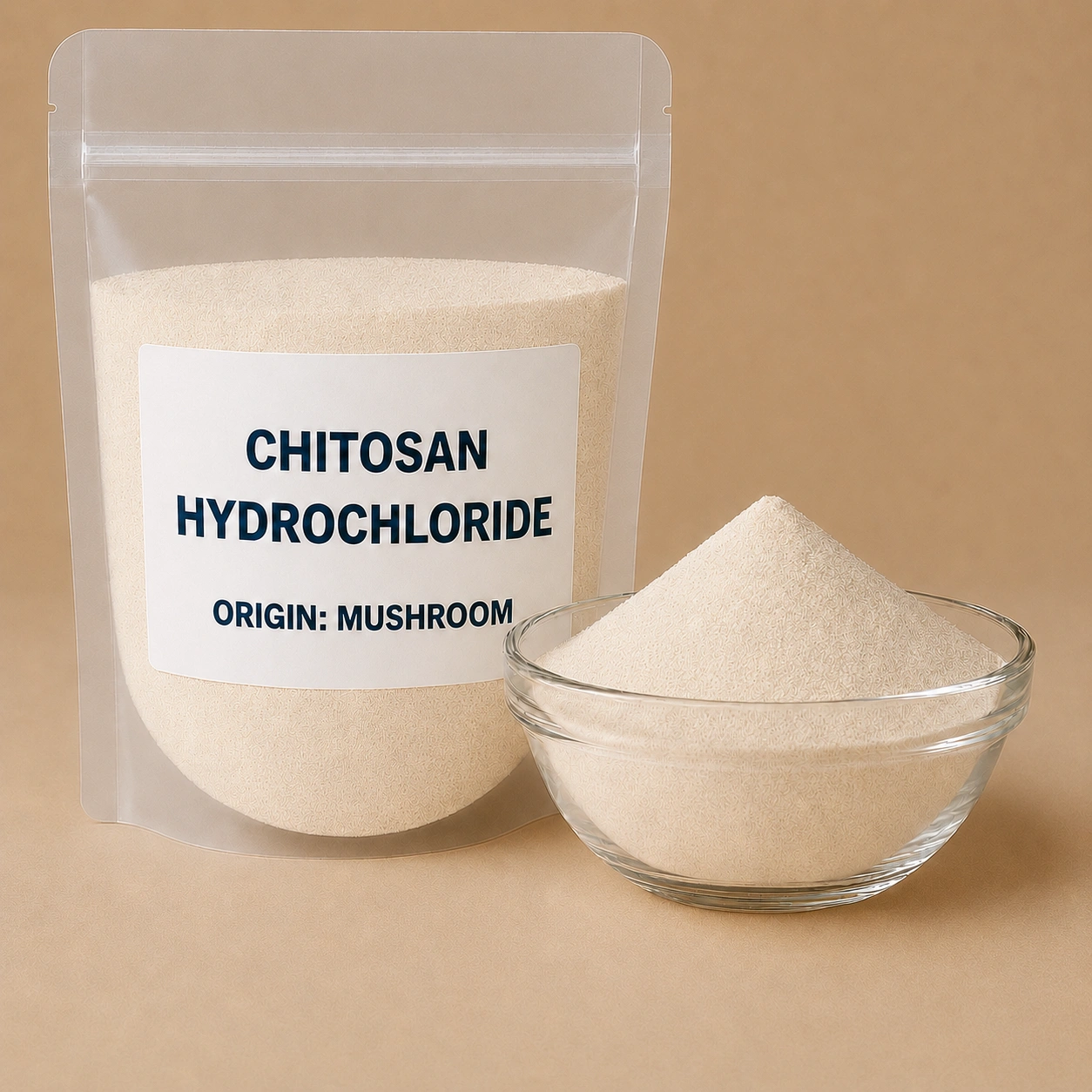
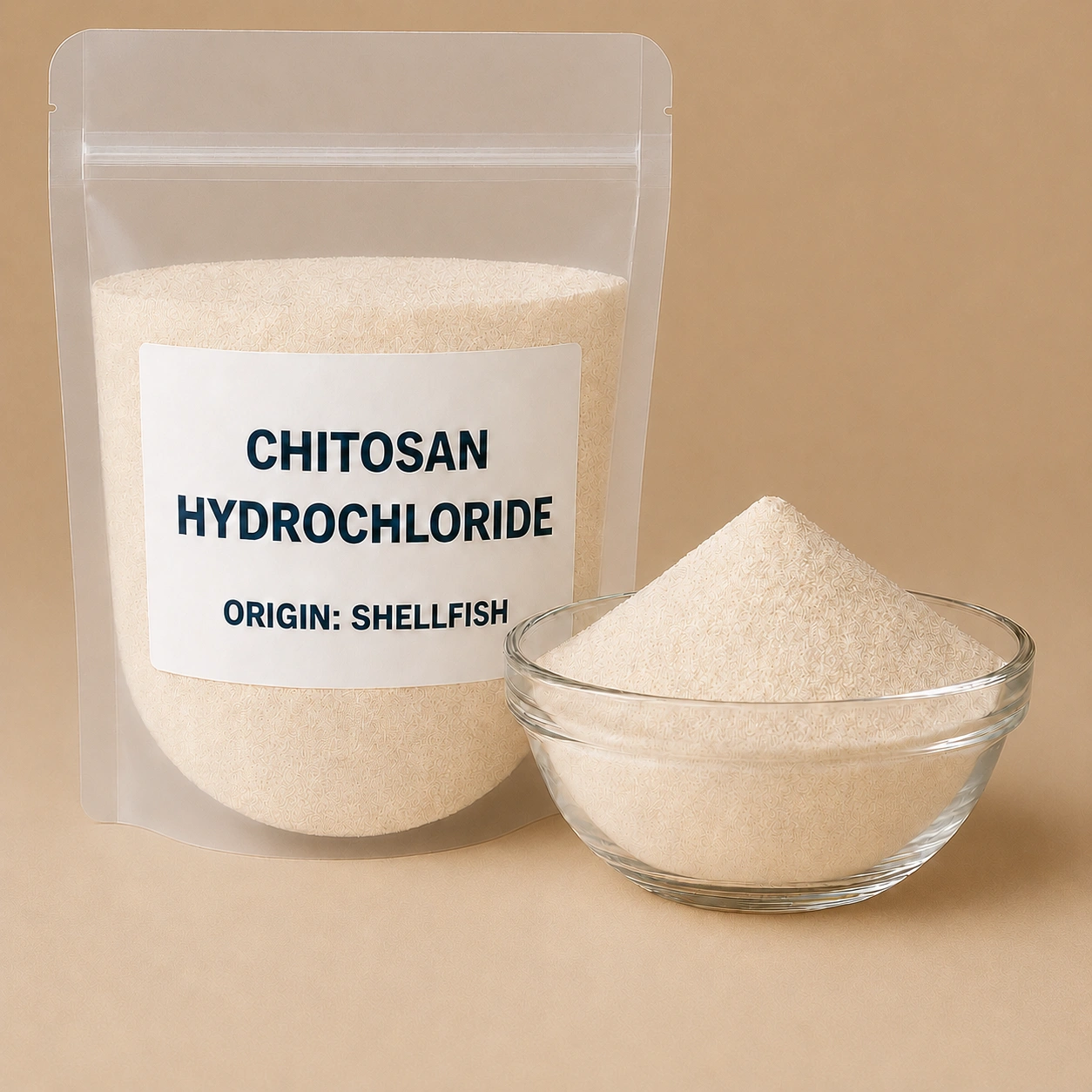
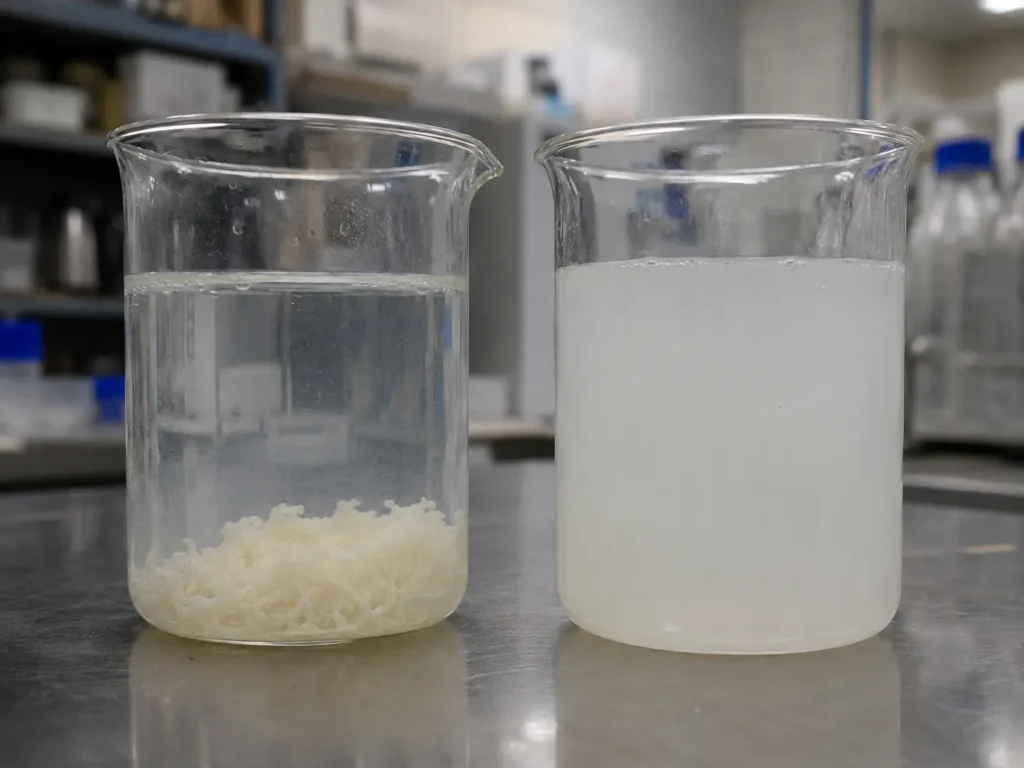
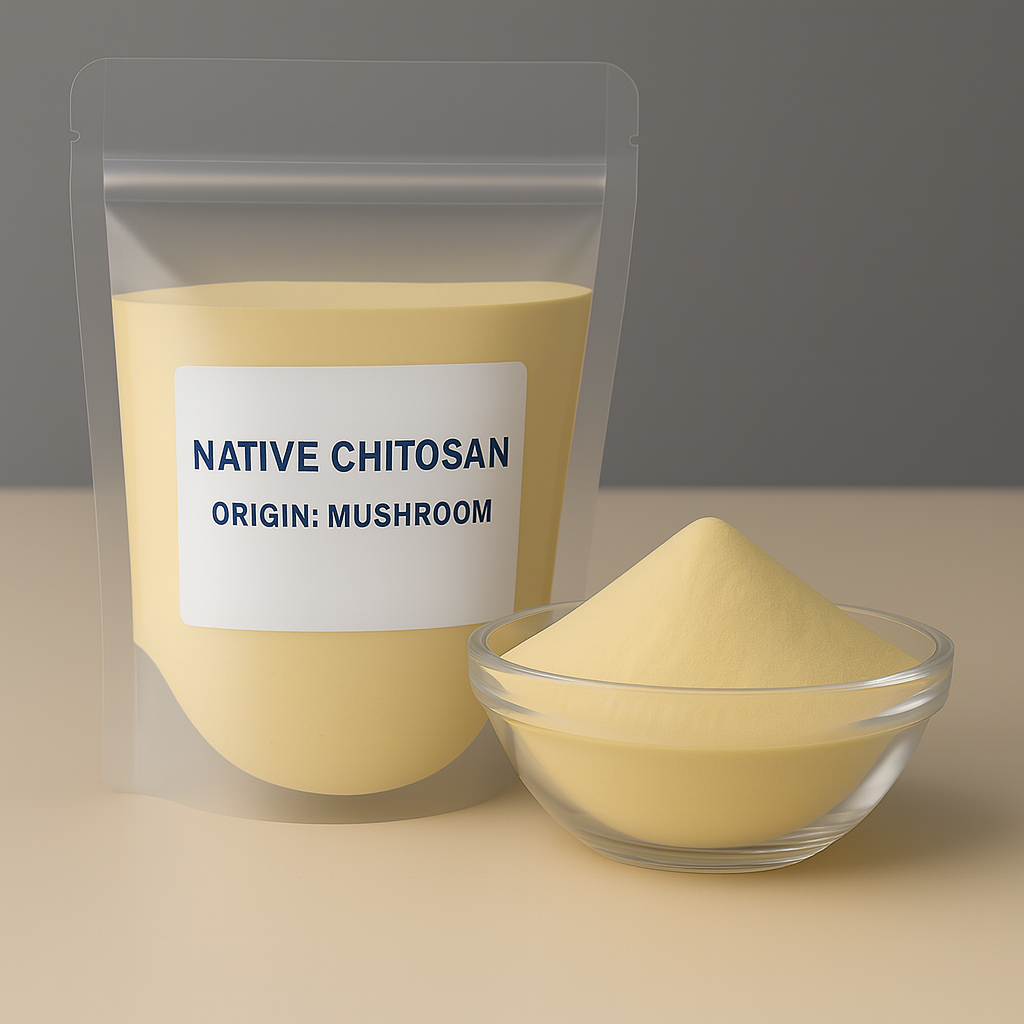
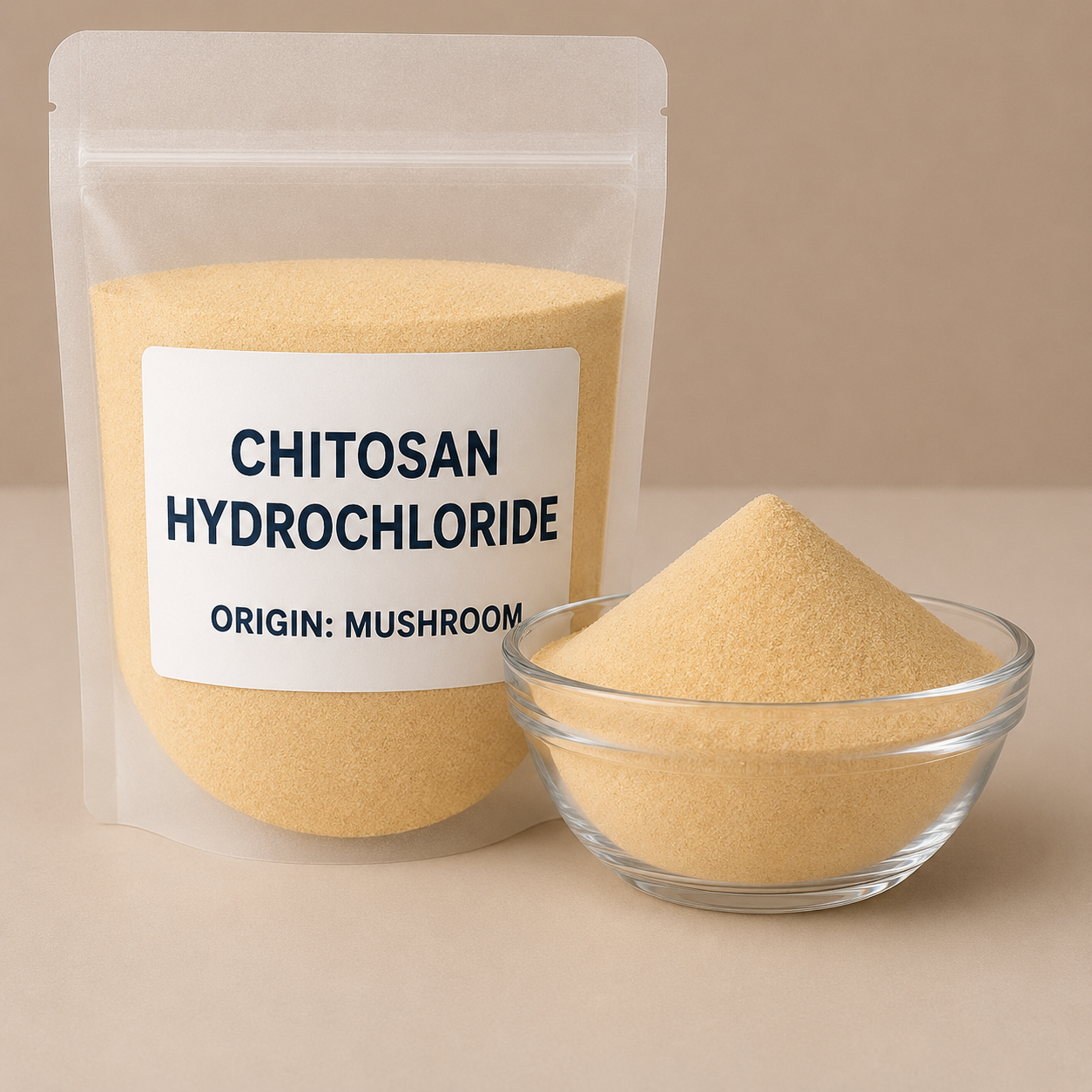
Native chitosan dissolves in acid. That’s fine until your formulation isn’t acidic a neutral-pH serum, a near-neutral beverage, a buffered pharmaceutical system at which point conventional chitosan simply won’t go into solution, no matter how finely it’s milled or how long you stir. Water-soluble mushroom chitosan, produced as the hydrochloride salt, exists specifically to remove that constraint.
Need a water-soluble mushroom chitosan for formulation work? Explore our Mushroom Chitosan Hydrochloride product, request a laboratory sample, review the COA, or speak with our technical team.
This page is a decision guide, not a general introduction for the full picture of what chitosan hydrochloride is and how it’s produced, see our Mushroom Chitosan Hydrochloride pillar guide.
Why Native Chitosan Resists Water in the First Place
Chitosan is a weak base with a pKa around 6.5. Its amine groups need to be protonated to carry the positive charge that disrupts inter-chain hydrogen bonding and allows water molecules to solvate the polymer. Below roughly pH 6, enough protonation occurs for that to happen. Above it, the amine groups stay largely unprotonated, hydrogen bonding between chains dominates, and the polymer stays essentially undissolved not partially soluble, not slow to dissolve, but functionally insoluble in practical formulation terms.
This is a real formulation constraint, not a minor inconvenience: any system that needs to stay at or near neutral pH for stability, for compatibility with an active ingredient, for a specific sensory profile simply can’t rely on native chitosan going into solution without adding acid the formulator has to manage separately.
What “Water-Soluble” Actually Means Here
Chitosan hydrochloride solves the pH problem at the manufacturing stage rather than the formulation stage: the amine groups are pre-protonated during salt formation, so the material dissolves in water without requiring you to introduce and control a separate acidifying agent.
That said, “water-soluble” isn’t a single fixed property identical across every batch or formulation. Several variables determine practical solution behavior:
- pH — even a pre-protonated salt has a practical working range; extreme pH shifts elsewhere in the formulation can still affect dissolution and stability over time.
- Concentration — viscosity increases with concentration, and the relationship isn’t linear; a specification that behaves predictably at 0.5% may behave differently at 2–3%.
- Molecular weight — higher molecular weight generally means higher viscosity at a given concentration, and commercial chitosan hydrochloride spans an unusually wide molecular weight range depending on source and processing, so this can’t be assumed from the salt form alone.
- Degree of deacetylation (DDA) — affects how many amine groups are available for charge interaction, which in turn affects solution behavior and compatibility with other charged ingredients.
- Ionic strength — other charged species in the formulation (proteins, competing polyelectrolytes, salts) can interact with chitosan’s cationic charge, potentially affecting clarity, viscosity, or even causing unwanted precipitation depending on the matrix.
- Compatibility with other ingredients — anionic surfactants, certain preservatives, and other negatively charged formulation components can interact with chitosan’s positive charge in ways that need direct testing rather than assumption.
None of this means water-soluble chitosan is unpredictable, it means “soluble” describes a starting capability, not a guarantee of performance in every formulation without verification.
Native Chitosan vs. Water-Soluble Mushroom Chitosan
| Requirement | Native Chitosan | Water-Soluble Mushroom Chitosan (HCl) | Why It Matters |
|---|---|---|---|
| Dissolves at neutral pH | No | Yes, without added acid | Removes a formulation step and a pH-management variable |
| Requires separate acidifying agent | Yes | No | Simpler process, fewer variables to control and document |
| Typical solution viscosity at equivalent concentration | Comparable or higher in some acid systems | Often lower, per comparative solvent research | Relevant where excess viscosity is undesirable |
| Best suited for | Film-forming systems, coatings, formulations already acidic | Aqueous systems requiring near-neutral pH stability | Matches the material to the formulation’s actual chemistry |
| Compatibility with acid-sensitive actives | Limited requires acidic carrier | Better — avoids introducing additional acid | Relevant for actives unstable at low pH |
For the deeper comparison including specification ranges and where native chitosan may still be the better technical choice see Chitosan Hydrochloride vs. Native Chitosan.
When Water Solubility Is a Real Advantage and When It Isn’t
Water solubility matters most when your formulation genuinely needs to operate outside chitosan’s native acid-soluble range, or when avoiding an added acidifying step simplifies your process meaningfully. It matters less and native chitosan may remain the more practical or cost-effective choice when:
- Your formulation is already acidic (many topical and some food applications are)
- You’re relying on chitosan’s film-forming behavior specifically, where native chitosan has a longer application track record
- Cost sensitivity favors the generally lower-cost native form and your process can accommodate acid addition without issue
Choosing between the two isn’t about which is “better” in the abstract, it’s about matching the material to what your formulation’s pH and process constraints actually require.
Application Relevance by Category
Pharmaceutical and drug delivery research — aqueous solubility supports formulation work where introducing additional acid could affect active ingredient stability or where a neutral-pH delivery vehicle is required.
Cosmetics and personal care — useful in toners, serums, and other aqueous formats where native chitosan’s acid dependency would conflict with the product’s target pH.
Food and nutraceutical systems — supports incorporation into beverages and liquid supplement formats without an acidic carrier that could affect taste or stability.
Agriculture — aqueous spray formulations benefit from a chitosan form that dissolves without extensive acid pre-treatment at the mixing stage.
Industrial aqueous systems — some water treatment applications benefit from readily soluble cationic polymer behavior, though cost and purity requirements should be weighed against native chitosan for less sensitive uses.
This isn’t a full applications directory, it’s meant to show where solubility specifically becomes the deciding factor.
What to Check Before Buying a Water-Soluble Mushroom Chitosan
Confirm the following against current documentation rather than assuming standard values:
- Source — fungal/mushroom origin and species, where relevant to labeling
- Degree of deacetylation (DDA)
- Molecular weight — given the wide reported range for commercial chitosan HCl generally
- Viscosity — at a stated concentration and temperature
- Purity, including residual chloride content
- Solubility — tested percentage and conditions
- pH of the reconstituted solution at your intended concentration
- Moisture content — relevant to storage stability and dosing accuracy
- Certificate of Analysis (COA) — batch-specific
- Safety Data Sheet (SDS) — for handling and regulatory needs
These are general evaluation parameters. For Chitosan Global’s current specific values, verify directly against the product page or request a Certificate of Analysis rather than assuming the figures above reflect our exact product data.
Frequently Asked Questions
Is mushroom chitosan hydrochloride fully water soluble? It’s designed to dissolve readily in water without added acid, since its amine groups are pre-protonated. “Fully” soluble depends on the specific batch, concentration, and formulation conditions confirm tested solubility via the product’s Certificate of Analysis rather than assuming it applies universally at any concentration or pH.
Why doesn’t native chitosan dissolve in water at neutral pH? Chitosan’s amine groups need to be protonated to carry the charge that allows water solvation, and this protonation only occurs sufficiently below roughly pH 6–6.5. Above that range, hydrogen bonding between polymer chains dominates and the material stays largely undissolved.
Does concentration affect how water-soluble chitosan behaves? Yes. Viscosity increases with concentration and doesn’t scale linearly, so a specification that dissolves predictably at low concentration may behave differently at higher concentration test at your actual intended use level.
Is water-soluble chitosan the same as chitosan hydrochloride? In practical commercial terms, chitosan hydrochloride is the most common water-soluble form of chitosan, produced by converting the polymer to its pre-protonated salt form.
When should I choose native chitosan instead of a water-soluble form? When your formulation is already acidic, when you specifically need chitosan’s film-forming behavior in an acid-based system, or when cost sensitivity favors native material and your process can accommodate acid addition without issue.
Does molecular weight affect solubility or just viscosity? Both. Higher molecular weight generally increases viscosity at a given concentration and can affect how readily the material disperses, even though the salt form itself remains designed for water solubility.
Ready to Evaluate a Water-Soluble Mushroom Chitosan?
If pH incompatibility is the reason your current chitosan source isn’t working, the hydrochloride form may solve that specific problem provided the batch specification matches your formulation’s actual requirements.
View Mushroom Chitosan Hydrochloride to request a laboratory sample or COA. Need sourcing details first? See our supplier page, or go straight to ordering options. For formulation-specific questions, contact our technical team directly.
You May Also Like
- All
- Microplastics
- Water Soluble
- All
- Native Chitosan
- Black Soldier Fly Chitosan
- Chitosan Oligosaccharide Hydrochloride
- Chitosan Oligosaccharide
- Chitosan Hydrochloride
- Carboxymethyl Chitosan
- Quaternary Chitosan
- Trimethyl Chitosan
- Sulphonated Chitosan
- Phosphorylated Chitosan
- Biochar
- Home Cleaning System
Get in Touch
Technical & Custom Solutions
Abhinav Chauhan, PhD – Application Scientist
Stephen Nice – Application Scientist