Water Treatment
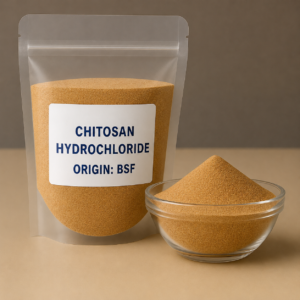
Can be evaluated as a positively charged, water-soluble biopolymer for flocculation, adsorption and industrial water-treatment formulations.
Learn more
High-Purity, Water-Soluble Chitosan Hydrochloride for Industrial Formulation
Industrial Grade Chitosan Oligosaccharide Hydrochloride
Designed for high-performance industrial applications
Approx. 70 mV charge density for strong interaction and stability
Rapid water solubility and easy dispersion
Supports efficient binding and formulation performance
Consistent molecular structure for reliable processing
Available in two sources: Mushroom and Insect
Mushroom source suitable for non-animal and vegan-preferred formulations
Insect source provides dependable molecular structure and performance
| Property | Value | Test method | Note |
|---|---|---|---|
| Purity | 99.13% | As per batch COA | Specification: 98.0–99.5% |
| Degree of Deacetylation | 98.67% | As per batch COA | Specification: ≥95% |
| Water Solubility | Passes—completely soluble | 1 g in 100 mL DI water; stirred 1–2 hours at room temperature without heating | Water-soluble grade |
| Zeta Potential | +71.04 mV | As per batch COA | Specification: +60 to +75 mV |
| pH | 4.48 | 1% solution in DI water at 25–30°C | Specification: 2.0–5.5 |
| Viscosity | 6.59 cSt | 1% aqueous solution at 30°C | Specification: 0.10–100 cSt |
| Heavy Metals (as Pb) | NIL | As per batch COA | Limit: NMT 10 ppm |
| Item | Detail |
|---|---|
| Available Quantities | 25 g sample, 1 kg unit and commercial bulk quantities |
| Quality Documentation | Batch-specific COA and MSDS/SDS available |
| Product Quality | 99.13% purity, 98.67% degree of deacetylation and +71.04 mV zeta potential |
| Shelf Life | 2 years when sealed and stored under recommended dry conditions |
| Quantity | Price / quote | Packaging | Shipping |
|---|---|---|---|
| 1–499 kg | $78/kg | Bulk packaging confirmed at quotation | Shipping, tariffs and destination charges are quoted separately. |
| 500–999 kg | $72/kg | Bulk packaging confirmed at quotation | Contact us for a custom freight and delivery quote. |
| 1,000 kg and above | $66/kg | Industrial bulk packaging | Custom freight quote required based on quantity and destination. |
CAS 70694-72-3 | +70 mV Zeta Potential | <3,000 Da | Mushroom & Insect Sources | COA Available
Chitosan Oligosaccharide Hydrochloride (Industrial Grade) is a water-soluble, low molecular weight cationic biopolymer engineered for demanding industrial formulation environments. With a zeta potential of approximately +70 mV and a molecular weight below 3,000 Da, this material delivers measurable electrostatic performance in water treatment, industrial coatings, surface modification, and chemical processing systems. Available in mushroom-derived and insect-derived variants, each batch ships with a full Certificate of Analysis (COA) and Material Safety Data Sheet (MSDS). Samples start at 25 g ($60); industrial bulk pricing available on request.
Chitosan Oligosaccharide Hydrochloride (COS-HCl) is produced by controlled enzymatic or chemical hydrolysis of native chitosan, followed by salt formation with hydrochloric acid. The result is a short-chain, cationic polysaccharide that dissolves directly in water at neutral pH eliminating the acidic pre-treatment required by standard chitosan.
For industrial buyers, grade matters because:
Learn more about how grades differ: Types of Chitosan Full Grade Comparison
Zeta potential measures the electrostatic charge on a particle surface in solution. At +70 mV, Chitosan Oligosaccharide Hydrochloride carries a strong positive charge that drives three critical industrial mechanisms:
A +70 mV value places this material in the ‘excellent stability’ band above the ±30 mV threshold where most polymers begin to destabilize. This makes it reliable across variable pH and temperature conditions common in industrial processing.
See how this applies in water treatment: Chitosan for Water Treatment — Applications & Dosage
| Parameter | Specification |
| Product Name | Chitosan Oligosaccharide Hydrochloride (Industrial Grade) |
| Common Name / Grade | Chitosan IG / Water-Soluble Chitosan |
| CAS Number | 70694-72-3 |
| Molecular Weight | < 3,000 Da |
| Degree of Deacetylation (DDA) | ≥ 95% |
| Zeta Potential | + 70 mV (approx.) |
| Solubility | Completely soluble in deionized water (neutral pH) |
| Appearance | Off-white to light yellow powder |
| pH (1% aqueous solution) | 5.0 – 6.5 |
| Moisture Content | ≤ 10% |
| Ash Content | ≤ 1% |
| Insoluble Matter | ≤ 1% |
| Heavy Metals | Complies with industrial standards |
| Available Sources | Mushroom (Fungal) | Insect (BSF) |
| Mesh Size | Customizable on request |
| Documentation | COA, MSDS/SDS, TDS available |
Most suppliers offer a single source. We offer both because the difference matters to procurement teams, sustainability officers, and formulation chemists.
| Attribute | Mushroom (Fungal) Source | Insect (BSF) Source |
| Origin | Oyster mushroom mycelium | Black Soldier Fly (BSF) larvae |
| Allergen Profile | Non-shellfish, vegan-compatible | Insect-derived disclose in formulation |
| Supply Chain | Fully plant-based, fungi fermentation | Upcycled from agricultural waste streams |
| Best For | Green chemistry, eco-label formulations | Cost-performance industrial processing |
| Molecular Consistency | High batch-to-batch uniformity | Dependable structural repeatability |
| Sustainability Angle | No animal inputs aligns with vegan/ESG procurement | Circular economy sourcing zero-waste chitin |
Learn about our sourcing: Insect-Origin Chitosan |
Vegetal/Mushroom-Origin Chitosan
Chitosan Oligosaccharide Hydrochloride is one of the most effective bio-based flocculants available for industrial and municipal water treatment. Its cationic charge interacts with negatively charged suspended solids, colloidal particles, heavy metals, and synthetic dyes, causing rapid aggregation and sedimentation.
Typical loading rates: 5–50 mg/L depending on turbidity, organic load, and target contaminant. In dye-laden textile effluent, COS-HCl has demonstrated >85% color removal in controlled studies at optimal pH (6.0–7.5).
Applications:
Related: Sustainable Water Treatment with Chitosan — Full Guide
The film-forming and adsorption properties of COS-HCl make it a functional additive in water-based coating systems. At recommended concentrations (0.5–3% w/w), it improves adhesion to negatively charged substrates, adds a degree of antimicrobial barrier performance, and enhances coating uniformity.
Applications:
In complex aqueous formulations, COS-HCl functions as a dispersion stabilizer, preventing particle agglomeration and extending shelf life. Its compatibility across a neutral-to-slightly-acidic pH range makes it a drop-in functional additive for many existing formulation processes.
As sustainability pressures drive the shift away from persistent synthetic polymers, COS-HCl is increasingly used in PLA bioplastic systems and biodegradable film development. Its low molecular weight allows uniform integration without compromising mechanical properties.
| Performance Factor | COS-HCl (This Product) | Typical Synthetic Polymer (e.g., PAC, PAM) |
| Biodegradability | Fully biodegradable | Persistent — does not degrade |
| Aqueous Solubility | Complete at neutral pH | Variable — often requires pH adjustment |
| Cationic Charge | +70 mV — strong, stable | +30 to +60 mV — variable by formulation |
| Flocculation Efficiency | High — proven in dye & heavy metal removal | High but with chemical residue concerns |
| Environmental Profile | Bio-based, low ecotoxicity | Petrochemical-derived, residue risk |
| Regulatory Trend | Favoured under green procurement | Increasing regulatory restriction in EU/US |
| Allergen / Safety | Non-toxic, food-origin material | Some monomers (acrylamide) require controls |
All pricing listed is for sample (25 g) and standard (1 kg) sizes. Industrial bulk orders above 1 kg are quoted separately based on volume, specification, and destination.
| Pack Size | Price (USD) | Source | Shipping (to USA) |
| 25 g | $60.00 | Mushroom or Insect | Standard rates apply |
| 1 kg | $176.00 | Mushroom or Insect | Free to USA (product $78 + $8 tariff + $90 shipping) |
| > 1 kg | Contact for quote | Both sources available | Custom quote required |
For non-US destinations or bulk orders, contact: steve@chitosanglobal.com | +1 423-202-6145
View all wholesale pricing: Wholesale Pricing Page
About our supply chain: Responsible Supply Chain Policy
It is used as a water-soluble cationic polymer in water treatment flocculation, industrial coating adhesion, chemical dispersion stabilization, and biodegradable material development. Its +70 mV zeta potential makes it especially effective in systems requiring strong electrostatic interaction.
The CAS number is 70694-72-3. This identifies the hydrochloride salt form of low molecular weight chitosan oligosaccharide.
Yes. Unlike standard chitosan which requires acidic conditions (pH < 6) for solubility, Chitosan Oligosaccharide Hydrochloride dissolves completely in deionized water at neutral pH. This makes it directly usable in most aqueous industrial formulations without pH adjustment.
This product has a molecular weight below 3,000 Da (< 3,000 Da), placing it in the low molecular weight oligosaccharide range. This enables faster dispersion, deeper substrate penetration, and improved flocculation kinetics compared to higher MW chitosan.
In many applications, yes. COS-HCl provides comparable flocculation and binding performance with significantly better biodegradability and environmental profile. It is increasingly used as a bio-based alternative in green-procurement-driven industries. Application-specific trials are recommended to validate dosage and performance in your system.
Mushroom-derived COS-HCl is produced from fungal mycelium and contains no animal inputs, making it suitable for vegan-compatible and non-shellfish formulations. Insect-derived COS-HCl (from Black Soldier Fly) offers reliable molecular consistency and is suited for standard industrial applications. Both meet the same technical specification.
Yes. A COA is provided for every batch. MSDS and TDS are also available. Download links are on the product page, or request directly at steve@chitosanglobal.com.
We supply 25 g samples for R&D evaluation, 1 kg standard units, and bulk industrial quantities. Bulk pricing and custom packaging are available — contact us for a quote.
→ Chitosan Hydrochloride (Standard Grade) — higher MW chitosan HCl for film and fiber applications
→ Chitosan Oligosaccharide (COS) — All Grades — food, agricultural, and industrial COS comparison
→ Carboxymethyl Chitosan — anionic derivative for different charge-interaction requirements
→ Quaternary Chitosan — permanently cationic chitosan for antimicrobial and fiber applications
→ Chitosan for Water Treatment — Application Guide
Select your source (Mushroom or Insect) and quantity above, or contact us for bulk pricing, technical documentation, or formulation support.
Email: steve@chitosanglobal.com
Phone: +1 423-202-6145
Can be evaluated as a positively charged, water-soluble biopolymer for flocculation, adsorption and industrial water-treatment formulations.
Learn moreHigh water solubility and positive charge support research into binding, dispersion and multi-component aqueous formulations.
Learn moreSuitable for professional research involving biodegradable films, polymer blends and sustainable material development.
Learn moreAdd gradually to deionized water while stirring. For laboratory evaluation, the COA solubility test uses 1 g in 100 mL DI water, stirred for 1–2 hours at room temperature without heating. Confirm the required concentration through application-specific testing.
Store below 30°C in a tightly closed container in a cool, dry and well-ventilated area. Avoid moisture, dust formation and strong oxidizing agents.
Chitosan 70 IG is a mushroom-derived, water-soluble chitosan hydrochloride manufactured by Promecens Entosystems Private Limited. Batch results: purity 99.13%, degree of deacetylation 98.67%, zeta potential +71.04 mV, pH 4.48, viscosity 6.59 cSt, insoluble matter 0.01%, and heavy metals as Pb: NIL. The product passed the specified tests for solubility, appearance and overall quality.
Water-soluble chitosan hydrochloride, CAS 70694-72-3, is not classified as hazardous according to EC Regulation No. 1272/2008. No hazard pictogram is required. Avoid inhalation and formation of fine dust. Wear gloves, eye protection and a dust mask when airborne particles may occur. Store below 30°C in a tightly closed container in a cool, dry and well-ventilated area. Keep away from strong oxidizing agents. The material is not classified as dangerous goods under ADR/RID, IMDG or IATA.
Explains how positively charged chitosan can be evaluated for coagulation, flocculation and the removal of suspended contaminants in water-treatment systems.
An overview of native chitosan and water-soluble derivatives, including how solubility, charge and chemical modification influence application selection.
A comparative study evaluating water-soluble chitosan hydrochloride as a biodegradable conditioner for improving activated-sludge filtration and dewatering performance.
Research describing the preparation and characterization of a chitosan hydrochloride salt with improved water solubility for aqueous applications.
Yes. The batch COA confirms complete solubility under its stated test conditions: 1 g in 100 mL of deionized water, stirred for 1–2 hours at room temperature without heating.
The tested batch has 99.13% purity, 98.67% degree of deacetylation, +71.04 mV zeta potential, 6.59 cSt viscosity and 0.01% insoluble matter.
The product is available as a 25 g sample, a 1 kg unit and in commercial bulk quantities. Custom quotations are required for orders above 1 kg.
No. According to the supplied MSDS, it is not classified as hazardous under normal industrial handling conditions. Standard precautions should still be used to avoid exposure to airborne powder.