Mushroom Chitosan Oligosaccharide: The Complete Guide to the Low-MW Fungal Form
- All
- Chitosan Oligosaccharide
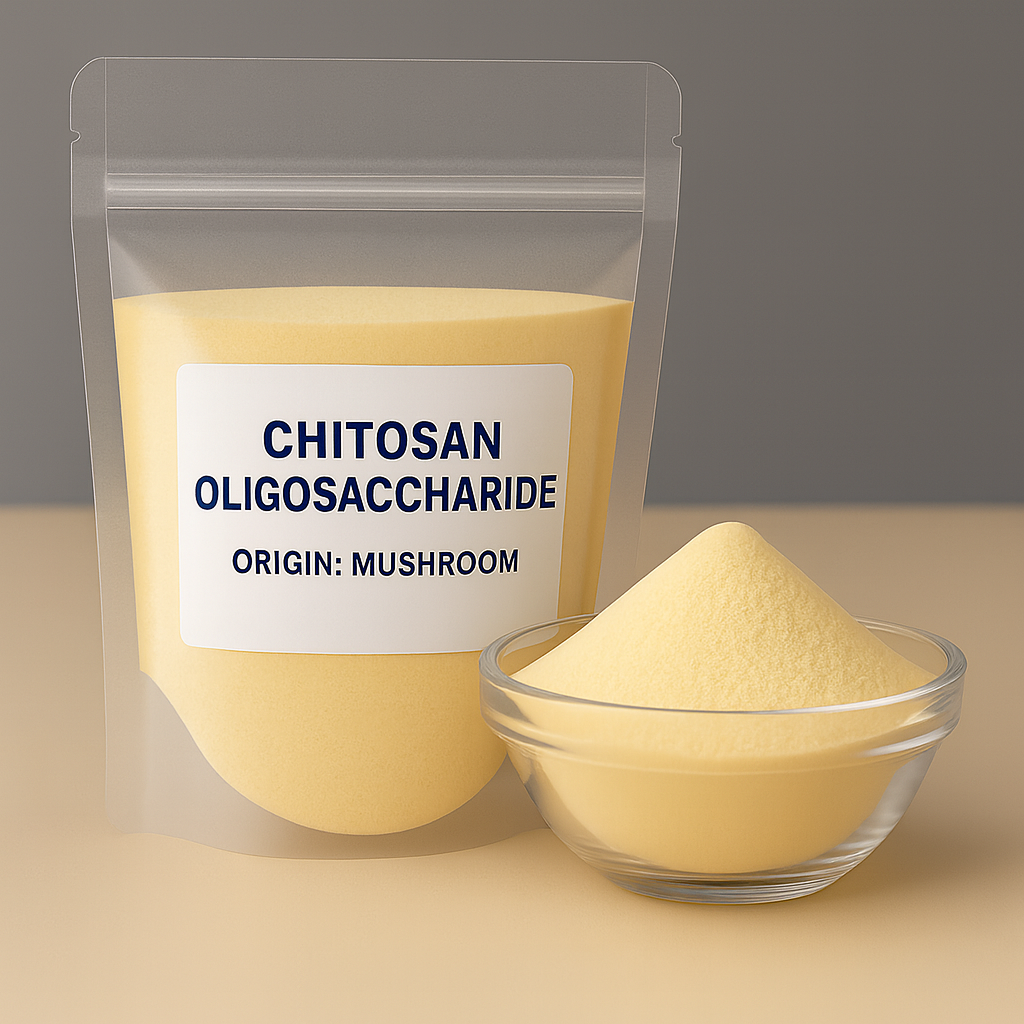
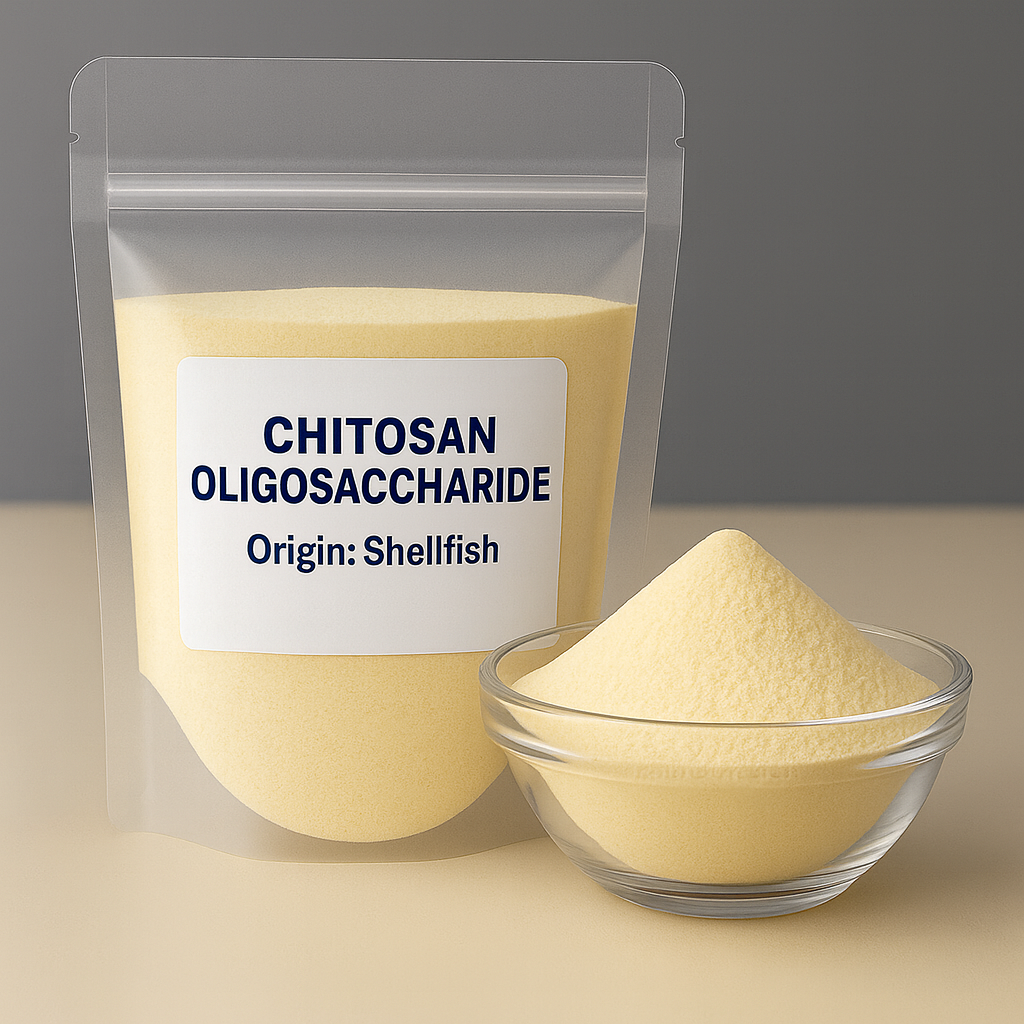
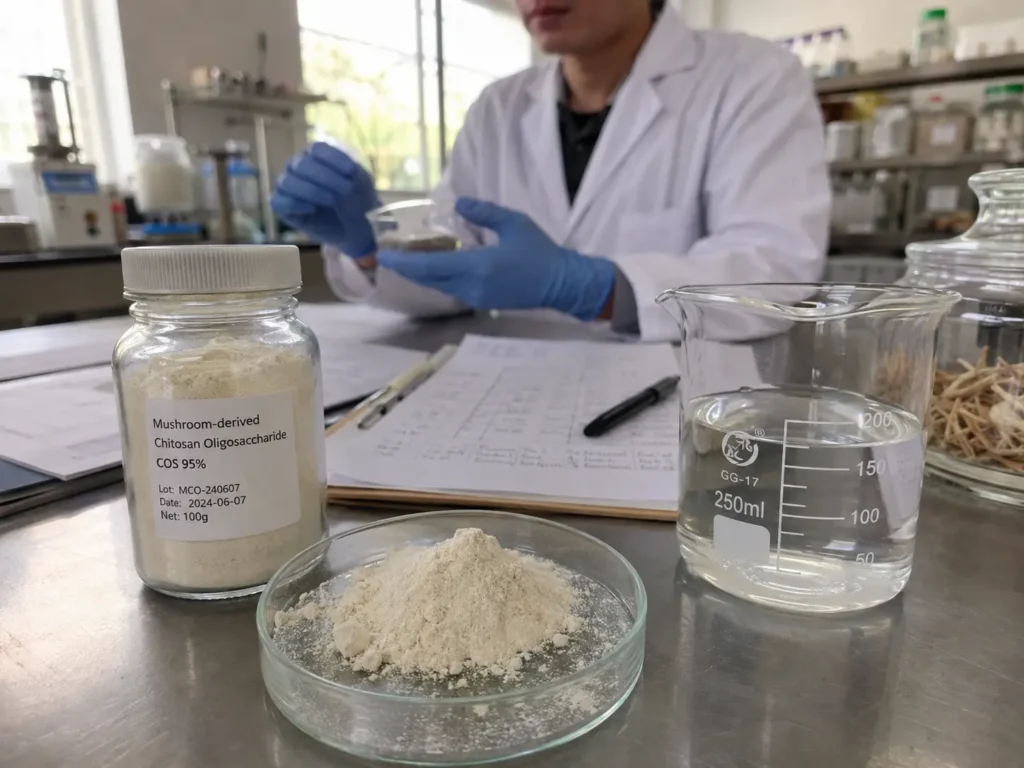
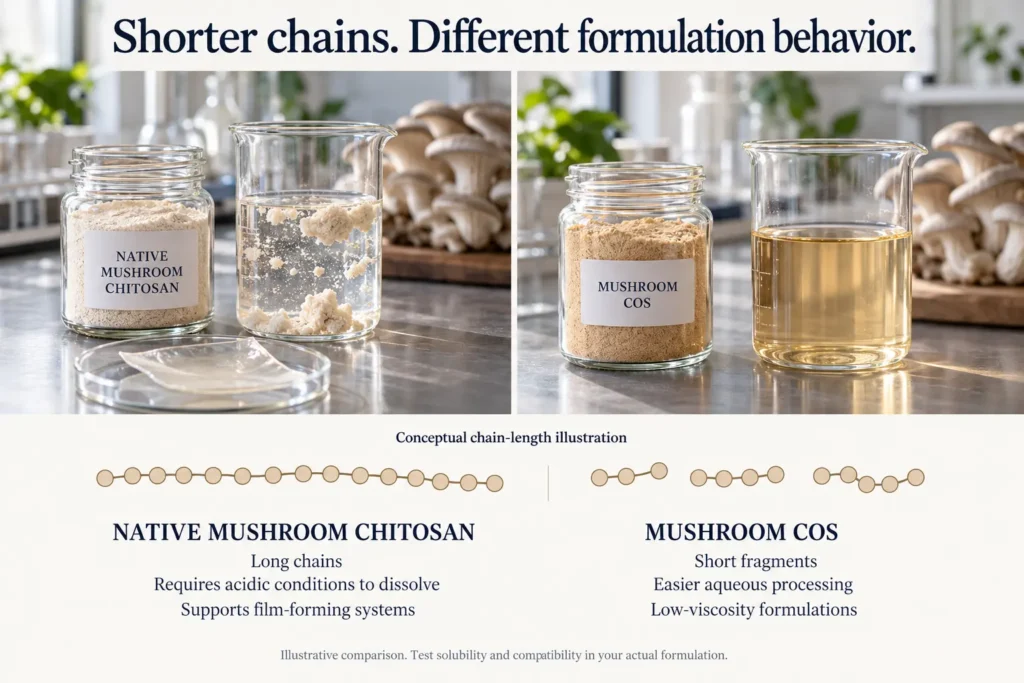
Your chitosan dissolves the way its chains are built: long native chains lock the polymer out of neutral water and force an acid step onto every batch you make. Mushroom chitosan oligosaccharide is what happens when that constraint is engineered away – the same fungal-derived polymer, cut down to short chains (documented batch: molecular weight ≤1,000, DDA 98.08%) that disperse directly in water at low viscosity. If your formulation has been fighting acid activation, thin-film weakness, or viscosity spikes, this page maps the material that ends that fight – what it is, how it compares, how it is made, what its benefits evidence really covers, and how to buy a documented batch of it.
Request a 25 g laboratory sample | Review current specifications and the batch COA
Mushroom chitosan oligosaccharide (mushroom COS) is fungal chitosan deliberately depolymerized to short chains – documented batch: molecular weight ≤1,000, degree of deacetylation 98.08%. Short chains change the formulation physics: low viscosity, fast dispersion, and water compatibility without the acid-activation step native chitosan requires. Sourced from mushroom biomass, it is shellfish-free by origin. It is the right material where aqueous flexibility matters more than polymer-chain film strength – and this guide maps everything around it: the native-vs-COS and mushroom-vs-shellfish decisions, the production process, the benefits evidence, and the buying discipline.
This guide answers the questions every buyer of mushroom COS eventually asks – and hands each deep question off to a dedicated resource, so you can read straight through or jump to what you need.
Question 1: What Exactly Is Mushroom Chitosan Oligosaccharide?
The problem this section solves: “oligosaccharide” sounds like a niche variant, when it is actually a defined low-molecular-weight material class with its own specification logic.
Mushroom COS is produced by taking fungal chitosan and deliberately shortening its polymer chains through controlled depolymerization. Native chitosan is a long-chain polymer; oligosaccharide chitosan is that same backbone cut into short fragments. The current documented batch carries these figures:
| Identity | Value |
|---|---|
| Biological source | Mushroom – fungal biomass |
| Molecular weight | ≤1,000 (oligosaccharide range) |
| Degree of deacetylation | ≥98% (batch result: 98.08%) |
| pH | 5.5-7.0 (batch result: 5.6) |
| Water content | ≤10% (batch result: 9.3%) |
| Total ash | 0.58% |
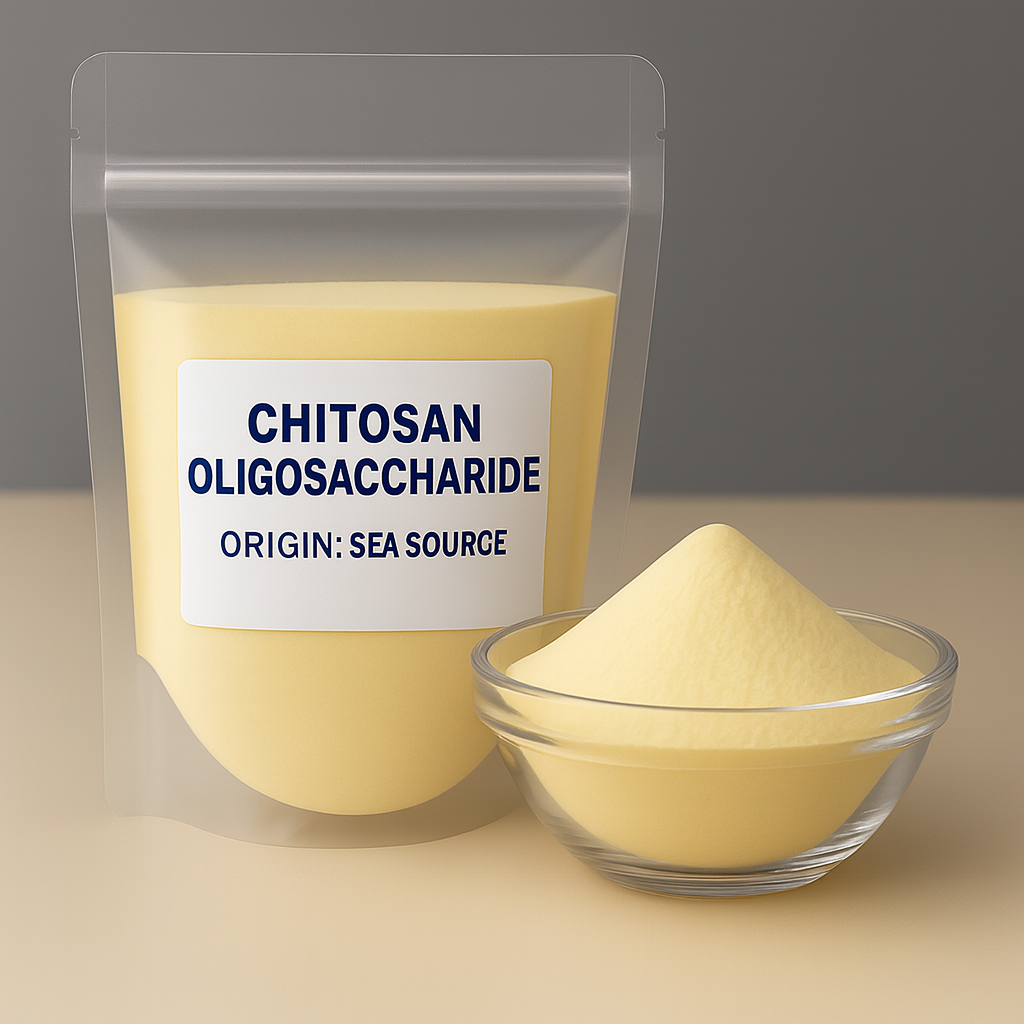
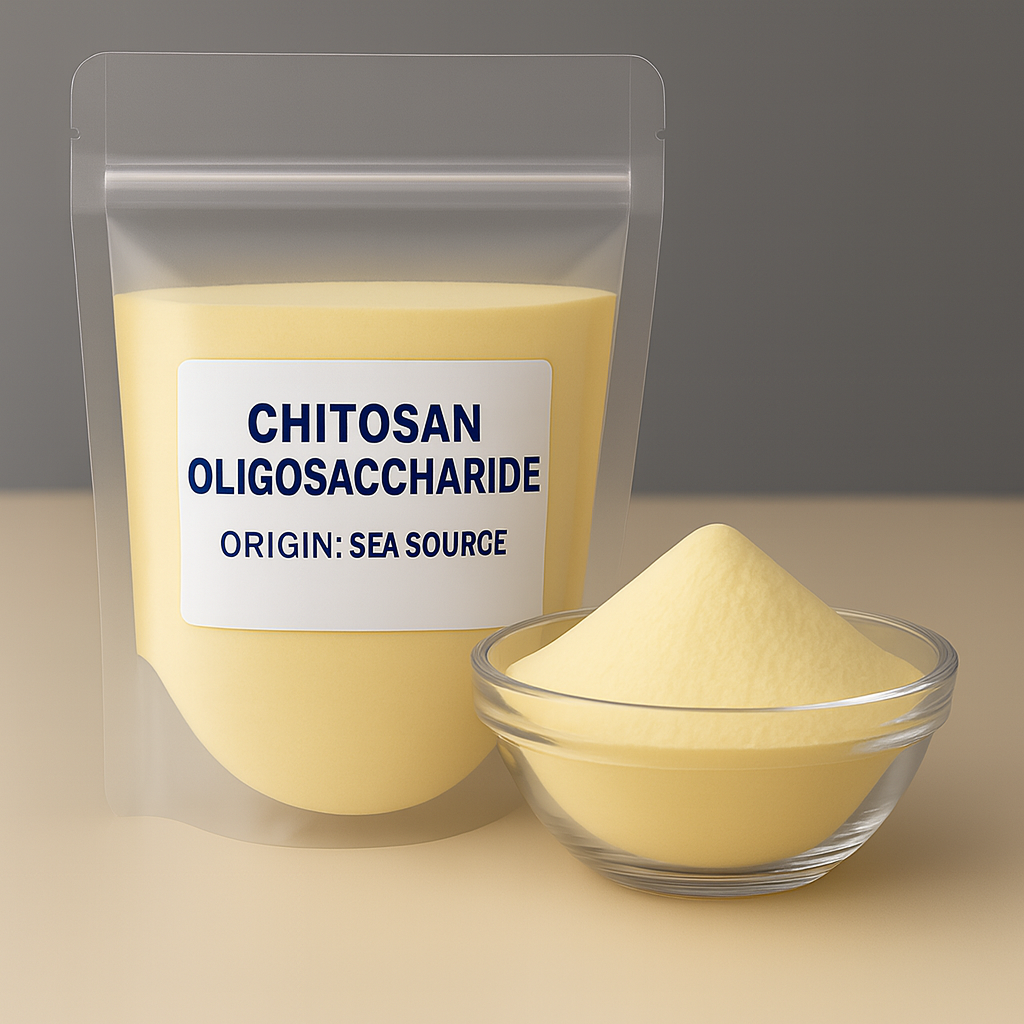
| Appearance | Light yellow to brownish powder |
| Microbiology | TPC 112 CFU/g, yeast and mold 28 CFU/g, E. coli and Salmonella negative |
| Particle | 100% through 100-mesh sieve |
| Grade options | Food Grade (supplements, functional foods, beverages); Industrial Grade (agriculture, water treatment, biopolymers) |
Synonyms worth knowing for sourcing searches: chitosan oligosaccharide (COS), mushroom COS, fungal chitosan oligosaccharide, oligochitosan, chitooligosaccharide, low-molecular-weight mushroom chitosan. Current batch documentation: the product page, where the batch COA is viewable.
The One-Line Chemistry Behind the Class
Chitosan is a weak base with a pKa around 6-6.5: native, long-chain chitosan only dissolves below roughly pH 6. Shortening the chains to the oligosaccharide range changes the physics – short chains carry enough charge relative to their length to remain soluble across a wider pH range, which is why COS disperses in water where its long-chain ancestor will not. That single fact explains most of this material’s formulation appeal.
Question 2: How Does It Differ from Native Chitosan – and from Shellfish COS?
The problem this section solves: the two comparisons buyers must make before ordering either form or source.
The form question – COS vs native: Native mushroom chitosan (long chains, acid-soluble) is the right tool for film formation, coating strength, and higher polymer-chain behavior; mushroom COS is the right tool for low-viscosity, aqueous-flexible formulations. Shorter chains mean faster dispersion, lower solution viscosity, easier incorporation into water-based processes, and more predictable scale-up – but they give up film strength. Neither is universally better; they are different tools. The full decision framework: Mushroom COS vs native mushroom chitosan. And the form-vs-form logic that applies to the hydrochloride family: chitosan hydrochloride vs native chitosan.
The source question – mushroom vs shellfish COS: Both are low-molecular-weight; they differ in origin and everything the origin carries – allergen labeling, supply pattern, documentation expectations. Shellfish COS carries crustacean-origin labeling considerations; mushroom COS is shellfish-free by origin (with certification claims still to be verified by document, not assumed). The full comparison: Mushroom COS vs shellfish COS.
A third option sits between the classes: if your program needs water solubility WITH higher molecular weight, that is the hydrochloride-salt family – mushroom chitosan hydrochloride keeps long chains and gains water solubility through salt conversion instead of chain shortening.
Question 3: Why Is Water Compatibility the Main Draw – and What Does It Not Guarantee?
The problem this section solves: treating “water-soluble” as a performance guarantee, then meeting trouble in the finished formulation.
Shorter chains improve dispersion and dissolution in aqueous environments – that is the class’s core advantage over native chitosan, which needs acid activation. But water compatibility is a starting capability, not a formulation guarantee. Actual behavior is still shaped by: final product pH, COS concentration, water temperature, mixing method and time, dissolved salts and minerals, proteins and polysaccharides and other charged ingredients, order of ingredient addition, and storage temperature and duration. A material that dissolves cleanly in purified water can behave differently inside a finished formulation full of actives – so test under the actual pH, concentration, and processing conditions planned for the final product.
The variables, the troubleshooting, and the behavior detail: water-soluble mushroom chitosan. Peer-reviewed background on the solubility physics – including the finding that chitosan oligomers remain soluble across a wider pH range than high-molecular-weight chitosan: Chitosan: An Overview of Its Properties and Applications (PMC8512176).
Question 4: What Does the Benefits Evidence Actually Cover?
The problem this section solves: the widest honesty gap in the COS market – “benefits” claimed from general research as if they were batch properties.
Chitosan oligosaccharides have been investigated across a broad range of scientific fields, and the published literature is genuinely large. But results depend on biological source, molecular-weight distribution, degree and pattern of deacetylation, concentration, purification method, experimental model, and exposure conditions – so general COS research should not be presented as proof of performance for a particular commercial product. The claims discipline is simple: distinguish general peer-reviewed COS research from verified batch-specific characteristics.
The categorized evidence review – what the research supports, at what strength, with what caveats – is in benefits of mushroom chitosan oligosaccharide. For the delivery-system research specifically: chitosan’s cationic character and mucoadhesive investigation are documented in the pharmaceutical literature (Bernkop-Schnurch and Dunnhaupt, 2012), and the carrier-focused view is in Mushroom COS for drug delivery – research context, not pharmaceutical approval for this commercial grade.
Question 5: How Is It Produced – and Why Does the Process Explain the Price Tier?
The problem this section solves: understanding why COS costs more per kilogram than native chitosan – the answer is an extra manufacturing stage.
Production runs one stage deeper than native chitosan: fungal biomass preparation, chitin isolation, deacetylation into chitosan, then controlled depolymerization – deliberately cutting the chains – followed by separation of the desired oligosaccharide fraction, purification, concentration, drying, and batch testing. That extra controlled step is why mushroom COS carries a premium over native material of the same origin, and why batch consistency depends on how tightly the depolymerization and fraction-separation are run.
The full technical walkthrough – including what suppliers should be able to explain without disclosing proprietary parameters – is in how mushroom chitosan oligosaccharide is produced.
Question 6: Where Is It Used?
The problem this section solves: matching the low-MW profile to its documented application areas:
- Functional foods and nutraceuticals – powder blends, functional beverages, and water-based supplement systems where low molecular weight and mushroom origin are both desired: Mushroom COS for functional foods
- Drug-delivery and biomedical research – low molecular weight and aqueous compatibility make it relevant to carrier, hydrogel, and delivery-system studies: Mushroom COS for drug delivery
- Cosmetics and personal care – water-based formulations and conditioning systems, subject to formulation compatibility and local regulations
- Industrial and biomaterial systems – coatings, biopolymer systems, and water-treatment research requiring a low-MW chitosan derivative
Question 7: What Should You Verify Before Buying?
The problem this section solves: the name “chitosan oligosaccharide” covers materials with potentially different quality profiles – the specification discipline is what protects the purchase.
Before approving a mushroom COS ingredient, define what the finished system requires (aqueous processing? viscosity ceiling? pH window? charged ingredients? market source requirements? documentation depth?), then verify against the batch document – not the category name:
- Molecular weight definition and analytical method – “≤1,000” means little without knowing how it was measured
- DDA – batch value (98.08% documented), not a headline claim
- Moisture, ash, and microbiology – all batch-tested on the current COA
- Traceability – batch identifiers connecting the document to the material you receive
- Grade match – Food Grade vs Industrial Grade, matched to your regulatory and technical expectations
The supplier-qualification checklist – what a credible mushroom COS supplier must document, and the questions that rank them – is in the Mushroom COS supplier guide. When you are ready to order: the product page lists current specifications, the batch COA, and the sample-to-bulk path, or contact the technical team with your application requirements.
Frequently Asked Questions
What is mushroom chitosan oligosaccharide?
A low-molecular-weight form of fungal chitosan produced by breaking longer chitosan chains into shorter fragments – selected for formulations requiring mushroom origin, low viscosity, and easier aqueous processing. The documented batch runs at ≤1,000 molecular weight with 98.08% deacetylation.
Is mushroom chitosan oligosaccharide water soluble?
Yes – the short-chain form is water-compatible across a wider pH range than native chitosan, without acid activation. Formulators should still test solubility at their intended concentration, temperature, pH, and with their other formulation ingredients.
Is mushroom COS vegan and shellfish-free?
The raw-material source is mushroom/fungal rather than shellfish, so it is shellfish-free by origin. Vegan, allergen-free, and shellfish-free finished-product claims should still be made only after reviewing supplier declarations, processing aids, and cross-contamination controls.
What is the molecular weight of this mushroom COS?
The batch COA specifies molecular weight ≤1,000 – the oligosaccharide range. Buyers needing a particular molecular-weight distribution should request the analytical method and batch documentation.
How is it different from native mushroom chitosan?
Native chitosan has long chains, is acid-soluble, and forms films; mushroom COS has short chains, is water-compatible, and has low viscosity. Film formation points to native; aqueous flexibility points to COS – the full comparison is in the guide linked above.
Can mushroom COS be used in food supplements?
A Food Grade option is available, and the material may be evaluated for dietary-supplement and functional-food formulations – the buyer remains responsible for confirming regulatory eligibility, permitted use levels, and labeling in the intended market.
What DDA does mushroom COS have?
≥98% specification – the current batch tested at 98.08%. Higher DDA means more available amino groups for charge-dependent behavior, confirmed batch by batch on the COA.
How do I request a sample or COA?
A 25 g laboratory sample is requestable here, with current specifications and the batch COA on the product page.
You May Also Like
- All
- Chitosan Oligosaccharide Hydrochloride
- Chitosan Oligosaccharide
Get in Touch
Technical & Custom Solutions
Abhinav Chauhan, PhD – Application Scientist
Stephen Nice – Application Scientist