
Mushroom Trimethyl Chitosan (TMC): The Industry Buyer’s Guide
Most pages about trimethyl chitosan start with a definition. This one starts with the problem TMC was built to solve, because that’s the order pharmaceutical scientists and procurement teams actually think in: what breaks, why it breaks, what fixes it, and what to check before you buy it.
- All
- Microplastics
- Water Soluble
- All
- Native Chitosan
- Black Soldier Fly Chitosan
- Chitosan Oligosaccharide Hydrochloride
- Chitosan Oligosaccharide
- Chitosan Hydrochloride
- Carboxymethyl Chitosan
- Quaternary Chitosan
- Trimethyl Chitosan
- Sulphonated Chitosan
- Phosphorylated Chitosan
- Biochar
- Home Cleaning System
Why Traditional Chitosan Has Formulation Limitations
Native chitosan’s usefulness has always run into the same wall: it only dissolves, and only carries its functional positive charge, in acidic conditions. Above roughly pH 6.5, its amine groups stop being protonated, the polymer loses its charge, and it drops out of solution. That’s a serious constraint, because almost none of the environments a formulator actually works in are that acidic human physiological fluids, most pharmaceutical buffers, and most food and cosmetic matrices sit at or above neutral pH. A polymer that only works below pH 6.5 is a polymer that fails in most real formulation work before it ever gets tested for efficacy.
How Scientists Solved Those Limitations
The fix wasn’t a better acid or a clever workaround, it was changing where chitosan’s charge comes from. Quaternization introduces a permanent cationic charge onto the polysaccharide backbone, independent of pH, which improves chitosan’s properties regardless of formulation environment. Instead of relying on protonation of a primary amine (which only happens in acid), quaternization replaces that amine with a quaternary ammonium group that carries four permanent substituents and a fixed positive charge with no acid required, no pH sensitivity, ever.
Why Trimethylation Changed Chitosan Technology
N,N,N-trimethyl chitosan (TMC) is the most extensively studied version of this fix, and the reason it became a genuine pharmaceutical technology rather than a lab curiosity is one specific, measurable property: degree of quaternization (DQ) the percentage of amine sites actually converted to quaternary ammonium groups turns out to directly control biological performance, not just solubility.
The research here is unusually precise for a polysaccharide derivative. Across a set of TMC polymers with degrees of quaternization ranging from 12% to 59%, only those with DQ above 22% were able to reduce transepithelial electrical resistance in a neutral-pH environment meaning low-DQ TMC simply doesn’t work as a permeation enhancer once you’re outside acidic conditions, regardless of how “quaternized” the label says it is. The maximum effect was reached at a DQ of 48%, and increasing quaternization further did not improve performance any more. That’s a genuinely useful, non-obvious fact: more quaternization is not always better, there’s a functional ceiling, and buying a higher-DQ grade than your application needs doesn’t buy you anything.
Separately, comparing TMC40 and TMC60 directly showed that TMC60 produced higher transport-enhancement ratios than TMC40 at every concentration tested, without affecting cell viability confirming that charge density, within that useful range, is the real lever, not molecular weight or dose alone.
Why the Synthesis Route Matters as Much as the Chemistry
This is the part almost no commercial page mentions, and it’s directly relevant to evaluating a supplier. The most common TMC synthesis procedure uses methyl iodide as the methylating agent, but this reaction is not N-selective it produces significant O-methylation as a side reaction, especially in highly trimethylated material, and this O-methylation reduces the solubility of the resulting TMC, limiting the usability of highly quaternized batches. In other words: two batches can both claim “high DQ” on a spec sheet and behave completely differently in solution, because one carries unwanted O-methylation and the other doesn’t.
Researchers have been actively working around this. Greener synthesis approaches using lipase biocatalysts and dimethyl carbonate as a methylating agent in deep eutectic solvent systems have been developed specifically to avoid the toxic organic agents and side reactions of conventional TMC synthesis. There’s also a real molecular-weight cost to the traditional process: the molecular weight of the starting chitosan decreases during TMC synthesis due to the strong alkaline environment and elevated temperatures required, and molecular weight and intrinsic viscosity of the resulting TMC decrease further as degree of quaternization increases so a very high-DQ batch is, almost by definition, a lower-molecular-weight batch than its starting material. Neither of these facts shows up on a typical spec sheet, but both affect how the material performs.
Why Mushroom-Derived TMC Is Different
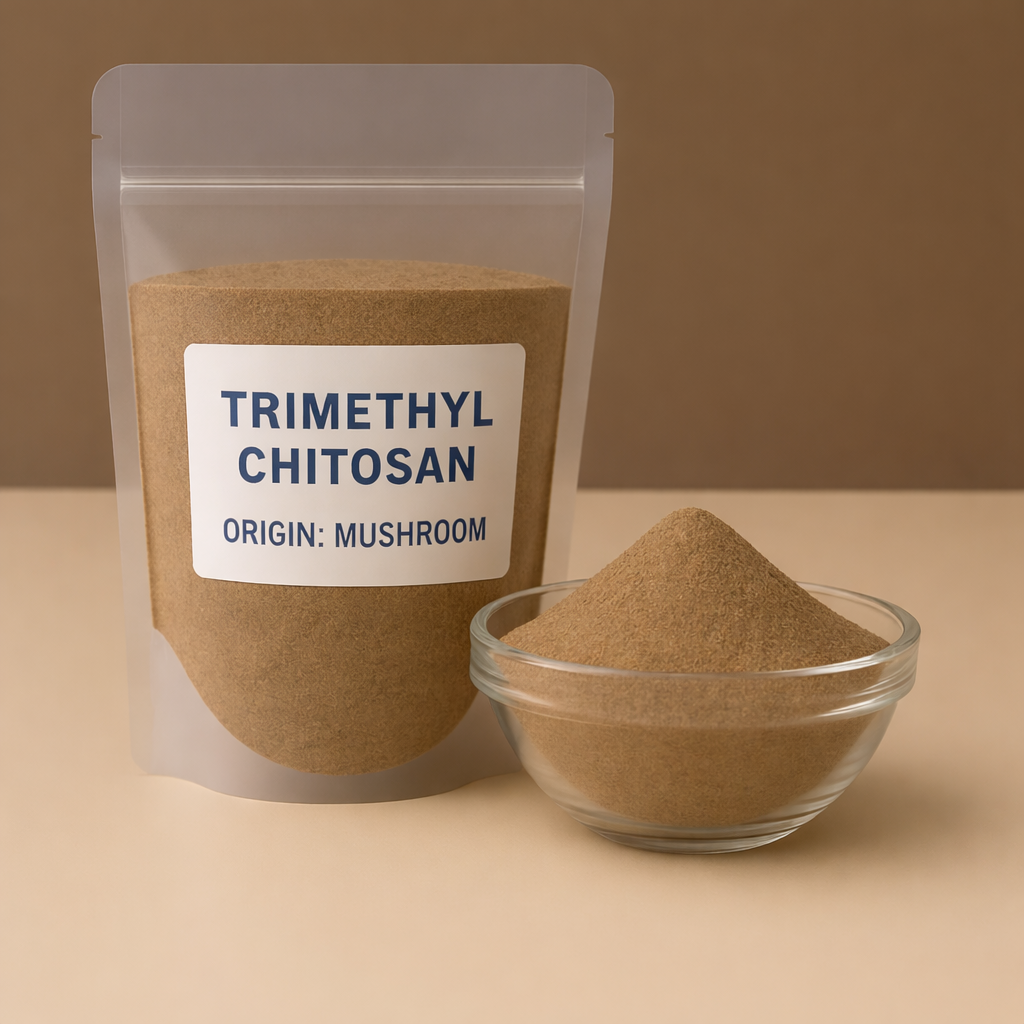
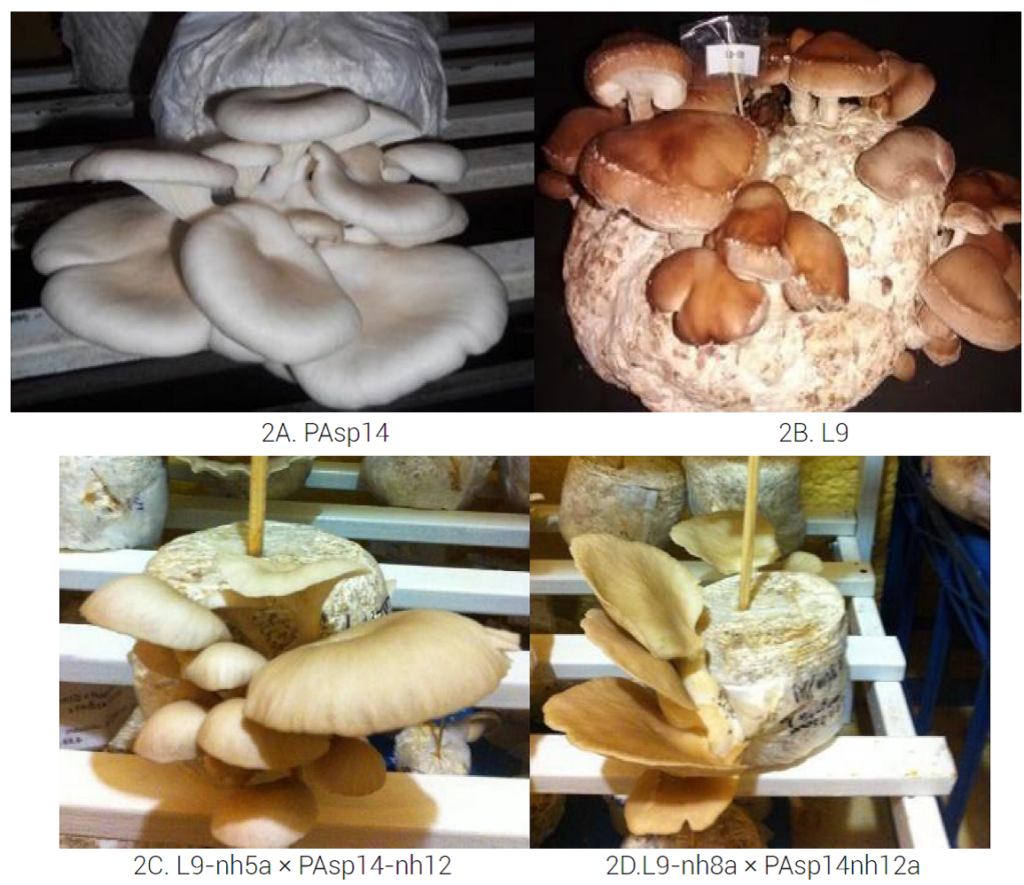
Quaternization chemistry itself doesn’t care what organism the starting chitosan came from but the starting material’s consistency absolutely affects how cleanly that chemistry runs. Fungal (mushroom) chitosan starts with a cleaner substrate than crustacean shell in two specific ways that matter for quaternization quality:
- Lower mineral content going in. Crustacean shell requires aggressive demineralization to remove calcium carbonate before any downstream chemistry can happen cleanly. Fungal biomass carries far less inorganic content, meaning fewer residual mineral impurities to interfere with the methylation reaction.
- Higher, more consistent starting degree of deacetylation. Because fungal chitosan can be produced from controlled cultivation rather than variable, mixed seafood-waste streams, it offers more amine sites available for quaternization per batch, and less batch-to-batch variation in how much quaternization a given reaction step actually achieves.
The practical consequence: when a formulator specifies “DQ 45%” from a mushroom-origin material, that number is more likely to reflect an actually clean, evenly distributed quaternization than the same claimed DQ from a variable shellfish-origin feedstock. This doesn’t change the chemistry, it changes how reliably you get what the certificate of analysis says you’re getting. See our Trimethyl Chitosan (Mushroom) product page for current batch documentation.
How Pharmaceutical Companies Evaluate TMC
Based on what the research above actually shows matters, a rigorous buyer evaluation checks:
- Degree of quaternization, with the target application in mind. Don’t default to “highest available” match DQ to the effect you need, since permeation-enhancement benefits plateau well before 100% quaternization.
- Molecular weight, reported alongside DQ, not separately. Because MW drops as DQ rises during synthesis, a spec sheet listing only one number without the other is incomplete for comparison purposes.
- Evidence of synthesis route and O-methylation control. Ask whether the supplier’s process is designed to minimize O-methylation, since this directly affects solubility regardless of the stated DQ.
- Batch-to-batch consistency data, not a single historical COA this is where sourcing (mushroom vs. shellfish vs. insect) genuinely shows up in practice.
- Solubility behavior at your actual working pH, tested directly rather than assumed from the DQ number alone.
Where TMC Creates the Greatest Commercial Value
Application area | Why TMC specifically (not native chitosan) | Supporting resource |
Oral peptide/protein drug delivery | Opens tight junctions at neutral intestinal pH, which native chitosan cannot do | |
Nanoparticle drug carriers | Permanent charge supports consistent nanoparticle self-assembly independent of formulation pH | |
Mucosal vaccine adjuvants | Charge density tunable via DQ for controlled particulate/soluble adjuvant behavior | |
Antimicrobial/water treatment systems | TMC is used for antibacterial and adsorbent properties in water treatment and food packaging applications | |
Hydrogel-based delivery systems | Combinable with anionic derivatives for controlled-release matrices |
Choosing the Right Grade for Different Applications
If your priority is… | Target DQ range | Also consider |
Maximum permeation enhancement at neutral pH | ~40–48% | Diminishing returns above 48%; verify MW retained |
Vaccine adjuvant (soluble form) | Lower DQ, tuned for solubility/particulate behavior | Application-specific pilot testing recommended |
Nanoparticle carrier stability | Moderate-high DQ | Confirm zeta potential directly, not DQ alone |
Antimicrobial/water treatment use | Higher DQ generally favorable | Cost-efficiency vs. pharmaceutical-grade purity tradeoff |
Combination/hydrogel systems (e.g., CMTMC) | Depends on co-derivative |
If your molecular weight requirements point toward a lower-MW system generally rather than TMC specifically, our Low Molecular Weight Chitosan resource covers that broader derivative decision.
Current Research Driving Future Innovation
Two research directions matter most for where TMC is headed commercially:
- Green synthesis routes. Biocatalytic synthesis using lipases and dimethyl carbonate in deep eutectic solvents avoids the toxic organic agents required by conventional methyl iodide synthesis, pointing toward cleaner, more scalable manufacturing that also sidesteps the O-methylation problem.
- Combination derivatives. Building on an optimized two-step TMC synthesis achieving DQ up to 46.6%, researchers have successfully layered O-carboxymethylation onto TMC to produce CMTMC with very high (>85%) carboxymethylation rates, creating amphoteric, multi-functional derivatives that combine TMC’s permeation-enhancing charge with carboxymethyl chitosan’s pH-versatility. This kind of stacked-derivative chemistry is where a meaningful share of new TMC-adjacent patent activity is concentrated.
- Characterization methodology. Solid-state 13C NMR methods have been developed specifically to quantify degree of quaternization in TMC that is too insoluble to characterize by standard solution-based NMR or titration a sign that even measuring TMC accurately is still an active research problem, which is exactly why buyers shouldn’t assume every “DQ” number on a spec sheet was determined the same way.
Common Mistakes When Selecting Trimethyl Chitosan
- Assuming higher DQ is always better. The permeation-enhancement research is clear that benefits plateau around DQ 48% paying a premium for a higher-DQ grade than your application needs is a common, avoidable cost.
- Comparing DQ numbers without checking molecular weight. Since MW drops as DQ rises during synthesis, two “DQ 40%” batches from different suppliers or synthesis routes are not necessarily equivalent.
- Ignoring synthesis route entirely. O-methylation from conventional methyl iodide synthesis can silently reduce solubility even when the stated DQ looks correct.
- Treating all “mushroom chitosan” as identical. Source consistency (cultivation-controlled fungal biomass vs. variable shellfish waste) affects how evenly a quaternization reaction proceeds, not just the final DQ average.
- Skipping pH-specific solubility testing. A DQ number is a proxy, not a guarantee testing solubility and charge behavior at your actual formulation pH is the only way to confirm performance.
Questions Procurement Teams Usually Ask
- What degree of quaternization should I request? It depends entirely on your application. For permeation-enhancement uses, the research shows benefits plateaus around DQ 48% going higher doesn’t add functional value and may reduce molecular weight further.
- Does higher DQ always mean better performance? No. Performance improvements from increased quaternization level off at a certain point; beyond that, you’re often just paying for a number on a spec sheet.
- Why does molecular weight matter alongside DQ? Because molecular weight decreases as degree of quaternization increases during synthesis a spec sheet showing only DQ, without corresponding molecular weight, is incomplete for making an apples-to-apples comparison between suppliers.
- What’s the difference between mushroom-derived and shellfish-derived TMC? The quaternization chemistry itself is the same; the difference is in starting-material consistency. Fungal biomass generally offers lower mineral content and more consistent starting deacetylation, which supports more even, reproducible quaternization batch to batch.
- Is trimethyl chitosan the same as quaternary chitosan? TMC is one specific, well-established route to producing a permanently quaternized chitosan derivative. “Quaternary chitosan” is the broader category, which also includes other quaternization chemistries such as HTCC. See our Quaternary Chitosan (Mushroom) product for the broader category.
- What synthesis method should I ask my supplier about? Ask specifically whether their process controls for O-methylation, since the conventional methyl iodide route is known to produce this side reaction, which reduces solubility even in high-DQ batches.
- Can TMC be used in oral drug delivery? Yes, TMC’s ability to open tight junctions at neutral intestinal pH is one of its best-documented pharmaceutical applications. See Trimethyl Chitosan for Oral Delivery.
- Is TMC suitable for nanoparticle formulation? Yes, its permanent charge supports stable nanoparticle self-assembly independent of formulation pH. See Chitosan Hydrochloride for Nanoparticles for related nanocarrier mechanisms.
- How is TMC characterized/verified for quality control? Standard methods include titration and 1H NMR for soluble TMC; solid-state 13C NMR has been developed specifically for TMC batches too insoluble for standard solution-based methods.
- Is TMC toxicity a concern? Toxicity in TMC is generally reported as dependent on degree of quaternization, which is another reason not to default to the highest available DQ without a specific functional reason.
- Can TMC be combined with other chitosan derivatives? Yes, combination chemistries such as carboxymethylated TMC (CMTMC) have been developed to layer permeation-enhancing charge with pH-versatile carboxymethyl functionality. See Carboxymethyl Chitosan for Hydrogels.
- What documentation should I request before purchasing bulk TMC? At minimum: degree of quaternization, molecular weight, synthesis route summary, solubility data at your target pH, and batch-to-batch consistency data not just a single historical COA.
How to Source High-Quality Mushroom TMC
The evaluation framework above is exactly what we build our documentation around. When you request a sample or COA for Trimethyl Chitosan (Mushroom), you’re getting degree of quaternization and molecular weight reported together, batch consistency data, and a fungal starting material chosen specifically for its lower mineral burden and consistent deacetylation the two factors that most directly affect how reliably a quaternization reaction performs.
For broader derivative and grade selection support, see Chitosan Derivatives Supplier, Water-Soluble Chitosan Supplier, or Food Grade Chitosan Supplier depending on your intended application.
Ready to Evaluate Mushroom Trimethyl Chitosan?
If you’re comparing TMC suppliers, the questions above DQ range, molecular weight pairing, synthesis route, and batch consistency are the ones worth asking before you request pricing.
View Technical Specifications · Request a Laboratory Sample · Download the COA · Request Bulk Pricing · Contact Our Technical Team
Start with the Trimethyl Chitosan (Mushroom) product page for current specifications and documentation, or reach our technical team directly to discuss the degree of quaternization and molecular weight requirements for your specific formulation.
You May Also Like
- All
- Native Chitosan
- Phosphorylated Chitosan
- Sulphonated Chitosan
- Quaternary Chitosan
- Chitosan Oligosaccharide Hydrochloride
- Chitosan Hydrochloride
- Carboxymethyl Chitosan
- Chitosan Oligosaccharide
Get in Touch
Technical & Custom Solutions
Abhinav Chauhan, PhD – Application Scientist
Stephen Nice – Application Scientist