
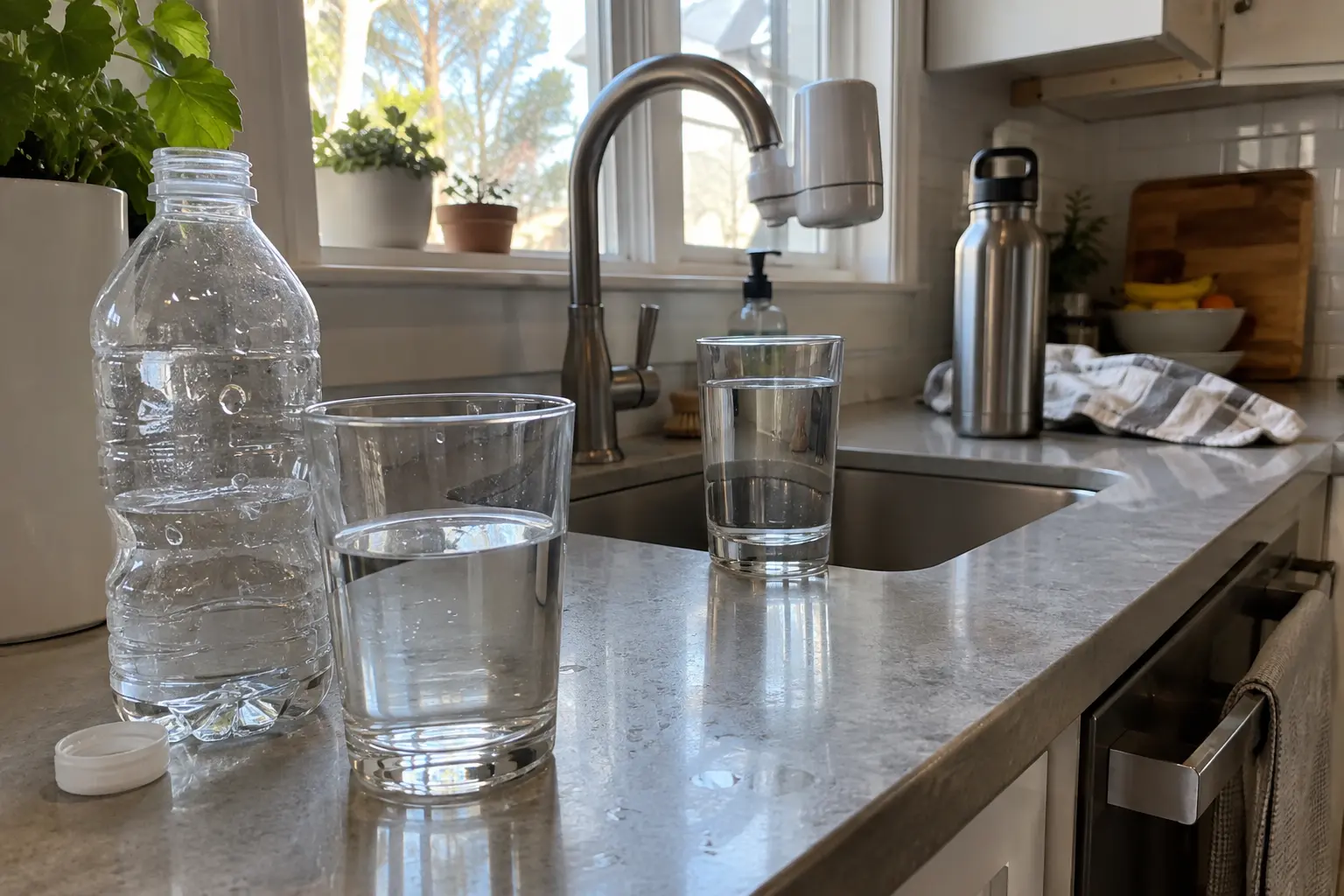
Two glasses of water sit on a table. One came from a sealed plastic bottle, one from the kitchen faucet. Both are clear, odorless, apparently identical and neither tells you how many plastic particles it carries.
That is the problem: you cannot see microplastics, and microplastics in bottled water have now been measured in study after study including brand-by-brand testing that found contamination in the overwhelming majority of bottles tested. This guide covers what the brand-testing research actually found, which factors make some bottles worse than others, and what to drink instead without falling for marketing.
Quick Answer
Independent testing of 259 bottles from 11 major brands found microplastics in 93% of them (Orb Media/Fredonia, 2018). A 2024 PNAS study using next-generation imaging counted an average of ~240,000 plastic particles per liter in bottled water, ~90% of them nanoplastics. Bottled water is not automatically worse than tap but it is not automatically cleaner either. The lowest-microplastic choice for most households: filtered tap water in glass or steel. Full brand data and the practical replacement plan below.
Which Brands Were Tested? What the Research Found
The Orb Media Study: 11 Brands, 259 Bottles, 93% Contaminated
The largest brand-level investigation to date conducted by Orb Media with researchers at the State University of New York (Fredonia) and reported worldwide in 2018 — tested 259 bottles across 11 major brands purchased in 9 countries.
The findings, as published and widely reported (including by the BBC’s investigation into bottled water microplastics):
The 2024 PNAS Study: Nanoplastics at Unprecedented Scale
A 2024 study in the Proceedings of the National Academy of Sciences used stimulated Raman scattering imaging on bottled water and estimated 110,000–370,000 particles per liter (average ~240,000), with roughly 90% classified as nanoplastics particles small enough that previous methods missed them entirely. You can read the original PNAS bottled-water study.
Important context before panicking: the study examined a limited number of brands, and the dramatically higher counts partly reflect better detection scientists changed what they could see, not necessarily what was in the bottle.
Independent Consumer Testing Continues
Beyond the academic studies, independent reviewers now publish ongoing brand comparisons testing popular brands with consumer-grade methods and ranking them. Treat any single ranking with caution (methods vary enormously), but the consistent pattern across every dataset so far:
|
Factor |
Worse choice |
Better choice |
|---|---|---|
|
Container |
PET plastic bottle |
Glass bottle |
|
Cap |
Screw cap (friction shedding) |
Still the weak point — wipe before opening |
|
Storage |
Hot trucks, sunlight, long warehouse time |
Cool, dark, short shelf time |
|
Water type |
Purified municipal water re-bottled |
Natural spring in glass (variable) |
|
Bottle reuse |
Refilling a soft PET bottle |
One-time use or permanent glass/steel |
The honest summary: no major brand category is microplastic-free, and the container plus its journey to the shelf often matters as much as the brand name on the label. For the balanced science behind bottled-vs-tap comparisons, see the peer-reviewed review of microplastics in tap and bottled water.
Bottled Water vs Tap Water: The Fair Comparison
The existing comparison table, kept and updated:
|
Question |
Bottled water |
Tap water |
|---|---|---|
|
Have microplastics been detected? |
Yes — 93% of bottles in the largest brand test |
Yes — concentrations vary by source and treatment |
|
Regulated for microplastics? |
No federal limit (FDA food rules) |
No federal limit yet (EPA monitoring advancing) |
|
Typical particle profile |
High nanoplastic share (PNAS 2024) |
Generally larger, fewer particles; highly local |
|
Main contamination routes |
Cap friction, PET wall, processing, heat in transit |
Environmental pollution, distribution pipes, building plumbing |
|
Can you control it? |
Only by choice of brand/container |
Yes — point-of-use filtration |
Tap water is local — a modern municipal system with point-of-use filtration is a very different exposure than an aging private well. Neither regulatory framework (FDA for bottled, EPA for tap) currently sets a federal maximum for microplastics, which is why consumer action matters.
What to Drink Instead: The Practical Replacement Plan
You do not need to fear water you need a smarter default. Here is the plan most supported by the data:
1. Filtered Tap Water as Your Daily Default
A point-of-use filter certified to reduce particles under 1 micron — reverse osmosis or a quality carbon block addresses the tap-water particle load at the moment of drinking. It also beats bottled water on cost by a factor of ten or more. The full setup routine, including kitchen swaps, lives in the microplastic detox protocol.
2. Glass or Stainless Steel for Storage and Travel
One permanent bottle replaces hundreds of PET bottles a year eliminating the cap-friction and heat-exposure contamination routes entirely. Glass-bottled water remains an option for situations where tap is not viable; keep the cap wiped and the bottle out of sun.
3. Support Your Body’s Natural Clearance With Meals
Even careful drinkers swallow particles they are in food, dust, and the air. The research-aligned addition: a binding fiber taken with your two largest meals, exactly when exposure happens. Chitosan is the only fiber with a published microplastic excretion study (Nature portfolio, 2025, animal model) the evidence is reviewed in can chitosan bind microplastics and the excretion research.
The meal-time clearance step
Microplastic Protect — 99% pure mushroom-derived chitosan, vegan and shellfish-free, third-party tested with published COAs. Built to be taken with meals, when exposure actually happens. Money-back guaranteed.
4. Skip the “Premium Bottled Water” Trap
Marketing aside, published testing shows premium labels are not reliably cleaner contamination follows the container and the supply chain, not the price tag. Money spent on a home filter returns value for years; money spent on boutique bottles returns marketing.
Should You Stop Drinking Bottled Water Entirely?
No — and pretending otherwise would be dishonest. Bottled water remains essential in places without safe tap water, valuable in emergencies, and far better than dehydration. The evidence supports a recalibration, not a panic:
That layered approach is exactly how the exposure research recommends thinking: reduce what you can, support clearance for what you cannot. The full removal-science guide covers the complete picture.
Frequently Asked Questions
Which bottled water brands have the most microplastics?
The largest published brand test (Orb Media, 2018) found 93% of 259 bottles across 11 major brands contaminated and did not find premium brands reliably cleaner. Contamination tracks the container, cap, and storage heat more than the label, so “worst offender” lists age quickly; the container choice is the durable signal.
Does bottled water have more microplastics than tap?
Often yes, but not always. The 2024 PNAS imaging study found ~240,000 particles per liter (mostly nanoplastics) in bottled samples, while tap results vary hugely by location and treatment. A quality home filter generally makes tap the lower-particle choice.
How do I remove microplastics from drinking water?
Use a point-of-use filter certified for particles under 1 micron reverse osmosis or quality carbon block. This is the single highest-impact change for household drinking water.
Can boiling water remove microplastics?
Recent research suggests boiling hard water can trap some particles in limescale a real but situational effect that depends on water hardness and does not replace filtration.
What should I drink instead of bottled water?
Filtered tap water in glass or steel containers is the evidence-aligned default. Where tap is not safe, glass-bottled water is the lower-exposure alternative to PET.
Can the body get rid of microplastics from water?
Most ingested particles are excreted naturally within days, and early research shows chitosan fiber taken with meals promotes that excretion. The strategy is supporting clearance while lowering intake.
Brand testing has found microplastics in the overwhelming majority of bottles examined across price tiers and continents. The container, the cap, and the heat in the supply chain drive contamination more than the brand name. The practical response: make filtered tap water your default, carry glass or steel, and support your body’s natural particle clearance with meal-timed chitosan a strategy your wallet will appreciate as much as your health.
Make the switch complete
Filter the water, fix the container and add Microplastic Protect with your two largest meals to support natural clearance. Or start with how to take it.
These statements have not been evaluated by the Food and Drug Administration. This product is not intended to diagnose, treat, cure, or prevent any disease.