
Searching for a microplastic detox supplement and finding nothing but hype? You are not alone. Four candidates dominate the conversation right now chitosan, sulforaphane, zeolite, and dietary fiber and almost nobody has compared them side by side against the actual research.
We did. This is an evidence-first comparison: what each candidate is supposed to do, whether studies support it, what human data exists, and which one deserves a place in your routine. No fear marketing, no miracle claims just mechanisms, studies, and honest verdicts.
Quick Answer
No supplement is clinically proven to remove microplastics from human tissue. But among the four candidates studied, chitosan has the most direct evidence: a 2025 Nature portfolio study found it promoted microplastic excretion through the gut via electrostatic binding. Sulforaphane shows early cellular activity, fiber is a plausible support, and zeolite has no human microplastic evidence at all. Full comparison below.
Do Microplastic Detox Supplements Actually Work?
Start with the mechanism, because this is where most products fail.
Microplastics are physically stable particles your body cannot “burn” or dissolve them. Removal depends on two realities:
Keeping those two mechanisms in mind changes how you evaluate every product on this list and it is exactly how the comparison below is structured. (New to the topic? Start with how microplastics enter your body.)
The Comparison: Chitosan vs Sulforaphane vs Zeolite vs Fiber
|
Candidate |
Proposed mechanism |
Direct microplastic evidence |
Human data |
Main risks / caveats |
Verdict |
|---|---|---|---|---|---|
|
Chitosan |
Positively charged fiber electrostatically binds negatively charged plastic particles in the gut, speeding excretion |
Direct — 2025 Nature portfolio animal study showed increased microplastic excretion within days |
Mechanism confirmed in animals; human trials not yet published |
Mild: fiber-related digestive adjustment; choose shellfish-free source if allergic |
Best supported — only candidate with a direct excretion study |
|
Sulforaphane |
Activates cellular cleanup pathways (autophagy-type responses) |
Indirect — 2025 human pilot reported cells releasing microplastic-associated markers |
One small pilot study, cellular endpoint |
Very safe from food; supplement dosing less standardized |
Promising — support role, not proven removal |
|
Zeolite / bentonite clay |
“Toxin binding” via porous mineral structure |
None in humans — binding shown only in wastewater/industrial settings |
No human microplastic studies |
Contamination concerns in some commercial clays (heavy metals) |
Not recommended for this purpose |
|
Psyllium / generic fiber |
Speeds gut transit; generic adsorption |
Indirect — transit benefit is established; plastic-specific binding is not |
No plastic-specific human studies |
Very safe |
Reasonable baseline — do this regardless |
Now let us look at each in detail — because the details are where the marketing falls apart or holds up.
Chitosan: The Only Candidate With a Direct Excretion Study
Chitosan is a dietary fiber derived from chitin and it is the only known sugar in nature that carries a positive ionic charge. That detail matters enormously here:
Two honest caveats, because this field attracts exaggeration:
What makes chitosan attractive despite the early stage: it is a widely consumed, GRAS-listed fiber with a long safety record, the mechanism is physics rather than wishful thinking, and it is taken with meals precisely when microplastic exposure from food actually happens. The full evidence chain is reviewed in Can Chitosan Bind Microplastics in the Digestive Tract? and Chitosan and Microplastic Excretion: What the Research Shows.
The supplement built around this mechanism
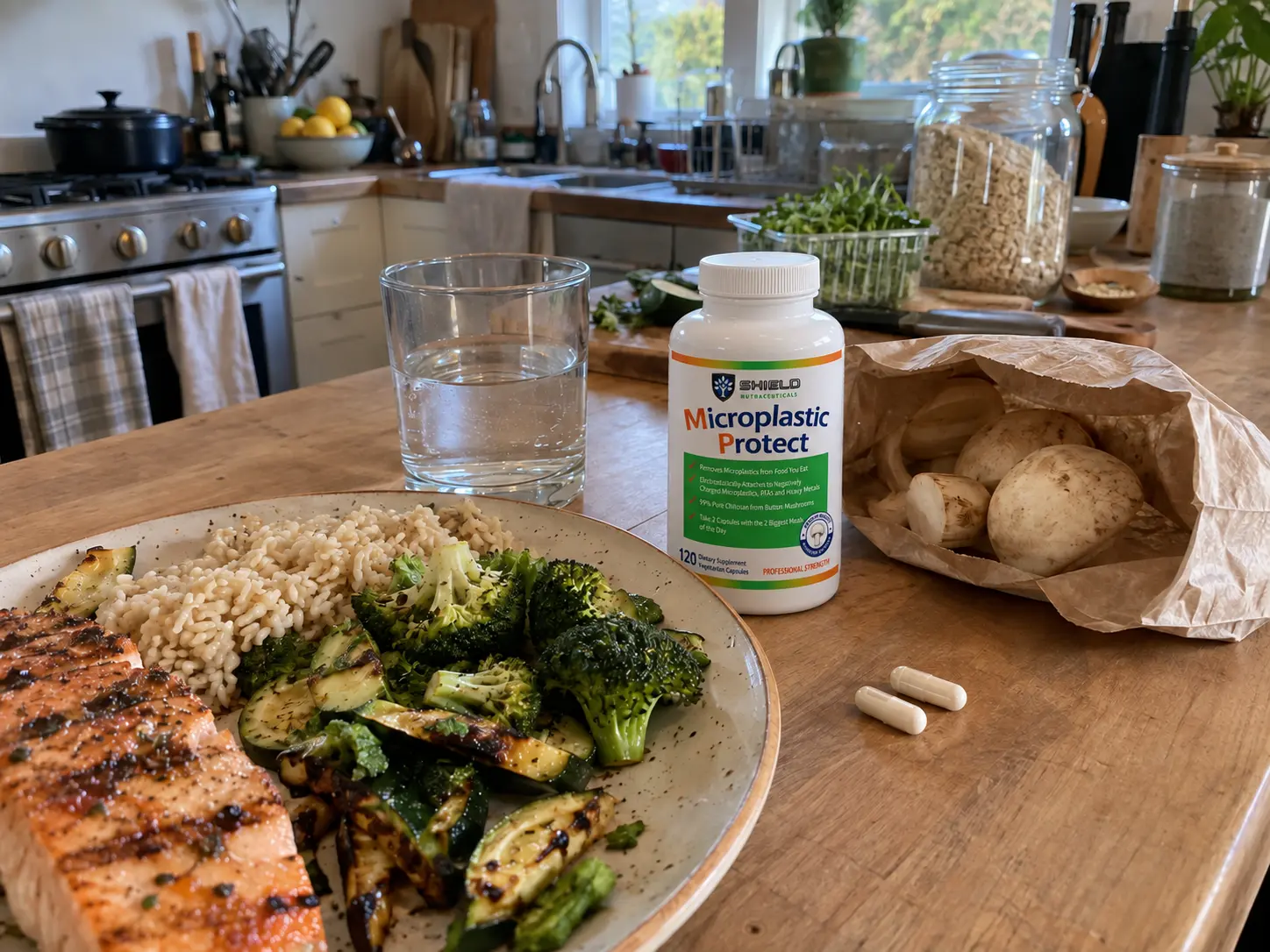
Microplastic Protect uses 99% pure, high-DDA mushroom-derived chitosan vegan, shellfish-free, third-party tested with published COAs, dosed for your two biggest meals. See the formula →
Sulforaphane: Promising Cellular Research, One Small Human Study
Sulforaphane — the compound concentrated in broccoli sprouts earned its microplastic reputation from a 2025 human pilot study that reported cells releasing microplastic-associated particles after sulforaphane stimulation of cleanup pathways. Coverage spread quickly through longevity communities.
The fair assessment:
Broccoli sprouts, broccoli, and other cruciferous vegetables remain the cheapest, safest source. Standardized sulforaphane supplements are reasonable for people who already follow that protocol — but claiming sulforaphane “removes microplastics” today would be ahead of the evidence.
Zeolite and Bentonite Clay: Skip It for Microplastics
Zeolite powders and clay “detoxes” dominate the detox aisle, so they deserve a straight answer:
If a product markets itself as a “microplastic cleanse” built on zeolite, that is a red flag about the brand’s evidence standards in general.
Psyllium and Generic Fiber: A Reasonable Baseline, Not a Detox
Dietary fiber especially viscous fibers like psyllium reliably speeds intestinal transit and supports the gut’s natural clearance. That is genuinely useful for the excretion half of the strategy, and fiber intake has many proven benefits independent of plastics.
What generic fiber lacks: any demonstrated binding affinity for plastic particles. Chitosan’s positive charge is what makes binding specific; psyllium’s benefit is general. Practical takeaway: keep fiber in your diet regardless, and if you want the binding mechanism, that is what chitosan adds.
What to Look for in a Quality Microplastic Detox Supplement
Whatever candidate you choose, this checklist filters out most of the market:
How Microplastic Protect scores on this checklist
99% purity · ~98% DDA · mushroom-derived (vegan, shellfish-free) · third-party COA published · dosed for meals · money-back guarantee. Check the current formula →
Chitosan vs Regular Chitosan Supplements: A Note on Product Quality
If you already own a chitosan supplement, check the label before buying anything new: many budget products are shellfish-derived, low-DDA (under 85%), or dosed without meal timing in mind. The differences are not cosmetic they sit exactly on the variables the binding research depends on. We compare them directly in Microplastic Protect vs Regular Chitosan Supplements.
Frequently Asked Questions
What is the best supplement for microplastics?
Based on published research, chitosan has the strongest case: it is the only supplement with a direct microplastic excretion study (Nature portfolio, 2025, animal model) and a clear electrostatic binding mechanism. Sulforaphane is a reasonable secondary support. No supplement is yet clinically proven in humans.
Can chitosan remove microplastics from the body?
The research shows chitosan promotes excretion of ingested microplastics through the gut removal from tissue is a different, unproven claim. Think of it as supporting your body’s natural clearance at the point of exposure.
Is zeolite good for microplastic detox?
There is no human evidence that ingested zeolite removes microplastics, its binding success is in industrial water treatment. Quality concerns with some consumer products add risk without established benefit.
Can I take chitosan and sulforaphane together?
They work through different mechanisms (gut binding vs cellular cleanup) and there are no known negative interactions. Most evidence-aligned protocols combine diet-first sulforaphane sources with meal-timed chitosan.
How long before I see results?
Excretion research suggests ingested particles clear within days when binding is supported which is why chitosan is taken with meals, when exposure happens. This is an ongoing strategy, not a one-week cleanse.
Are microplastic detox supplements regulated?
In the US, chitosan as a dietary fiber falls under supplement rules which is why third-party testing and published COAs are your quality protection. Buy from brands that publish them.
Of the four candidates competing for your attention, only one has a published study testing it against microplastics directly: chitosan. Sulforaphane earns a supporting role, fiber is your baseline, and zeolite should stay in the water-treatment plant where the evidence for it actually lives.
A realistic stack looks like this: reduce exposure where you can, keep dietary fiber high, consider sulforaphane-rich vegetables, and if you want the most mechanism-relevant supplement available today take high-DDA mushroom chitosan with your two largest meals.
Ready when you are
Microplastic Protect — 99% pure mushroom chitosan, third-party tested, money-back guaranteed. Prefer to start with the research? Read the excretion study review first.
These statements have not been evaluated by the Food and Drug Administration. This product is not intended to diagnose, treat, cure, or prevent any disease.