Mushroom-derived chitosan can be vegan, because its chitin comes from fungal cell walls rather than from shrimp, crab or other animals. It can also be shellfish-free when the manufacturer confirms that no shellfish-derived chitosan is used and that cross-contact is controlled.
There is one important catch. A vegan ingredient does not automatically make a vegan supplement. The capsule shell, fillers, processing aids and manufacturing facility all have to be checked too. This guide explains how to verify each part, so you know what you are really buying.
Key Takeaways
- Mushrooms are fungi, not animals, and chitosan made from fungal chitin does not need crustacean shells.
- Regular chitosan is often made from shellfish, so the word “chitosan” alone does not tell you whether a product is vegan.
- Shellfish allergy is linked mainly to proteins such as tropomyosin, which can remain as residue in shellfish-derived chitin and chitosan. Fungal chitin is reported to be free of it.
- “Mushroom-derived,” “shellfish-free,” “vegetarian” and “vegan” are four different claims.
- People with a mushroom allergy should not assume mushroom chitosan is suitable for them.
Why Do People Associate Chitosan With Shellfish?
For many years most commercial chitosan came from the shells of shrimp, crab and other crustaceans. Seafood processing creates large volumes of shell waste rich in chitin, and manufacturers convert that chitin into chitosan through deacetylation. Because of this, many consumers learned to link the word “chitosan” with shellfish.
Chitin is not exclusive to crustaceans, though. It is also a structural part of fungal cell walls, which makes chitosan from mushrooms and other controlled fungal sources possible. A review of fungal chitosan production (Crognale et al., 2022) describes fungi as an alternative source and explains how cultivation and processing conditions shape the finished material. You can compare all origins on our types of chitosan page, including shellfish origin, vegetal origin and insect origin.
Are Mushrooms Vegan if They Are Not Plants?
Yes. Vegan does not mean “made only from plants.” Mushrooms belong to the kingdom Fungi, which is separate from both plants and animals. Vegan products can include ingredients from fungi, bacteria, algae and minerals as long as no animal-derived ingredients or conflicting practices are involved.
The Vegan Society’s definition of veganism centers on avoiding animal exploitation and animal-derived products as far as possible and practicable. It does not limit vegan products to the plant kingdom, so a fungal source does not rule out a vegan chitosan.
How Is Mushroom Chitosan Made?
Mushroom chitosan is not dried culinary mushroom powder placed in a capsule. It starts with chitin-rich mushroom or fungal biomass, which is purified and then deacetylated. A simplified sequence looks like this:
- Select suitable mushroom biomass
- Clean, dry and prepare the material
- Remove proteins, glucans and other cell components
- Recover the chitin-rich fraction
- Deacetylate the chitin to produce chitosan
- Wash and purify the chitosan
- Dry and mill the finished material
- Test identity and specifications
Research shows that chitin can be recovered from Agaricus bisporus, the common button mushroom, and used to produce fungal chitosan (Almeida et al., 2025). A 2025 Green Chemistry study compared isolation methods for white mushroom chitin and describes it as a renewable, hypoallergenic, non-animal alternative to crustacean chitin (Zannat et al., Green Chemistry). For more on the source and process, read about button mushroom-derived chitosan and our oyster mushroom chitosan page.
The Ingredient Test: Is the Chitosan Itself Vegan?
Start with one question: where did the original chitin come from? The answer should name the source clearly.
Vegan-compatible sources
- Button mushrooms
- Other documented mushroom species
- Controlled fungal biomass
Animal-derived sources
- Shrimp, crab or lobster shells
- Other crustacean materials
- Insect chitin
A label that says only “chitosan” does not answer the question, and neither does “natural chitosan,” because both fungal and crustacean chitosan can be called natural. The source should be stated by the brand or confirmed in ingredient documentation.
The Capsule Test: Where Vegan Claims Often Fail
Even when the chitosan is entirely from mushrooms, the supplement may not be vegan. The capsule could be gelatin, which is made from animal collagen. Look for capsule materials such as:
- Hypromellose (HPMC)
- Vegetable cellulose
- Pullulan
- Other clearly documented non-animal materials
Review the other ingredients as well, including coatings, colorants, lubricants, fillers and processing aids. A transparent label lets you verify the whole formula, not just the headline ingredient.
The Shellfish-Free Test: Source Is Only the First Step
If chitosan is produced from mushrooms, shellfish is not its original chitin source, which is the strongest starting point for a shellfish-free formula. A careful buyer should still verify three details.
1. Ingredient Identity
Confirm the product contains only mushroom-derived chitosan, not a blend of fungal and shellfish chitosan.
2. Allergen Statement
Read the “Contains” statement and any advisory language, such as “manufactured in a facility that also processes shellfish.” In the United States, crustacean shellfish is one of the major food allergens covered by federal labeling law, and labels must name the specific type such as shrimp, crab or lobster (FARE guide to food labels).
3. Cross-Contact Controls
If the company handles shellfish-derived chitosan elsewhere, ask about separate equipment, validated cleaning procedures and allergen-control protocols.
Why Fungal Chitosan Matters for Shellfish Allergy
Shellfish allergy is generally triggered by proteins in the animal, not by the chitin polymer itself. Tropomyosin is the best-known crustacean allergen, and the UK Committee on Toxicity notes that tropomyosin has been detected in technical samples of chitin and chitosan derived from shellfish (UK COT position paper). A related COT document states that chitin and chitosan from algae or fungi are free of tropomyosin and that a reported allergic reaction to a chitosan supplement was most likely caused by shellfish residue in the source material (UK COT allergenicity paper). A review of chitin isolation from crustaceans and mushrooms likewise positions fungi as an emerging source of non-animal chitin (Zannat and Shamshina).
That is why a verified mushroom source is meaningful for people avoiding shellfish. It still does not replace allergen documentation, and anyone with a serious diagnosed allergy should seek individual medical guidance.
Can You Be Allergic to Mushroom Chitosan?
Consumer health references advise people with a shellfish or mushroom allergy to be cautious with chitosan supplements (Healthline). A mushroom source avoids shellfish, but it is not suitable for someone with a diagnosed mushroom allergy unless a healthcare professional says otherwise. If you have either allergy, ask the supplier for source and allergen documentation before use.
Vegan, Vegetarian, Shellfish-Free and Mushroom-Derived Are Not Interchangeable
| Claim | What it tells you | What it does not automatically tell you |
|---|---|---|
| Mushroom-derived | The chitosan originated from fungal biomass | Whether the capsule and other ingredients are vegan |
| Shellfish-free | Shellfish ingredients are not used under the stated product standard | Whether every ingredient is free from other animal sources |
| Vegetarian | The product avoids certain animal-derived ingredients | Whether it meets a strict vegan standard |
| Vegan | The complete formula is intended to avoid animal-derived ingredients | Whether it suits every person with an allergy, including mushroom allergy |
| Plant-based | A marketing term often linked to plant ingredients | Whether fungal ingredients, processing aids or capsule materials qualify |
The most reliable product description addresses source, complete formula and allergen status separately.
The 60-Second Label Check
Front label. Look for specific language such as “mushroom-derived chitosan,” “button mushroom chitosan,” “shellfish-free” or “vegan capsules.” Do not rely on green packaging, mushroom illustrations or a leaf symbol.
Supplement Facts panel. Confirm the active ingredient identifies its source. “Chitosan” alone leaves the origin unclear.
Other ingredients. Check the capsule shell, fillers, flow agents, colorants and coatings. Avoid gelatin if you need a vegan product.
Allergen statement. Look for any mention of shrimp, crab, crustacean shellfish or shared processing.
Manufacturer’s website. A responsible product page should offer more detail than the label can hold.
Supporting documentation. If anything is unclear, request the ingredient specification, certificate of analysis, source declaration, allergen statement, any vegan or vegetarian certification, and cross-contact information. Technical documents are available in our document library. If you are comparing retail options, see how to find real chitosan capsules online.
If a company cannot identify where its chitosan comes from, do not assume it is mushroom-derived.
Does “Shellfish-Free” Mean Allergy-Safe for Everyone?
No company should promise that a product is safe for every person with an allergy. “Shellfish-free” generally means shellfish-derived ingredients are not intentionally used. Individual risk can still depend on manufacturing controls, shared facilities or equipment, supplier documentation, testing and the person’s allergy severity. A mushroom source removes the need for shrimp or crab shells, but consumers with serious allergies should still review the finished product’s documentation.
Is Mushroom Chitosan Chemically Different From Shellfish Chitosan?
Both belong to the same polymer family and contain glucosamine and N-acetylglucosamine units. The source may influence the starting material and the production process, but the performance of the finished ingredient also depends on:
- Degree of deacetylation
- Molecular weight
- Purity
- Particle size
- Acetyl-group distribution
- Moisture and ash
- Manufacturing conditions
- Final formulation
So “mushroom-derived” describes origin. It does not by itself prove stronger charge or better performance than every shellfish-derived alternative. Our mushroom chitosan vs shellfish chitosan comparison covers these differences without source-based superiority claims, and our guide to chitosan vs chitosan oligosaccharide explains why molecular weight matters.
Does Vegan Chitosan Still Carry a Positive Charge?
Yes. The charge comes from chitosan’s amino groups, not from whether the chitin came from a mushroom or a shell. Under suitable acidic conditions these groups can become protonated and positively charged, which may support interactions with certain negatively charged molecules and surfaces. The charge depends on pH, degree of deacetylation and molecular characteristics. Learn more in our guide to how the positive charge of chitosan works.
Is Mushroom Chitosan the Same as Mushroom Powder?
No. A purified mushroom chitosan ingredient is mainly the processed chitosan polymer recovered from mushroom cell-wall material. It should not be assumed to provide the nutrients or compounds found in whole mushrooms or mushroom extracts. It is better understood as a mushroom-derived functional polymer than as a conventional mushroom food supplement.
How Microplastic Protect Approaches the Question
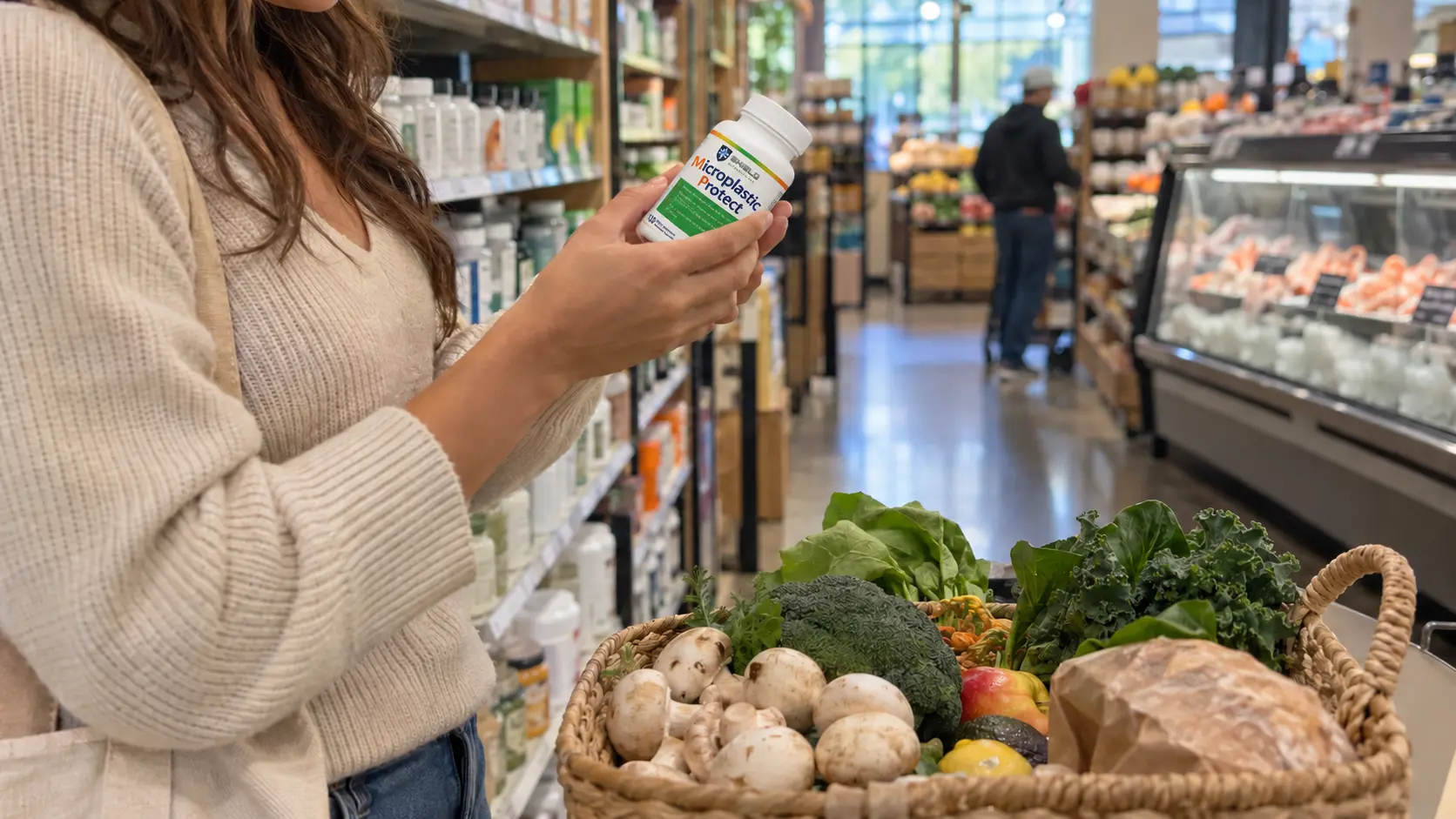
Microplastic Protect contains 99% pure chitosan derived from button mushrooms and uses vegetarian capsules. The formula does not use shrimp- or crab-derived chitosan. The fungal source is intended to provide a shellfish-free, non-crustacean option for people who want native chitosan.
The mushroom source explains where the chitosan comes from. It is not proof that the supplement prevents, treats or cures any disease, and research on dietary chitosan and microplastics is still developing, especially in humans. For the evidence so far, read whether chitosan can bind microplastics and our review of the chitosan microplastic excretion study.
Five Questions to Ask Before You Buy
- What species or fungal source is used to produce the chitosan?
- Is the capsule made from gelatin or vegetable cellulose?
- Does the finished product contain any shellfish-derived ingredient?
- Is it made on equipment that also processes shellfish?
- Can the company provide specifications or allergen documentation?
These questions tell you far more than a leaf icon or an undefined “natural” claim.
Frequently Asked Questions
Is mushroom chitosan vegan?
Mushroom-derived chitosan can be vegan because it comes from fungi, not animals. The capsule and every other component of the finished supplement must also qualify.
Is chitosan vegan?
Not always. Chitosan from shrimp, crab or other crustacean shells, or from insects, is animal-derived. Chitosan from mushrooms or other fungal sources can be vegan-compatible, so the source must be stated.
Is chitosan made from shellfish?
Much commercial chitosan is, but not all. Chitosan can also be made from fungal biomass such as mushrooms.
Are mushrooms vegan?
Yes. Mushrooms are fungi, not animals, and are generally compatible with vegan diets and products.
Is mushroom chitosan shellfish-free?
It does not originate from shrimp, crab or other shellfish. The finished product’s allergen statement and manufacturing controls should still be checked.
Can people with a shellfish allergy take chitosan?
Shellfish-derived chitosan may carry residual shellfish proteins such as tropomyosin, and consumer references advise caution. A mushroom-derived product avoids shellfish as the source, but people with serious allergies should review allergen documentation and speak with a healthcare professional first.
Does mushroom chitosan contain tropomyosin?
Regulatory and scientific sources report that chitin and chitosan from fungi are free of tropomyosin, which is a crustacean protein. Confirm that the supplier uses a verified fungal source and ask for allergen documentation.
Can you be allergic to mushroom chitosan?
It is possible for someone with a mushroom allergy to react, so people with that allergy should seek medical advice before using it.
Does mushroom chitosan contain gelatin?
The chitosan does not, but a manufacturer could put it in a gelatin capsule. Check the other-ingredients list.
Is vegetarian chitosan automatically vegan?
Not always. Vegetarian standards may allow ingredients that strict vegan standards exclude, so verify the complete formula.
How is mushroom chitosan made?
Manufacturers recover chitin from mushroom biomass, purify it, deacetylate it to chitosan, then wash, dry, mill and test it. Button mushrooms are one documented source.
Is mushroom chitosan better than shellfish chitosan?
Not automatically. Source does not determine performance on its own. Degree of deacetylation, molecular weight, purity and formulation also matter.
Does vegan chitosan have a positive charge?
Yes. Charge depends on chitosan’s amino groups and pH, not on whether it came from a mushroom or a shell.
How can I tell if a chitosan supplement is really mushroom-derived?
Look for a named source on the Supplement Facts panel, check the capsule and other ingredients, read the allergen statement and ask the company for a source declaration and specification.
Does chitosan have side effects or medication interactions?
Common side effects listed by health references include constipation, gas and bloating, and chitosan may interact with blood thinners such as warfarin and affect absorption of fat-soluble vitamins (WebMD). Speak with a healthcare professional before use, especially if you take medication or are pregnant.
Read Past the Front Label
The ingredient can be vegan when it is genuinely produced from mushroom or fungal biomass, and it can offer a shellfish-free alternative to conventional shrimp- or crab-derived chitosan. The final answer depends on the complete supplement: the original chitosan source, capsule material, inactive ingredients, allergen statement and cross-contact information. A specific, documented label is more meaningful than a green package, a leaf symbol or an unsupported “natural” claim. Mushroom-derived chitosan answers the source question; transparent product documentation answers the rest.
This article is for education and is not medical advice.
Talk to the Chitosan Global Team
Need documentation for a mushroom-derived chitosan, such as a source declaration, specification or certificate of analysis? Our technical team can help with product selection, origin, molecular weight and degree of deacetylation, samples and bulk supply.
- Call us on +1 (423) 202-6145
- Email your requirements to steve@chitosanglobal.com
- Request wholesale pricing or contact our team to book a free initial consultation