The Molecule That Learned to Speak the Body’s Language
Somewhere in a hospital blood bank, a substance extracted from pig intestines is quietly doing one of the most important jobs in modern medicine. It’s called heparin, and without it, dialysis, open-heart surgery, and blood transfusions as we know them wouldn’t be possible. It works by mimicking a molecule your own body already makes — heparan sulfate — one of the tiny sulfate-covered chains that lines the surface of nearly every cell you have, quietly telling your blood when to clot and when not to, and telling growth factors where to go and what to build.
Here’s the part almost nobody outside a handful of research labs knows: chitosan — the same biopolymer sold in bulk for water treatment and agriculture — can be chemically rebuilt to speak that same molecular language. Not perfectly. Not identically. But closely enough that in laboratory testing, it has bound viral particles more effectively than heparin itself. That transformation has a name: sulfonation. And when the starting material is mushroom-derived rather than shellfish-derived, it becomes something pharmaceutical and biotech teams are only just beginning to take seriously.
- All
- All
- Native Chitosan
- Black Soldier Fly Chitosan
- Chitosan Oligosaccharide Hydrochloride
- Chitosan Oligosaccharide
- Chitosan Hydrochloride
- Carboxymethyl Chitosan
- Quaternary Chitosan
- Trimethyl Chitosan
- Sulphonated Chitosan
- Phosphorylated Chitosan
- Biochar
- Home Cleaning System
The Problem Ordinary Chitosan Couldn’t Touch
Native chitosan is a genuinely useful molecule biodegradable, biocompatible, mildly antimicrobial. But it has never been able to do one specific thing that a huge swath of modern medicine depends on: interact meaningfully with the sulfated sugar chains that cover the surface of human cells and control how growth factors, viruses, and blood-clotting proteins move through the body. Native chitosan’s chemistry simply doesn’t have the right functional groups for that conversation. It’s a useful material standing outside a room it can’t get into.
Did You Know? Heparin itself was discovered almost by accident in 1916, extracted from dog liver tissue by a medical student looking for clotting-promoting substances and found the opposite. A century later, the entire global heparin supply chain still runs almost exclusively on pig intestinal mucosa, a source with well-documented contamination risk (the 2008 heparin crisis, in which a contaminated Chinese supply chain was linked to dozens of deaths, is the reason regulators still scrutinize heparin sourcing closely today). That single historical fact is a large part of why a synthetic, plant- or fungal-derived heparin mimetic is not a niche academic curiosity. it’s a genuine supply-chain safety question the pharmaceutical industry has been quietly trying to solve for over a decade.
How Sulfonation Rewired the Molecule
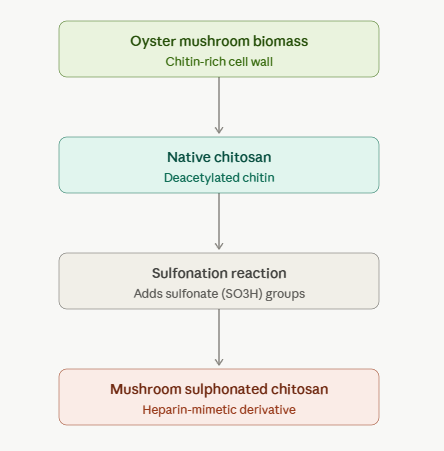
Sulfonation attaches sulfonate (–SO₃H) groups onto the chitosan backbone, and that single chemical change does something native chitosan’s amine groups alone never could: it gives the polymer a structural resemblance to heparin and heparan sulfate, the body’s own sulfated glycosaminoglycans. Sulfonated chitosan derivatives have been employed for blood anticoagulant properties precisely because of this structural similarity to heparin, and separately, sulfated chitosan has been used as a delivery system for tissue repair and regeneration because of its capacity to bind protein growth factors in fact showing itself to be among the most efficient sulfated derivatives for directing neural differentiation.
Research Spotlight. The mechanism isn’t just theoretical resemblance. it’s measurable. Studies characterizing chitosan polysulfate’s anticoagulant activity have used surface plasmon resonance to directly measure its molecular binding to two of the body’s own blood-clotting regulators, antithrombin III and heparin cofactor finding that anticoagulant activity is mediated principally through heparin cofactor II and depends on the polysaccharide’s molecular weight.That’s a real, quantified interaction with the same regulatory proteins heparin itself uses not a loose metaphor.
Industry Perspective. In animal-model testing, the effect wasn’t subtle. Sulfonated chitosan derivatives evaluated for in vivo anticoagulant activity in rats showed faster onset of action and greater potency than nicoumalone, a standard anticoagulant drug, within one hour of administration. For a formulation scientist, that’s the kind of head-to-head comparison against an actual pharmaceutical standard that turns “interesting polymer chemistry” into “worth a serious look.”
Old Technology vs. Modern Technology
| Heparin (animal-derived) | Sulfonated Chitosan (mushroom-derived) | |
|---|---|---|
| Source | Porcine/bovine intestinal mucosa | Fungal (mushroom) biomass |
| Supply chain risk | History of contamination incidents; animal-disease exposure | Controlled, cultivated biomass |
| Allergen/animal-origin concern | Yes | No |
| Anticoagulant mechanism | Native heparin cofactor II / antithrombin III binding | Demonstrated binding to the same regulatory proteins |
| Growth factor interaction | Native GAG function | Structural mimicry, actively researched |
| Antiviral binding capacity | Established benchmark | <cite index=”27-1″>Outperformed soluble heparin and heparin microparticles in HIV-1 binding tests in one study — achieving up to a 70% reduction in viral load versus roughly 53% and 60% for the heparin comparators</cite> |
| Vegan/non-animal status | No | Yes |
Why Mushroom-Derived Sulphonated Chitosan Specifically
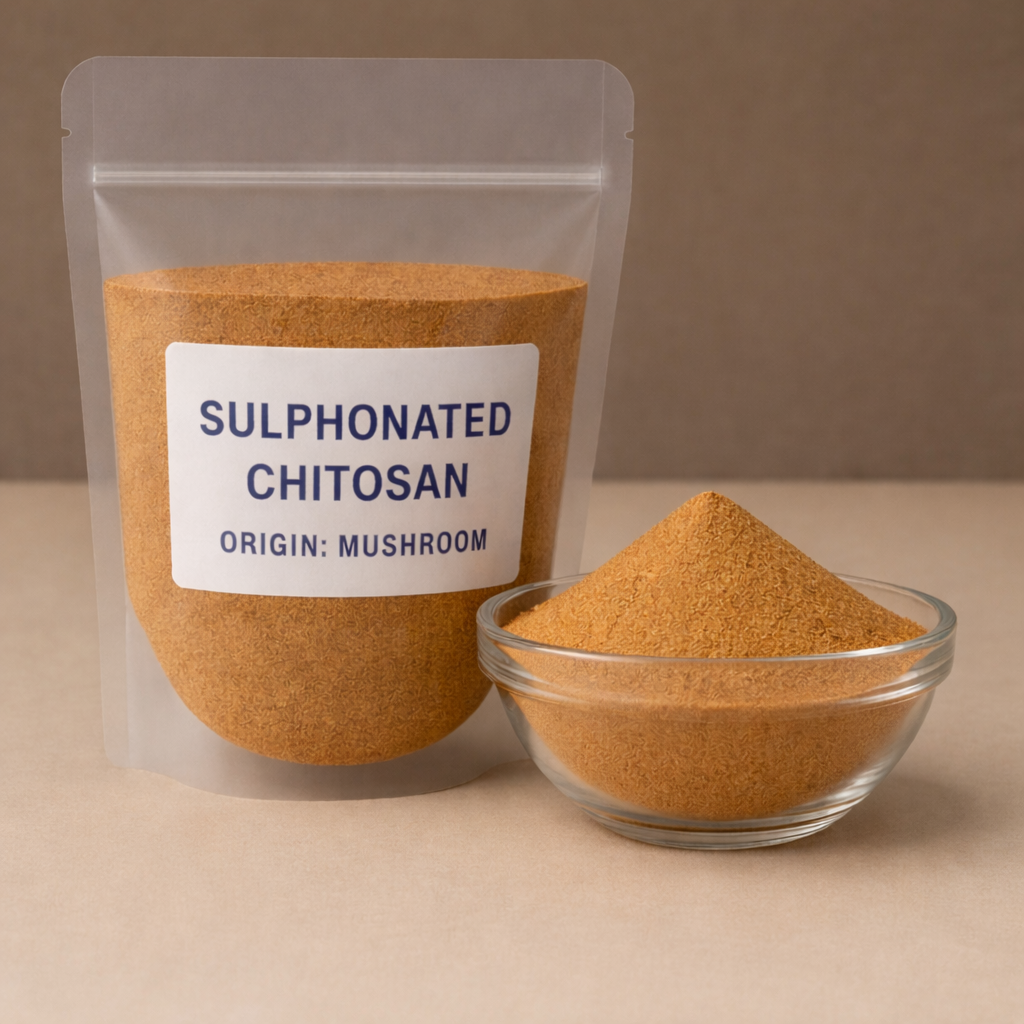
The sulfonation chemistry itself works on chitosan regardless of source. What changes with a fungal starting material is everything upstream of that reaction: a cleaner, lower-mineral substrate, a more consistent starting degree of deacetylation, and critically for anything destined for pharmaceutical or blood-contact use the complete absence of shellfish allergen and animal-origin risk that follows crustacean-derived material into a finished biomedical product. For a molecule being positioned as a safer alternative source for heparin-like activity, starting from an animal-free, allergen-free fungal biomass isn’t a marketing footnote it’s the whole point.
The Industries Quietly Adopting This Technology Today
- Blood-contact medical devices — vascular grafts, catheters, and other blood-contacting surfaces benefit from anticoagulant surface chemistry without relying on animal-sourced heparin.
- Tissue engineering and regenerative medicine — sulfated chitosan derivatives are used as delivery systems for tissue repair and regeneration because of their capacity to bind protein growth factors, with documented use in bone tissue engineering.</cite>
- Drug delivery systems — growth-factor-binding behavior supports controlled-release scaffolds and carriers; see Chitosan for Drug Delivery Systems for the broader mechanism set chitosan derivatives offer.
- Antiviral research — the HIV-1 binding data above points toward microbicide and antiviral barrier applications still in active development.
- Hydrogel and nanoparticle systems — sulfonated chitosan pairs naturally with other functionalized derivatives for multi-mechanism carriers; see Carboxymethyl Chitosan for Hydrogels and Chitosan Hydrochloride for Nanoparticles.
What the Next Generation of Biomedical Materials May Look Like
The direction of travel in the literature is toward precision: researchers aren’t just asking “does sulfonated chitosan mimic heparin,” they’re mapping exactly which sulfation patterns bind which proteins. Work on synthetic heparan-sulfate-mimetic oligosaccharides has shown that specific sulfate positioning 2-O and 6-O sulfation patterns in particular forms key electrostatic interactions with the binding sites of fibroblast growth factors, meaning the next wave of heparin-mimetic chitosan chemistry is likely to move toward controlled, positional sulfonation rather than uniform substitution engineering the polymer to bind a specific target protein rather than mimicking heparin’s activity broadly. That’s a meaningfully more sophisticated design goal than early sulfonated-chitosan chemistry aimed for, and it’s where the most interesting pharmaceutical patent activity in this space is heading.
Common Questions
1. Is sulphonated chitosan the same thing as heparin? No. It’s a structurally similar, chitosan-derived polymer that mimics some of heparin’s biological interactions. it isn’t a chemical copy of heparin itself.
2. Is sulfonated chitosan safe for pharmaceutical use? It has been studied extensively in vitro and in animal models for anticoagulant and tissue-engineering applications; safety for any specific use should be confirmed through your own regulatory and toxicology evaluation pathway.
3. How is sulphonated chitosan made? Through sulfonation reactions commonly using agents such as chlorosulfonic acid that attach sulfonate groups to the chitosan backbone, converting it into a heparin-mimetic biomaterial.
4. Can chitosan actually replace heparin? Research suggests sulfonated chitosan can replicate several of heparin’s key biological interactions including binding to antithrombin III and heparin cofactor though it is generally studied as a heparin-mimetic biomaterial rather than a direct clinical replacement at this stage.
5. What makes mushroom-derived sulphonated chitosan different from shellfish-derived? The sulfonation chemistry is the same; the difference is in starting-material purity, consistency, and importantly for biomedical use the complete absence of shellfish allergen and animal-origin risk.
6. What is a heparin mimetic? A heparin mimetic is a molecule engineered or selected to structurally resemble heparin or heparan sulfate closely enough to interact with the same biological targets, such as clotting-regulation proteins or growth factors.
7. Is sulfonated chitosan water soluble? Yes, sulfonation significantly increases chitosan’s water solubility compared to the native, acid-soluble-only form.
8. What industries use sulfonated chitosan today? Blood-contact medical devices, tissue engineering, drug delivery research, and antiviral/microbicide research are the most active current application areas.
9. Does sulfonated chitosan have antiviral properties? Research has shown sulfated chitosan microparticles binding and neutralizing HIV-1 in vitro, in some studies outperforming heparin-based comparators an active area of ongoing research rather than an established clinical application.
10. How does sulfonated chitosan interact with growth factors? Its sulfate groups form electrostatic interactions with growth factor binding domains, similar to how heparan sulfate naturally regulates growth factor signaling in the body.
11. Is sulphonated chitosan vegan? Mushroom-derived sulphonated chitosan is vegan; sulfonation chemistry can be applied to any chitosan source, so vegan status depends specifically on the starting material, not the sulfonation itself.
12. How do I know which chitosan derivative is right for my application — sulphonated, quaternary, or carboxymethyl? It depends on the interaction you need: sulphonated chitosan for heparin-mimetic/anticoagulant and growth-factor-binding behavior, quaternary chitosan for permanent cationic charge and antimicrobial performance, and carboxymethyl chitosan for anionic, pH-versatile hydrogel systems. Our technical team can help match derivative to application.
Ready to Explore Mushroom Sulphonated Chitosan for Your Research or Commercial Project?
If your work touches blood-contact materials, tissue engineering, growth-factor delivery, or antiviral research, sulphonated chitosan’s heparin-mimetic behavior sourced from an allergen-free, animal-free mushroom substrate is worth a direct look rather than a footnote.
Explore Technical Specifications · Compare with Other Chitosan Derivatives · Request a Research Sample · Download the COA · Talk to Our Technical Team · Request Bulk Pricing
Start with the Sulphonated Chitosan (Mushroom) product page for current specifications, or reach our technical team to discuss your specific application.
You May Also Like
- All
- Native Chitosan
- Phosphorylated Chitosan
- Sulphonated Chitosan
- Quaternary Chitosan
- Chitosan Oligosaccharide Hydrochloride
- Chitosan Hydrochloride
- Carboxymethyl Chitosan
- Chitosan Oligosaccharide
Get in Touch
Technical & Custom Solutions
Abhinav Chauhan, PhD – Application Scientist
Stephen Nice – Application Scientist