
Black Soldier Fly Sulphonated Chitosan: The Complete Guide
Behind the Innovation
Two separate research threads have been running for years without much overlap. One is about a chemical trick: attach sulfonate groups to chitosan, and it starts behaving like heparin the molecule your own bloodstream depends on to regulate clotting and growth factor signaling. The other is about a sourcing problem: 95% of the world’s chitosan still comes from shellfish waste, material that’s seasonal, variably characterized, and carries a real allergen risk that follows it into any finished biomedical product.
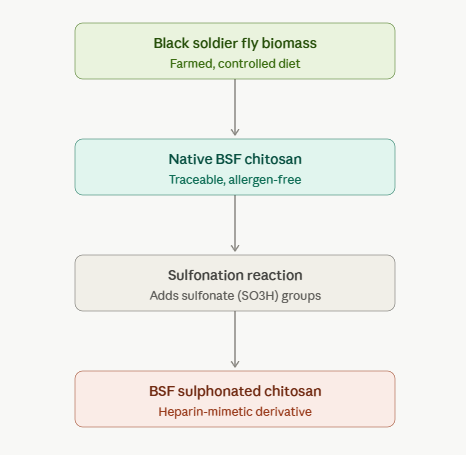
Black Soldier Fly sulphonated chitosan is what happens when those two threads meet. It’s the same heparin-mimetic sulfonation chemistry, applied to a starting material that was never a source of concern in the first place.
- All
- All
- Native Chitosan
- Black Soldier Fly Chitosan
- Chitosan Oligosaccharide Hydrochloride
- Chitosan Oligosaccharide
- Chitosan Hydrochloride
- Carboxymethyl Chitosan
- Quaternary Chitosan
- Trimethyl Chitosan
- Sulphonated Chitosan
- Phosphorylated Chitosan
- Biochar
- Home Cleaning System
Why Researchers Are Paying Attention
The sulfonation chemistry itself isn’t new. Sulfonated chitosan derivatives have been studied for blood anticoagulant properties tied to their structural similarity to heparin, and separately for their capacity to bind protein growth factors in tissue repair and regeneration applications, including directing neural differentiation. What’s new is where researchers are increasingly looking for the starting material.
Research Spotlight. Black soldier fly chitosan isn’t a theoretical alternative. it has independently documented advantages even in its native (non-sulfonated) form. Chitin is found in the exoskeletons of crustaceans and insects and in the cell walls of fungi, but the chitin and chitosan extracted from black soldier fly culture have been specifically studied as a source for materials applications because of the insect’s rapid, controllable life cycle. Separately, the chitin content and physicochemical properties of commercially available crustacean-sourced chitin vary meaningfully by species variation in raw material that is generally undesirable for industrial use a problem BSF’s farmed, single-species production doesn’t have.
From Laboratory Discovery to Industrial Adoption
Sulfonated chitosan’s clinical relevance isn’t speculative. In vivo testing of sulfonated chitosan derivatives against a real anticoagulant drug standard (nicoumalone) showed the sulfonated compounds achieved faster onset of action and greater potency within one hour of administration. Separate mechanistic work has used surface plasmon resonance to directly measure sulfonated chitosan’s molecular binding to antithrombin III and heparin cofactor the same regulatory proteins heparin itself engages. This is chemistry that has already cleared the bar of “does it actually do the thing,” which is precisely why the sourcing question where does the starting chitosan come from, and how well-characterized is it becomes the next serious question for anyone considering it for pharmaceutical or blood-contact use.
Expert Notes. For blood-contact and tissue-engineering applications specifically, starting-material provenance isn’t a footnote it’s a real risk factor. A polymer destined to interact with clotting proteins and growth factors needs a supply chain that can answer, precisely, what it’s made from and how consistent each batch is. That’s a much easier conversation to have about farmed insect biomass than about a mixed seafood-waste stream.
Hidden Advantages Most Buyers Overlook
- Consistency compounds through the reaction, not just the starting material. A more uniform starting degree of deacetylation from BSF’s controlled farming doesn’t just mean a cleaner input it means the sulfonation reaction itself proceeds more evenly, batch to batch, because there’s less structural variability for the reaction to interact with unpredictably.
- No shellfish allergen carryover into a blood-contact material. For any application where the finished polymer will touch human tissue or blood, starting from a source with zero crustacean protein risk removes an entire category of downstream regulatory and safety scrutiny.
- Traceability that shellfish-derived material structurally cannot match. Most of the world’s chitosan supply is not well characterized or reproducible a genuine problem for sulfonation chemistry, where the resulting derivative’s performance depends on knowing exactly what went in.
Which Industries Benefit Most — and Why
| Industry | Why sulphonated BSF chitosan specifically |
|---|---|
| Blood-contact medical devices | Heparin-mimetic anticoagulant surface chemistry without animal-sourced heparin’s contamination history |
| Tissue engineering / regenerative medicine | Growth-factor-binding behavior on a traceable, allergen-free scaffold material |
| Biotech/pharma R&D | A well-characterized starting material simplifies downstream regulatory documentation |
| Antiviral/microbicide research | Sulfated chitosan’s demonstrated viral-binding capacity, on a non-shellfish substrate |
Choosing the Right Derivative for the Right Application
Sulphonated chitosan isn’t always the right BSF derivative — the decision depends entirely on which molecular interaction your application actually needs:
| If you need… | Choose | Why |
|---|---|---|
| Heparin-mimetic anticoagulant/growth-factor binding | Sulphonated Chitosan (Soldier Fly) | Sulfonate groups mimic heparan sulfate’s protein-binding behavior |
| Permanent cationic charge, antimicrobial performance | Quaternary Chitosan (Soldier Fly) | See Quaternary Chitosan for Antimicrobial Systems |
| Oral/mucosal permeation enhancement | Trimethyl Chitosan (Soldier Fly) | Permanently charged, pH-independent |
| Anionic, pH-versatile hydrogel systems | Carboxymethyl Chitosan (Soldier Fly) | See Carboxymethyl Chitosan for Hydrogels |
| Simple water solubility, general formulation | Promecens Insect Chitosan Hydrochloride | Straightforward salt-form solubility |
| Phosphate/bone-mineral-binding chemistry | Phosphorylated Chitosan | Different functional group, different target interaction entirely |
Industry Perspective. A useful rule of thumb: if your application involves a protein your body already regulates with a sulfated sugar chain clotting factors, growth factors, certain viral coat proteins sulphonated chitosan is worth evaluating first. If it involves microbial membranes or general antimicrobial performance, quaternary chitosan is usually the better starting point. See Chitosan for Drug Delivery Systems and Chitosan Hydrochloride for Nanoparticles for how these derivatives fit into broader delivery-system design.
What Emerging Research Could Reshape the Market
The direction of the underlying sulfonation literature is toward positional precision controlling exactly where sulfate groups attach rather than distributing them uniformly, since specific sulfation patterns appear to determine which proteins a sulfated polysaccharide binds. As that chemistry matures, the practical question shifts from “is this material heparin-like” to “which specific protein interaction is this batch engineered for” which makes starting-material consistency (the thing BSF sourcing solves) more important, not less, as the chemistry gets more targeted.
Future Outlook
Expect three things to converge over the next several years: tighter positional control over sulfonation chemistry, growing regulatory interest in non-animal heparin alternatives following heparin’s own supply-chain safety history, and continued growth in farmed-insect biomass as a characterized, traceable feedstock for specialty derivatives generally not just chitosan. Black soldier fly sulphonated chitosan sits at the convergence of all three.
Frequently Asked Questions
1. What is black soldier fly sulphonated chitosan? It’s chitosan derived from black soldier fly (Hermetia illucens) biomass that has been chemically sulfonated given sulfonate (–SO₃H) groups that make it structurally resemble heparin.
2. Why use insect-derived chitosan instead of shellfish-derived for this application? Farmed BSF biomass offers more consistent starting material, no shellfish allergen risk, and full traceability — all genuinely relevant for a material intended for blood-contact or biomedical use.
3. Is sulfonated chitosan the same as heparin? No, it’s a structurally similar, chitosan-derived biomaterial that mimics some of heparin’s biological interactions, not a copy of heparin itself.
4. What does sulfonation actually do to chitosan? It attaches sulfonate groups to the polymer backbone, giving it a structural resemblance to heparan sulfate and enabling it to interact with the same regulatory proteins heparin binds, such as antithrombin III and heparin cofactor II.
5. Is BSF sulphonated chitosan safe for biomedical use? It has been studied through in vitro and animal-model testing for anticoagulant and tissue-engineering applications; safety for any specific use should go through your own regulatory and toxicology evaluation.
6. How is BSF chitosan different from shellfish chitosan structurally? The base chitosan chemistry is comparable; the meaningful differences are in sourcing consistency, allergen profile, and traceability all of which matter more once the material is chemically modified for a specific biological interaction.
7. What industries currently use sulfonated chitosan? Blood-contact medical devices, tissue engineering and regenerative medicine, drug delivery research, and antiviral/microbicide research are the most active application areas.
8. Is black soldier fly chitosan vegan? No as an insect-derived material, it’s not vegan. It’s typically positioned as a more traceable, allergen-conscious alternative to shellfish-derived material rather than a vegan option.
9. How do I choose between sulphonated, quaternary, and trimethyl BSF chitosan? It depends on the interaction you need: sulphonated for heparin-mimetic/growth-factor binding, quaternary for permanent cationic charge and antimicrobial performance, trimethyl for pH-independent permeation enhancement.
10. Does sulfonation reduce chitosan’s other properties? Sulfonation changes the polymer’s charge profile and interactions significantly; any specific property tradeoff should be evaluated against your application’s requirements and confirmed with batch-specific data.
11. What documentation should I request before purchasing? Degree of substitution, molecular weight, source traceability documentation, and batch-to-batch consistency data not just a single historical COA.
12. Can sulphonated chitosan be combined with other derivatives? Yes combination chemistries pairing sulfonation with other functional groups are an active area of chitosan derivative research, though specific combinations should be discussed directly with our technical team.
13. Is BSF sulphonated chitosan water soluble? Yes sulfonation significantly increases water solubility relative to native, acid-soluble-only chitosan.
14. How do I request a sample or pricing? Visit the Sulphonated Chitosan (Soldier Fly) product page, or contact our technical team directly to discuss your specific application and required specifications.
Ready to Evaluate Black Soldier Fly Sulphonated Chitosan?
Here’s what actually matters when evaluating this material: the sulfonation chemistry gives it genuine heparin-mimetic behavior, measurable through real binding assays against the same regulatory proteins heparin itself engages. The insect sourcing gives that chemistry something shellfish-derived material structurally can’t a traceable, allergen-free, consistently characterized starting point, which matters more, not less, the more precisely this chemistry gets engineered.
Chitosan Global works directly with researchers and industrial manufacturers who need documented, reproducible specialty derivatives not just a spec sheet, but a partner who can talk through degree of substitution, sourcing, and batch consistency in detail.
Continue to the Sulphonated Chitosan (Soldier Fly) product page for current specifications, samples, and pricing, or reach our technical team to discuss custom manufacturing for your specific application.
You May Also Like
- All
- Native Chitosan
- Phosphorylated Chitosan
- Sulphonated Chitosan
- Quaternary Chitosan
- Chitosan Oligosaccharide Hydrochloride
- Chitosan Hydrochloride
- Carboxymethyl Chitosan
- Chitosan Oligosaccharide
Get in Touch
Technical & Custom Solutions
Abhinav Chauhan, PhD – Application Scientist
Stephen Nice – Application Scientist