
Mushroom Chitosan Oligosaccharide: The Low-Molecular-Weight, Fully Water-Soluble Form of Fungal Chitosan
No Products Found!
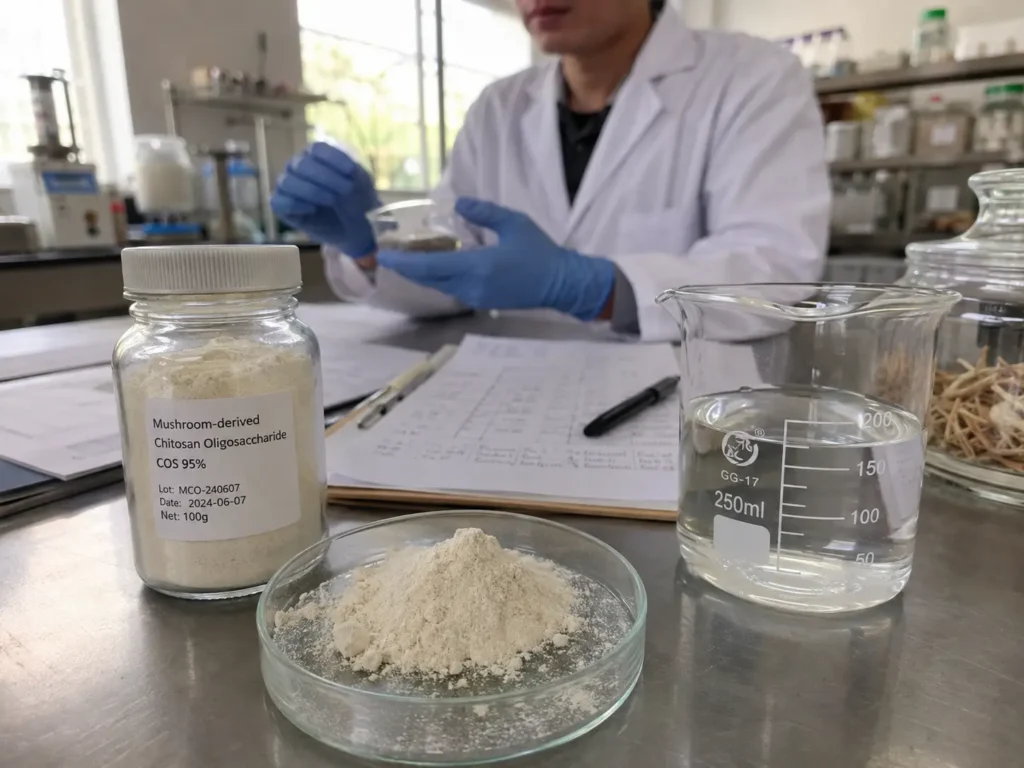
Native chitosan has a size problem as much as a solubility problem. Even chitosan hydrochloride, pre-protonated to dissolve without added acid, is still a long polymer chain and chain length itself limits viscosity, absorption, and how the material behaves in some formulations. Mushroom Chitosan Oligosaccharide (Mushroom COS) solves a different part of the same puzzle: it’s chitosan broken down into much shorter fragments, small enough to dissolve completely in water across a wide pH range without needing a salt form at all.
Evaluating Mushroom Chitosan Oligosaccharide for a formulation? Review the current product specifications, request the COA, or order a laboratory sample.
What “Oligosaccharide” Actually Means Here
Chitosan oligosaccharides (COS) are short-chain fragments produced by breaking down the long chitosan polymer through chemical hydrolysis, enzymatic digestion, or other depolymerization methods — into pieces small enough to be classified by degree of polymerization (DP) rather than molecular weight in the hundreds of kilodaltons. Published literature generally defines COS as having a DP below roughly 20 and molecular weight below about 3,900 Da, though some sources use different cutoffs; low-MW COS specifically (below about 1,500 Da) is reported soluble in water across a wide pH range because chain fragments this short have far fewer intermolecular hydrogen bonds and van der Waals interactions holding them together in an insoluble network.
This is a fundamentally different mechanism from chitosan hydrochloride’s approach to solubility. The hydrochloride salt stays a long polymer chain but pre-protonates its amine groups. COS shortens the chain itself, which is why it can achieve full water solubility without needing to be in salt form at all though COS can also exist as a salt if further modified.
It’s worth being precise about what shorter chain length does and doesn’t guarantee. Reduced molecular weight is consistently linked to higher water solubility and lower viscosity in the literature — but “lower molecular weight always means better absorption” is an oversimplification. Actual biological and functional performance depends on the interaction of molecular weight distribution, degree of deacetylation (DDA), concentration, and the specific formulation or biological system being tested, not molecular weight alone.
Mushroom Origin: What It Changes, and What It Doesn’t
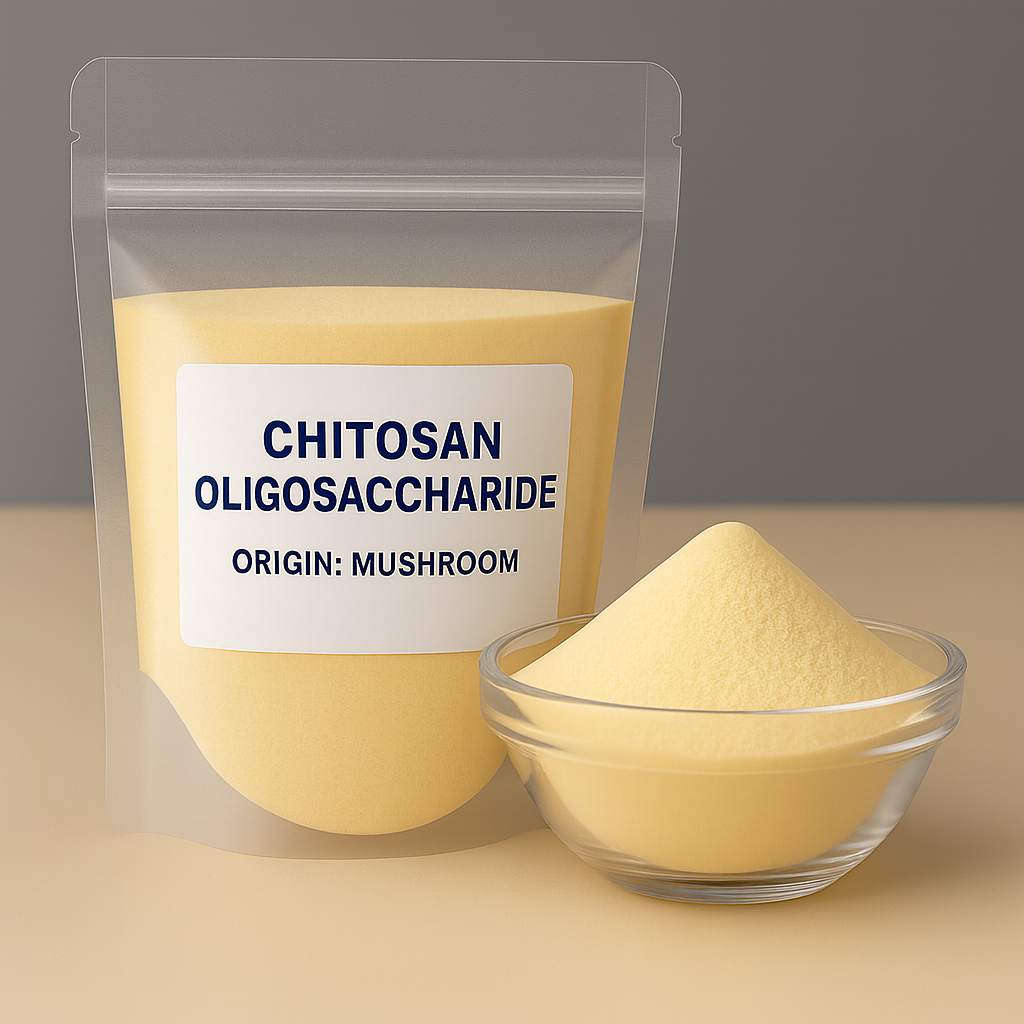
Chitosan oligosaccharide can be produced from any chitosan source shellfish, insect, or fungal. Mushroom-derived COS starts from chitin found in mushroom/fungal cell walls rather than crustacean shells, which matters for a specific, limited set of reasons: it removes shellfish-origin material from the supply chain, which is relevant to manufacturers with non-animal sourcing requirements, and it draws on a fungal cultivation supply base rather than seafood-processing byproduct streams.
What mushroom origin does not automatically confer: allergen-free status, vegan certification, halal or kosher certification, superior purity, or greater sustainability. Each of those requires its own supporting documentation or certification specific to a batch and market none of them follow automatically from “fungal origin” alone, and buyers should request the relevant documentation directly rather than assume it.
Why Water Solubility Matters Here — Briefly
Because COS chain length is already short, it dissolves fully in water across a wide pH range without the acid-handling or salt-conversion steps native chitosan or chitosan hydrochloride require. This is one of COS’s most practically useful properties for aqueous formulation work — but the deeper formulation chemistry (concentration effects, pH stability windows, compatibility with other ingredients) deserves its own treatment. For that detail, see our water-soluble mushroom chitosan guide.
Mushroom COS vs. Native Mushroom Chitosan
| Factor | Mushroom COS | Native Mushroom Chitosan | Why It Matters |
|---|---|---|---|
| Molecular weight | Low — typically well under 4 kDa | High — commonly tens to hundreds of kDa | Drives viscosity, absorption behavior, and processing method |
| Water solubility | Fully soluble across a wide pH range | Acid-soluble only | Determines whether acid handling is required in formulation |
| Viscosity | Low | Higher, especially at commercial-scale concentration | Affects mixing, pumping, and spray application behavior |
| Processing | Simple aqueous dissolution | Requires acid or salt-conversion step | Fewer formulation variables for COS |
| Film formation | Limited — short chains don’t form strong films | Well-suited to coatings and films | Native chitosan generally preferred where film strength matters |
| Typical research focus | Nutraceutical, food, and biological-activity research | Coatings, industrial, and structural applications | Application fit often follows from molecular weight, not origin |
For the fuller comparison, including specification ranges and use-case guidance, see Mushroom COS vs. Native Mushroom Chitosan.
Mushroom COS vs. Shellfish COS: Two Separate Decisions
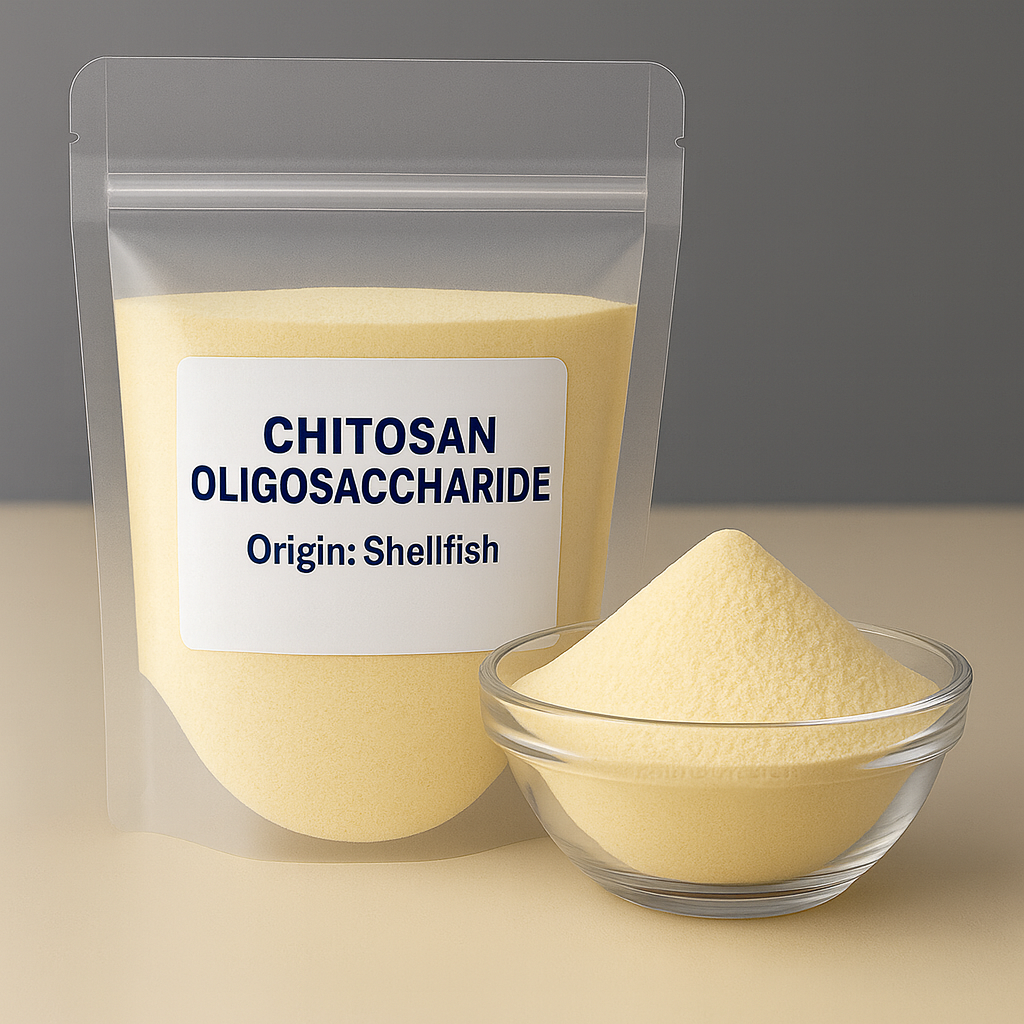
Biological source and polymer specification are genuinely separate questions, and it’s worth stating that plainly rather than letting the two blur together. A mushroom-derived and a shellfish-derived COS can share nearly identical DDA, molecular weight, and purity — or differ substantially — regardless of origin. Choosing between them typically comes down to sourcing requirements (non-animal positioning, allergen considerations, supply consistency) rather than a performance difference inherent to the source itself. Neither source is universally superior; the right choice depends on your application’s specific requirements and documentation needs. See Mushroom COS vs. Shellfish COS for the full comparison.
Functional Properties Under Research
COS has been studied for a range of biological and functional activities. It’s worth being precise about the evidence hierarchy here: much of this research is general COS science (applicable across sources), some is fungal/mushroom-specific, and none of it should be read as a guaranteed property of any particular commercial batch.
- Antioxidant activity — COS has been studied for free-radical scavenging activity in multiple assay systems; fungal-sourced oligochitosan specifically has been reported in at least one study to show higher antioxidant activity than shellfish-derived chitosan across several in vitro tests, though this is a single study’s finding, not an established category-wide conclusion.
- Antimicrobial activity — broadly documented across chitosan and COS regardless of source; fungal-derived chitosan and chitosan-glucan complexes from mushroom fruiting bodies have shown antimicrobial and antioxidant activity in recent characterization studies, attributed partly to co-occurring compounds like glucans and phenols naturally present in fungal cell wall material.
- Cell compatibility research — COS with DDA above roughly 85% has been reported more compatible with certain cell growth systems than lower-DDA chitosan in preclinical research, relevant to biomedical materials research specifically.
- Rapid absorption/bioavailability research — COS’s low molecular weight is frequently cited as enabling faster cellular uptake than higher-molecular-weight chitosan in research settings; this is a documented research finding, not a claim that any specific commercial product delivers a specific bioavailability outcome in humans.
These are general and fungal-specific research findings, not confirmed properties of Chitosan Global’s commercial product. For a deeper, fully cited treatment of functional benefits, see Benefits of Mushroom Chitosan Oligosaccharide.
Where This Matters: Application Overview
Functional foods and nutraceuticals. COS’s full water solubility and low viscosity make it straightforward to incorporate into beverages and liquid supplement formats without an acidic carrier — relevant for products marketed on rapid absorption or gut-supportive positioning where research supports discussing the mechanism. See Mushroom COS for Functional Foods for formulation-specific detail.
Drug-delivery research. Low-molecular-weight chitosan materials are studied for their ability to penetrate biological barriers and biofilms more readily than higher-MW chitosan, and for use in hydrogel and nanoparticle carrier systems. See Mushroom COS for Drug Delivery for the research picture specific to this material.
Agriculture. Chitosan oligosaccharides are studied as plant biostimulants and elicitors of natural plant defense responses, with water solubility simplifying aqueous spray-application research.
Cosmetics and personal care. Water solubility and low viscosity support incorporation into aqueous formulations; some studies report improved emulsification and antioxidant/antimicrobial performance when mushroom-derived chitosan is chemically modified (e.g., with caffeic acid) for use in emulsion systems — a research finding specific to a modified derivative, not unmodified COS generally.
Industrial and biomaterials research. Lower viscosity and full aqueous solubility support use in film and hydrogel research, though native chitosan’s longer chains generally remain preferred where mechanical film strength is the priority.
Not All Chitosan Oligosaccharides Are Equivalent
This is worth its own section because it’s where buyers most often go wrong. “COS” describes a size category, not a fixed specification — the term alone doesn’t tell you what you’re actually getting. Before evaluating any COS source, understand why each of these varies and matters:
- Molecular weight distribution — COS is inherently a mixture of chain lengths, not a single uniform molecule; the distribution, not just an average figure, affects solubility and biological activity.
- Degree of polymerization (DP) — related to but distinct from molecular weight; research has found DP as low as 2–3 units can have measurably different biological activity than DP 6–15 fractions from the same starting material.
- Degree of deacetylation (DDA) — affects charge behavior and, in some research, biological activity independent of chain length.
- Purity — including residual reagents from the depolymerization process (acid, hydrogen peroxide, or enzymatic residues depending on production method).
- Solubility — should be confirmed at your target pH and concentration, not assumed universal.
- Moisture and ash content — affect storage stability and accurate dosing.
- Source — fungal vs. shellfish vs. insect, relevant to sourcing and labeling requirements, not performance by default.
- Residual process materials — depends on whether the COS was produced chemically, enzymatically, or physically; each method leaves different potential residuals.
- Microbiological specifications — relevant for food, nutraceutical, and pharmaceutical-adjacent applications specifically.
- Documentation — a batch-specific Certificate of Analysis, not a generic product description.
Buyer Specification Guide
| Parameter | Why It Matters | What to Verify |
|---|---|---|
| Molecular weight / DP range | Drives solubility, viscosity, and biological activity | Batch-specific tested range, not a general “COS” label |
| Degree of deacetylation (DDA) | Affects charge behavior and some biological activity | Tested value on the COA |
| Solubility | Confirms actual performance at your conditions | Tested percentage at your target pH and concentration |
| Purity | Affects consistency and safety documentation | Residual reagent testing appropriate to the production method used |
| Moisture / ash content | Affects storage stability and dosing accuracy | Current tested values |
| Grade | Research, food, cosmetic, or pharmaceutical-adjacent use carry different requirements | Confirm the grade matches your application’s documentation needs |
| Source | Relevant to labeling and sourcing requirements | Confirmed fungal/mushroom origin where relevant to your claims |
| COA / SDS | The actual source of truth for any specific batch | Request before scale-up, not after |
Review the current Mushroom Chitosan Oligosaccharide product specification and request the latest COA before scale-up. View the product page to get started.
How Mushroom COS Is Produced — A High-Level View
At a general level: mushroom/fungal biomass is processed into chitin, converted to chitosan through deacetylation, then broken down further through controlled depolymerization or hydrolysis (chemical, enzymatic, or physical methods each have documented tradeoffs) to isolate the oligosaccharide fraction, which is then purified and dried into the final product. No single method is universal — chemical hydrolysis, enzymatic digestion using chitosanase enzymes, and physical methods each produce COS with different molecular weight distributions and residual profiles. For the full technical breakdown, see How Mushroom COS Is Produced.
Sourcing Mushroom Chitosan Oligosaccharide
Once you’ve confirmed COS fits your application, sourcing consistently documented material matters as much as the underlying science. Our Mushroom COS supplier guide covers what to expect from a traceable, documented source.
Frequently Asked Questions
What is Mushroom Chitosan Oligosaccharide? It’s a low-molecular-weight, short-chain fragment of mushroom/fungal-derived chitosan, produced by breaking down the longer chitosan polymer through hydrolysis or enzymatic digestion. Its short chain length makes it fully water-soluble across a wide pH range.
How is COS different from native chitosan? Native chitosan is a long polymer chain, soluble only in acidic solution. COS is a much shorter fragment of the same polymer, small enough to dissolve completely in water without needing acid or salt conversion.
Is Mushroom COS water soluble? Yes, fully soluble across a wide pH range, due to its short chain length reducing the intermolecular forces that keep longer-chain chitosan insoluble in neutral water.
What molecular weight is considered COS? Published literature generally classifies chitosan oligosaccharides as having a degree of polymerization below roughly 20 and molecular weight below about 3,900 Da, though different sources use somewhat different cutoffs — always confirm the specific range for the batch you’re evaluating.
Is Mushroom COS different from Shellfish COS? Both can share similar specifications; the primary differences are biological source and associated sourcing/documentation considerations, not a guaranteed performance difference. See our full comparison.
What applications use Mushroom COS? Functional foods and nutraceuticals, drug-delivery research, agriculture, cosmetics, and industrial biomaterials research — anywhere full water solubility and low viscosity at low molecular weight are useful.
How is Mushroom COS produced? Through depolymerization of mushroom-derived chitosan via chemical, enzymatic, or physical methods, followed by purification and drying. See our production guide for detail.
What specifications should buyers check? Molecular weight/DP range, DDA, solubility, purity, and moisture content, confirmed via a batch-specific Certificate of Analysis rather than assumed from the “COS” label alone.
Can I request a sample and COA? Yes — both are available through the Mushroom Chitosan Oligosaccharide product page.
Ready to Evaluate Mushroom Chitosan Oligosaccharide?
Understanding why COS behaves differently from native chitosan is the first step — the next is confirming whether a specific batch’s documented specification actually fits your formulation.
Review the Mushroom Chitosan Oligosaccharide product page to request a laboratory sample or Certificate of Analysis. For sourcing questions, see our supplier guide, or contact our technical team directly.
You May Also Like
- All
- Chitosan Oligosaccharide Hydrochloride
- Chitosan Oligosaccharide
Get in Touch
Technical & Custom Solutions
Abhinav Chauhan, PhD – Application Scientist
Stephen Nice – Application Scientist