
Microplastic Detox Protocol: A Simple Evidence-Based Plan (Diet, Habits, Supplements)
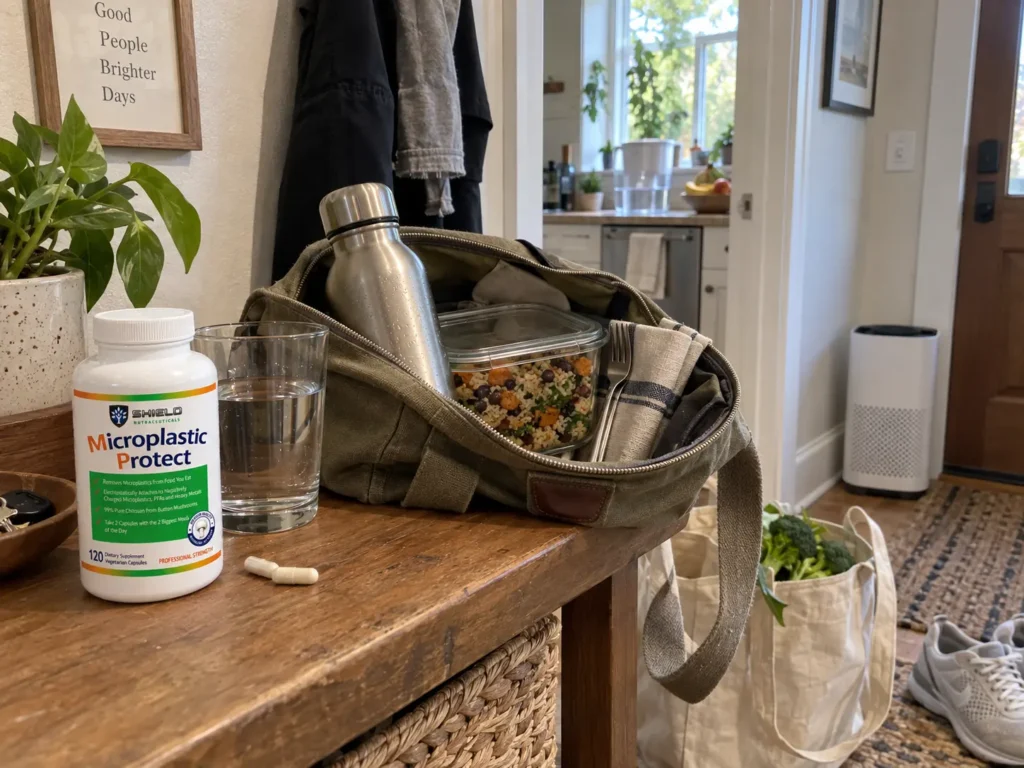
Headlines about microplastics in blood, lungs, placentas and even brain tissue are real. So are the cleanse kits that promise to flush them out. Neither tells you what is actually supported by research. This guide gives you a realistic microplastic detox protocol built on three ideas: reduce the plastic you take in, support normal digestion and excretion, and keep general health habits steady. It includes a daily routine and a 4-week plan. It also says plainly what no routine, supplement or cleanse has been shown to do. Quick answer: No protocol is proven to remove microplastics from human tissue. The best-supported step is reducing exposure, especially heat plus plastic around food and drink. Beyond that, a high-fiber diet supports normal digestion, and some chitosan research suggests a possible role in stool excretion of ingested particles, though that research does not show removal from organs. Key Takeaways A “detox” cannot honestly promise to remove particles already in tissue. Cutting exposure at the source is the most practical lever: water, hot drinks, food storage, reheating and cutting boards. Chitosan has direct microplastic research in rats and one small preliminary human stool study, all using crustacean-derived chitosan, mostly with larger chains than chitosan oligosaccharide. Fiber, vegetables and good hydration support normal digestion but have not been shown to clear microplastics. Cleanse kits, foot baths and sauna “sweat-outs” had no supporting evidence in our review. What a Microplastic Detox Can and Cannot Do What the evidence supports Microplastics can be measured in human stool, so some ingested particles pass through the digestive tract. Reducing the plastic that contacts hot food and drink lowers one avoidable source of particles. Animal studies and one small preliminary human study report higher stool excretion of microplastics after chitosan. Read the details in our review of the chitosan microplastic excretion study. What no protocol can honestly claim Removing particles already in organs, blood or the brain. See where microplastics actually go and what we actually know about microplastics and human health. Results from juice cleanses, ionic foot baths or saunas. We found no evidence for them. For the reasoning behind each method, read how to remove microplastics from your body. This page is the action-plan version. The Three Pillars Reduce intake. Water, hot drinks, food storage, reheating and kitchen tools. Support normal digestion and excretion. Fiber-rich meals and, if you choose, a chitosan product used as labeled. Keep general health habits steady. Vegetables, regular sleep and medical care. These support health overall, but they are not shown to clear microplastics. The Daily Routine: Morning, Meals, Evening Morning Rethink your water. A 2024 study found that boiling hard tap water and filtering out the scale removed up to about 90% of added nano- and microplastics, though results varied with water type (ScienceAlert summary of Yu et al.; DOI). If you use a filter, check which particle sizes the manufacturer tests for and whether the claim is independently certified. News coverage of a World Health Organization review reported more microplastics in bottled water than in tap water (Valley News Live), so bottled water is not automatically the cleaner choice. See also bottled water vs tap water microplastics. Choose your tea and coffee gear. A McGill University study found that a single plastic tea bag steeped in near-boiling water released billions of microplastic and nanoplastic particles (Irish Times report). Loose-leaf tea, a steel infuser or a paper filter avoids that source. The authors said more research is needed on human effects. With Your Two Largest Meals Meals are when much food-related exposure happens, so this is where many people place their routine. Build the plate. Fill about half with vegetables and fiber-rich foods. Fiber supports normal digestion, which is useful whether or not you use a supplement. Our guide to foods and microplastics explains what food can and cannot do. If you use a chitosan supplement, follow the label. The Microplastic Protect label directs two capsules (1,200 mg) with water about 15 minutes before each of the two largest meals. Read how to take Microplastic Protect for the full routine, and speak with a healthcare professional first if you take medication, are pregnant or breastfeeding, or have allergies. In the Kitchen Storage and reheating. Heating food in plastic containers, even ones labeled microwave-safe, increases particle release compared with glass or ceramic, according to a summary of the research (Park Record). Use glass or ceramic. See what heating food in plastic does. Cutting boards. A 2023 Environmental Science & Technology study estimated that regular use of polyethylene or polypropylene boards could release roughly 14 million to 79 million microplastic particles per year (Park Record summary). Wood, bamboo or tempered glass boards avoid that source. Hot plastic. Where heat meets plastic, more particles move into food and drink, so keep the two apart. Evening and at Home Cruciferous vegetables. Broccoli, cauliflower, cabbage and kale are good dietary choices. They contain sulforaphane, but we could not identify a peer-reviewed human trial showing it removes microplastics. Air and dust. Synthetic textiles and household dust can carry fibers. Ventilating rooms and vacuuming regularly may reduce what you breathe in, though we have not cited a study for this tip. Leftovers. Move hot leftovers into glass or steel containers rather than letting hot food sit in plastic. The 4-Week On-Ramp Plan Changing everything at once is why most routines fail. Build it in stages. Week Focus New habits 1 Water and drinks Review your water source and filter, cut single-use bottles, switch to loose-leaf tea or a steel infuser 2 Kitchen Move storage to glass or steel, reheat in ceramic, swap plastic cutting boards for wood or glass 3 Meals Add a high-fiber food to both large meals; start any supplement only after checking with a professional, following the label 4 Home and habits Add a daily vegetable serving, ventilate sleeping space, review textiles and dust By week four the routine takes only a few minutes a day. It is a long-term habit for a continuous exposure,
Best Microplastic Detox Supplement? Chitosan vs Sulforaphane vs Zeolite vs Fiber
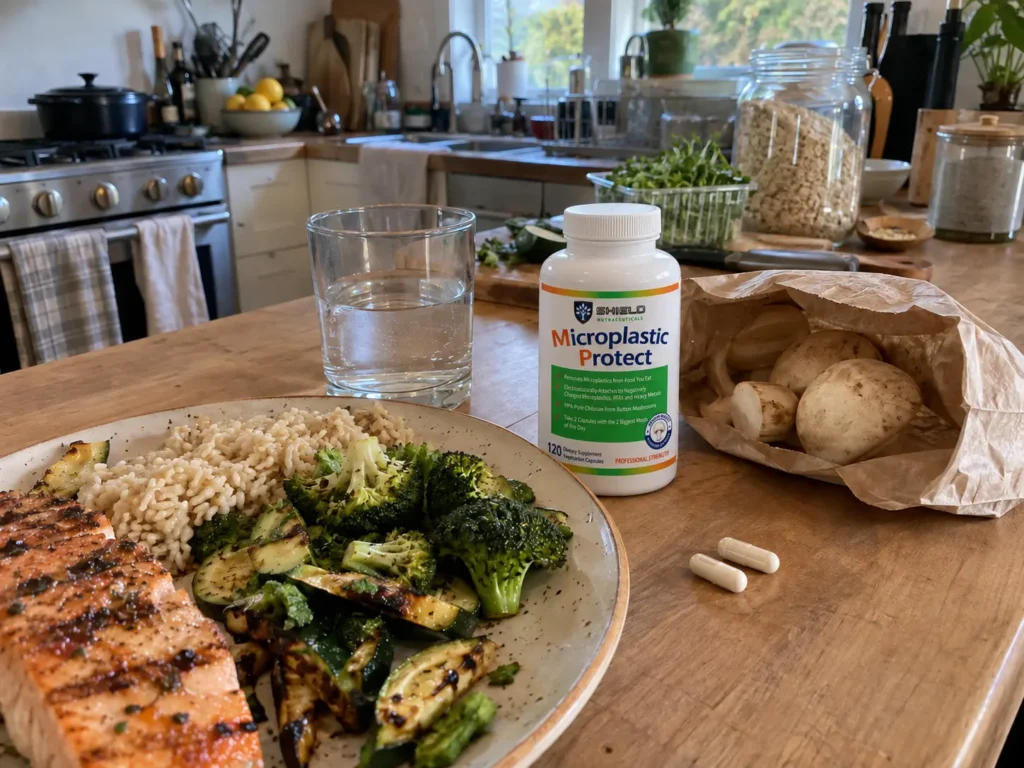
Searching for a microplastic detox supplement and finding nothing but hype? You are not alone. Four candidates dominate the conversation right now chitosan, sulforaphane, zeolite, and dietary fiber and almost nobody has compared them side by side against the actual research. We did. This is an evidence-first comparison: what each candidate is supposed to do, whether studies support it, what human data exists, and which one deserves a place in your routine. No fear marketing, no miracle claims just mechanisms, studies, and honest verdicts. Quick Answer No supplement is clinically proven to remove microplastics from human tissue. But among the four candidates studied, chitosan has the most direct evidence: a 2025 Nature portfolio study found it promoted microplastic excretion through the gut via electrostatic binding. Sulforaphane shows early cellular activity, fiber is a plausible support, and zeolite has no human microplastic evidence at all. Full comparison below. Do Microplastic Detox Supplements Actually Work? Start with the mechanism, because this is where most products fail. Microplastics are physically stable particles your body cannot “burn” or dissolve them. Removal depends on two realities: Most ingested particles leave naturally. Excretion research suggests swallowed particles pass through the digestive tract within days. A supplement can only help by (a) binding particles in the gut so they exit faster, or (b) supporting cellular cleanup pathways. Anything claiming to “pull plastics out of your organs” through other mechanisms has no scientific basis. Keeping those two mechanisms in mind changes how you evaluate every product on this list and it is exactly how the comparison below is structured. (New to the topic? Start with how microplastics enter your body.) The Comparison: Chitosan vs Sulforaphane vs Zeolite vs Fiber Candidate Proposed mechanism Direct microplastic evidence Human data Main risks / caveats Verdict Chitosan Positively charged fiber electrostatically binds negatively charged plastic particles in the gut, speeding excretion Direct — 2025 Nature portfolio animal study showed increased microplastic excretion within days Mechanism confirmed in animals; human trials not yet published Mild: fiber-related digestive adjustment; choose shellfish-free source if allergic Best supported — only candidate with a direct excretion study Sulforaphane Activates cellular cleanup pathways (autophagy-type responses) Indirect — 2025 human pilot reported cells releasing microplastic-associated markers One small pilot study, cellular endpoint Very safe from food; supplement dosing less standardized Promising — support role, not proven removal Zeolite / bentonite clay “Toxin binding” via porous mineral structure None in humans — binding shown only in wastewater/industrial settings No human microplastic studies Contamination concerns in some commercial clays (heavy metals) Not recommended for this purpose Psyllium / generic fiber Speeds gut transit; generic adsorption Indirect — transit benefit is established; plastic-specific binding is not No plastic-specific human studies Very safe Reasonable baseline — do this regardless Now let us look at each in detail — because the details are where the marketing falls apart or holds up. Chitosan: The Only Candidate With a Direct Excretion Study Chitosan is a dietary fiber derived from chitin and it is the only known sugar in nature that carries a positive ionic charge. That detail matters enormously here: Most microplastic particles, like most bacterial pathogens, carry a negative charge. Opposite charges attract, so chitosan can physically bind plastic particles in the digestive tract through electrostatic interaction. A 2025 study in a Nature portfolio journal reported that ingesting chitosan promoted microplastic excretion in animal models with gut clearance within days, not weeks. Mainstream coverage followed, including New Scientist’s report on the supplement binding research. Two honest caveats, because this field attracts exaggeration: The landmark study is animal research. Human trials are the necessary next step and have not yet been published. Not all chitosan is equal. The binding property depends on the degree of deacetylation (DDA) and molecular weight which is exactly why the positive charge mechanism should decide your purchase, not the marketing. What makes chitosan attractive despite the early stage: it is a widely consumed, GRAS-listed fiber with a long safety record, the mechanism is physics rather than wishful thinking, and it is taken with meals precisely when microplastic exposure from food actually happens. The full evidence chain is reviewed in Can Chitosan Bind Microplastics in the Digestive Tract? and Chitosan and Microplastic Excretion: What the Research Shows. The supplement built around this mechanism Microplastic Protect uses 99% pure, high-DDA mushroom-derived chitosan vegan, shellfish-free, third-party tested with published COAs, dosed for your two biggest meals. See the formula → Sulforaphane: Promising Cellular Research, One Small Human Study Sulforaphane — the compound concentrated in broccoli sprouts earned its microplastic reputation from a 2025 human pilot study that reported cells releasing microplastic-associated particles after sulforaphane stimulation of cleanup pathways. Coverage spread quickly through longevity communities. The fair assessment: It is the only candidate besides chitosan with any human data that matters. The study was small, and the endpoint was cellular, not measurable whole-body plastic reduction. Sulforaphane works through a completely different pathway than chitosan (cellular cleanup vs gut binding), which is why some protocols combine both. Broccoli sprouts, broccoli, and other cruciferous vegetables remain the cheapest, safest source. Standardized sulforaphane supplements are reasonable for people who already follow that protocol — but claiming sulforaphane “removes microplastics” today would be ahead of the evidence. Zeolite and Bentonite Clay: Skip It for Microplastics Zeolite powders and clay “detoxes” dominate the detox aisle, so they deserve a straight answer: The porous mineral structure genuinely binds certain molecules which is why wastewater treatment plants use zeolite industrially. There are no published human studies showing ingested zeolite removes microplastics from the body. The industrial mechanism does not transfer. Several commercial zeolite and bentonite products have faced heavy-metal contamination concerns a quality risk you take on for zero established benefit in this use case. If a product markets itself as a “microplastic cleanse” built on zeolite, that is a red flag about the brand’s evidence standards in general. Psyllium and Generic Fiber: A Reasonable Baseline, Not a Detox Dietary fiber especially viscous fibers like psyllium reliably speeds intestinal transit and supports the gut’s
Microplastics in Bottled Water vs Tap Water: What Do the Studies Actually Show?
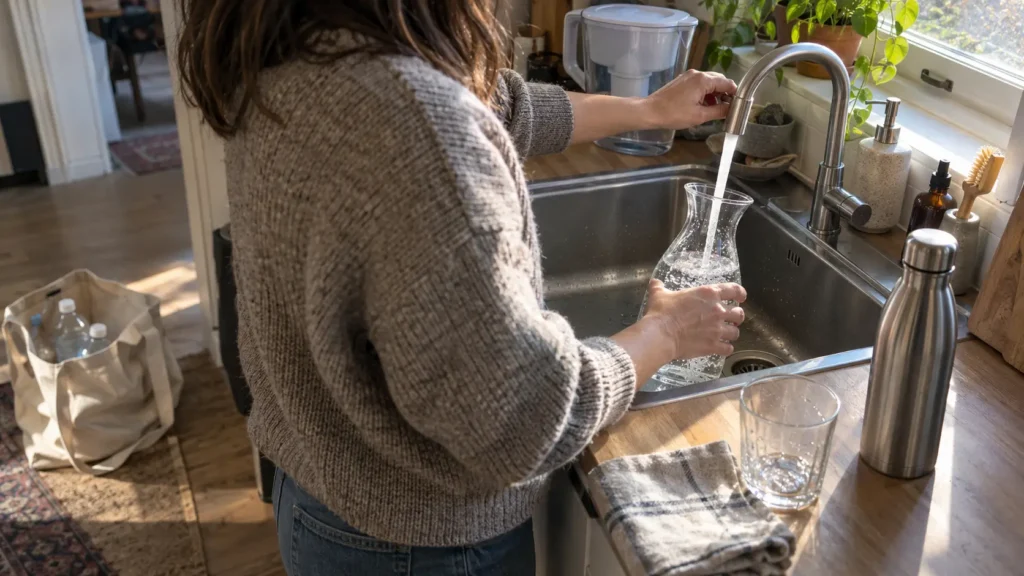
Microplastics in bottled water vs tap water is not a question with one clean answer. Particles have been found in both, and studies that look at smaller particles report far higher counts than studies that do not, so the numbers cannot be compared fairly across papers. Some analyses estimate higher particle intake for people who drink only bottled water, but detection alone does not show harm, and neither type of water can be guaranteed particle-free. This guide explains what the research found, why counts are so hard to compare, and how to choose your drinking water sensibly. Quick answers Microplastics have been detected in both bottled and tap water. A 2019 analysis estimated about 90,000 particles a year from water for people drinking only bottled water, compared with about 4,000 for tap-only drinkers. A 2024 study found roughly 240,000 particles per liter in three bottled water brands, about 90% of them nanoplastics, using a new imaging method. Results depend heavily on the smallest particle size measured, so different studies are not directly comparable. Neither the U.S. Environmental Protection Agency nor FDA has set a microplastics limit for drinking water, and current evidence does not show that detected levels cause harm. Microbial safety and local water quality matter more for most people than microplastic counts. In this article Two glasses that look identical Bottled water: what studies found Tap water: what studies found Practical comparison What FDA and WHO say Why particle counts are hard to compare Does bottled water always contain more Heat and storage Should you filter tap water How to choose your water What not to do Where Microplastic Protect fits Frequently asked questions Two Glasses That Look Identical Pour a glass from a sealed bottle and a glass from the tap. Nothing visible separates them, and eyesight cannot reveal microplastics. What matters is what the science can measure, how reliable the measurement is, and whether the amount found has any known effect on health. Our wider guide to microplastics in food and water puts drinking water in the context of total exposure. Glass A: Water From a Sealed Bottle Bottled water passes through many stages: the source, treatment, bottling, packaging, transport and storage. Each stage can add particles, and the bottle walls and cap are not the only possible sources. Processing equipment, filters and tubing may also contribute. What did the 2024 bottled-water study find? Researchers at Columbia University and Rutgers University used a laser-based imaging method called stimulated Raman scattering to count and identify particles in three unnamed bottled water brands. They reported an average of about 240,000 plastic particles per liter, with roughly 90% being nanoplastics smaller than one micrometer. All seven plastic types in their reference library were detected (PNAS study abstract; ABC News coverage). The study has important limits. It tested only three brands. The authors note that their library identified only about 10% of imaged particles, so many stayed unidentified, and they gave an upper-bound estimate near one million particles per liter that assumes all organic particles are plastic. The high count mainly reflects a method able to see particles as small as 100 to 200 nanometers, which earlier methods could not. The International Bottled Water Association responded that there is no standardized testing method and no scientific consensus on health effects. Glass B: Water From the Tap Tap water travels from a source through treatment, distribution pipes and building plumbing. Treatment removes some particles, with effectiveness depending on particle size, and quality varies by city and by building. Tap water is local Tap water is not a single standardized product. Other concerns, such as microbes, lead, arsenic, nitrates, PFAS and treatment by-products, may matter more for your household than microplastics. In the United States, the EPA regulates public tap water and FDA regulates bottled water, and neither has set a federal limit for microplastics (FDA overview of microplastics and nanoplastics in foods). What Does the Evidence Say When the Two Are Compared? A peer-reviewed review of the occurrence of microplastics in tap and bottled water found particles in both and noted large differences in methods across studies (review in PMC). Studies that can detect smaller particles cannot be fairly compared with those that cannot. One widely cited 2019 analysis in Environmental Science & Technology combined data from 26 earlier studies. It estimated that people who drink only bottled water take in about 90,000 microplastic particles a year from water, compared with about 4,000 for those who drink only tap water, and the authors called their totals likely underestimates (Cox et al., 2019). Treat this as a rough comparison from earlier-generation methods, not a measurement of your own exposure. Bottled Water vs Tap Water: A Practical Comparison Question Bottled water Tap water Microplastics detected in studies Yes Yes Typical sources Source water, processing, bottle, cap, storage Source water, treatment, pipes, building plumbing Quality varies by Brand, source, bottle, storage City, treatment plant, building Federal microplastics limit in the U.S. None None Regulated by FDA EPA Single-use plastic waste Yes No Guaranteed particle-free No No No universal winner appears in the research. The better choice for you depends on your local water quality, your budget, your access to safe tap water and your environmental priorities. What Do FDA and WHO Say? FDA reports that microplastics have been found in both tap and bottled water, and says current evidence does not show that the levels detected in foods pose a health risk. It also notes that detection methods vary and are not standardized. The World Health Organization’s first assessment of microplastics in drinking water found no sign of serious harm from the particles based on limited evidence, and advised against routine monitoring for now, saying resources should stay focused on removing disease-causing microbes (summary of the WHO drinking water report). WHO’s 2022 review of dietary and inhalation exposure said the evidence was not yet enough to characterize health risks fully and called for more research (WHO assessment). Why Are Particle Counts So Hard
How to Reduce Microplastic Exposure During Meals: 9 Practical Steps
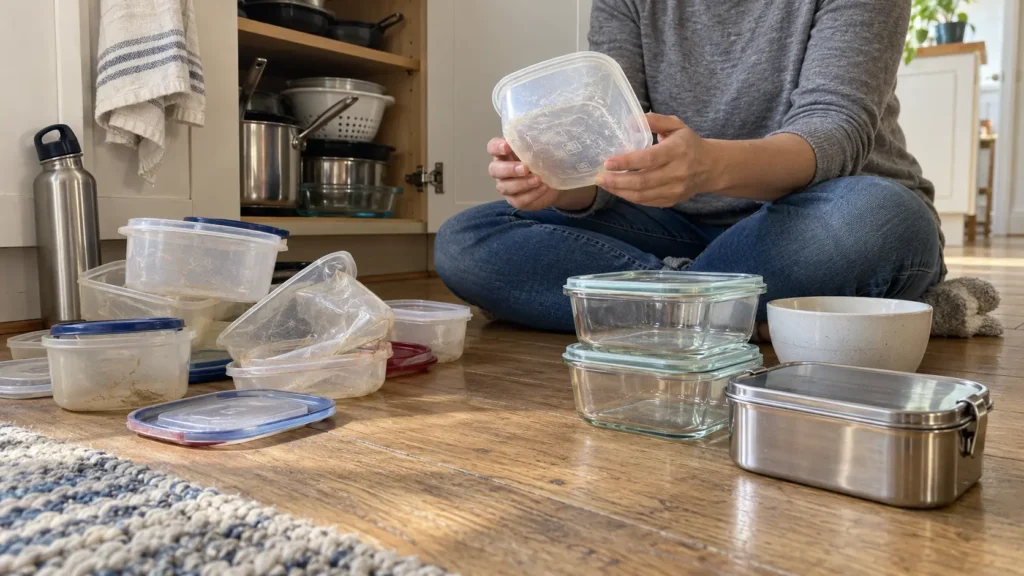
To reduce microplastic exposure during meals, focus on the contact points you can change easily: avoid heating food in plastic, replace worn containers and cutting boards, serve and store food in glass, ceramic or steel, and choose your drinking water and hot drinks with care. No kitchen can be plastic-free, and current evidence does not show that the levels found in food cause harm, so the aim is fewer avoidable contacts, not perfection or fear. This guide follows a normal dinner from takeaway container to leftovers, explains what the research actually shows at each step, and gives you a simple way to decide which habits are worth keeping. Quick answers Do not routinely heat food in disposable plastic. Move it to glass or ceramic first. Replace scratched, warped or cloudy plastic containers and heavily scored plastic cutting boards. Neither bottled nor tap water is automatically cleaner. Avoid leaving plastic bottles in heat. Choose glass, ceramic or stainless steel for serving and storing leftovers. Do not skip nutritious food or hydration out of fear. FDA says current evidence does not show a health risk from the levels found in foods. In this article Why meals are a useful place to start Takeaway containers Choosing the right container The microwave shortcut Cutting boards and prep What you drink with dinner, including tea bags Serving the meal Leftovers The traffic-light method What not to do Where Microplastic Protect fits A seven-day kitchen reset Frequently asked questions Why Start With Meals? Microplastics in food and drink come mainly from environmental contamination, according to the U.S. Food and Drug Administration, which also says there is not yet sufficient evidence that plastic packaging releases them into food or drink. FDA adds that the levels found in foods have not been shown to pose a health risk, and that many detection methods are of limited accuracy (FDA on microplastics and nanoplastics in foods). That leaves a practical question. If you cannot remove the environmental share, which contact points in your own kitchen are easy and low-cost to change? Meals are a good place to look because they involve heat, friction, packaging and repeated daily habits. For the wider picture, read our guide to microplastics in food and water. Takeaway Containers: Move Hot Food Out Hot takeaway food often sits in disposable plastic for the whole journey home. Transferring it to a ceramic or glass dish when you get in removes one avoidable stretch of contact between hot food and plastic. It costs nothing and takes a minute. Keep in mind that results from one laboratory container setup should not be treated as a rule for every container, food and temperature. Match the Container to Its Job Some containers look reusable but were not designed for repeated heating or washing, such as thin yogurt tubs, ice cream tubs and takeaway boxes. Before reusing a plastic container, check: Whether the label says it is intended for reheating or reuse Whether the maker states a temperature limit Whether it is scratched, cloudy, warped or stained Whether it has been through many high-heat dishwasher cycles Replace damaged containers first. Our guide to heating food in plastic and microplastic exposure covers this in more depth. The Microwave Shortcut Microwaving food in plastic is the habit with the strongest laboratory signal. Researchers at the University of Nebraska-Lincoln microwaved two FDA-approved baby food containers, one polypropylene and one polyethylene pouch, filled with water or dilute acetic acid for three minutes at full power. They reported releases of more than two billion nanoplastic particles and four million microplastic particles per square centimeter of container, with amounts varying by container and liquid (news summary of the Environmental Science & Technology study). Read this result with care. The test used water and acetic acid, not real meals, and the health effects of swallowing these particles are unclear. It does, however, support a simple precaution: Heat food in glass or ceramic with a loose lid or plate cover Keep plastic wrap from touching food Do not microwave takeaway containers, old tubs or warped plastic Use microwave-safe labels as a minimum, not a guarantee of zero release Cutting Boards and Food Prep Preparation surfaces are easy to overlook. A 2023 study in Environmental Science & Technology from North Dakota State University had people chop on polyethylene, polypropylene and wooden boards. The authors estimated that cutting boards could contribute millions of microplastic particles a year, with polypropylene boards shedding more than polyethylene in their model, though the figures depend heavily on chopping force, food and board wear (summary of the study by Snopes). The study was small, and preliminary tests on mouse cells showed no significant toxicity over 72 hours. Wooden boards also shed particles, mostly wood. So the sensible takeaway is modest: Retire plastic boards that are deeply scored or fuzzy Use a lighter touch when chopping on plastic Keep a good wooden, bamboo or composite board for produce and bread Wash boards gently and let them dry fully What Are You Drinking With Dinner? Microplastics have been reported in both bottled and tap water, so neither is automatically cleaner. Our comparison of microplastics in bottled water vs tap water goes through the evidence. Practical points: Do not leave plastic bottles in hot cars or direct sun Do not reuse disposable bottles indefinitely Use a clean stainless steel or glass bottle if you want to reduce plastic contact Stay well hydrated, since hydration matters more than any microplastic worry Tea bags A 2019 McGill University study tested four commercial teas packaged in plastic bags and reported that a single bag released billions of micro- and nanoplastic particles at brewing temperature (FoodNavigator summary). The tea industry noted that the study covered nylon and PET bags only and that most bags in Canada are paper. If you want to avoid the question, use loose-leaf tea with a steel infuser or choose paper bags without plastic mesh. When the Meal Reaches the Table Serving food on ceramic, glass or stainless steel
Microplastics in Food and Water: Sources, Exposure and Practical Ways to Reduce It
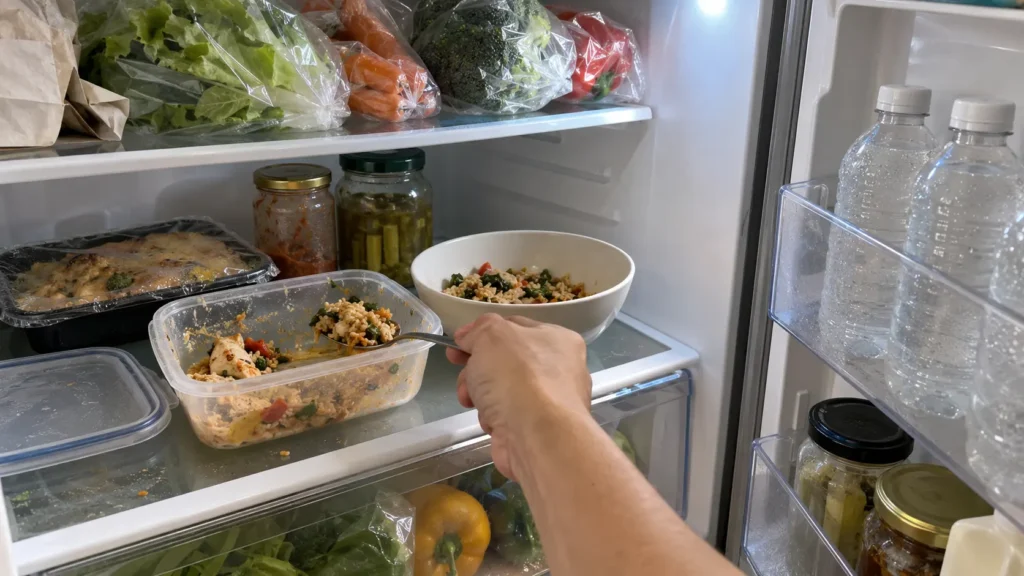
Microplastics in food and water come mainly from environmental contamination, and they reach the body through many small contact points: farmland and oceans, food processing, packaging and storage, and the kitchen. Researchers have detected them in salt, seafood, bottled water, tap water, beer, honey, milk and tea, but current evidence does not show that the levels found in food cause harm. This guide explains where exposure comes from, what the science can and cannot say, and which habits may reduce avoidable contact. Quick answers Microplastics are plastic pieces smaller than 5 millimeters. Nanoplastics are smaller than 1 micron. Reported sources include seafood, salt, bottled water, tap water, beer, honey, milk and tea. One widely cited 2019 estimate put annual intake from food and drink at roughly 39,000 to 52,000 particles for Americans, and the authors called their own figures likely underestimates. Detecting a particle in food is not the same as proving harm. Health effects are still being studied. Exposure cannot be eliminated, but a few habits can lower it. In this article What microplastics are Where the particles come from The four stops on a particle’s journey Microplastics in drinking water How much do people consume What happens after swallowing Practical ways to reduce exposure Where Microplastic Protect fits What science knows and what it does not Frequently asked questions What Are Microplastics? The U.S. Food and Drug Administration describes microplastics as small plastic pieces under 5 millimeters in at least one dimension, and nanoplastics as smaller particles, generally under 1 micron. For scale, a human hair is about 70 microns across. There is no single standard definition for either size range. Some particles are manufactured at that size, such as resin pellets, while many form when larger plastic waste breaks down in the environment (FDA overview of microplastics and nanoplastics in foods). Where Do Microplastics in Food and Water Come From? Plastic is used widely, and it sheds fragments as it ages, weathers and wears. Those fragments travel through soil, rivers, oceans, wastewater and air, so they can end up in the places where food is grown, raised or harvested. FDA states that microplastics in food come mainly from environmental contamination, and that there is not sufficient evidence that plastic food packaging releases them into foods or drinks. That statement matters, because it is easy to assume packaging is the main source. The honest picture is that the environment is the best-supported source, while processing, packaging and cooking may add smaller contributions that are harder to measure. The Four Stops on a Particle’s Journey Stop 1: The Environment Fish, shellfish, sea salt, crops and drinking water sources can all pick up particles from their surroundings. Seafood is one of the most studied examples, since marine animals live in and filter water that carries plastic debris. FDA lists salt, seafood, sugar, beer, bottled water, honey, milk and tea among the foods where microplastics have been reported. Stop 2: Processing Factory equipment, conveyor parts, filters, tubing and cutting surfaces can contribute fragments through wear. How much they add depends on the material, the age of the equipment and the product being handled, and this area has fewer reliable measurements than environmental sampling. Stop 3: Packaging and Storage Water bottles, plastic wrap, takeaway containers and bottle caps are the contact points people think about first. Some laboratory studies report particle release from worn or heated plastic, while FDA’s position is that evidence for packaging as a meaningful source is not yet sufficient. Reducing contact with damaged or heated plastic is a reasonable low-cost precaution, even though it is not a proven fix. Stop 4: The Kitchen and Table Scratched cutting boards, old plastic containers, worn non-stick surfaces, plastic kettles and reused disposable containers can all shed small pieces. Our guide to heating food in plastic and microplastic exposure looks at this contact point in more detail, and our tips to reduce microplastic exposure during meals turn it into daily habits. Microplastics in Drinking Water Microplastics have been found in both tap and bottled water. The World Health Organization’s first assessment of microplastics in drinking water noted that runoff and treated wastewater are the main routes into water supplies. It considered three possible concerns: the particles, chemicals they may carry and microbes that can grow on them. Based on limited evidence, WHO found no sign of serious harm from the particles, low concern about the chemicals and no evidence of risk from microbial growth. It advised against routine monitoring for now and said resources should stay focused on removing disease-causing microbes (summary of WHO’s drinking water report). WHO followed that work in 2022 with a broader review of exposure from food, water and air, which identified research gaps and defined future work (WHO assessment of dietary and inhalation exposure to nano- and microplastics). Bottled water is not automatically worse or better than tap water in every study, since methods, brands and regions differ. Read our comparison of microplastics in bottled water vs tap water for the details. Does boiling tap water remove microplastics? In a laboratory study in Environmental Science & Technology Letters, researchers spiked hard tap water with plastic particles, boiled it for five minutes, cooled it and filtered out the limescale. Water with about 300 milligrams of calcium carbonate per liter lost nearly 90 percent of the particles, because they became trapped in the scale. Water with under 60 milligrams per liter lost only about 25 percent (Smithsonian Magazine coverage of the study). The test covered only three plastic types under controlled conditions, so it is a promising finding, not a guarantee for every home. How Many Microplastics Do People Consume? A 2019 analysis in Environmental Science & Technology combined data from 26 earlier studies and estimated that Americans consume about 39,000 to 52,000 microplastic particles a year through food and drink, depending on age and sex. Adding inhalation raised the range to roughly 74,000 to 121,000 particles. The same analysis estimated that people who drink only bottled water
Microplastic Protect vs Regular Chitosan Supplements
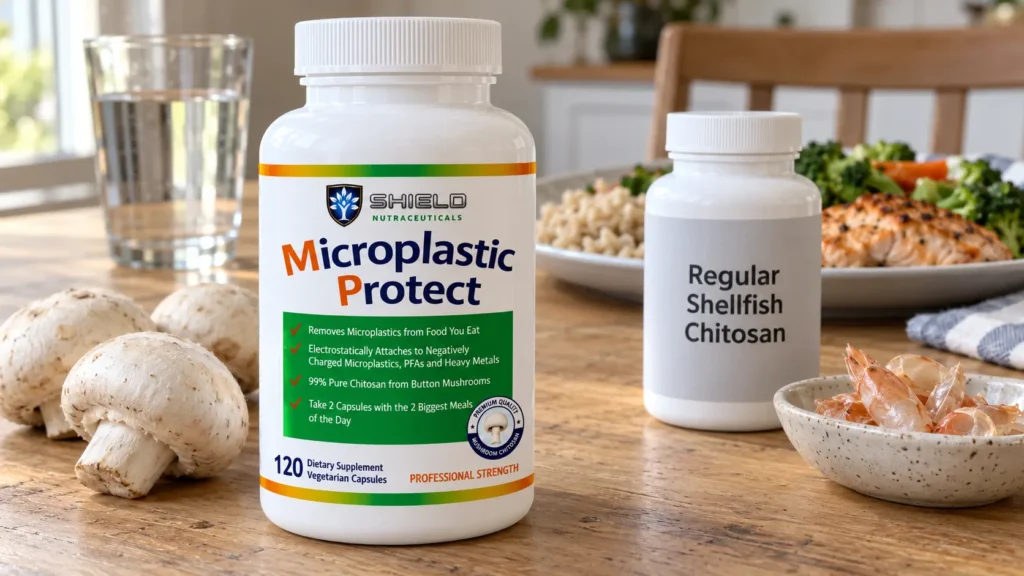
Microplastic Protect belongs to the chitosan family, but it is not built like a typical chitosan supplement. It uses chitosan oligosaccharide (COS) from button mushrooms, adds sodium alginate and beet pectin, and is taken around your two biggest meals. Many standard chitosan products use longer-chain chitosan from shrimp or crab shells and are positioned around dietary fat or weight management. This guide compares the two on source, molecular form, formula, capsules, dosing and evidence. It also covers what current research does and does not show, and the questions worth asking before you buy any chitosan product. Key Takeaways Microplastic Protect lists mushroom-derived chitosan oligosaccharide, sodium alginate, beet pectin, microcrystalline cellulose and a cellulose vegetarian capsule. Many standard chitosan supplements use native chitosan from crustacean shells, but formulas vary widely. Most microplastic-related chitosan research so far has used larger chitosan from crustacean sources, so those results should not be assumed to apply to COS. No finished-product human study has established that Microplastic Protect or any specific chitosan supplement removes microplastics from the body. Reading the back label (source, form, amounts, capsule and allergen statement) tells you more than the front. What Is a Standard Chitosan Supplement? No single formula represents every chitosan supplement. A conventional product may use chitosan from shrimp or crab shells, native longer chains and a simple capsule. Common positioning includes dietary fat interaction, weight management, fiber supplementation and cholesterol-related wellness, and many are taken before meals that contain fat. Dose, molecular weight, purity and capsule material differ by brand, so “regular chitosan supplement” describes a category, not a standard. For context, WebMD notes that chitosan is sold as a “fat blocker,” that the FDA has warned about such claims, and that a review of high-quality studies found overweight people taking chitosan did not lose significant weight (WebMD). Healthline similarly describes chitosan’s weight loss effect as minimal at best (Healthline). What Is Microplastic Protect? Microplastic Protect is a multi-ingredient formula intended for use around the two largest meals of the day. According to the full label it contains: 99% pure chitosan oligosaccharide from Agaricus bisporus button mushrooms Sodium alginate Beet pectin Microcrystalline cellulose Cellulose vegetarian capsules One serving is two capsules (1,200 mg in total), taken about 15 minutes before each of the two largest meals, which is four capsules per day. A bottle holds 120 capsules, about 30 days of use at that routine. See our guide on how to take Microplastic Protect for the full routine. Side-by-Side Comparison What to check Microplastic Protect Typical chitosan supplement Source Button mushrooms Often shrimp or crab shells Chitosan form Chitosan oligosaccharide (COS) Commonly native chitosan Formula Chitosan oligosaccharide, sodium alginate, beet pectin Often chitosan with few other ingredients Shellfish Label states made without shellfish May be shellfish-derived Capsule Cellulose vegetarian capsule Vegetarian or gelatin Serving Two capsules, 1,200 mg in total Varies Schedule About 15 minutes before the two largest meals Varies Typical positioning Mealtime environmental-exposure routine Often dietary fat or weight management Finished-product human evidence on microplastics Not established Varies by product; usually not established Difference One: The Chitosan Source Shellfish-Derived Chitosan Commercial chitosan is frequently made from shrimp, crab, lobster and other crustacean shells. Chitin is separated from minerals, proteins and pigments, then deacetylated. This is an established, high-volume process, but the animal source may not suit vegetarian consumers or people who want a shellfish-free product. There is also an allergen angle. The UK Committee on Toxicity notes that tropomyosin, the best-known crustacean allergen, has been detected in technical samples of chitin and chitosan from shellfish (UK COT position paper), and a related COT document states that chitin and chitosan from algae or fungi are free of tropomyosin (UK COT allergenicity paper). Mushroom-Derived Chitosan Microplastic Protect names Agaricus bisporus button mushrooms as its source. Mushroom cell walls contain chitin, which can be extracted, purified and deacetylated into fungal chitosan, and research confirms button mushrooms are a recoverable chitin source (Almeida et al., 2025). A mushroom source does not remove every consideration: consumer references advise people with a mushroom allergy to be cautious with chitosan too (Healthline). For more, read whether mushroom chitosan is vegan and shellfish-free and our technical comparison of mushroom chitosan vs shellfish chitosan supplements. Difference Two: Chitosan Oligosaccharide vs Native Chitosan Source tells you where the material began. Molecular form tells you what happened to it afterward. The Microplastic Protect label identifies chitosan oligosaccharide (COS), which has much shorter chains than typical native chitosan. COS is commonly defined as chitosan under about 3.9 kDa with fewer than 20 monomer units (Frontiers in Physiology review). Shorter chains may bring lower viscosity, higher mobility, easier dispersion and better water solubility. Longer chains may bring higher viscosity, more extensive chain interactions, different surface adsorption and greater polymer-bridging potential. A review of chitosan notes that molecular weight and degree of acetylation influence solubility and viscosity (Aranaz et al., 2021). Neither form is universally better, and in at least one rat study low molecular weight chitosan outperformed COS on lipid-related measures (study record). Our guide to chitosan vs chitosan oligosaccharide explains the trade-offs. Difference Three: One Polymer vs a Three-Polymer Formula A standard chitosan supplement may rely mainly on chitosan. Microplastic Protect combines three polysaccharides. Chitosan oligosaccharide. The principal positively chargeable component. Its amino groups can become protonated under suitable conditions. Sodium alginate. Commonly obtained from brown seaweed, it carries negative charges and is known for water interaction, viscosity and gel formation (Abka-khajouei et al., 2022). Beet pectin. A plant-derived soluble fiber. Sugar beet pectin differs from citrus pectin, with weaker gelling but good emulsifying behavior (The Analytical Scientist), while pectin overall is used as a stabilizer, thickener and dietary-fiber component (Lara-Espinoza et al., 2018). Reviews of chitosan polyelectrolyte complexes describe how chitosan can associate with negatively charged polymers such as alginate and pectin (MDPI Polymers review). That is a formulation concept, mostly studied outside dietary supplements, and it does not by itself show what the finished capsule does in people. See the full Microplastic Protect ingredients guide.
How to Take Microplastic Protect with Meals
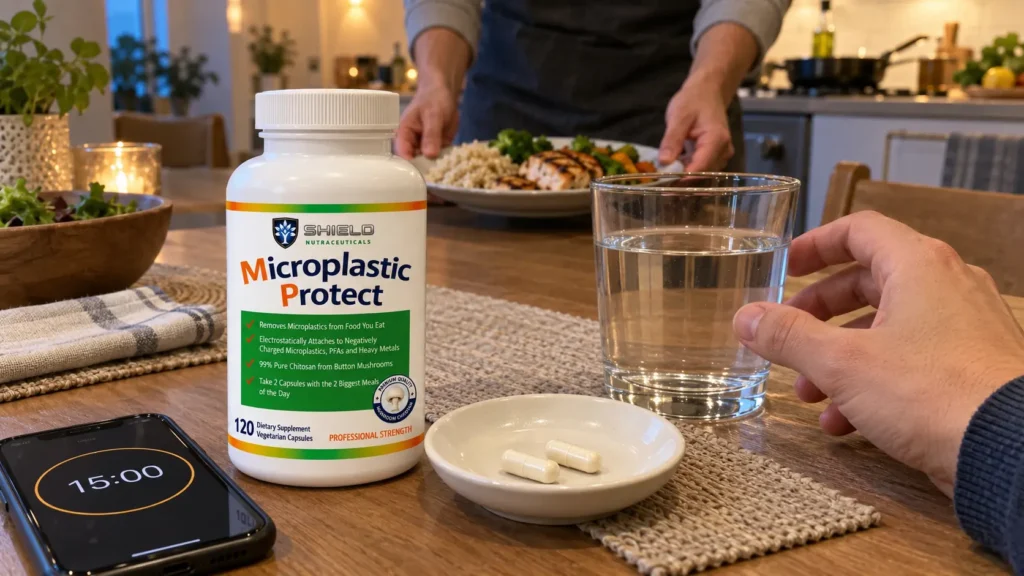
Here is the label direction in one line: take two capsules, totaling 1,200 mg, approximately 15 minutes before each of your two biggest meals of the day, with water. For many people those meals are lunch and dinner. For others, breakfast is the larger meal. The routine follows meal size, not fixed clock times. This guide turns the label into a practical daily routine and answers the questions people ask most, including what to do when your schedule changes, how to store the bottle and when to speak with a healthcare professional first. Key Takeaways One serving is two capsules (1,200 mg). Take one serving before each of your two biggest meals, which makes four capsules per day. Take the capsules approximately 15 minutes before the meal, with water. Choose your two biggest meals by how much you eat, not by the time on the clock. One bottle holds 120 capsules, which is about 30 days at four capsules per day. People who are pregnant, nursing, taking medication or under medical supervision should consult a healthcare professional before use. The label does not give a missed-serving rule, so do not double up. Resume at the next selected meal. The Two-Meal Rule Microplastic Protect is not labeled for use before every snack, drink or small meal. The suggested use centers on the two largest meals of your day. Daily eating pattern First selected meal Second selected meal Light breakfast, regular lunch, large dinner Lunch Dinner Large breakfast, light lunch, regular dinner Breakfast Dinner Two-meal eating schedule First meal Second meal Night-shift schedule Largest meal of your waking period Second largest meal Weekend brunch routine Brunch Dinner You do not need the same meal times as anyone else. Identify the meals in which you normally eat the most. A Realistic Day With Microplastic Protect Say your day starts with coffee and a small piece of toast. At noon you eat rice, vegetables and protein, and dinner is another full meal. Your routine could be: Small breakfast: no scheduled serving About 15 minutes before lunch: two capsules with water About 15 minutes before dinner: two capsules with water If you eat a substantial breakfast but only a small afternoon snack, breakfast and dinner are the more logical choices. The goal is a consistent routine around your two largest meals, not forcing the capsules into a schedule that does not match how you eat. How Many Capsules Do You Take? The label defines one serving as 2 capsules, 1,200 mg in total, and the directions call for one serving before each of the two selected meals. That means: Two capsules before the first major meal Two capsules before the second major meal Four capsules in total across the day Two capsules is not the daily total. A bottle contains 120 vegetarian capsules, so at this routine one bottle lasts about 30 days. Why About 15 Minutes Before a Meal? Taking the capsules shortly before eating places the formula in the digestive tract around the time food and drink arrive. The word “approximately” matters. The label gives a practical pre-meal window, not a claim that timing stops mattering at exactly 14 or 16 minutes. An easy habit is to take the capsules when you start preparing food, set the table or place a restaurant order. Common cues include: Before you start serving dinner Shortly before leaving your desk for lunch After ordering at a restaurant, if the food is expected soon Before a planned breakfast or brunch Before the Meal or With the Meal? The detailed directions say to take the capsules approximately 15 minutes before eating. The shorter wording on the front of the bottle refers to taking them with the two biggest meals. The detailed directions are the more precise instruction, so follow the pre-meal timing. If you forget and have already started eating, do not take extra capsules to make up for it. Resume at the next selected meal, and contact the manufacturer or a healthcare professional if you need guidance for your situation. How to Choose Your Two Biggest Meals Meal size is about the overall amount of food and drink, not just the size of the plate. Ask yourself: Which meals contain the most food? Which meals include several dishes or courses? Which meals involve takeout or packaged food? Is breakfast substantial, or just coffee and a small snack? Does my schedule differ between weekdays and weekends? A Simple Selection Method Write down one day of eating and label each meal small, medium or large. Choose the two marked large. If you have only one large meal, add the next most substantial complete meal. You do not need to count calories. What Counts as a Meal? A meal is a planned eating occasion with a meaningful amount of food. Complete meals include eggs, toast and fruit at breakfast, rice, vegetables and chicken at lunch, pasta, salad and protein at dinner, a large restaurant meal or a full brunch. These would not usually count as one of your two biggest meals: a cup of coffee, a piece of fruit, a small yogurt, a handful of nuts, a light snack, or water alone. If you eat several small meals and the two-meal structure does not fit, ask a healthcare professional how to adapt. Take It With Water The directions specify taking the capsules with water. Use enough to swallow them comfortably. The label does not state a required water type, temperature or volume. The label also does not describe opening, crushing or dissolving the capsules, so use them in the capsule form in which they are supplied unless a qualified professional advises otherwise. If swallowing capsules is difficult, ask a pharmacist for advice. Coffee, Juice or Soda? Plain water is the label-consistent choice. Other drinks differ in acidity, sugar and mineral content, and the label offers no data on taking the capsules with them. Unless the manufacturer provides product-specific guidance, use water. What Is Inside the Two Capsules? According to the
Microplastic Protect Ingredients: What Is Inside the Formula?
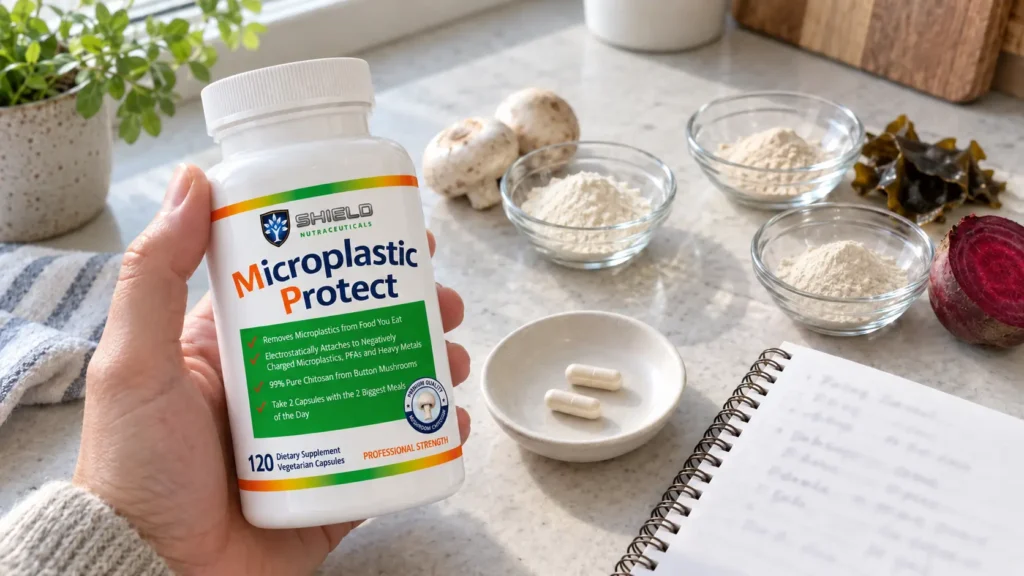
According to the product label, the main Microplastic Protect ingredients are 99% pure chitosan oligosaccharide from Agaricus bisporus button mushrooms, sodium alginate and beet pectin. The formula also uses microcrystalline cellulose and a cellulose-based vegetarian capsule. That makes it more than a single-ingredient chitosan supplement. It pairs a positively chargeable mushroom-derived polymer with two polysaccharides from seaweed and sugar beet. This guide explains what each ingredient is, what role it plays, what the label does not establish on its own, and which questions are worth asking before you buy any supplement of this kind. Key Takeaways The label lists chitosan oligosaccharide (COS) from button mushrooms, sodium alginate, beet pectin, microcrystalline cellulose and a vegetarian cellulose capsule. One serving is two capsules weighing 1,200 mg in total, with 60 servings per bottle. The Supplement Facts panel does not give a separate milligram amount for each ingredient, so the 1,200 mg should not be read as 1,200 mg of chitosan oligosaccharide. Chitosan, alginate and pectin can interact through opposite electrical charges in laboratory settings, but that is a formulation concept, not proof of a human health outcome. “99% pure” describes the purity of the chitosan ingredient, not the share of the whole capsule. The Formula at a Glance Label component Source or type Role in the formula Chitosan oligosaccharide Agaricus bisporus button mushrooms Principal mushroom-derived chitosan ingredient Sodium alginate Commonly obtained from brown seaweed Polysaccharide with water-binding and gel-forming properties Beet pectin Derived from sugar-beet material Plant polysaccharide and soluble-fiber component Microcrystalline cellulose Purified cellulose Filler or formulation aid for consistent capsule filling Cellulose capsule Plant-derived capsule material Vegetarian capsule shell The label states that a serving is two capsules weighing 1,200 mg in total, and each bottle holds 120 capsules, or 60 servings. Ingredient One: Mushroom-Derived Chitosan Oligosaccharide The central ingredient is listed as 99% pure chitosan oligosaccharide from Agaricus bisporus mushrooms. Agaricus bisporus includes the common white button mushroom, and its cell walls contain chitin, the same structural polysaccharide found in crustacean shells. To make the ingredient, chitin-containing material is separated from the mushroom biomass and purified. Deacetylation converts the chitin into chitosan, and further controlled processing shortens the chains into chitosan oligosaccharides (COS). Research confirms that Agaricus bisporus can serve as a recoverable chitin source for fungal chitosan (Almeida et al., 2025). Learn more in our guide to button mushroom-derived chitosan and on our chitosan oligosaccharide product page. Chitosan Oligosaccharide Is Not Mushroom Powder The word “mushroom” can suggest dried culinary mushroom powder. That is not what the ingredient statement describes. Mushroom powder contains proteins, carbohydrates, glucans, minerals and many other components. Chitosan oligosaccharide is a processed and purified polymer obtained from mushroom cell-wall material, which makes it different from both mushroom powder and conventional mushroom extracts. The “99% pure” statement refers to the purity specification of the chitosan ingredient. It does not mean 99% of the capsule contents is chitosan unless the quantitative Supplement Facts information says so. Why Oligosaccharide Instead of Longer-Chain Chitosan? Native chitosan generally consists of long polymer chains, while COS has shorter chains and a lower molecular weight. That change can influence water solubility, viscosity, molecular mobility, dispersion, surface interactions and behavior across pH conditions. A major scientific overview notes that solubility depends on chain length, degree of acetylation, pH and formulation conditions (Aranaz et al., 2021). Higher solubility does not automatically mean better performance for every purpose, because longer and shorter chains can differ in adsorption and bridging behavior. Our full comparison of chitosan vs chitosan oligosaccharide explains the trade-offs. The Charge Question Chitosan has amino groups that can accept hydrogen ions under suitable conditions. Once protonated, they carry a positive charge that can support electrostatic attraction to compatible negatively charged materials. The mechanism is more nuanced than “positive sticks to negative,” because the outcome depends on: pH Degree of deacetylation Molecular weight Particle size Ionic strength Surface chemistry Concentration Competing substances in the surrounding medium A charge figure such as zeta potential is only meaningful with its test method, pH, solvent and concentration. Our explainer on how the positive charge of chitosan works covers the protonation mechanism. Ingredient Two: Sodium Alginate Sodium alginate is a polysaccharide most commonly obtained from brown seaweed. It is widely used in food and formulation science because it can absorb water, raise viscosity and form gels under suitable conditions. Alginate carries negatively charged carboxyl groups, and its behavior changes with molecular composition, concentration, pH, mineral content, calcium ions and viscosity grade. Calcium ions can link sections of alginate chains into a network or gel, which is one reason alginate is used in food, encapsulation, pharmaceutical and biomaterial applications. A review in the scientific literature describes its structure, physicochemical properties and wide use across food and biomedical formulations (Abka-khajouei et al., 2022). Inside a capsule formula, sodium alginate may contribute water-interaction and formulation properties. It should not be described as removing microplastics from the body on its own, and results for isolated alginate in a laboratory cannot predict how a multi-ingredient capsule behaves during human digestion. Ingredient Three: Beet Pectin Pectin is a complex polysaccharide found in plant cell walls. Commercial pectin is usually associated with citrus peel and apple pomace, but it can also be recovered from sugar beet. A review of pectin describes its role as a dietary-fiber material and its use as a gelling agent, thickener, stabilizer and emulsifier (Lara-Espinoza et al., 2018). Sugar beet pectin behaves differently from citrus pectin. Technical literature notes that beet pectin has weak gelling ability compared with citrus pectin but good emulsifying properties (The Analytical Scientist), and research on beet by-products shows that its structure and properties vary with the extraction method (Pacheco et al., 2019). In this formula, beet pectin is best described as a plant-derived polysaccharide and soluble-fiber component. It should not be assumed to form a gel or matrix after swallowing without finished-product testing. How Might the Three Polymers Interact? This is the most interesting part of the ingredient list. Chitosan is positively charged at
Is Mushroom Chitosan Vegan and Shellfish-Free?
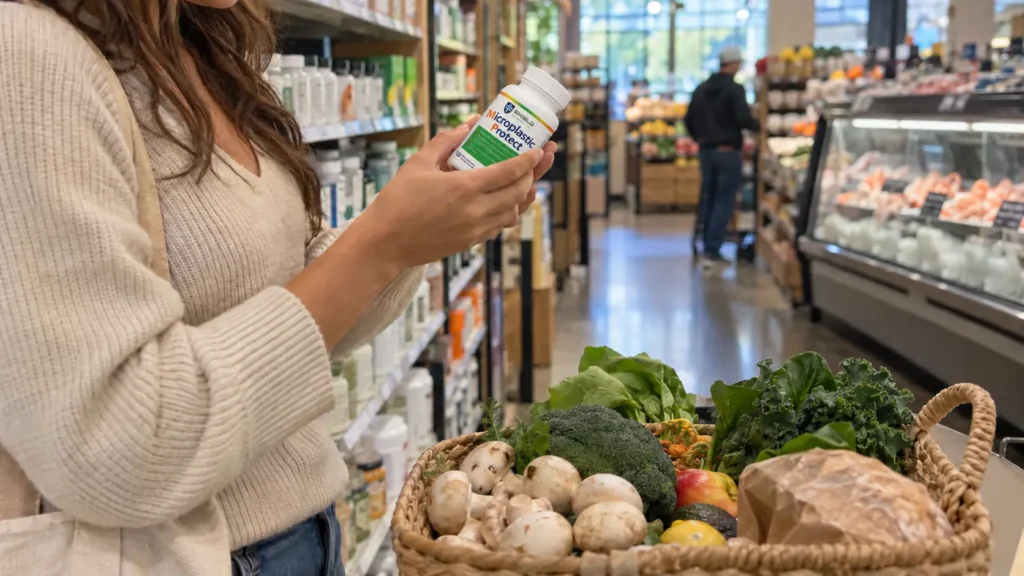
Mushroom-derived chitosan can be vegan, because its chitin comes from fungal cell walls rather than from shrimp, crab or other animals. It can also be shellfish-free when the manufacturer confirms that no shellfish-derived chitosan is used and that cross-contact is controlled. There is one important catch. A vegan ingredient does not automatically make a vegan supplement. The capsule shell, fillers, processing aids and manufacturing facility all have to be checked too. This guide explains how to verify each part, so you know what you are really buying. Key Takeaways Mushrooms are fungi, not animals, and chitosan made from fungal chitin does not need crustacean shells. Regular chitosan is often made from shellfish, so the word “chitosan” alone does not tell you whether a product is vegan. Shellfish allergy is linked mainly to proteins such as tropomyosin, which can remain as residue in shellfish-derived chitin and chitosan. Fungal chitin is reported to be free of it. “Mushroom-derived,” “shellfish-free,” “vegetarian” and “vegan” are four different claims. People with a mushroom allergy should not assume mushroom chitosan is suitable for them. Why Do People Associate Chitosan With Shellfish? For many years most commercial chitosan came from the shells of shrimp, crab and other crustaceans. Seafood processing creates large volumes of shell waste rich in chitin, and manufacturers convert that chitin into chitosan through deacetylation. Because of this, many consumers learned to link the word “chitosan” with shellfish. Chitin is not exclusive to crustaceans, though. It is also a structural part of fungal cell walls, which makes chitosan from mushrooms and other controlled fungal sources possible. A review of fungal chitosan production (Crognale et al., 2022) describes fungi as an alternative source and explains how cultivation and processing conditions shape the finished material. You can compare all origins on our types of chitosan page, including shellfish origin, vegetal origin and insect origin. Are Mushrooms Vegan if They Are Not Plants? Yes. Vegan does not mean “made only from plants.” Mushrooms belong to the kingdom Fungi, which is separate from both plants and animals. Vegan products can include ingredients from fungi, bacteria, algae and minerals as long as no animal-derived ingredients or conflicting practices are involved. The Vegan Society’s definition of veganism centers on avoiding animal exploitation and animal-derived products as far as possible and practicable. It does not limit vegan products to the plant kingdom, so a fungal source does not rule out a vegan chitosan. How Is Mushroom Chitosan Made? Mushroom chitosan is not dried culinary mushroom powder placed in a capsule. It starts with chitin-rich mushroom or fungal biomass, which is purified and then deacetylated. A simplified sequence looks like this: Select suitable mushroom biomass Clean, dry and prepare the material Remove proteins, glucans and other cell components Recover the chitin-rich fraction Deacetylate the chitin to produce chitosan Wash and purify the chitosan Dry and mill the finished material Test identity and specifications Research shows that chitin can be recovered from Agaricus bisporus, the common button mushroom, and used to produce fungal chitosan (Almeida et al., 2025). A 2025 Green Chemistry study compared isolation methods for white mushroom chitin and describes it as a renewable, hypoallergenic, non-animal alternative to crustacean chitin (Zannat et al., Green Chemistry). For more on the source and process, read about button mushroom-derived chitosan and our oyster mushroom chitosan page. The Ingredient Test: Is the Chitosan Itself Vegan? Start with one question: where did the original chitin come from? The answer should name the source clearly. Vegan-compatible sources Button mushrooms Other documented mushroom species Controlled fungal biomass Animal-derived sources Shrimp, crab or lobster shells Other crustacean materials Insect chitin A label that says only “chitosan” does not answer the question, and neither does “natural chitosan,” because both fungal and crustacean chitosan can be called natural. The source should be stated by the brand or confirmed in ingredient documentation. The Capsule Test: Where Vegan Claims Often Fail Even when the chitosan is entirely from mushrooms, the supplement may not be vegan. The capsule could be gelatin, which is made from animal collagen. Look for capsule materials such as: Hypromellose (HPMC) Vegetable cellulose Pullulan Other clearly documented non-animal materials Review the other ingredients as well, including coatings, colorants, lubricants, fillers and processing aids. A transparent label lets you verify the whole formula, not just the headline ingredient. The Shellfish-Free Test: Source Is Only the First Step If chitosan is produced from mushrooms, shellfish is not its original chitin source, which is the strongest starting point for a shellfish-free formula. A careful buyer should still verify three details. 1. Ingredient Identity Confirm the product contains only mushroom-derived chitosan, not a blend of fungal and shellfish chitosan. 2. Allergen Statement Read the “Contains” statement and any advisory language, such as “manufactured in a facility that also processes shellfish.” In the United States, crustacean shellfish is one of the major food allergens covered by federal labeling law, and labels must name the specific type such as shrimp, crab or lobster (FARE guide to food labels). 3. Cross-Contact Controls If the company handles shellfish-derived chitosan elsewhere, ask about separate equipment, validated cleaning procedures and allergen-control protocols. Why Fungal Chitosan Matters for Shellfish Allergy Shellfish allergy is generally triggered by proteins in the animal, not by the chitin polymer itself. Tropomyosin is the best-known crustacean allergen, and the UK Committee on Toxicity notes that tropomyosin has been detected in technical samples of chitin and chitosan derived from shellfish (UK COT position paper). A related COT document states that chitin and chitosan from algae or fungi are free of tropomyosin and that a reported allergic reaction to a chitosan supplement was most likely caused by shellfish residue in the source material (UK COT allergenicity paper). A review of chitin isolation from crustaceans and mushrooms likewise positions fungi as an emerging source of non-animal chitin (Zannat and Shamshina). That is why a verified mushroom source is meaningful for people avoiding shellfish. It still does not replace allergen documentation, and anyone with a serious diagnosed allergy should
What Is Button Mushroom-Derived Chitosan?
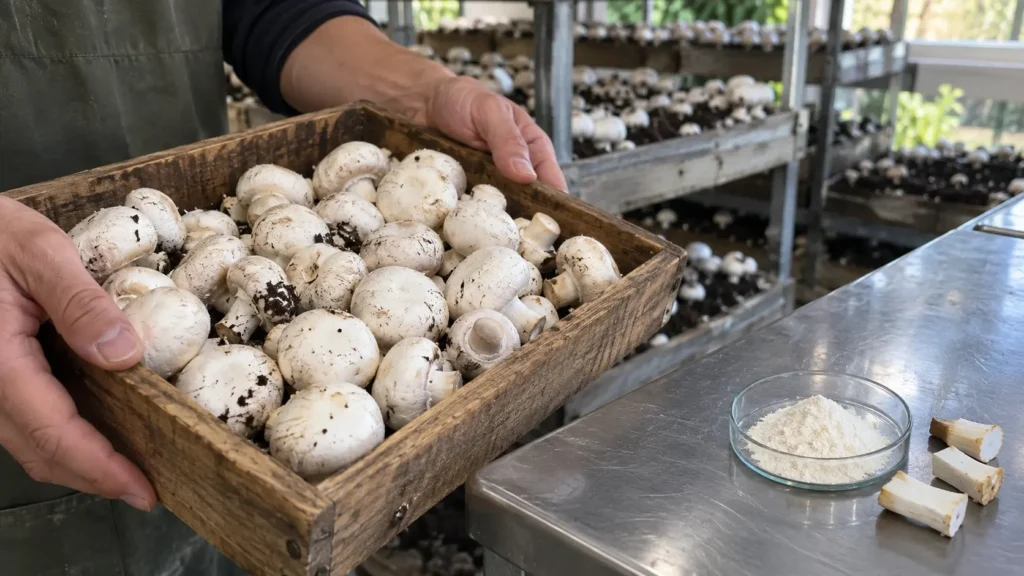
Button mushroom-derived chitosan is chitosan made from chitin in the cell walls of Agaricus bisporus, the common cultivated mushroom. It is not mushroom powder or a mushroom extract. It is a purified polymer produced by separating chitin from other cell-wall components and then deacetylating it. This guide covers how it is made, how it differs from shellfish-derived chitosan and from chitosan oligosaccharide, and what to check on a specification sheet. Where the Chitin Comes From Agaricus bisporus is sold as white button, cremini, or portobello mushrooms, depending on maturity. Like other fungi, it has a cell wall built from chitin and glucans. A study on chitin recovery from Agaricus bisporus summarizes earlier work in which the highest chitin yield came from the stipes, at about 7.4% of dry weight. Production residues can also serve as a starting material. See our overview of vegetal-origin chitosan. How Button Mushroom Chitosan Is Made Processes differ between producers, but published work describes a common sequence: Clean, dry, and grind the mushroom biomass. Separate minerals (demineralization) and proteins (deproteinization) from the chitin. Deacetylate the chitin with alkali to expose free amino groups. Wash, dry, and mill the chitosan into a powder. Test the result against a defined specification. Temperature, treatment time, and chemical concentration all affect degree of deacetylation, molecular weight, viscosity, and solubility. A study on fungal chitosan from Agaricus bisporus followed this demineralization, deproteinization, and deacetylation sequence and reported that the product differed from commercial chitosan in crystallinity, thermal stability, and morphology. Another team using microwave-assisted extraction on button mushroom waste reported chitosan yields of roughly 6% to 7%, and noted that quality depends on the method used (microwave extraction study). Why Specifications Vary Two batches called mushroom chitosan can differ a lot. In one study of fresh mushrooms and production residues, the highest degree of deacetylation reached was 69.5% under the conditions tested, and the authors optimized alkali concentration and treatment time to get there. Other methods report different values. Source is one input, and process is another, so the certificate of analysis for a specific lot is more informative than the species name alone. Chitosan, Chitin, and Mushroom Powder Chitin is the parent polymer, made mostly of N-acetylglucosamine units. Chitosan is what remains after enough acetyl groups are removed, which exposes amino groups. Those groups are also the source of its pH-dependent charge, covered in the positive charge of chitosan. Mushroom powder is whole dried mushroom and contains many other components. These are three different materials, and labels should say which one is meant. Does Appearance Say Anything About Quality? Purified mushroom chitosan usually looks like a pale off-white or cream powder, but color varies with purity, particle size, moisture, and processing. Appearance cannot confirm identity or purity, which need analytical testing. Mushroom Chitosan vs. Chitosan Oligosaccharide Mushroom-derived describes the source. Oligosaccharide describes size. Chitosan oligosaccharide (COS) is a shorter-chain, lower molecular weight form that can be made from chitosan of fungal or crustacean origin, and it is often more water-soluble than native chitosan. Native chitosan generally dissolves in dilute acid and is less soluble as pH rises. The two forms are not interchangeable, and neither is better for every purpose. Our guide to chitosan vs. chitosan oligosaccharide supplements compares them in detail. Mushroom vs. Shellfish Chitosan The clearest difference is the raw material. Shellfish chitosan usually starts with shrimp or crab shells, which are rich in minerals and protein, while mushroom chitosan starts with fungal cell walls that have a different composition and need a different extraction route. Finished ingredients can still differ in molecular weight, viscosity, deacetylation, mineral content, and batch consistency, and those depend on manufacturing as much as source. No source is universally better. See mushroom chitosan vs. shellfish chitosan supplements for a full comparison. Why Researchers Study Mushroom Sources Researchers describe fungal biomass as a renewable, non-animal source of chitosan, and mushroom production residues are being studied as starting material. These are sourcing points, not performance claims, and each ingredient still needs its own testing. Shellfish-Free and Vegetarian: What to Verify Mushroom-derived chitosan does not start from shrimp, crab, or other crustaceans, so it can be used in shellfish-free formulas. A finished product still needs checking: read the allergen statement, other ingredients, and manufacturing details. Vegetarian or vegan status depends on the whole formula, including the capsule shell. Anyone with a diagnosed food allergy should follow the label and ask a healthcare professional. See is mushroom chitosan vegan and shellfish-free. Does Source Change Results With Microplastics? The rat study on chitosan and polyethylene microplastics in Scientific Reports described chitosan made from shrimp and crab shell chitin and did not test a mushroom-derived form. Nothing in it shows that source changes the outcome either way. Read our analysis of chitosan and microplastic excretion and can chitosan bind microplastics in the digestive tract for the design and limits. What to Ask for on a Specification Useful details for any mushroom chitosan ingredient include: The species, such as Agaricus bisporus, rather than a vague fungal label. Degree of deacetylation and the method used to measure it. Molecular weight and form, such as native chitosan or oligosaccharide. What the purity figure refers to, the raw ingredient or the finished capsule. Allergen documentation and certificates of analysis. About Microplastic Protect Microplastic Protect is a dietary supplement made with a 99% pure chitosan oligosaccharide ingredient derived from button mushrooms (Agaricus bisporus). A serving is 2 capsules (1,200 mg), and a bottle holds 120 vegetarian capsules. The label directs 2 capsules about 15 minutes before your two largest meals, with water. Check the ingredients guide and how to take Microplastic Protect for details, and confirm the allergen statement on the label. Check with a healthcare professional first if you are pregnant, nursing, taking medication, or managing a medical condition. These statements have not been evaluated by the Food and Drug Administration. This product is not intended to diagnose, treat, cure, or prevent any disease. Frequently Asked Questions What is button mushroom chitosan