
Mushroom Chitosan vs Shellfish Chitosan Supplements
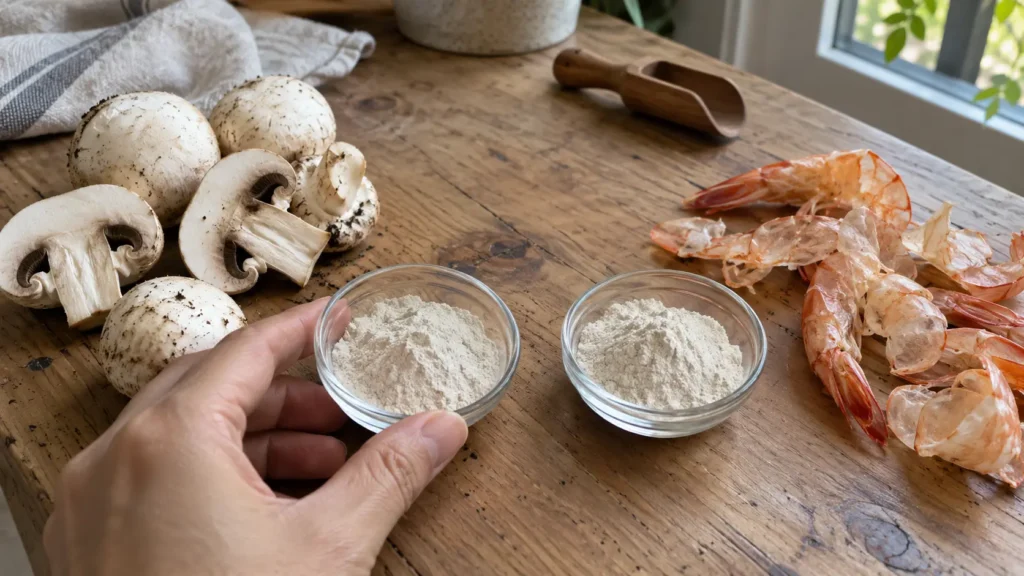
Mushroom chitosan and shellfish chitosan are the same type of polymer made from different raw materials. Mushroom (fungal) chitosan comes from the chitin in fungal cell walls, while shellfish chitosan comes from the chitin in shrimp, crab or lobster shells. The source affects allergen labeling, dietary suitability and supply, but purity, degree of deacetylation and molecular weight determine how a finished supplement actually behaves. This guide explains how the two sources differ, what the research says about shellfish allergy, how to read a supplement label, and what to know about safety and side effects before you buy. Quick answers Mushroom chitosan is a fungal, non-animal ingredient. Shellfish chitosan is an animal-derived marine ingredient. Both share the same basic chemistry: chains of glucosamine and N-acetylglucosamine units. Mushroom chitosan does not use shellfish as its source, which makes label review simpler for people who avoid shellfish. The finished product still needs to be checked. Neither source guarantees better performance. Product specifications matter more than origin. Chitosan can cause digestive side effects and may interact with some medicines, so speak with a healthcare professional first. In this article Quick comparison table What chitosan is and where it comes from What mushroom chitosan is What shellfish chitosan is Are the two chemically the same Shellfish allergy and chitosan Is mushroom chitosan vegan Positive charge and degree of deacetylation Molecular weight and viscosity Sustainability Safety, side effects and interactions Chitosan oligosaccharide How to choose a chitosan supplement Where Microplastic Protect fits Frequently asked questions Mushroom vs Shellfish Chitosan: Quick Comparison Feature Mushroom (Fungal) Chitosan Shellfish Chitosan Raw material Fungal cell walls, such as button or oyster mushrooms Shrimp, crab, lobster or other crustacean shells Source category Fungal, non-animal Animal-derived, marine by-product Shellfish-free sourcing Yes, when the supplier verifies it No Vegan-compatible ingredient Yes, if the full formula and capsule also qualify No Availability Less common, growing Widely available Supply pattern Controlled cultivation, year-round Linked to seafood processing waste Molecular weight and DDA Depend on species and processing Depend on species and processing Positive charge Depends on DDA, pH and specifications Depends on DDA, pH and specifications These are general distinctions. Any individual ingredient should be judged by its certificate of analysis and finished-product documentation. What Is Chitosan and Where Does It Come From? Chitosan is a polysaccharide made by removing acetyl groups from chitin, a structural polymer found in crustacean shells, insect exoskeletons and fungal cell walls. The removal step is called deacetylation. It exposes free amino groups, which give chitosan its useful chemical behavior. Chitin is the raw material, and chitosan is the processed result. That is why a chitosan ingredient can be traced to different biological sources. Our guide to the types of chitosan covers the full family, including chitosan hydrochloride and carboxymethyl chitosan. What Is Mushroom Chitosan? Mushroom chitosan is produced from chitin in fungal cell walls. In fungi, chitin is bound up with other components such as glucans and proteins, so it has to be separated and purified before it can be converted to chitosan. Production generally follows these steps: Prepare the fungal or mushroom biomass Separate the chitin-containing material Remove unwanted cell components Deacetylate the chitin to form chitosan Purify and dry the ingredient Test it against its specification Common sources include the white button mushroom (Agaricus bisporus) and the oyster mushroom (Pleurotus ostreatus). You will also see the term fungal chitosan, which is broader because it can come from fungi that are not edible mushrooms, such as Aspergillus niger. Read more about how button mushroom-derived chitosan is made and about our vegetal-origin chitosan, including oyster mushroom chitosan. Researchers are studying fungi as an alternative to crustacean shells. A review of fungal chitosan production notes that controlled cultivation can reduce dependence on seasonal shellfish supply and give more control over production conditions (Crognale et al., 2022). A separate review from Texas Tech University describes mushrooms as an emerging non-animal chitin source that is free of allergenic proteins and can be cultivated year-round, while stressing that mushroom chitin needs standardized, quantitative characterization (Zannat and Shamshina). What Is Shellfish Chitosan? Shellfish chitosan is made from the shells of shrimp, crab or other crustaceans, which are plentiful as seafood-industry by-products. Shells contain chitin along with minerals, proteins and pigments, so processing is more extensive: Demineralization to remove calcium carbonate Deproteinization to remove protein Decolorization when required Deacetylation Washing and purification Drying and milling It remains the most common commercial source because the supply chain is established and many technical, food, cosmetic and research grades exist. You can browse our shellfish-origin chitosan and shrimp, crab and lobster chitosan pages for specifications. People who avoid shellfish or animal-derived ingredients should check the source before choosing a supplement. Are Mushroom and Shellfish Chitosan Chemically the Same? Both are chains of glucosamine and N-acetylglucosamine units, so they belong to the same polymer family. Data submitted in a food-additive application to Food Standards Australia New Zealand reported that the chitosan portion of a mushroom-derived product was chemically equivalent to crustacean chitosan and to the United States Pharmacopeia chitosan reference standard (FSANZ application A1315 supporting document). That is applicant data, not an independent ruling, but it supports the idea that source does not create a different molecule. Finished materials can still differ in physical properties. A direct comparison of fungal and crustacean samples found differences in molecular weight, viscosity and degree of deacetylation between the specific samples tested (Żukiewicz-Sobczak et al.). Those results describe particular batches, not every fungal or shellfish product. Differences between any two chitosan ingredients usually come from: Raw-material species and natural variation Molecular-weight distribution Degree of deacetylation and the pattern of acetylation Extraction and purification methods Particle size, moisture and ash content Residual protein or mineral content Shellfish Allergy and Chitosan This is the question most buyers care about, and the evidence needs careful wording. Shellfish allergy is generally a reaction to proteins in the flesh, with tropomyosin being the major allergen, rather than to the chitin polymer itself. A review in Marine Drugs
Chitosan vs Chitosan Oligosaccharide: Key Differences for Supplements and Formulators
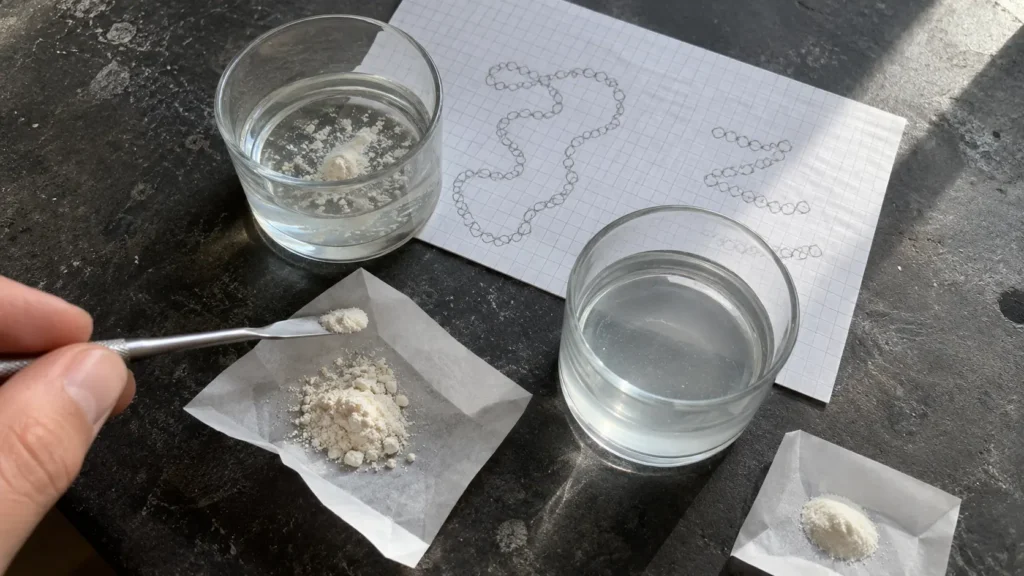
The main difference between chitosan and chitosan oligosaccharide (COS) is chain length. Chitosan is a long polymer made by deacetylating chitin, while COS is made by breaking chitosan into much shorter fragments. That size gap changes water solubility, viscosity, molecular mobility and how each ingredient behaves in a supplement. COS is often marketed as the more soluble form, and that is usually true. But better solubility does not make it the better choice for every purpose. This guide compares the two forms on structure, solubility, charge, adsorption, safety and label quality, so consumers and formulators can judge which one suits a given application. Key Takeaways Chitosan has long polymer chains; COS has short chains, commonly defined as under about 3.9 kDa and fewer than 20 sugar units. COS is generally more water-soluble and less viscous. Native chitosan typically needs mildly acidic conditions to dissolve. Both carry amino groups that can become positively charged, so shorter chains do not automatically mean stronger charge. “Low molecular weight chitosan” and “chitosan oligosaccharide” are not the same thing. Neither form is universally better. Source, purity, degree of deacetylation and molecular weight range matter more than the name on the label. Chitosan vs Chitosan Oligosaccharide: Comparison Table Feature Chitosan Chitosan Oligosaccharide (COS) How it is made Deacetylation of chitin Hydrolysis (enzymatic, chemical or physical) of chitosan Molecular structure Long polymer chains Short chains or oligomers Molecular weight Considerably higher; varies by grade Commonly defined as under about 3.9 kDa; some sources cite up to 10 kDa Water solubility Often limited at neutral pH; dissolves in dilute acid Generally water-soluble across a broader pH range Viscosity Typically higher Typically lower Polymer bridging Longer chains may support bridging Short chains provide less extensive bridging Molecular mobility Lower Usually higher Charge Depends on amino-group protonation and pH Also depends on amino groups, pH and formulation Best choice Depends on the intended application Depends on the intended application These are general differences. Actual performance depends on molecular-weight distribution, degree of deacetylation, purity, pH and manufacturing specifications. What Is Chitosan? Chitosan is a natural polysaccharide produced by deacetylating chitin, which occurs in crustacean shells, fungal cell walls and certain insects. Chemically, chitin is the highly acetylated form (above roughly 70% acetylation) and chitosan is the mostly deacetylated form (below roughly 30%), according to a review of chitosan and chito-oligosaccharides in Frontiers in Physiology. Deacetylation exposes free amino groups along the chain. In acidic conditions these groups become protonated and positively charged, which lets chitosan interact with negatively charged molecules and surfaces. Its long chains can also connect several particles at once, a process called polymer bridging. Chitosan behavior is influenced by: Molecular weight Degree of deacetylation Source and purity Particle size pH and ionic strength Viscosity Manufacturing method A scientific overview reports that chitosan solubility is shaped by molecular weight, degree of acetylation, pH, temperature and polymer crystallinity (Aranaz et al., 2021). You can see the grades we supply on our chitosan product page and in our overview of the types of chitosan. What Is Chitosan Oligosaccharide (COS)? Chitosan oligosaccharide, also called chito-oligosaccharide or chitosan oligomer, is produced by cutting chitosan chains into short fragments. One widely cited definition describes COS as chitosan with an average molecular weight under 3.9 kDa and fewer than 20 monomer units per chain. Other sources use broader ranges, so a specification sheet matters more than the name. Because the chains are short, COS usually offers: Lower molecular weight Lower viscosity Greater water solubility Greater molecular mobility Different adsorption and biological behavior Researchers describe COS as a way around chitosan’s poor solubility, which is why it is common in plant-science work as well as supplements (Frontiers in Plant Science). Still, COS is not one uniform material. Commercial products differ in chain length, degree of deacetylation, salt form and purity, so the term alone cannot predict how a finished supplement will perform. Our chitosan oligosaccharide page lists the specifications we provide. How Is COS Made From Chitosan? COS is a downstream product. Manufacturers start with chitosan and shorten the chains using enzymes, acids or physical methods. Each route produces a different distribution of chain lengths, which is one reason two products both labelled COS can behave differently. If the chitosan used as raw material has a different source or degree of deacetylation, the COS made from it will differ as well. Molecular Weight: The Central Difference Molecular weight is the most important variable when comparing chitosan and COS. Native chitosan’s longer chains may provide: More extensive polymer-chain interactions Higher viscosity Greater potential for bridging between compatible particles Different retention and movement within a formulation COS’s shorter chains may provide: Faster dispersion in water Lower viscosity Greater mobility in solution Easier use in certain liquid formulations Neither profile is universally better. The right chain length depends on what the ingredient is expected to do. Which Form Is More Water-Soluble? COS is generally more water-soluble than native chitosan. Unmodified chitosan dissolves most readily in dilute acid, because its amino groups gain protons as pH falls and the added charge helps it dissolve. As pH rises above chitosan’s apparent pKa, commonly reported around 6.3 to 6.5, fewer amino groups stay protonated and solubility can drop. COS has shorter chains and less entanglement, so many COS materials dissolve across a wider range of aqueous conditions. Solubility should not be confused with adsorption capacity, though. An ingredient that dissolves easily is not automatically better at interacting with every particle or surface. For chitosan that has been converted into a salt to improve solubility, see our chitosan hydrochloride page. How Do Their Positive Charges Compare? Both forms contain amino groups that can become positively charged. The actual charge depends on: Environmental pH Degree of deacetylation Distribution of amino groups Molecular weight Acid or counterion used Salt concentration Chemical modifications Measurement conditions A shorter chain does not guarantee a stronger positive charge, and a higher molecular weight does not prove a material is more highly charged. To evaluate charge properly, ask suppliers
How Does the Positive Charge of Chitosan Work?
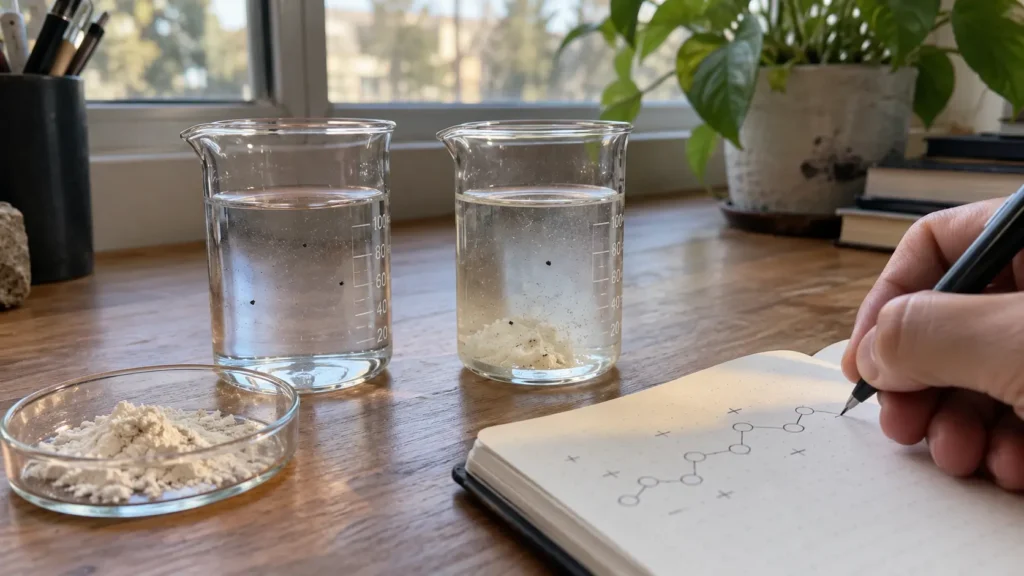
Chitosan carries a positive charge because its chain contains amino groups that pick up hydrogen ions in acidic conditions. That charge is not fixed. It rises and falls with pH, and it also depends on degree of deacetylation, molecular weight, and the surrounding medium. This guide explains the chemistry step by step, shows where charge matters in adsorption, and is clear about what charge alone cannot tell us, especially for microplastics. What Gives Chitosan Its Positive Charge? Chitosan is made by deacetylating chitin, which removes acetyl groups and exposes primary amino groups (–NH₂) along the polymer chain. In acidic conditions, many of these groups accept a hydrogen ion and become –NH₃⁺. Written out, the step is –NH₂ + H⁺ → –NH₃⁺. Because many charged groups sit along one chain, chitosan behaves as a polycation, a polymer with many positive sites. A review of chitosan chemistry by Aranaz and colleagues describes how protonation of these amino groups shapes charge, solubility, and interactions with other materials. How Chitosan Differs From Chitin Chitin has a high share of acetylated groups, which do not pick up hydrogen ions the way free amino groups do. Deacetylation increases the number of free amino groups, so chitosan generally has more charge potential than chitin. How extensively and evenly the chitin was deacetylated shapes the result. How pH and pKa Control the Charge The amino groups of chitosan have a pKa of roughly 6.3 to 6.5, according to reviews of chitosan properties, though the exact value shifts with the material and the measurement. Below that pH, more groups are protonated, so chitosan carries more positive charge and dissolves more readily. Above it, groups lose their hydrogen ions, and unmodified chitosan becomes less charged and less soluble. This matters in the body because acidity changes along the digestive tract. The stomach is acidic, while the small intestine is closer to neutral. The authors of the rat study discussed in our excretion study analysis note that chitosan dissolves in gastric juice and becomes positively charged, but charge state further along the tract depends on conditions and formulation. Deacetylation, Molecular Weight, and Other Variables The degree of deacetylation (DDA) is the share of acetyl groups removed from chitin. A higher DDA generally means more free amino groups available to become charged. DDA alone does not decide behavior, though, because molecular weight, purity, and formulation also matter. Other variables that change measured charge include: Molecular weight, which affects chain length and bridging. Ionic strength, since dissolved salts can screen charge. The acid or counterion used to dissolve or formulate it. Chemical modification, which can change charge behavior across pH. Chitosan oligosaccharide, made of shorter chains, is often more water-soluble than native chitosan, but the two are not interchangeable. Compare them in chitosan vs. chitosan oligosaccharide supplements. How Charge Is Measured and Reported Charge is reported in several ways. Zeta potential describes the electrical potential near a particle’s surface in a specific medium. Titration estimates how many amino groups are protonated at a given pH. Electrophoretic mobility tracks how particles move in an electric field. Each method answers a slightly different question, and each result depends on pH, salt content, and concentration. When you compare products or studies, look for the pH, medium, and method behind any charge figure, and treat numbers without that context with caution. How Charge Shows Up in Adsorption Charge is one part of how chitosan interacts with other materials. Common mechanisms include: Electrostatic attraction to negatively charged surfaces. Charge neutralization, which lowers repulsion between particles. Polymer bridging, where one chain links several particles. Hydrogen bonding through hydroxyl and amino groups. Hydrophobic and other non-electrostatic interactions. A review of chitosan composites notes that chitosan can neutralize and flocculate negatively charged suspended particles, which is why it is studied in water treatment. Charge is important, but it does not guarantee binding under every condition. What Charge Means for Microplastics Some microplastic surfaces pick up negative character through weathering, oxidation, or coatings, so an attraction to positively charged chitosan is plausible in some conditions. Microplastics vary widely, though, by polymer type, size, shape, additives, and surrounding chemistry. The rat study on chitosan and polyethylene microplastics, published in Scientific Reports, is a useful example of that caution. Its authors noted that polyethylene is nonpolar, so the effect of charge is likely small in that experiment, and they called for more work on the mechanism. Read how the study was built in our analysis of chitosan and microplastic excretion, and the wider question in can chitosan bind microplastics in the digestive tract. Does the Source Change the Charge? Chitosan is a family of materials, not one identical substance. Whether it comes from mushrooms, shellfish, or insects does not by itself show that one material carries a stronger charge. That needs analytical testing under stated conditions. For sourcing differences, see mushroom vs. shellfish chitosan and is mushroom chitosan vegan and shellfish-free. Questions to Ask About a Chitosan Specification When reviewing a chitosan supplement or raw material, useful questions include: What is the degree of deacetylation, and how was it measured? What are the molecular weight and form, such as native chitosan or oligosaccharide? What does a stated purity figure refer to: the raw ingredient or the finished capsule? Is any charge data given with its pH, medium, and method? Are certificates of analysis available? About Microplastic Protect Microplastic Protect is a dietary supplement made with a 99% pure chitosan oligosaccharide ingredient derived from button mushrooms. This article describes general chitosan chemistry and does not report charge measurements for the finished product. Review the ingredients guide and how to take Microplastic Protect for label details. Check with a healthcare professional first if you are pregnant, nursing, taking medication, or managing a medical condition. These statements have not been evaluated by the Food and Drug Administration. This product is not intended to diagnose, treat, cure, or prevent any disease. Frequently Asked Questions Why is chitosan positively charged? Its free amino groups accept hydrogen ions in
Chitosan and Microplastic Excretion: What Does the Research Show?

A study in Scientific Reports by Di Liu and Muneshige Shimizu of Tokai University compared four indigestible dietary materials in rats that were also fed polyethylene microplastics. Only the chitosan group showed a significant difference from controls in fecal excretion and in particles left in the gut. The result is interesting, and it comes from a small, short animal experiment. This guide walks through the design, the numbers, the reason one rate exceeded 100%, and what the authors say about mechanism. It also lists what the study cannot tell us. Why Researchers Looked at Excretion The authors wanted to know how long ingested microplastics stay in the digestive tract and whether common dietary materials change that. They report that in control rats, particles lingered in the gut, mainly the cecum, for the week studied, and that they knew of no earlier published work on this question at the time of writing. Their reasoning is that prolonged presence of particles in the gut may matter for gut health, an area they describe as needing more research. How the Study Was Designed The team used 30 Sprague-Dawley rats split into five groups of six: a control group, plus groups receiving indigestible dextrin, lactosucrose, chitosan, or eggshell membrane protein. All animals ate a standard AIN-93M laboratory diet containing blue, spherical polyethylene particles averaging 200 micrometers, about 3,300 particles per rat per day. Dextrin, lactosucrose, and chitosan each replaced 5% of the corn starch, while eggshell membrane protein replaced 5% of the protein. Rats lived in metabolism cages for one week, and researchers counted particles in feces and in the digestive tract. The paper describes its chitosan as an insoluble fiber made from shrimp and crab shell chitin. What the Researchers Found The chitosan group produced more feces from the first day. Fecal excretion of particles was higher throughout: 39.6% versus 14.8% in the first 24 hours, and 115.6% versus 83.7% across 144 hours. At dissection, 6.1% of ingested particles remained in the chitosan group’s digestive tract, compared with 12.1% in controls. Group Fecal excretion rate, 0–144 h Left in digestive tract Control 83.7% ± 3.8% 12.1% ± 0.5% Chitosan 115.6% ± 4.5% 6.1% ± 0.5% Dextrin, lactosucrose, or eggshell membrane protein Not significantly different from control Not significantly different from control The other three materials did not differ significantly from the control on either particle measure, so chitosan was the only material tested that stood apart on particle counts. Eggshell membrane protein also increased fecal weight from the second day, but its particle counts did not differ significantly from controls. Read the full paper on Nature or PubMed, and a summary at News-Medical. Why One Rate Exceeded 100% A fecal excretion rate above 100% cannot describe a literal outcome. The authors explain that they could not analyze the whole fecal sample, so counts came from portions of it, and they call for better sample volume and pre-treatment methods. The paper reports totals of fecal excretion plus gut retention of 121.7% for chitosan and 95.8% for controls, so the counts are best treated as estimates. Read the figure as a comparison between groups, not an exact percentage. What the Authors Say About Mechanism The paper does not directly observe binding. It counts particles, then proposes that chitosan interacts with other gut components. The authors point to earlier work in which high-molecular-weight chitosan formed gel aggregates with oil and bile salts, and they note that chitosan becomes positively charged in gastric juice. They also caution that polyethylene is nonpolar, so the effect of charge is likely small, and they call for more study of the mechanism across plastic types and sizes. For general background on chitosan’s charge, see our guide to the positive charge of chitosan, and for the wider question, read can chitosan bind microplastics in the digestive tract. What the Study Does Not Answer Several limits apply before any result is applied to people: It was a one-week experiment with six rats per group. It tested one plastic type, polyethylene, in one size and shape. It did not test Microplastic Protect or any mushroom-derived chitosan oligosaccharide. It did not test other particle sizes or plastics already in tissue. It measured particle counts, not clinical outcomes, and it did not set a human dose. Animal studies suggest questions for future research; they do not set doses or outcomes for people, which is why human studies would be needed to answer them. For broader context, read what we actually know about microplastics and human health and where microplastics actually go. Where Microplastic Exposure Comes From The paper’s introduction notes microplastics in table salt, beer, and mineral water, among other foods. Exposure comes from many everyday sources, which is why reducing intake is a practical first step for anyone concerned. Our guides on microplastics in food and water and ways to reduce exposure during meals cover the main routes. About Microplastic Protect Microplastic Protect is a dietary supplement made with a 99% pure chitosan oligosaccharide ingredient derived from button mushrooms. A serving is 2 capsules (1,200 mg), and a bottle holds 120 vegetarian capsules. The label directs 2 capsules about 15 minutes before your two largest meals, with water. Compare forms in chitosan vs. chitosan oligosaccharide supplements and mushroom vs. shellfish chitosan, or review the ingredients guide and how to take Microplastic Protect. It was not part of the study described here. Check with a healthcare professional first if you are pregnant, nursing, taking medication, or managing a medical condition. These statements have not been evaluated by the Food and Drug Administration. This product is not intended to diagnose, treat, cure, or prevent any disease. Frequently Asked Questions What is chitosan microplastic excretion? It refers to the amount of ingested microplastic particles found in feces, measured in this rat study when chitosan was added to the diet. It describes a measured outcome in animals, not an established effect in people. What did the chitosan microplastic study find? Rats fed chitosan had higher fecal weight, a
Can Chitosan Bind Microplastics in the Digestive Tract?
Can chitosan bind microplastics once they are in the digestive tract? Early research points to a possible interaction, but the evidence is limited. A study in Scientific Reports found that rats fed chitosan alongside polyethylene microplastics excreted more of those particles in their feces than rats fed a control diet. Human evidence is still lacking. This guide explains what the study measured, what it did not, why chitosan’s chemistry makes the idea plausible, and where everyday exposure comes from. Every claim is tied to published research or to the product label. What Is Chitosan, and Why Does Its Charge Matter? Chitosan is a polysaccharide made by deacetylating chitin, the structural material in crustacean shells, insect exoskeletons, and fungal cell walls. Deacetylation exposes amino groups along the chain, and in acidic conditions these groups pick up a positive charge. That charge is why chitosan is also used in water treatment to gather suspended particles. Microplastics often carry negatively charged surfaces, particularly after weathering, and opposite charges attract. The study authors note that chitosan dissolves in gastric juice and becomes positively charged, and they suggest it may bind components of the gut and carry particles out with the feces. That remains a hypothesis, not a confirmed human outcome. Our guide to the positive charge of chitosan covers the chemistry in more detail. What the Rat Study Found The study, by Di Liu and Muneshige Shimizu at Tokai University in Japan, appeared in Scientific Reports. Researchers mixed polyethylene microplastics averaging 200 micrometers into rat feed alongside one of four indigestible materials: indigestible dextrin, lactosucrose, eggshell membrane proteins, or chitosan. Among the four, chitosan was the one the authors highlighted for these effects. The chitosan group showed higher fecal weight, a higher microplastic excretion rate, and lower microplastic retention in the intestine. Over the first 144 hours, the authors reported excretion rates of 83.7% in the control group and 115.6% in the chitosan group. Because a rate above 100% needs context, check the paper’s methods before quoting these figures. For a closer reading, see our analysis of the chitosan microplastic excretion study, the full paper on Nature or PubMed Central, and the summary from News-Medical. What the Study Does Not Show The findings are useful, and they have clear limits: It was an animal study, and results in rats may not carry over to people. It tested one plastic type, polyethylene, at one particle size. Particles were mixed into feed, so it did not test plastics already in blood, organs, or other tissue. It did not establish a human dose or long-term safety. It did not test Microplastic Protect or any finished supplement. Any claim that a supplement cleans tissues or the whole body goes beyond this evidence. For wider context, read what we actually know about microplastics and human health. Does the Type of Chitosan Matter? Chitosan varies by source (shellfish, fungal, or insect), molecular weight, degree of deacetylation, and form. Chitosan oligosaccharide, for example, is a shorter-chain, lower molecular weight form than conventional chitosan. Results from one form should not be assumed for another, which is why we compare them openly in chitosan vs. chitosan oligosaccharide supplements and mushroom vs. shellfish chitosan. Source is a separate question from binding. Mushroom-derived chitosan is shellfish-free and vegetarian-friendly, as explained in is mushroom chitosan vegan and shellfish-free, but source alone does not tell you how a form behaves in the gut. Dose matters too. The study fed chitosan mixed into feed, and an animal dose cannot be converted directly to a person, so label directions, not extrapolation from rat data, should guide use. How to Evaluate Microplastic Supplement Claims Interest in this topic has produced plenty of marketing, so it helps to ask a few questions before you buy any product: Was the ingredient tested in humans, or only in animals or laboratory conditions? Is the form in the research the same as the form in the product? Does the brand link to the original study rather than only to news coverage? Does the label list the amount per serving, the source, and clear directions? Apply the same questions to every product, including ours. Where Microplastic Exposure Comes From Microplastics are plastic fragments 5 millimeters or smaller. People encounter them through food, drinking water, and packaging, so reducing intake is a sensible, low-risk place to start, whatever supplement you consider. Practical steps include avoiding heating food in plastic containers, comparing your drinking water options in bottled water vs. tap water, and learning the main routes in microplastics in food and water and how to reduce microplastic exposure during meals. About Microplastic Protect Microplastic Protect is a dietary supplement made with a 99% pure chitosan oligosaccharide ingredient derived from button mushrooms (Agaricus bisporus). Each 2-capsule serving contains 1,200 mg, and each bottle holds 120 vegetarian capsules, about a 30-day supply. The label directs you to take 2 capsules about 15 minutes before your two largest meals, with water. Read the ingredients guide and the how-to-take guide before you start. Microplastic Protect was not tested in the study described above. Check with a healthcare professional first if you are pregnant, nursing, taking medication, or managing a medical condition. These statements have not been evaluated by the Food and Drug Administration. This product is not intended to diagnose, treat, cure, or prevent any disease. Frequently Asked Questions Can chitosan bind microplastics? In a rat study, chitosan increased the fecal excretion of polyethylene microplastics, and the authors suggest binding in the gut as a possible explanation. Human evidence is still needed. What did the chitosan microplastics study find? Rats fed chitosan with polyethylene microplastics showed higher fecal weight, higher excretion of the particles, and lower intestinal retention than controls. It was a short animal study, not a human trial. Does chitosan remove microplastics from the body? The evidence does not show that. The rat research followed particles passing through the digestive tract, not plastics already stored in blood or tissue. Does chitosan bind every type of plastic? Not