
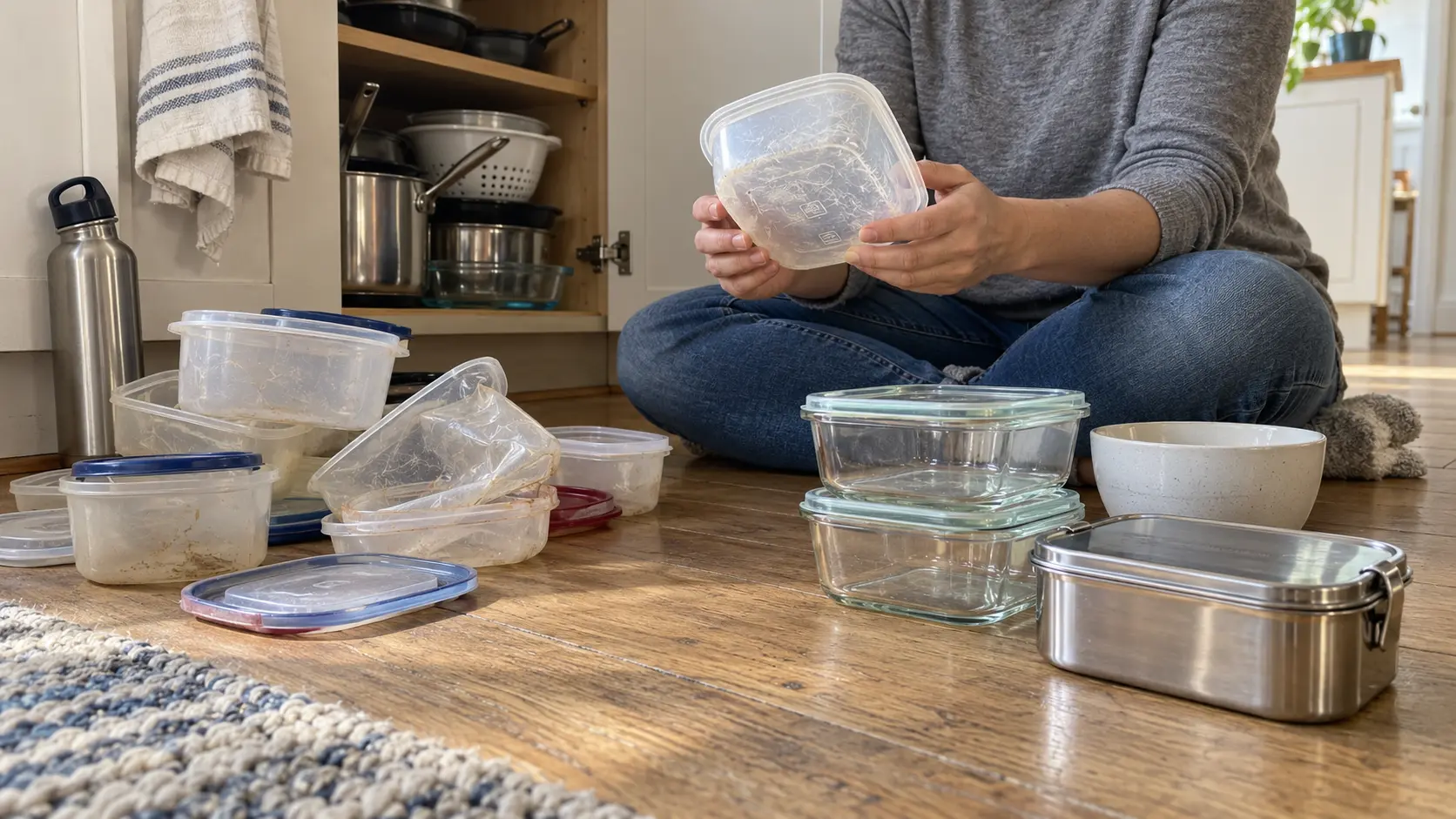
To reduce microplastic exposure during meals, focus on the contact points you can change easily: avoid heating food in plastic, replace worn containers and cutting boards, serve and store food in glass, ceramic or steel, and choose your drinking water and hot drinks with care. No kitchen can be plastic-free, and current evidence does not show that the levels found in food cause harm, so the aim is fewer avoidable contacts, not perfection or fear.
This guide follows a normal dinner from takeaway container to leftovers, explains what the research actually shows at each step, and gives you a simple way to decide which habits are worth keeping.
Quick answers
- Do not routinely heat food in disposable plastic. Move it to glass or ceramic first.
- Replace scratched, warped or cloudy plastic containers and heavily scored plastic cutting boards.
- Neither bottled nor tap water is automatically cleaner. Avoid leaving plastic bottles in heat.
- Choose glass, ceramic or stainless steel for serving and storing leftovers.
- Do not skip nutritious food or hydration out of fear. FDA says current evidence does not show a health risk from the levels found in foods.
In this article
- Why meals are a useful place to start
- Takeaway containers
- Choosing the right container
- The microwave shortcut
- Cutting boards and prep
- What you drink with dinner, including tea bags
- Serving the meal
- Leftovers
- The traffic-light method
- What not to do
- Where Microplastic Protect fits
- A seven-day kitchen reset
- Frequently asked questions
Why Start With Meals?
Microplastics in food and drink come mainly from environmental contamination, according to the U.S. Food and Drug Administration, which also says there is not yet sufficient evidence that plastic packaging releases them into food or drink. FDA adds that the levels found in foods have not been shown to pose a health risk, and that many detection methods are of limited accuracy (FDA on microplastics and nanoplastics in foods).
That leaves a practical question. If you cannot remove the environmental share, which contact points in your own kitchen are easy and low-cost to change? Meals are a good place to look because they involve heat, friction, packaging and repeated daily habits. For the wider picture, read our guide to microplastics in food and water.
Takeaway Containers: Move Hot Food Out
Hot takeaway food often sits in disposable plastic for the whole journey home. Transferring it to a ceramic or glass dish when you get in removes one avoidable stretch of contact between hot food and plastic. It costs nothing and takes a minute.
Keep in mind that results from one laboratory container setup should not be treated as a rule for every container, food and temperature.
Match the Container to Its Job
Some containers look reusable but were not designed for repeated heating or washing, such as thin yogurt tubs, ice cream tubs and takeaway boxes. Before reusing a plastic container, check:
- Whether the label says it is intended for reheating or reuse
- Whether the maker states a temperature limit
- Whether it is scratched, cloudy, warped or stained
- Whether it has been through many high-heat dishwasher cycles
Replace damaged containers first. Our guide to heating food in plastic and microplastic exposure covers this in more depth.
The Microwave Shortcut
Microwaving food in plastic is the habit with the strongest laboratory signal. Researchers at the University of Nebraska-Lincoln microwaved two FDA-approved baby food containers, one polypropylene and one polyethylene pouch, filled with water or dilute acetic acid for three minutes at full power. They reported releases of more than two billion nanoplastic particles and four million microplastic particles per square centimeter of container, with amounts varying by container and liquid (news summary of the Environmental Science & Technology study).
Read this result with care. The test used water and acetic acid, not real meals, and the health effects of swallowing these particles are unclear. It does, however, support a simple precaution:
- Heat food in glass or ceramic with a loose lid or plate cover
- Keep plastic wrap from touching food
- Do not microwave takeaway containers, old tubs or warped plastic
- Use microwave-safe labels as a minimum, not a guarantee of zero release
Cutting Boards and Food Prep
Preparation surfaces are easy to overlook. A 2023 study in Environmental Science & Technology from North Dakota State University had people chop on polyethylene, polypropylene and wooden boards. The authors estimated that cutting boards could contribute millions of microplastic particles a year, with polypropylene boards shedding more than polyethylene in their model, though the figures depend heavily on chopping force, food and board wear (summary of the study by Snopes).
The study was small, and preliminary tests on mouse cells showed no significant toxicity over 72 hours. Wooden boards also shed particles, mostly wood. So the sensible takeaway is modest:
- Retire plastic boards that are deeply scored or fuzzy
- Use a lighter touch when chopping on plastic
- Keep a good wooden, bamboo or composite board for produce and bread
- Wash boards gently and let them dry fully
What Are You Drinking With Dinner?
Microplastics have been reported in both bottled and tap water, so neither is automatically cleaner. Our comparison of microplastics in bottled water vs tap water goes through the evidence. Practical points:
- Do not leave plastic bottles in hot cars or direct sun
- Do not reuse disposable bottles indefinitely
- Use a clean stainless steel or glass bottle if you want to reduce plastic contact
- Stay well hydrated, since hydration matters more than any microplastic worry
Tea bags
A 2019 McGill University study tested four commercial teas packaged in plastic bags and reported that a single bag released billions of micro- and nanoplastic particles at brewing temperature (FoodNavigator summary). The tea industry noted that the study covered nylon and PET bags only and that most bags in Canada are paper. If you want to avoid the question, use loose-leaf tea with a steel infuser or choose paper bags without plastic mesh.
When the Meal Reaches the Table
Serving food on ceramic, glass or stainless steel avoids unnecessary plastic contact, especially for hot meals. Switching plates is not a proven way to remove a measurable amount of microplastics from your diet, and the World Health Organization points to real uncertainty about human exposure and effects (WHO assessment of dietary and inhalation exposure to nano- and microplastics). It is simply a cheap habit that reduces contact where you can control it.
Leftovers Need a Landing Place
Move leftovers from takeaway packaging into clean glass, stainless steel or intact food-grade containers. Do not leave food out at room temperature to avoid plastic, since food safety always comes first.
The Traffic-Light Method for Meal Decisions
Use this method to sort habits so you do not try to change everything at once.
Green: Easy, low-disruption changes
- Serve in ceramic, glass or steel
- Transfer takeaway food before reheating
- Replace visibly damaged plastic
- Store leftovers in glass or steel
Yellow: Check these first
- Reheating food in plastic labeled microwave-safe
- Washing thin disposable containers repeatedly
- Using plastic tea bags
- Using an old, heavily scored plastic cutting board
Red: Avoid these
- Heating food in damaged or warped plastic
- Microwaving takeaway containers
- Letting fear of microplastics affect hydration or nutrition
What Not to Do
Do Not Label Individual Foods as “Toxic”
Detecting particles in a sample does not establish harm from ordinary servings.
Do Not Assume “Plastic-Free” Means Risk-Free
Alternative materials have their own manufacturing and safety considerations.
Do Not Wash Food With Household Chemicals
Soap, bleach and cleaners should not be used on produce unless a product is specifically approved for it. Rinse produce with plain water.
Do Not Stop Eating Nutritious Foods
Vegetables, fruit, whole grains and seafood remain part of a healthy diet.
Do Not Trust Guaranteed “Detox” Claims
No routine, food or product can guarantee removal of accumulated particles from the body.
Where Does Microplastic Protect Fit?
Habits come first, and a supplement is a separate category. Chitosan Global’s Microplastic Protect supplement contains 99% pure chitosan derived from button mushrooms, a shellfish-free source. See what is inside the Microplastic Protect formula and how to take Microplastic Protect with meals for ingredients and directions.
To understand the science, read whether chitosan can bind microplastics in the digestive tract and our review of chitosan and microplastic excretion research. Research in humans is still developing. The supplement is not a substitute for the habits above and is not intended to diagnose, treat, cure or prevent any disease. If you are pregnant, nursing, taking medication or managing a health condition, speak with a healthcare professional first.
A Seven-Day Kitchen Reset
Pick one action a day, and keep the two or three that fit your routine.
- Day 1: Inspect your containers and set aside any that are scratched, warped or cloudy.
- Day 2: Choose a glass or ceramic dish to be your default for reheating.
- Day 3: Review your water bottle and replace worn seals or caps.
- Day 4: Create a leftover station with glass or steel containers.
- Day 5: Decide how you will handle takeaway, and transfer food on arrival.
- Day 6: Check your cutting boards and your tea or coffee habit.
- Day 7: Keep what worked and drop what felt like too much effort.
Small Changes That Last
You do not need a perfect kitchen to reduce microplastic exposure during meals. Heat, wear and repeated use are the easiest levers to adjust, and most of the useful changes cost little. For deeper reading, see what we actually know about microplastics and human health, where microplastics actually go, and the Chitosan Global document library.
Frequently Asked Questions
How can I reduce microplastic exposure from food?
Avoid heating food in plastic, replace worn containers and cutting boards, serve and store food in glass, ceramic or steel, and use a clean reusable bottle. These steps lower avoidable contact, but they cannot remove environmental sources.
Does microwaving food in plastic release microplastics?
Laboratory studies report particle release from plastic containers heated in a microwave, with amounts varying by container, liquid and heating time. Using glass or ceramic with a loose cover is a simple way to avoid the question.
Is microwave-safe plastic free from microplastic release?
Not necessarily. A microwave-safe label means the container is designed to withstand heat, not that it releases zero particles. Check condition and temperature limits, and replace warped or scratched containers.
Should I throw away all my plastic containers?
No. Replace damaged, warped or heavily scratched ones first, and stop heating food in the rest. Throwing everything out is costly, and alternative materials have their own considerations.
Do plastic cutting boards release microplastics?
A 2023 study reported that plastic cutting boards shed particles during chopping, with the amount depending on the plastic, the chopping force and the food. The study was small, and health effects are unknown, so replace badly scored boards and use a lighter touch.
Are wooden cutting boards better than plastic?
Wooden boards shed mostly wood particles, not plastic, but the research on health differences is limited. A good wooden or composite board is a reasonable choice for produce and bread, and keep any board clean and dry.
Do tea bags release microplastics?
A 2019 McGill University study found that plastic (nylon and PET) tea bags released billions of particles into hot water. Paper bags without plastic mesh were not part of that study, and loose-leaf tea in a steel infuser avoids the question.
Is bottled water safer than tap water for microplastics?
Not automatically. Microplastics have been found in both, and results vary by brand, region and testing method. Avoid heat exposure for plastic bottles, and use a reusable steel or glass bottle if you want to cut plastic contact.
Does washing fruit and vegetables remove microplastics?
Washing removes dirt and some surface residue, but it cannot be expected to remove all microplastics, particularly particles absorbed or embedded in the food. Rinse produce with plain water and avoid soaps or household cleaners.
Are microplastics in food harmful?
That is not established. FDA says current evidence does not show a health risk from the levels found in foods, and WHO notes major knowledge gaps. Researchers are still studying absorption and long-term effects.
Is it safe to store leftovers in plastic containers?
Intact, food-grade containers are widely used, but glass or stainless steel avoids heat and wear concerns. Let hot food cool a little before storing, replace damaged containers, and never skip refrigeration to avoid plastic.
Can you avoid microplastics completely?
No. Particles are present in air, water, soil and food, so total avoidance is unrealistic. The practical goal is to lower the contact points you can control.
Can a supplement remove microplastics from my body?
No supplement has been proven to remove microplastics from the human body. Research on chitosan is still developing, and a supplement should be treated as separate from exposure-reduction habits. Speak with a healthcare professional before starting one.
Can Microplastic Protect replace safer meal habits?
No. Meal habits address contact with plastic, and a supplement is a different category. Microplastic Protect is not a substitute for those habits and is not intended to diagnose, treat, cure or prevent any disease.
Does boiling or filtering water reduce microplastics?
A laboratory study found that boiling hard water and filtering the limescale removed a large share of added particles, while soft water saw a much smaller effect. Filters vary widely, so look for independent test data. Our microplastics in food and water guide explains the study in more detail.
References
- U.S. Food and Drug Administration. Microplastics and Nanoplastics in Foods: https://www.fda.gov/food/environmental-contaminants-food/microplastics-and-nanoplastics-foods
- World Health Organization. Dietary and inhalation exposure to nano- and microplastic particles and potential implications for human health, 2022: https://www.who.int/publications/i/item/9789240054608
- Packaging Gateway. Microwave baby food study (University of Nebraska-Lincoln, Environmental Science & Technology): https://www.packaging-gateway.com/news/microwave-baby-food-study
- Snopes. Plastic cutting boards and microplastics (North Dakota State University study, Environmental Science & Technology, 2023): https://www.snopes.com/fact-check/cutting-boards-microplastics/
- FoodNavigator. Plastic tea bags release microplastics into brew, says study (McGill University, 2019): https://www.foodnavigator.com/Article/2019/09/30/Plastic-tea-bags-release-microplastics-into-brew-says-study/
This article is for general education and is not medical advice. Speak with a qualified healthcare professional before starting any supplement.
Ready to Take the Next Step? Talk to Our Team
Whether you are building a lower-exposure kitchen routine, comparing chitosan sources, or looking for documentation, samples or bulk supply, the Chitosan Global team can help.
- Review the Microplastic Protect
- Browse the chitosan shop
- See wholesale pricing
- Call our team at +1 (423) 202-6145
- Email steve@chitosanglobal.com