
Carboxymethyl Chitosan Mushroom: Properties, Water Solubility & Applications
No Products Found!
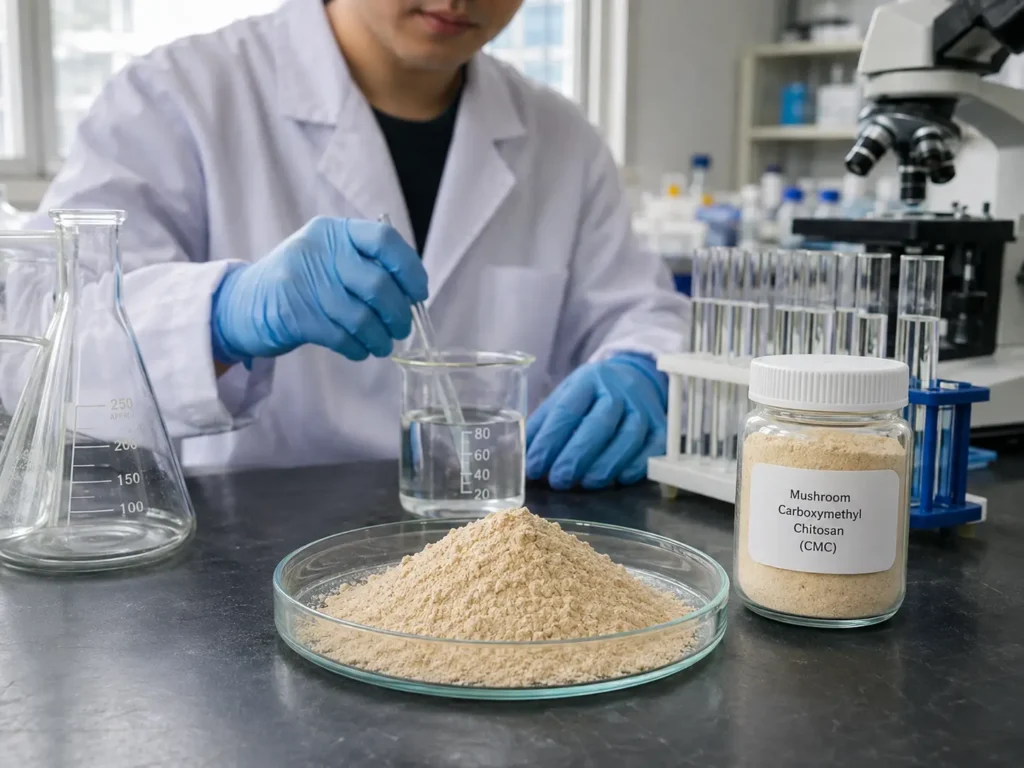
Carboxymethyl chitosan (CMC) is one of the most widely researched modified chitosan derivatives, developed in part to overcome one of native chitosan’s major formulation limitations: restricted water solubility outside acidic conditions.
When the starting chitosan is obtained from fungal or mushroom biomass, the resulting mushroom carboxymethyl chitosan provides a non-crustacean source option for researchers, formulators, manufacturers, and procurement teams evaluating water-soluble chitosan derivatives.
By introducing carboxymethyl groups into the chitosan structure, CMC gains substantially different aqueous and charge behavior from native chitosan. These characteristics have led to research involving hydrogels, drug-delivery systems, food-preservation technologies, biomedical materials, coatings, and other aqueous polymer systems. The existing page already covers this broad application range, but published research values should not be treated automatically as specifications for the commercial product.
For current specifications, available quantities, and ordering information, visit the Mushroom Carboxymethyl Chitosan product page.
Evaluating Mushroom CMC for a formulation? Review the current specification and Certificate of Analysis (COA), then consider a small sample for bench testing before scaling to larger quantities.
What Is Mushroom Carboxymethyl Chitosan?
Mushroom carboxymethyl chitosan is a modified chitosan derivative produced from fungal-derived chitosan. Carboxymethyl groups are introduced into the chitosan structure, altering important physicochemical characteristics such as aqueous solubility and charge behavior.
A simplified relationship is:
Mushroom/Fungal Biomass → Chitin/Chitosan Fraction → Chitosan → Carboxymethylation → Mushroom Carboxymethyl Chitosan
Native chitosan contains amino and hydroxyl functional groups and is generally associated with pH-dependent aqueous solubility. Carboxymethylation introduces additional hydrophilic and ionizable functionality into the polymer.
The result is not simply “more soluble chitosan.” CMC should be considered a distinct functional derivative whose performance can depend on factors including molecular weight, degree of substitution (DS), degree of deacetylation (DDA), substitution pattern, concentration, pH, and formulation environment.
Why Is Chitosan Carboxymethylated?
One of native chitosan’s most significant practical limitations is its restricted solubility in water under neutral conditions. This can complicate its incorporation into formulations where acidic dissolution is undesirable.
Carboxymethylation addresses this limitation by introducing hydrophilic carboxymethyl groups. As a result, appropriately prepared CMC grades can exhibit substantially improved aqueous solubility and different ionic behavior.
These changes can be valuable in the development of:
- aqueous polymer formulations;
- coatings and films;
- hydrogels;
- delivery matrices;
- composite biomaterials; and
- food-preservation systems.
However, the term “carboxymethyl chitosan” does not describe one universally identical material. Differences in synthesis, degree and position of substitution, molecular weight, parent chitosan, and purification can produce materials with different functional characteristics.
For a deeper look at the underlying chemistry, read why carboxymethyl chitosan is water soluble.
Key Properties of Carboxymethyl Chitosan
For researchers and commercial buyers, the derivative name is only the beginning. The specification of the actual CMC grade is more important when determining whether it fits a particular application.
| Property | Why It Matters |
|---|---|
| Source | Identifies mushroom/fungal material versus crustacean or other sources |
| Molecular Weight | Can influence viscosity, diffusion, film behavior, and formulation performance |
| Degree of Substitution (DS) | Describes the extent of carboxymethyl modification and can affect solubility and charge behavior |
| Degree of Deacetylation (DDA) | Describes an important structural characteristic inherited from chitosan |
| Solubility | Important for aqueous formulation and processing |
| Viscosity | Relevant to coatings, gels, and solution processing |
| pH Behavior | Helps determine compatibility with the intended formulation |
| Purity / Moisture / Ash | Useful quality-control parameters |
| Batch Documentation | Allows buyers to compare actual supplied material with application requirements |
Published fungal CMC values are useful for scientific context, but they should not be substituted for the specification of a particular commercial batch.
For the material offered by Chitosan Global, check the current Mushroom Carboxymethyl Chitosan specifications and purchasing options and request the current COA when batch-specific information is required.
Water Solubility: A Major Difference from Native Chitosan
Water solubility is one of the central reasons for continued research into carboxymethyl chitosan.
Native chitosan generally requires protonation of its amino groups under acidic conditions for practical aqueous dissolution. Introducing carboxymethyl functionality changes the polymer’s interaction with water and gives suitably prepared CMC grades broader aqueous-processing possibilities.
This can be advantageous for systems such as:
aqueous coatings → films → hydrogels → delivery matrices → composite polymer systems
But “water soluble” does not mean every CMC grade behaves identically at every pH, ionic strength, concentration, or temperature.
Actual formulation compatibility should therefore be tested with the specific grade being considered.
For the formulation-focused discussion, see Water-Soluble Carboxymethyl Chitosan.
Carboxymethyl Chitosan vs Native Chitosan
Carboxymethylation changes more than solubility, so CMC and native chitosan should not automatically be treated as interchangeable.
| Consideration | Native Chitosan | Carboxymethyl Chitosan |
|---|---|---|
| Aqueous behavior | Generally acid-dependent | Improved aqueous solubility |
| Main functionality | Amino + hydroxyl groups | Amino + hydroxyl + carboxymethyl functionality |
| Charge behavior | Primarily cationic when protonated | Can exhibit amphoteric behavior |
| Neutral-pH processing | Often challenging | Potentially more practical |
| Hydrogel research | Extensively studied | Extensively studied with additional functionalization possibilities |
| Selection | Application-dependent | Application-dependent |
CMC may be attractive where water solubility, carboxyl functionality, or different polymer interactions are required. Native chitosan may remain more appropriate when its conventional cationic behavior or other native-polymer characteristics are specifically needed.
For a deeper material-selection comparison, see Carboxymethyl Chitosan vs Native Chitosan.
Carboxymethyl Chitosan vs Chitosan Hydrochloride
Carboxymethyl chitosan and chitosan hydrochloride can both offer improved aqueous handling compared with native chitosan, but their chemistry is fundamentally different.
Chitosan hydrochloride is a salt form of chitosan, whereas CMC is produced by introducing carboxymethyl functionality into the chitosan structure.
This distinction can influence:
- ionic behavior;
- polymer interactions;
- pH response;
- hydrogel formation;
- compatibility with other formulation components; and
- suitability for particular applications.
Neither derivative is universally superior. Selection should depend on the formulation objective and the specification of the actual material.
See the detailed guide to Carboxymethyl Chitosan vs Chitosan Hydrochloride.
Applications of Mushroom Carboxymethyl Chitosan
The combination of water solubility, carboxymethyl functionality, and tunable polymer characteristics has led to CMC research across several industries.
It is important to distinguish published research on a CMC material or CMC-containing composite from demonstrated performance of a particular commercial grade.
Drug Delivery Systems
Carboxymethyl chitosan has been investigated as a component of nanoparticles, hydrogels, microspheres, and other drug-delivery systems.
Its functional groups provide opportunities for interaction with active compounds and other polymers, while improved aqueous processability can facilitate formulation under conditions where native chitosan may be more difficult to use.
A 2025 review describes CMC as an extensively investigated derivative for the delivery of drugs, genes, proteins, and other bioactive agents.
For a focused discussion of delivery-system research and formulation considerations, see Carboxymethyl Chitosan for Drug Delivery.
Carboxymethyl Chitosan Hydrogels
Hydrogel development is another important research area for CMC.
The polymer’s amino, hydroxyl, and carboxymethyl functionality provides multiple possibilities for crosslinking and interaction with complementary polymers and materials.
Published fungal CMC research has examined combinations with materials including polyvinyl alcohol, polydopamine, bacterial cellulose, and other components to create hydrogels with application-specific mechanical, swelling, adhesion, and release characteristics. The existing pillar page currently goes deeply into individual hydrogel systems, which is better handled by the dedicated supporting page.
Explore these systems in Carboxymethyl Chitosan for Hydrogels.
Food Preservation and Packaging Research
CMC is also being investigated in food-related polymer systems, particularly films, coatings, active packaging, and carrier matrices.
A 2024 comprehensive review discusses carboxymethyl chitosan synthesis, properties, and food applications, including its potential use as a film-forming matrix and carrier for active compounds. The review also highlights the importance of appropriate safety evaluation rather than assuming that every CMC material is automatically suitable for every food use.
For application-specific research, formulation factors, and preservation technologies, see Carboxymethyl Chitosan for Food Preservation.
Biomedical and Tissue-Engineering Research
CMC-based materials have been investigated in wound-related materials, tissue-engineering scaffolds, composite biomaterials, and bioactive-delivery systems.
Fungal CMC research has included hydrogel systems designed to investigate properties such as adhesion, porous structure, self-healing behavior, and compatibility with other functional materials. The existing page, for example, cites fungal CMC-polydopamine hydrogel research involving porcine-skin adhesion and cell studies.
These findings describe research systems. They should not be interpreted as evidence that every mushroom CMC product is approved or validated for wound care, medical devices, or pharmaceutical use.
Agriculture and Environmental Applications
CMC and CMC-containing materials are also being investigated in controlled-release systems, coatings, adsorption materials, and environmental technologies.
Research examples include polymer networks designed for controlled nutrient or active-ingredient release and composite materials investigated for interaction with metal ions.
Performance in these applications depends on the complete formulation—not merely the presence of CMC. The existing page currently makes several strong agriculture claims around fertilizer coatings, fungicide delivery, and seed coatings; these should remain framed as published research rather than guaranteed performance of the commercial material.
Why Choose a Mushroom Source?
Historically, commercial chitosan has been strongly associated with crustacean raw materials. Fungal biomass provides an alternative starting source.
Mushroom-derived chitosan may be relevant when a project specifically requires:
- a fungal source;
- a non-crustacean raw material;
- an alternative to conventional marine sourcing;
- source-specific product positioning; or
- research comparing chitosan from different biological origins.
Fungal sourcing also differs from crustacean sourcing during upstream processing. For example, the current page notes that fungal chitin does not carry the same mineral-removal requirements associated with calcium-rich crustacean shells.
However, source alone does not determine functional performance.
A mushroom-derived CMC should not automatically be described as better than shellfish CMC. Buyers should compare the parameters relevant to their application, including molecular weight, DS, DDA, viscosity, solubility, purity, documentation, and actual formulation performance.
How to Select a Mushroom Carboxymethyl Chitosan Grade
Choosing CMC should start with the intended function—not simply the derivative name.
1. Define Your Application
Determine whether the material is being evaluated for a hydrogel, coating, delivery system, preservation technology, composite polymer, or another application.
2. Identify Critical Material Parameters
Depending on the application, these may include:
MW → DS → DDA → Solubility → Viscosity → Purity → pH Behavior
3. Review the Technical Specification
Scientific literature can help determine which characteristics may matter, but published values from unrelated CMC samples should not replace supplier documentation.
4. Request the Current COA
Use batch-specific documentation to determine whether the supplied material matches the required specification.
5. Conduct Bench Testing
Evaluate the actual material in the intended formulation and under relevant processing conditions.
6. Scale After Validation
Once compatibility has been established, discuss larger quantities, batch requirements, documentation, and procurement.
A practical qualification pathway is:
DEFINE APPLICATION → REVIEW SPECIFICATION → REQUEST COA → TEST SAMPLE → BENCH EVALUATION → PILOT EVALUATION → BULK SOURCING
Buying Mushroom Carboxymethyl Chitosan
For procurement teams, scientific literature establishes context—but it does not replace the specification of the material being purchased.
Before placing a commercial order, consider verifying:
- mushroom/fungal source;
- molecular weight;
- degree of substitution, where specified;
- DDA, where relevant;
- water solubility;
- viscosity;
- purity;
- moisture and ash;
- available grade;
- COA and SDS availability;
- required quantity; and
- suitability for the intended market and application.
For procurement-specific information, see the Carboxymethyl Chitosan Supplier guide.
For current product specifications and available ordering quantities, visit the Mushroom Carboxymethyl Chitosan product page.
Ready to Evaluate Mushroom Carboxymethyl Chitosan?
Review the current specification, request batch documentation, and test the material against your actual formulation requirements before scaling.
Buy Mushroom Carboxymethyl Chitosan Sample
Request Current COA
Request Bulk Pricing
Frequently Asked Questions
What is mushroom carboxymethyl chitosan?
Mushroom carboxymethyl chitosan is a modified chitosan derivative produced from fungal-derived chitosan. Carboxymethyl groups are introduced into the chitosan structure to alter characteristics including aqueous solubility and ionic behavior.
Why is carboxymethyl chitosan water soluble?
Carboxymethylation introduces additional hydrophilic and ionizable functionality that changes the polymer’s interaction with water. Actual solubility can still depend on molecular structure, substitution, pH, concentration, and formulation conditions. See the detailed explanation of why carboxymethyl chitosan is water soluble.
Is carboxymethyl chitosan the same as native mushroom chitosan?
No. Native mushroom chitosan retains the conventional chitosan structure, whereas CMC contains introduced carboxymethyl functionality. This can significantly change solubility and formulation behavior. See Carboxymethyl Chitosan vs Native Chitosan.
Is CMC the same as chitosan hydrochloride?
No. Chitosan hydrochloride is a chitosan salt, while CMC is a chemically modified chitosan derivative. Their charge behavior and formulation characteristics can therefore differ. Read the full Carboxymethyl Chitosan vs Chitosan Hydrochloride comparison.
What is mushroom CMC used for?
CMC is investigated in areas including hydrogels, drug-delivery systems, food-preservation materials, coatings, biomedical materials, and other aqueous polymer systems. Application-specific performance depends on the actual grade and formulation.
What does degree of substitution mean in CMC?
Degree of substitution describes the extent of carboxymethyl substitution on the polymer. It can influence properties including aqueous behavior, ionic characteristics, and interactions with other formulation components.
Is every mushroom carboxymethyl chitosan grade the same?
No. CMC materials can differ in molecular weight, degree and position of substitution, DDA, viscosity, purity, and other parameters. Product selection should therefore be specification-based.
Where can I buy Mushroom Carboxymethyl Chitosan?
Current product information and purchasing options are available on the Mushroom Carboxymethyl Chitosan product page.
You May Also Like
- All
- Native Chitosan
- Phosphorylated Chitosan
- Sulphonated Chitosan
- Quaternary Chitosan
- Chitosan Oligosaccharide Hydrochloride
- Chitosan Hydrochloride
- Carboxymethyl Chitosan
- Chitosan Oligosaccharide
Get in Touch
Technical & Custom Solutions
Abhinav Chauhan, PhD – Application Scientist
Stephen Nice – Application Scientist