Quaternary Chitosan: The Definitive Guide to a Permanently Cationic Biopolymer
- All
- All
- Native Chitosan
- Black Soldier Fly Chitosan
- Chitosan Oligosaccharide Hydrochloride
- Chitosan Oligosaccharide
- Chitosan Hydrochloride
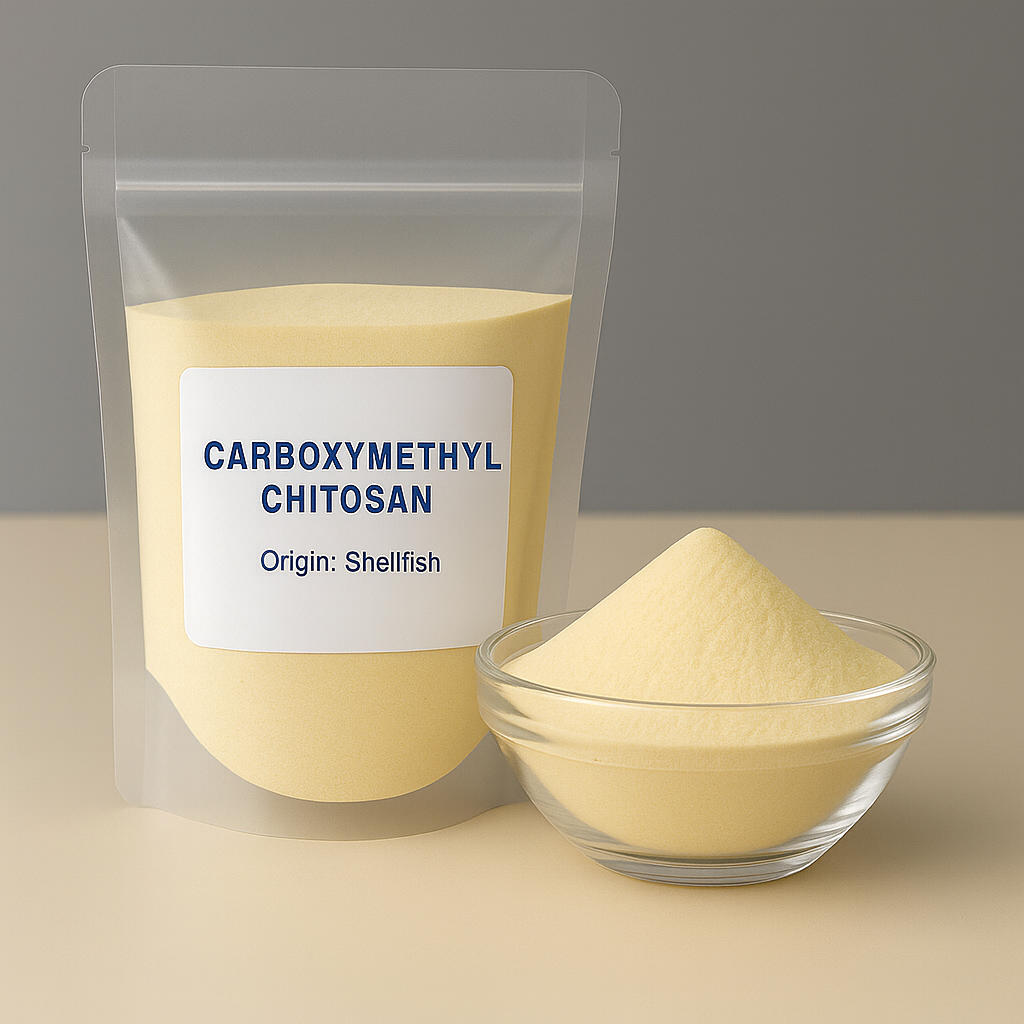
- Carboxymethyl Chitosan
- Quaternary Chitosan
- Trimethyl Chitosan
- Sulphonated Chitosan
- Phosphorylated Chitosan
- Biochar
- Home Cleaning System
Why Quaternary Chitosan Was Developed
Native chitosan has one persistent limitation that has shaped decades of chitosan chemistry research: it only dissolves, and only carries a positive charge, in acidic solution. Its amine groups must be protonated to ionize, so as soon as the surrounding environment reaches neutral or alkaline pH, the polymer loses both its solubility and the electrostatic charge responsible for much of its antimicrobial and binding behavior. For a biopolymer being evaluated in physiological fluids, industrial process water, or neutral-pH cosmetic bases, that is a serious constraint.
Quaternary chitosan was developed specifically to remove that constraint. By permanently attaching a quaternary ammonium group to the chitosan backbone, chemists created a polymer whose positive charge is fixed rather than pH-dependent solving the solubility and charge-stability problem at the molecular level rather than working around it with formulation tricks. This is why quaternary chitosan is treated less as a chitosan variant and more as a distinct functional biopolymer platform in current literature.
What Makes Permanent Quaternization Unique
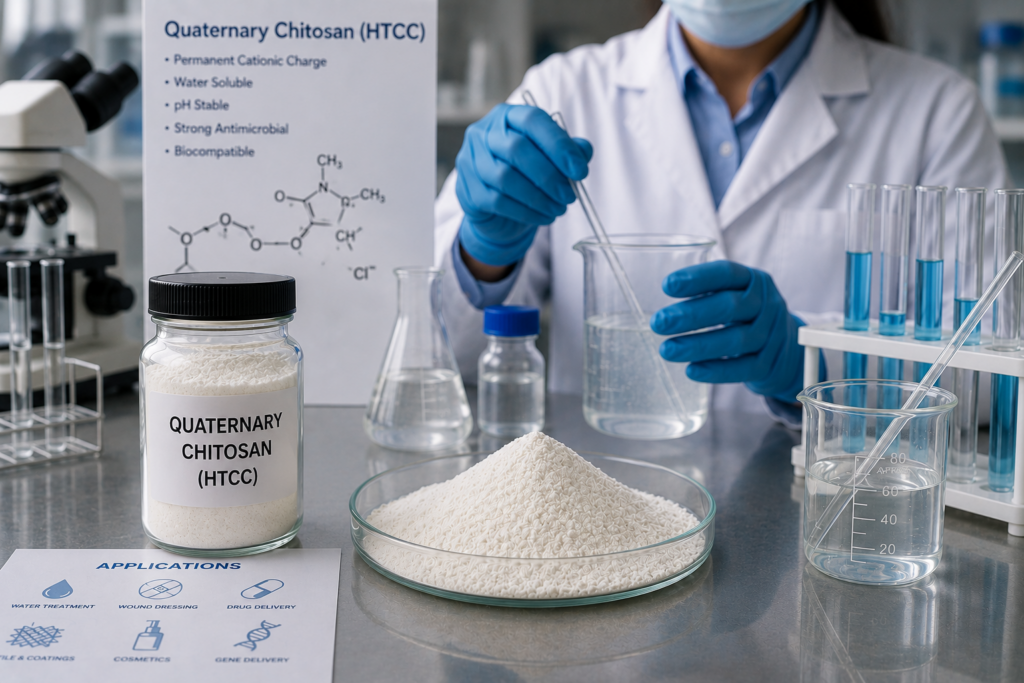
Quaternization replaces a reactive amine group with a quaternary ammonium moiety through nucleophilic substitution, most commonly using an epoxide-based quaternizing agent such as glycidyltrimethylammonium chloride (GTMAC). The reaction can target the primary amine, the hydroxyl groups, or both, and the resulting derivative is commonly referred to in the scientific literature as HTCC (N-(2-hydroxypropyl)-3-trimethylammonium chitosan chloride) when GTMAC is used the most extensively studied quaternary chitosan chemistry to date.
The structural consequence is significant. Quaternization disrupts the inter- and intramolecular hydrogen bonding that gives native chitosan its crystalline structure, producing a more amorphous polymer. This amorphous structure allows water molecules to diffuse more freely through the polymer chains, which is part of why quaternized chitosan shows improved solubility, viscosity behavior, and absorption compared to unmodified chitosan. The degree of quaternization the proportion of available sites that have reacted becomes the key variable formulators must specify, since it directly governs charge density, solubility, and downstream performance.
Simplified Reaction Pathway
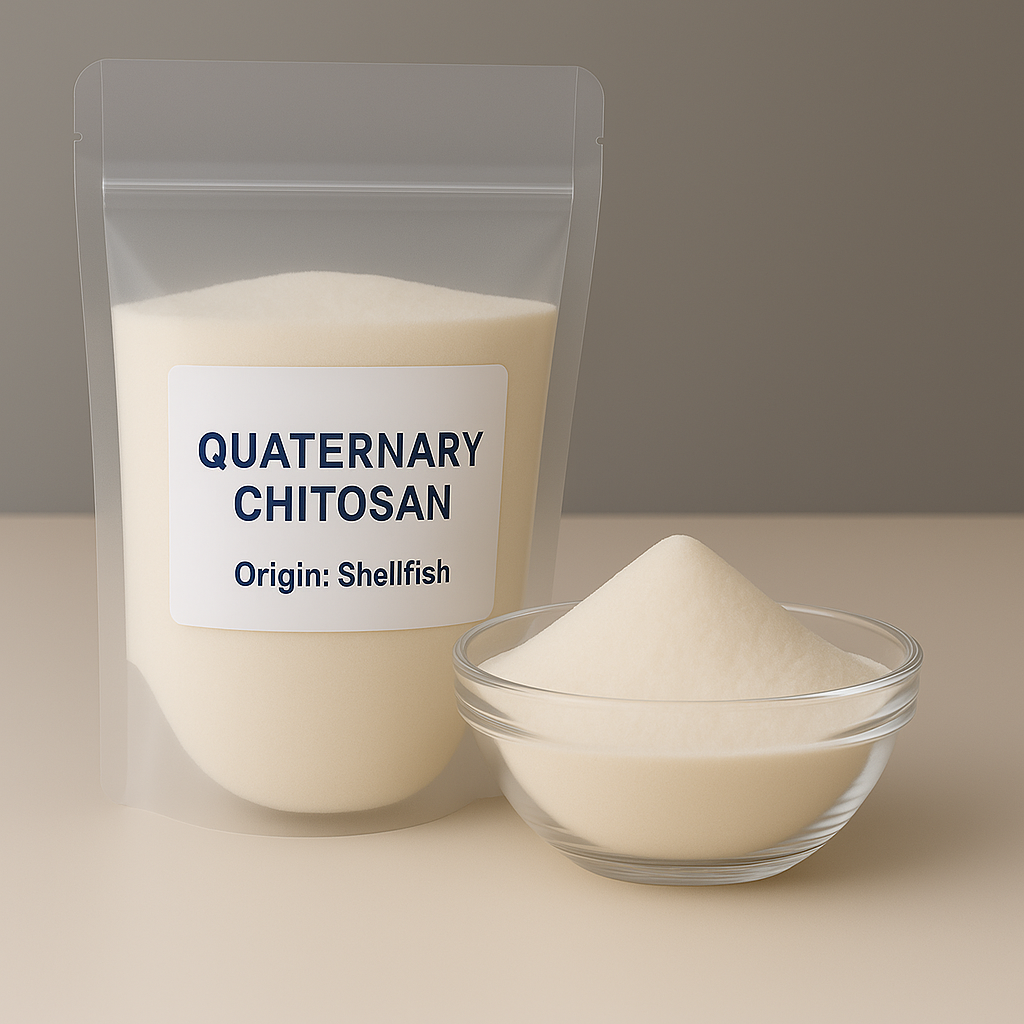
→ Shellfish chitin is deacetylated to produce native chitosan
→ Chitosan is reacted with a quaternizing agent (e.g., GTMAC) under controlled pH and temperature
→ Nucleophilic substitution attaches a permanent quaternary ammonium group to the amine and/or hydroxyl positions
→ The resulting polymer (commonly HTCC) is purified, dried, and characterized for degree of quaternization
→ Finished quaternary chitosan is milled to powder and tested for charge density, solubility, and molecular weight
How Improved Water Solubility Changes Industrial Formulations
Because quaternary chitosan dissolves directly in water without an acidic carrier, it removes an entire category of formulation constraints that apply to native chitosan. Acid-neutralization steps, pH-adjustment stages, and compatibility checks against acid-sensitive actives are no longer necessary, which simplifies process design and reduces the risk of degrading sensitive co-formulated ingredients.
This matters most in three formulation contexts: aqueous-phase pharmaceutical systems where acidic conditions would destabilize a co-formulated drug; industrial process water where pH swings are costly to control at scale; and neutral-pH cosmetic and personal care bases where consistent solubility is required for product stability over shelf life. In each case, the same underlying chemistry a permanent rather than conditional charge is what unlocks the formulation.
Formulators sourcing pre-characterized cationic material can review specifications through the water-soluble chitosan supplier resource.
Why Researchers Choose It Over Conventional Chitosan
Across the antimicrobial, antiviral, and drug-delivery literature, quaternary chitosan is consistently selected over native chitosan for one core reason: reliability of performance outside acidic conditions. Native chitosan’s antimicrobial action depends on protonated amine groups interacting with negatively charged microbial membranes an interaction that weakens as pH rises. Quaternary chitosan’s permanent charge sustains that same electrostatic mechanism across a much broader pH range, which is why studies report stronger, broader-spectrum, and more consistent antimicrobial and antiviral activity for quaternized derivatives compared to unmodified chitosan.
Researchers working in gene delivery cite a related advantage: the permanent cationic charge allows quaternary chitosan to reliably complex with negatively charged nucleic acids to form polyplexes, without the interaction depending on maintaining an acidic buffer that could be incompatible with a biological delivery target.
Quaternary Chitosan vs. Conventional Chitosan: Technical Comparison
Property | Quaternary Chitosan (HTCC) | Native Chitosan |
Charge behavior | Permanent, pH-independent cationic charge | pH-dependent; charge lost above acidic range |
Solubility | Fully water-soluble across a wide pH range | Soluble only in dilute acid |
Antimicrobial consistency | Stable across neutral and physiological pH | Diminishes as pH rises toward neutral |
Structural form | More amorphous after quaternization | Semi-crystalline, hydrogen-bonded |
Gene/nucleic acid complexation | Reliable across formulation pH | Limited outside acidic conditions |
Typical use context | Neutral-pH industrial and biomedical systems | Acidic-condition formulations only |
Table 1. Functional comparison between quaternized (HTCC-type) chitosan and unmodified native chitosan.
Where Quaternary Chitosan Delivers the Greatest Commercial Value
Not every application benefits equally from permanent quaternization the commercial value concentrates where charge-driven performance under neutral or variable pH conditions is a hard requirement, not a nice-to-have. Three areas stand out in current industrial and research adoption:
- Antimicrobial systems operating outside acidic conditions — wound care, medical device coatings, and hygienic textiles, where the surrounding environment is neutral or physiological.
- Water treatment and flocculation, where cationic charge must remain effective across the variable pH of real wastewater streams rather than a controlled acidic bench condition.
- Nucleic-acid and drug-carrier systems, where consistent electrostatic complexation is required for reproducible manufacturing and biological performance.
How Different Industries Apply Quaternary Chitosan Today
Water Treatment and Separation Technologies
Quaternary chitosan’s permanent cationic charge lets it neutralize the negative surface charge carried by suspended particles, dyes, and colloidal organic matter in wastewater, causing them to aggregate into flocs that settle or filter out efficiently. Because that charge does not depend on maintaining acidic process water, it performs consistently across the pH swings typical of real industrial effluent an advantage synthetic flocculants and native chitosan alike do not offer in combination with biodegradability.
See broader remediation strategies in the chitosan for water treatment resource.
Functional Coatings, Textiles, and Fiber Manufacturing
In surface and fiber applications, quaternary chitosan is incorporated into coatings, packaging surface treatments, and bi-component fiber structures to impart durable, non-leaching antimicrobial performance. Because the antimicrobial charge is covalently fixed to the polymer rather than a small molecule that can migrate out of the material, it tends to offer more durable antimicrobial performance through washing and wear cycles than surface-applied synthetic antimicrobial finishes.
Infection-Resistant Medical Materials
In healthcare materials, quaternary chitosan’s electrostatic interaction with microbial cell membranes supports its use in antimicrobial wound dressings, infection-resistant coatings, and medical device surface treatments. Because performance does not depend on an acidic microenvironment, it remains active at the physiological pH found at wound sites and on implanted device surfaces.
Detailed mechanism and formulation guidance is available in quaternary chitosan for antimicrobial systems.
Biomaterials and Tissue Engineering
Quaternary chitosan is explored in hydrogel systems, tissue scaffolds, and biomedical coatings, where its biocompatibility, charge-driven bioadhesion, and structural flexibility support cell interaction and material integration in regenerative medicine research.
Pharmaceutical Absorption and Permeability Enhancement
As a permeation enhancer, quaternary chitosan helps therapeutic molecules cross biological barriers more effectively in oral, nasal, and mucosal drug delivery platforms, improving bioavailability for actives that would otherwise be poorly absorbed.
For adjacent permeation-enhancement chemistry, see trimethyl chitosan for oral delivery and broader context in chitosan for drug delivery systems.
Nanotechnology, Drug Carriers, and Gene Delivery
In nanoparticle systems, quaternary chitosan’s high, stable charge density makes it an effective carrier for binding and transporting pharmaceutical molecules, including nucleic acids for gene delivery and antigens for vaccine adjuvant systems. Research indicates that the degree of quaternization can be tuned for the application: a higher degree of quaternization favors strong antimicrobial and nucleic-acid binding, while a more moderate degree can favor antigen adsorption through residual hydrogen-bonding sites.
Complementary nanoparticle carrier chemistry is covered in chitosan hydrochloride for nanoparticles.
Cosmetic and Personal Care Formulations
Quaternary chitosan’s substantivity. its tendency to bind to and remain on hair and skin surfaces combined with its antimicrobial activity, makes it a candidate ingredient in hair care and skin care formulations where a conditioning, film-forming, or preservative-supporting function is desired.
See broader formulation context in chitosan in cosmetics.
Where Future Innovation Is Heading
Several research directions are actively expanding what quaternary chitosan can do. Structure-activity studies are refining exactly how charge density, alkyl chain length, and molecular weight influence antimicrobial and antiviral potency, moving the field from broad empirical observation toward predictive, structure-based design of new quaternizing chemistries. Fluorinated and dual-functionalized quaternary chitosan derivatives are being investigated to combine quaternization with additional functional groups for enhanced antibacterial killing kinetics.
In nanofiber and textile engineering, quaternized chitosan is being combined with electrospinning techniques to produce antimicrobial nanofiber membranes for wound dressings, air and water filtration, and even energy storage and fuel cell applications an indication that quaternary chitosan’s relevance is expanding well beyond its original antimicrobial and drug-delivery use cases. On the commercial side, the greatest opportunity lies with suppliers who can provide consistent, well-characterized degree-of-quaternization data across production batches, since reproducibility at that molecular level is what allows researchers and manufacturers to scale laboratory results into industrial processes.
Manufacturers scaling a quaternary chitosan-based product can review sourcing and documentation standards through an industrial chitosan manufacturer, or explore the full range of engineered derivatives via the chitosan derivatives supplier resource.
Frequently Asked Questions
What does quaternization actually mean in chitosan chemistry?
Quaternization is a chemical reaction that permanently attaches a quaternary ammonium group to the amine or hydroxyl positions on the chitosan backbone. Unlike the protonation that gives native chitosan its pH-dependent charge, this substitution creates a fixed positive charge that does not depend on the surrounding pH.
Why is a permanent charge better than chitosan’s natural pH-dependent charge?
Native chitosan only carries a positive charge in acidic conditions, because its amine groups must be protonated to ionize. Once the environment becomes neutral or alkaline, that charge — and the solubility and antimicrobial activity that come with it — is lost. A permanently quaternized polymer keeps its charge and solubility across the full pH range, so performance does not drop out in neutral or physiological conditions.
Is quaternary chitosan the same thing as HTCC?
HTCC (N-(2-hydroxypropyl)-3-trimethylammonium chitosan chloride) is the most widely studied quaternary chitosan derivative in the scientific literature, but it is one specific quaternization chemistry among several. The general term quaternary chitosan covers any chitosan modified with a quaternary ammonium group, of which HTCC is the best-documented example.
What quaternizing agents are used to modify chitosan?
Common reagents include glycidyltrimethylammonium chloride (GTMAC) and similar epoxide-based quaternary ammonium compounds, which react with the chitosan backbone through nucleophilic ring-opening substitution at the amine or hydroxyl groups.
Does a higher degree of quaternization always mean better performance?
Not necessarily. Research indicates that a higher degree of quaternization generally increases antimicrobial strength and solubility, but a lower degree of quaternization can be preferable for applications like vaccine adjuvants, where residual free amino groups are needed for hydrogen-bond-based antigen adsorption. The right degree of quaternization depends on the target application.
Why do formulators choose quaternary chitosan over standard chitosan for antimicrobial applications?
Standard chitosan’s antimicrobial action weakens outside acidic conditions because it loses its charge. Quaternary chitosan retains a strong, permanent positive charge that continues to interact electrostatically with negatively charged microbial cell membranes regardless of the surrounding pH, giving it broader-spectrum and more consistent antimicrobial performance.
Can quaternary chitosan be used in gene delivery systems?
Yes. Its permanent cationic charge allows it to electrostatically complex with negatively charged nucleic acids, forming polyplexes that protect genetic material and support cellular uptake, which is why it has been studied as a non-viral gene delivery carrier.
Is quaternary chitosan biodegradable?
Yes. Despite the chemical modification, quaternary chitosan retains the biodegradable backbone of chitosan and breaks down through enzymatic and microbial pathways, distinguishing it from synthetic cationic polymers and quaternary ammonium compounds that persist in the environment.
How is quaternary chitosan used in water treatment?
Its strong, pH-independent cationic charge allows it to neutralize the negative surface charge on suspended particles, dyes, and organic contaminants in wastewater, causing them to aggregate into flocs that settle out or can be filtered, making it useful as a biodegradable alternative to synthetic flocculants.
What role does quaternary chitosan play in fiber and textile manufacturing?
Quaternary chitosan can be incorporated into fiber-spinning processes, including bi-component fiber structures, to impart durable antimicrobial and moisture-management properties to the finished textile, without relying on leachable synthetic antimicrobial agents.
Can quaternary chitosan be combined with other chitosan derivatives?
Yes. It is frequently paired with derivatives such as carboxymethyl chitosan (anionic, water-soluble) or trimethyl chitosan (a related cationic derivative used for oral delivery) to build multifunctional systems that combine cationic and anionic behavior in a single formulation.
What analytical methods confirm successful quaternization?
FTIR spectroscopy is used to detect the characteristic quaternary ammonium peak, while 1H NMR and elemental (nitrogen) analysis are used to quantify the degree of quaternization on a given batch.
Is quaternary chitosan safe for use in cosmetic formulations?
Quaternary chitosan is studied for use in hair and skin care due to its substantivity (its tendency to bind and remain on hair and skin surfaces) and antimicrobial properties. As with any functional ingredient, cosmetic-grade material should come with full documentation and be evaluated under relevant regulatory frameworks for the target market.
What degree of quaternization should I request for antimicrobial coatings versus drug delivery?
Antimicrobial coatings generally benefit from a higher degree of quaternization to maximize charge density and killing efficiency, while drug and gene delivery systems may use a moderated degree of quaternization to balance charge-driven binding with biocompatibility and controlled release. Suppliers should be able to provide degree-of-quaternization data on the certificate of analysis so formulators can match the grade to the application.
Can research institutions request samples of quaternary chitosan for testing?
Yes. Reputable derivative suppliers typically provide sample quantities along with technical data sheets so formulators can validate solubility, charge density, and compatibility before scaling to bulk production.
You May Also Like
- All
- All
- Native Chitosan
- Black Soldier Fly Chitosan
- Chitosan Oligosaccharide Hydrochloride
- Chitosan Oligosaccharide
- Chitosan Hydrochloride
- Carboxymethyl Chitosan
- Quaternary Chitosan
- Trimethyl Chitosan
- Sulphonated Chitosan
- Phosphorylated Chitosan
- Biochar
- Home Cleaning System
Get in Touch
Technical & Custom Solutions
Abhinav Chauhan, PhD – Application Scientist
Stephen Nice – Application Scientist