
Shellfish COS Supplier: What to Verify Before You Buy – From Us or Anyone
No Products Found!
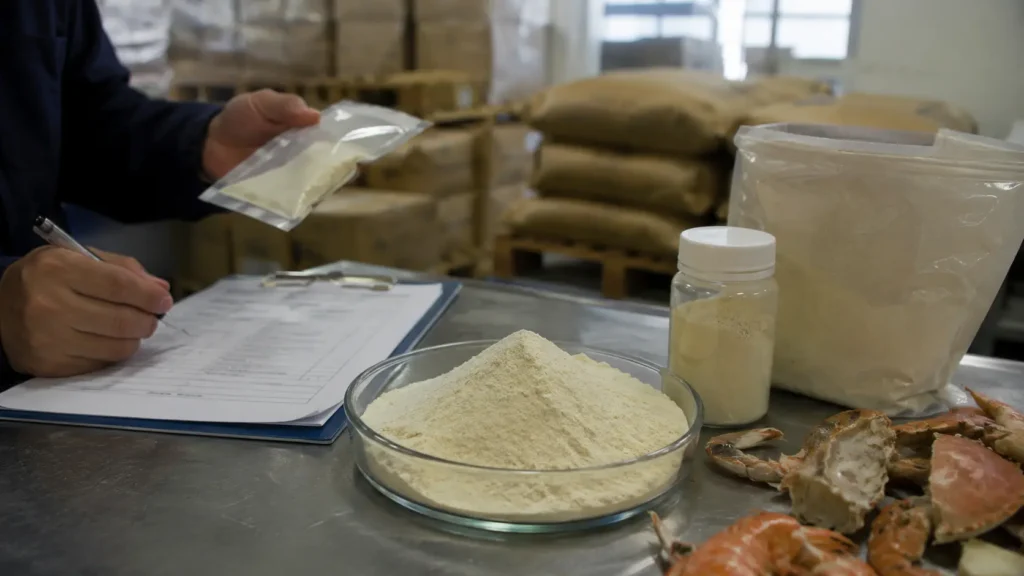
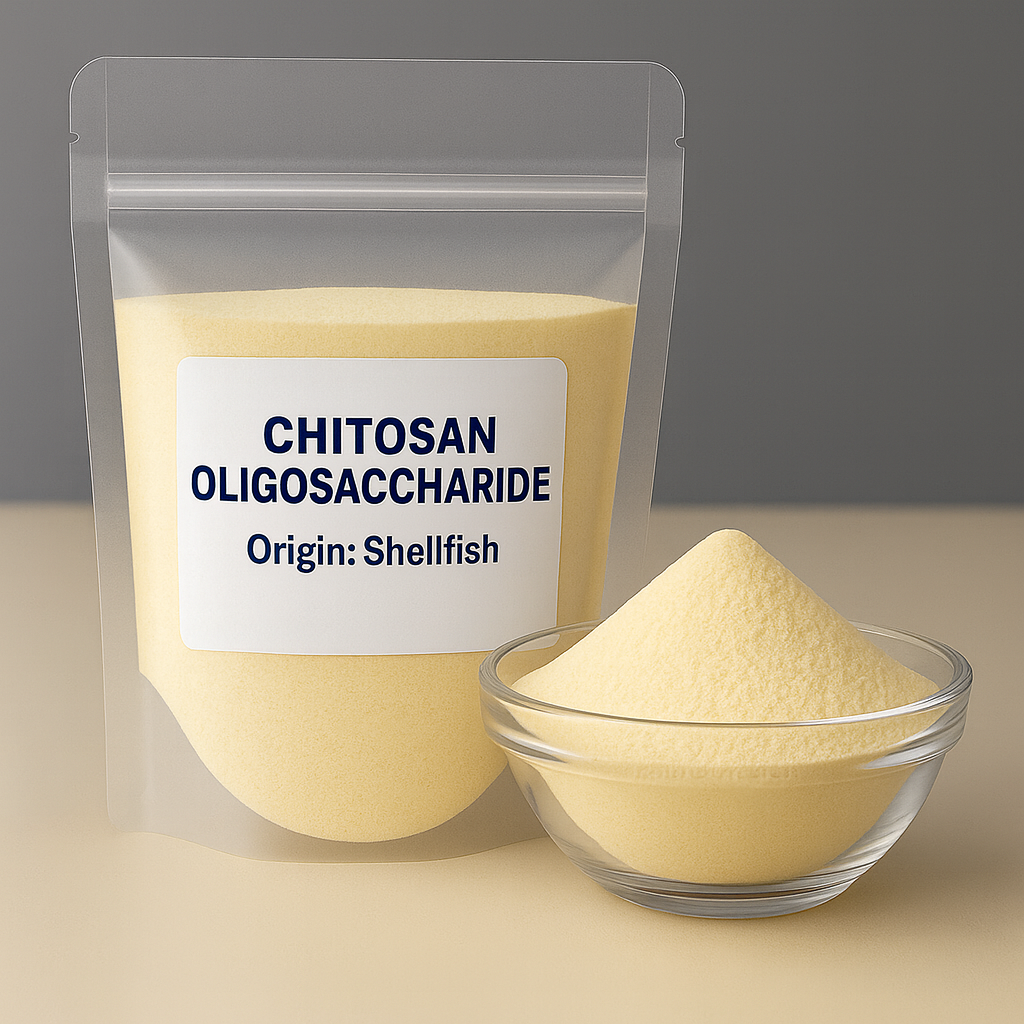
Choosing a shellfish COS supplier should not require a chemistry lesson – so this page leads with what you actually need to know: whether Chitosan Global has Shellfish Chitosan Oligosaccharide in stock, what grades, at what specification, and whether you can get a sample before committing real money. The short answers: shrimp-and-crab-derived COS, Food and Industrial grades (Agricultural also listed), molecular weight under 5,000 Da, DDA in the 85-90% range depending on grade, COA issued per batch, 25 g sample with free shipping, 1 kg standard unit, bulk on request. Everything below is what to check before you buy from anyone – us included – because on a category name this loose, the supplier you qualify is really the documentation you qualify.
Buy 25 g Sample · Request Current COA
Quick answer: A Shellfish COS supplier worth qualifying proves four things: source identity (named shellfish origin, not a substituted or blended feedstock); batch-specific figures for the two specifications that define the category – molecular weight (below 5,000 Da documented) and DDA (85-90%, grade-dependent) – plus purity, solubility, and microbiology on the COA; the right grade for your regulatory pathway (Food, Industrial, or Agricultural – tested and documented differently, never interchangeable); and a laboratory sample available before any volume commitment. Verify the figures against the product page and the batch COA – specifications can change between production runs, and “chitosan oligosaccharide” alone tells you nothing you can qualify against.
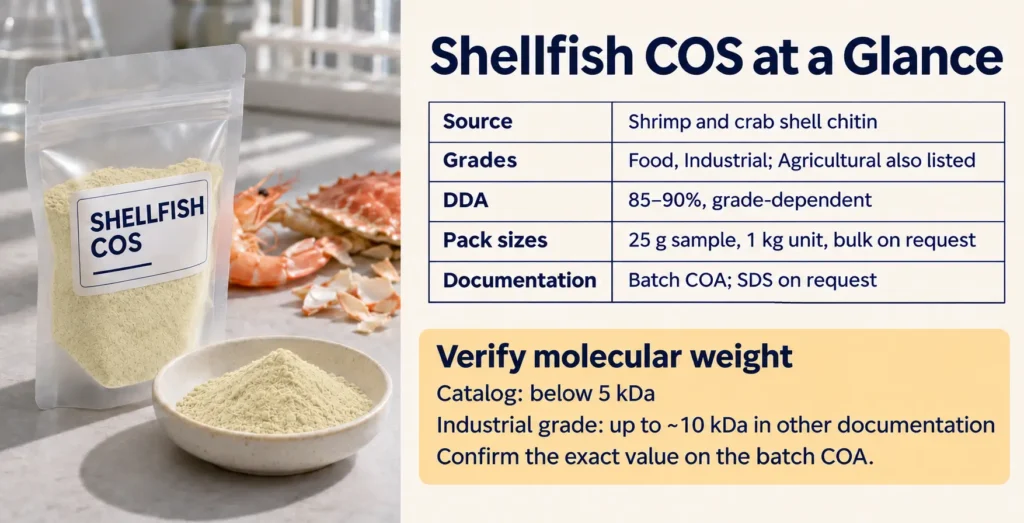
Shellfish COS Supplier at a Glance: Supply, Specs, and One Honest Flag
The problem this table solves: the four quick answers above, with every figure attached – and one honest flag.
| Parameter | Available Information |
|---|---|
| Product | Chitosan Oligosaccharide – Shellfish |
| Source | Shrimp and crab shell chitin |
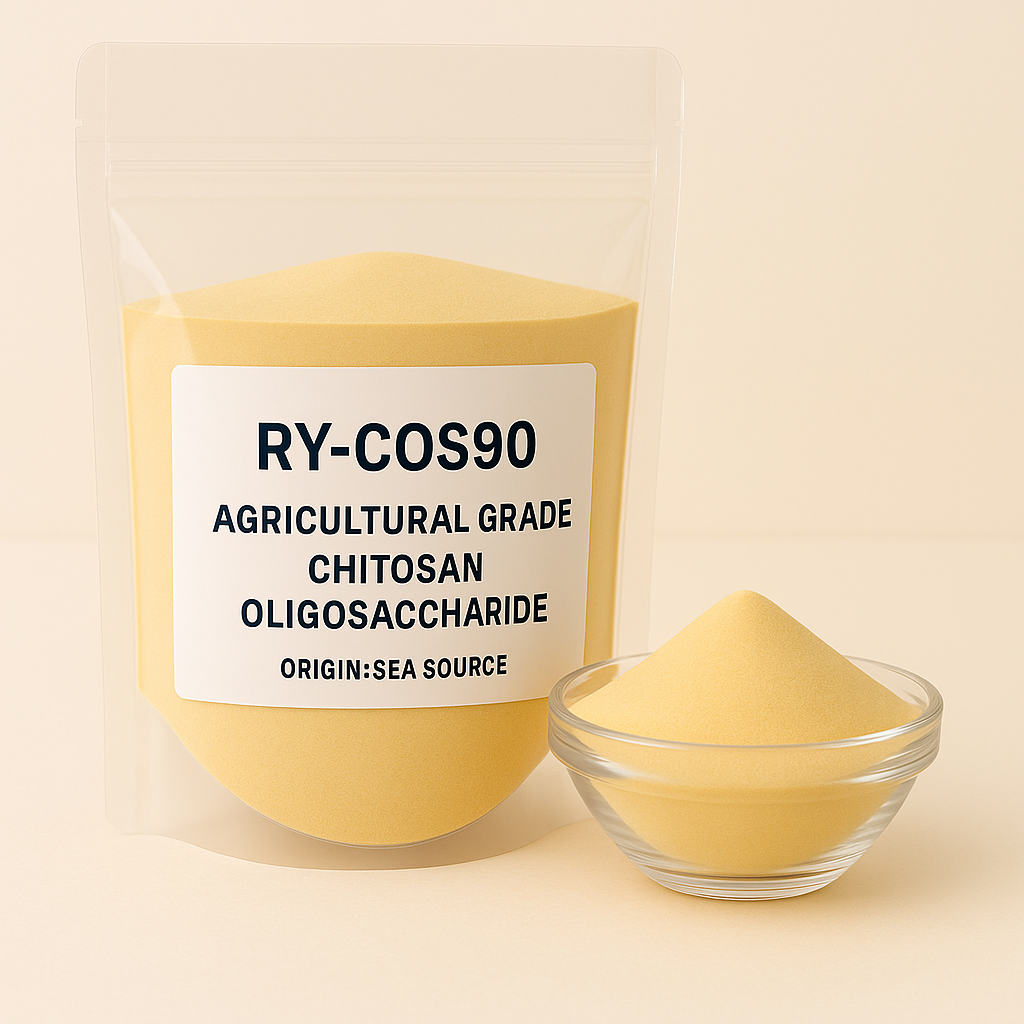
| Grades | Food, Industrial (Agricultural grade also listed on the product catalog) |
| Molecular weight | Below 5,000 Da (product listing); Industrial-grade range shown elsewhere as up to 10,000 Da – see the flag below |
| DDA | 85-90%, grade-dependent |
| Solubility | Fully water-soluble at neutral pH |
| Appearance | White to light yellow powder |
| Package options | 25 g sample, 1 kg unit, bulk packs |
| Sample | 25 g, free shipping |
| COA | Issued per batch, available on request |
| SDS/MSDS | Available on request |
| Bulk availability | Yes – contact for quantity and lead time |
Flagged for your own verification before ordering: the product catalog’s quick-reference spec lists molecular weight as “below 5 kDa” across the board, while grade-specific documentation elsewhere describes an Industrial-grade range extending up to roughly 10 kDa. If your application depends on a precise molecular-weight ceiling, request the batch-specific COA and confirm the exact figure rather than relying on either summary number – this is exactly the kind of discrepancy the next section tells you to catch with any supplier, including this one. The current batch COA is viewable on the product page.
Don’t Buy on the Name Alone
The problem this section solves: “chitosan oligosaccharide” is not a specification – it is a category with a wide range of legitimate variation inside it, and price-per-kilo tells you nothing about what is actually in the bag. Before you commit to any supplier, pull these numbers and compare them against your requirement:
| Specification | Why You Should Check It |
|---|---|
| Source | Confirms shellfish origin, not a substituted or blended feedstock |
| Molecular weight | Sets solubility, viscosity, and diffusion behavior |
| Molecular-weight distribution | A wide distribution can behave inconsistently even at a matching average |
| DDA | Governs charge density and reactivity |
| Purity | Determines fit for sensitive or regulated applications |
| Solubility | Confirm it dissolves at your actual working pH and concentration, not just “in general” |
| Moisture / ash | Affects handling, shelf life, and effective concentration |
| Microbiological limits | Relevant to food, supplement, or biologically sensitive use |
| Heavy metals | Relevant to food-grade and regulated applications |
| Intended grade | Food, Industrial, and Agricultural grades are tested and documented differently – do not assume one covers another |
| Batch COA | The only document that tells you what is actually in the specific lot you would receive |
Any supplier who cannot produce a current, batch-specific COA on request is asking you to buy blind.
Why Molecular Weight Decides More Than You’d Think
The problem this section solves: the most common way buyers get burned comparing suppliers on price alone.
Two bags of “Shellfish COS” at the same price point can perform completely differently in your system if their molecular-weight profiles do not match. Lower molecular weight generally means faster dissolution and lower viscosity; a wider distribution around that average can mean inconsistent behavior batch to batch even when the headline number looks fine. For the deeper technical explanation of what molecular weight controls and why the distribution matters as much as the average: low molecular weight shellfish COS.
Grade Fit, Not Just Availability
The problem this section solves: the ordering mistake that looks like a bargain and behaves like a failure.
Availability is not the same as fit. Food Grade is documented for nutraceutical, functional-food, and beverage use; Industrial Grade carries a different purity and testing profile suited to agricultural, water-treatment, and coating applications. Ordering the wrong grade because it was cheaper or in stock faster is a common, avoidable procurement mistake. If you are formulating a functional food or beverage: Shellfish COS for functional foods. If you are working on an agricultural or plant-growth application: Shellfish COS for plant growth.
Where This Material Comes From – and How to Verify It
The problem this section solves: process control, not the final powder test, is what determines whether the batch you receive matches the one you sampled.
Shellfish COS starts as shrimp or crab shell, gets demineralized and deproteinized down to purified chitin, deacetylated into chitosan, then broken down into the short-chain oligosaccharide you are actually buying. Process control at each stage – not just the final powder test – is what determines batch-to-batch consistency. Ask any supplier how they control for that, not just what the final spec sheet says. For the full production pathway: how shellfish COS is manufactured.
Same Backbone, Different Feedstock – Is Shellfish Actually Right for You?
The problem this section solves: origin disqualifying itself before specification ever matters.
Shellfish is not automatically the correct choice just because it is the most established source. If your product needs vegan or shellfish-allergen-free labeling, shellfish origin disqualifies itself immediately – no spec sheet fixes that. If your formulation needs a specific molecular-weight or DDA range that is easier to source from a different origin, source selection should follow the spec, not the reverse. See Shellfish COS vs mushroom COS and Shellfish COS vs BSF COS for direct, non-biased comparisons before you lock in a sourcing decision. For the broader chemistry, properties, and full application picture: the shellfish chitosan oligosaccharide guide – this page stays focused on sourcing and procurement, not the underlying science.
Sample First, Always: How to Qualify a Shellfish COS Supplier in Seven Steps
The problem this sequence solves: turning a category purchase into a documented qualification – the same sequence whether you evaluate this supplier or another:
- Review the specification against your actual requirement – not the marketing bullet points
- Request the current COA – if a supplier hesitates here, that is your answer
- Buy a 25 g sample – cheap insurance against a bulk order that does not perform
- Test it in your own process – solubility, mixing, viscosity, compatibility with whatever else is in your formulation
- Confirm the grade and quantity you actually need based on what the sample tells you
- Request bulk pricing once you know the material fits
- Move to production quantity
A clean COA and a good sample result are strong signals, not guarantees that performance holds identically at commercial scale – plan for a verification step when you do scale up. Start with the 25 g sample.
Need Bulk Shellfish COS?
Once your sample confirms fit, request bulk pricing directly: give us your target quantity, grade, application, and destination, and we will come back with current pricing and lead time – pricing depends on volume, current market conditions, and shipping, so we do not publish a static bulk price table that goes stale. Get bulk pricing.
Frequently Asked Questions
Where can I buy shellfish chitosan oligosaccharide?
Through the product page – 25 g sample, 1 kg unit, and bulk packs are all available.
What specifications should I check before buying shellfish COS?
Molecular weight, molecular-weight distribution, DDA, purity, solubility, moisture, ash, and – for food-relevant grades – microbiological and heavy-metal data, all from the current batch COA rather than a general spec sheet.
What is the MOQ for shellfish COS?
A 25 g sample is the smallest unit, intended specifically for evaluation before you commit to a 1 kg or bulk order.
Can I buy a 25 g sample?
Yes, with free shipping, through the product page.
Is a COA available before ordering?
Yes, on request – confirm the exact molecular-weight and DDA figures for your batch before finalizing an order, especially given the range discrepancy flagged in the spec table above. The current batch COA is viewable on the product page.
What grades of shellfish COS are available?
Food and Industrial grades are the primary offerings, with Agricultural grade also listed – confirm which grade’s testing scope matches your actual regulatory or application requirement.
Do you supply shellfish COS in bulk?
Yes – contact us with your required quantity, grade, and destination for current bulk pricing and lead time.
What is the molecular weight of shellfish COS?
Under 5,000 Da per the current product listing; confirm the exact figure and distribution for your specific grade and batch via COA, since documentation across grade tiers is not fully consistent (see the flagged discrepancy above).
How should I choose between shellfish and mushroom COS?
Start with any hard requirement – vegan or allergen-free labeling rules out shellfish immediately. Beyond that, compare molecular weight, DDA, and purity against your formulation need rather than assuming either origin is inherently better: Shellfish COS vs mushroom COS.
You May Also Like
- All
- Chitosan Oligosaccharide Hydrochloride
- Chitosan Oligosaccharide
Get in Touch
Technical & Custom Solutions
Abhinav Chauhan, PhD – Application Scientist
Stephen Nice – Application Scientist