
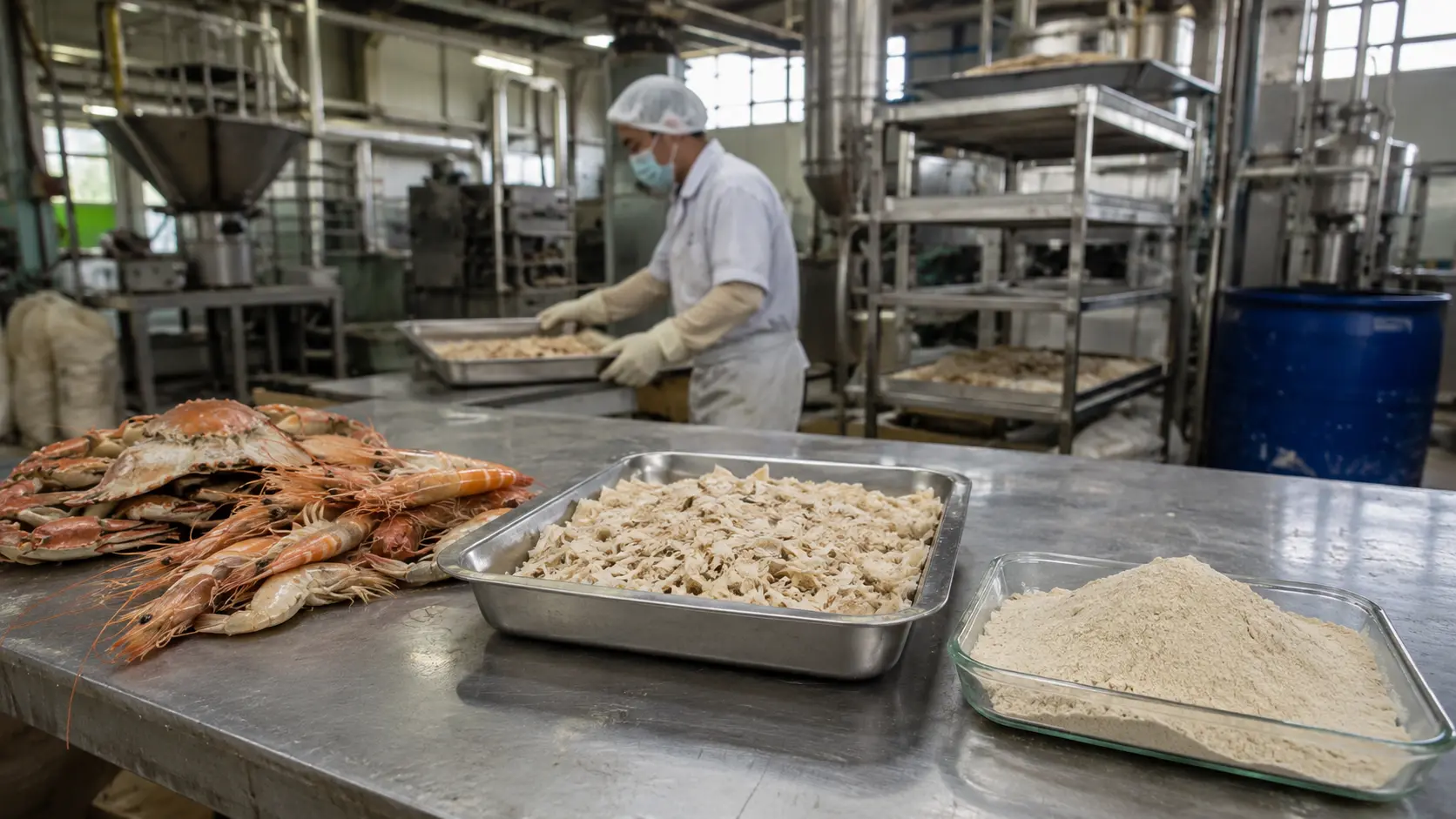
No credible manufacturer publishes their exact reaction conditions online and if a page you’re reading does, treat that as a red flag, not a transparency win. What you should be able to get is the general science behind the process, an honest account of which variables actually determine final quality, and a batch-specific COA proving what came out the other end. This page draws that line deliberately: general manufacturing science on one side, proprietary process parameters on the other, with the COA as the bridge between them.
Evaluating a commercial Shellfish COS grade? Review the current product specification and COA, or start with a 25 g sample before moving to larger quantities.
Buy 25g Sample · Request Current COA
The Path From Shell to Powder
Shellfish shell material → cleaning/preparation → demineralization → deproteinization → chitin → deacetylation → chitosan → controlled depolymerization → purification/fractionation → drying → quality control → finished Shellfish Chitosan Oligosaccharide
Not every manufacturer runs this exact sequence with the same conditions the stages themselves are standard industry science; the specific parameters at each stage are where manufacturers differentiate, and where legitimate proprietary information lives.
Stage 1: Shell Material to Chitin
Shrimp and crab shell arrives carrying calcium carbonate (mineral content) and residual protein bound to the chitin structure both have to come out before you have usable chitin. Demineralization (typically an acid wash) removes the mineral fraction; deproteinization (typically an alkaline treatment) removes residual protein. What’s left is purified chitin, ready for deacetylation.
Raw-material quality genuinely matters here inconsistent shell sourcing or incomplete demineralization/deproteinization carries forward into every downstream stage. What this page won’t do is claim any specific batch is “zero-protein,” “zero-allergen,” or automatically food-safe based on this description alone those are testable claims that belong on a COA, not in a general process explanation.
Stage 2: Chitin to Chitosan
Deacetylation strips acetyl groups from the chitin backbone, exposing free amino groups. How far that reaction is pushed determines the degree of deacetylation (DDA) the proportion of those groups actually converted. More extensive deacetylation generally means higher DDA, but it also affects chain integrity and can influence molecular weight even at this stage, before intentional chain-shortening begins. This page isn’t publishing the specific alkali concentration, temperature, or reaction time any manufacturer uses those are legitimate proprietary operating parameters, and a page that hands them to you for free should make you wonder what else it’s willing to give away without verification.
Stage 3: Chitosan to COS — Where the Real Differentiation Happens
This is the stage that actually turns chitosan into chitosan oligosaccharide — deliberately breaking the long polymer chain down into the short fragments that define COS. Three broad method categories exist in the literature, each with real tradeoffs:
| Method | General Principle | Potential Advantage | Important Limitation |
|---|---|---|---|
| Enzymatic hydrolysis | Chitinase/chitosanase enzymes cleave the chain at specific glycosidic bonds | More precise control over resulting chain length and distribution; milder reaction conditions | Enzyme cost is a real barrier to scaling |
| Acid hydrolysis | Acids chemically cleave the polymer chain | Lower cost, scalable to high volume | Less precise control over final fragment size; strong-acid handling raises process considerations |
| Oxidative depolymerization | Oxidizing agents break the chain via a different chemical mechanism | Alternative route with different degradation kinetics | Produces material with different physicochemical properties than acid-hydrolyzed chitosan the two chemical routes aren’t interchangeable outputs |
Physical or assisted methods (e.g., mechanical/energy-assisted processes combined with a milder chemical step) also appear in the literature as a way to reduce required acid strength while still hitting a target molecular weight — worth knowing exists, without this page claiming which route any specific manufacturer uses unless independently verified.
Molecular Weight Control Is Harder Than “Break It Smaller”
Depolymerization can reduce molecular weight dramatically published enzymatic work has documented average molecular weight dropping from roughly 500,000+ Da to around 1,000 Da over an extended treatment period. Hitting a specific target range, with a tightly controlled distribution around that target, is a materially harder goal than simply achieving “low.” Final quality depends on the target molecular-weight range, how tightly the distribution clusters around it, reaction severity, and how effectively the reaction gets stopped and purified at the right point. A batch with a wide, poorly controlled distribution can behave inconsistently even if its reported average molecular weight looks fine on paper. For the deeper mechanics of why this matters to your formulation, see low molecular weight Shellfish COS.
DDA and Molecular Weight Are Measuring Two Different Things
Worth stating plainly, because these get conflated constantly: DDA measures how much acetyl content was removed from the backbone a chemistry measurement, set primarily at the deacetylation stage. Molecular weight measures how large the resulting chains are a size measurement, set primarily at the depolymerization stage. A material can carry a high DDA alongside a wide range of possible molecular-weight profiles, or a similar DDA to another batch while landing at a completely different molecular weight. Neither number predicts the other. If a spec sheet gives you one without the other, you’re missing half the picture ask for both.
Purification and Fractionation
After depolymerization, the reaction mixture isn’t pure COS, it contains residual processing salts or reagents, unreacted higher-molecular-weight material that didn’t fully break down, and byproducts affecting ash content, color, and odor. Purification and fractionation isolate the target COS fraction from that mixture. At an educational level: this generally involves separation techniques suited to isolating oligosaccharides by size while removing residual processing chemicals. The specific protocols any individual manufacturer runs here are, again, legitimately proprietary not something this page discloses or estimates.
Drying and Final Powder Form
Purified COS exists in solution and needs conversion to a stable powder for shipping, storage, and formulation use. Spray drying and freeze drying are both established polysaccharide-drying approaches in the literature; which method (or combination) any specific manufacturer uses for a given product should be confirmed directly, not assumed. Drying method affects moisture content, particle characteristics, handling behavior, and how readily the powder redissolves real, testable differences that show up on a COA, not in a general process description.
Quality Control: What Should Actually Be on the COA
| Parameter | Why It Matters | What Buyers Should Verify |
|---|---|---|
| Molecular weight | Governs solubility, viscosity, formulation behavior | Current batch figure |
| Molecular-weight distribution | Determines consistency within the batch | Whether the supplier reports distribution, not just an average |
| DDA | Determines charge density, independent of chain length | Current batch figure |
| Solubility | Confirms depolymerization/purification achieved its goal | Confirmed at your working concentration |
| Purity | Affects consistency and sensitive-application suitability | Current COA figure |
| Moisture / ash | Affects handling and shelf stability | Current batch figures |
| pH | Relevant to formulation compatibility | Current batch figure |
| Appearance | Basic consistency indicator | Consistency with prior batches |
| Particle characteristics | Affects dissolution rate and handling | Confirmed for your grade, where relevant |
| Microbiological data | Relevant to food/nutraceutical grades | Confirm this testing is actually included before assuming so |
| Heavy metals | Relevant to food/regulated grades | Confirm this testing is actually included before assuming so |
| COA / SDS | Documents the actual batch and handling requirements | Requested before order |
| Batch consistency | Determines whether one batch’s performance predicts the next | Batch-to-batch history where available |
How Manufacturing Carries Into Application
Processing determines molecular weight and DDA, which together govern the solubility, viscosity, and charge behavior that make COS relevant to your specific use case see Shellfish COS for Functional Foods and Shellfish COS for Plant Growth for how those variables play out by application. Reported biological research findings antioxidant, antimicrobial, and others are tied to the specific molecular-weight and DDA profile actually tested, not to “COS” as a category or to any particular production route by default. Full evidence discussion: Benefits of Shellfish COS.
Source Changes the Raw Material, Not the Downstream Logic
Mushroom and BSF-derived COS start from a different raw material at Stage 1 — fungal cell-wall chitin or insect exoskeleton chitin instead of shellfish shell — but the depolymerization, purification, and quality-control logic downstream is the same category of process. Technical quality still comes down to DDA, molecular weight, purification effectiveness, and process control, not the starting organism. See Shellfish COS vs Mushroom COS or Shellfish COS vs BSF COS if source is part of your evaluation.
What Should Buyers Ask a Shellfish COS Manufacturer or Supplier?
- What is the raw-material source, specifically?
- What molecular-weight range is supplied, and is distribution data available — not just an average?
- What is the current DDA?
- What purification controls are used, at a level you’re willing to actually describe?
- Is a current, batch-specific COA available before I order?
- Is an SDS available?
- What grades are available, and what does each grade’s testing scope actually cover?
- Can I test a sample before committing to bulk?
- What is the MOQ?
- What is the bulk lead time?
A supplier who can only answer half of this list hasn’t given you enough to make a real sourcing decision. For the full procurement-side checklist, see the Shellfish COS supplier resource.
The Process Explains the Science. The COA Proves the Batch.
Manufacturing method matters, but the final commercial decision should rest on the actual finished specification and how the material performs in your application not on how confident a process explanation sounds.
Request COA → buy 25g sample → test the material → compare against your requirements → request bulk quote.
Test the Finished Material — Buy 25g Sample · Request Bulk Pricing
Frequently Asked Questions
How is Shellfish COS manufactured?
Through a multistage process: shell cleaning, demineralization, deproteinization to yield chitin, deacetylation into chitosan, controlled depolymerization to reduce chain length, purification, and drying into finished powder.
What is Shellfish COS made from?
Chitin extracted from shrimp and crab shell, processed through deacetylation and controlled depolymerization.
How is shellfish chitin converted to chitosan?
Through deacetylation removing acetyl groups from the chitin backbone under alkaline conditions to expose amino groups, with the extent of reaction determining DDA.
How is chitosan converted into COS?
Through controlled depolymerization most commonly enzymatic hydrolysis, though acid and oxidative methods are also used in the industry breaking the long chitosan chain into short oligosaccharide fragments.
What is depolymerization?
The deliberate breakdown of a long polymer chain into shorter fragments, reducing molecular weight while aiming to preserve other desired material properties.
Does manufacturing affect molecular weight?
Yes — directly. The depolymerization method and its specific operating conditions determine both the final molecular weight and how tightly distributed it is around that average.
What is the difference between DDA and molecular weight?
DDA measures how much acetyl content was removed from the backbone (a chemistry measurement); molecular weight measures chain size (a size measurement). They’re set at different production stages and don’t predict each other.
How is Shellfish COS purified?
Through separation techniques that isolate the target COS fraction from residual salts, reagents, and unreacted material left over from depolymerization specific protocols vary by manufacturer and aren’t disclosed here.
Does production method affect product quality?
Yes depolymerization method, purification effectiveness, and process control together determine molecular-weight distribution, DDA, purity, and ultimately how the material performs.
Can I request a COA and 25 g sample?
Yes, both are available through the product page.
References
- Preparation and biological activities of chitosan oligosaccharides. (ScienceDirect).
- Production of low molecular weight chitosan by acid and oxidative pathways: Effect on physicochemical properties. (ScienceDirect).
- Preparation of chitooligosaccharides by the enzymatic hydrolysis of chitosan. (ScienceDirect).
- Comparative Potential of Chitinase and Chitosanase for the Production of Antifungal Chitosan Oligomers. PMC12101196.
- Bioprocessing of Squid Pens Waste into Chitosanase and Its Application in Low-Molecular-Weight Chitosan Oligosaccharide Production. PMC7284385.
- Production of Low Molecular Weight Chitosan Using a Combination of Weak Acid and Ultrasonication Methods. PMC9416096.