
How Mushroom COS is Produced
Mushroom COS for Drug Delivery
Mushroom COS for Functional Foods
Benefits of Mushroom Chitosan Oligosaccharide
Mushroom COS vs Shellfish COS: Does Biological Source Actually Change Performance?
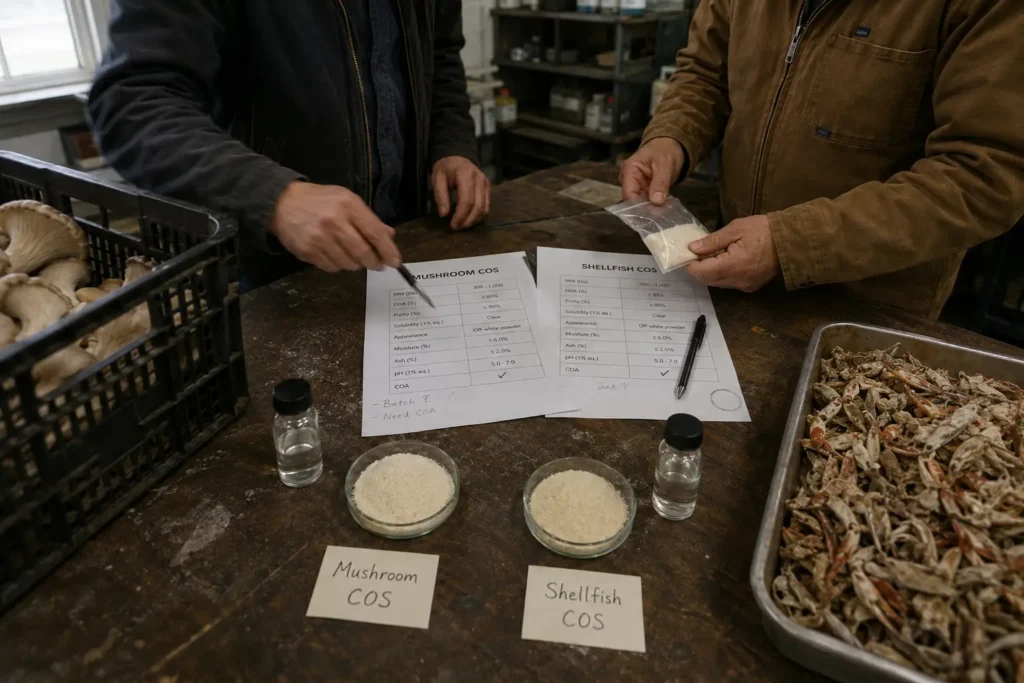
Both Mushroom Chitosan Oligosaccharide and Shellfish Chitosan Oligosaccharide are low-molecular-weight chitosan derivatives short-chain oligomers produced by breaking down the long chitosan polymer into fragments typically under 5,000 Da. What differs is the biological source: Mushroom COS comes from fungal chitin, Shellfish COS from shrimp and crab shell chitin. Biological origin is not the same thing as technical performance. Actual behavior depends on molecular weight, molecular weight distribution, DDA, purity, solubility, and formulation conditions not simply on which organism the chitin came from. Already comparing materials? Review the current Mushroom COS and Shellfish COS product specifications and COAs before selecting a source. Quick Comparison Factor Mushroom COS Shellfish COS Why It Matters Biological source Mushroom / fungal chitin Shrimp & crab shell chitin Determines allergen/labeling considerations and sourcing model Molecular weight Below 1 kDa (current specification) Below 5 kDa (Food Grade); up to ~10 kDa range (Industrial Grade) Affects solubility, viscosity, and formulation behavior DDA 95%+ (current specification) ≥90% (Food Grade), ≥85% (Industrial Grade) Determines charge density available for interaction Water solubility Water-soluble Water-soluble Both dissolve at neutral pH — the defining COS characteristic Available grades Food, Industrial Food, Industrial, Agricultural Both offer grade-specific documentation Documentation COA and SDS available COA and SDS available; food-grade heavy-metal/microbial testing documented Both support pre-purchase specification verification Source traceability Controlled fungal cultivation Established shrimp/crab shell supply chain, subject to seasonal variation Different supply-consistency profiles Commercial maturity Newer commercial source, growing supply Long-established, largest global chitosan/COS feedstock Affects available grade breadth and typical lead times Allergen/labeling Not shellfish-derived Shellfish-derived — not suitable for shellfish-allergen-free or vegan claims Relevant for label and market-positioning decisions Sample availability Sample and COA available Sample and COA available Both support sample-first evaluation Specifications reflect current published product data at the time of writing. Always confirm against the batch-specific Certificate of Analysis before finalizing a formulation, since values and available grade ranges can change between production runs. Does the Biological Source Change COS Performance? Not by itself. Two COS materials from different biological origins with similar molecular weight, DDA, and purity can behave more similarly to each other than two COS grades from the same origin with very different molecular-weight distributions. Comparing “mushroom” against “shellfish” as if origin alone predicts solubility, bioactivity, viscosity, or formulation behavior overstates what origin actually determines. Origin affects sourcing, documentation, supply-chain characteristics, and labeling not the polymer chemistry itself, which is governed by chain length and charge density. Molecular Weight and DDA Matter More Than Source Labels Lower molecular weight generally improves water solubility, reduces viscosity, and increases dispersion speed relevant wherever fast, neutral-pH incorporation matters. It is not automatically “better” in every context: applications that need more structural or viscosity-building behavior may prefer a higher-MW grade within the COS range, or a native (non-oligosaccharide) chitosan altogether. Higher DDA generally increases the density of protonated amino groups available for charge-driven interactions again, not a fixed hierarchy, since some research contexts specifically call for a lower DDA. The current Mushroom COS specification (sub-1 kDa, 95%+ DDA) and Shellfish COS specification (sub-5 kDa Food Grade, ≥90% DDA) put mushroom-origin material at a lower MW range in Chitosan Global’s current catalog — but that reflects today’s specific grades, not an inherent property of either source. Water Solubility Both materials are already low-molecular-weight oligosaccharides, so both are designed to dissolve directly in neutral water without the acid-activation step native chitosan requires — that’s the defining functional advantage of the COS form generally, independent of biological source. For the deeper solubility chemistry and formulation-behavior detail, see water-soluble Mushroom Chitosan. Mushroom Source Considerations Buyers may consider Mushroom COS for a fungal, non-crustacean sourcing preference; product-positioning requirements around non-shellfish origin; controlled cultivation supply; or documentation and traceability tied to a fungal feedstock. This is a sourcing and positioning consideration, not a claim that mushroom-origin material is inherently cleaner, safer, or higher-performing — confirm any allergen-free, vegan, halal, or kosher claim against actual current certification before relying on it. Shellfish Source Considerations Shrimp and crab shell chitin remains the largest and most established global chitosan and COS feedstock, backed by decades of characterization research, mature processing infrastructure, and the broadest range of commercially available molecular-weight and DDA grades. That maturity is a genuine advantage for buyers prioritizing supply depth and grade selection. It does not make shellfish-derived material lower quality, less pure, or less safe than fungal-origin material the two sourcing models simply carry different supply-chain and labeling characteristics. Allergen and Labeling Considerations Shellfish-derived starting material can raise sourcing, labeling, or customer-policy questions depending on your final application, market, and jurisdiction particularly for allergen-sensitive food, supplement, or vegan-positioned products. This is a labeling and documentation consideration, not a settled medical claim about whether a purified, processed COS retains meaningful shellfish-allergen risk; that determination is application- and regulation-specific, and buyers with allergen-labeling requirements should confirm directly with their regulatory or quality team. Mushroom COS is not shellfish-derived, but that alone does not automatically make it “allergen-free” in a regulatory sense confirm against current documentation for your specific market. Sustainability Sustainability comparisons between fungal and crustacean COS sourcing depend on more than origin. Relevant factors include feedstock inputs, cultivation or shell-processing conditions, extraction chemistry, energy and water use, yield, waste handling, transportation, and manufacturing scale. Shellfish COS production can utilize existing seafood-processing by-products, which is itself a resource-efficiency argument; mushroom COS production utilizes fungal biomass streams under controlled cultivation. Without direct lifecycle-assessment data comparing the two specific production systems, origin alone is not sufficient evidence to declare either source more sustainable. Application Decision Functional foods: both are studied and used in aqueous functional-food and beverage systems; the deciding factor is typically specification and labeling fit, not source alone. See Mushroom COS for Functional Foods. Drug-delivery research: molecular weight, DDA, purity, and formulation compatibility are generally more relevant to research design than biological origin. See Mushroom COS for Drug Delivery. Cosmetics and personal care: selection should follow the specification (MW, viscosity, solubility) your formulation needs, evaluated against either source’s current grade. Agriculture: technical requirements — dispersion behavior,
Mushroom COS vs Native Mushroom Chitosan: What’s the Real Difference?
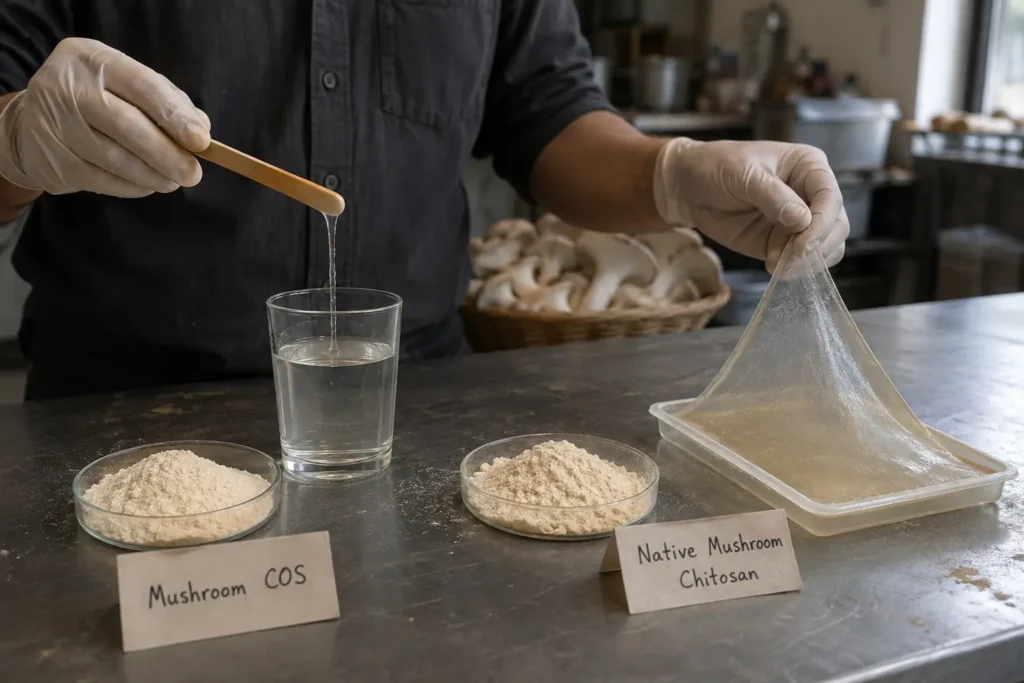
Both Mushroom Chitosan Oligosaccharide (COS) and Native Mushroom Chitosan come from the same fungal starting material but they are not the same material form. The difference that actually matters isn’t “mushroom vs. mushroom,” since both share fungal origin. It’s polymer chain length. Native Mushroom Chitosan retains the long polymer chains typical of unmodified chitosan and is generally acid-soluble. Mushroom COS is produced by breaking those chains down into much shorter oligosaccharide fragments, which is what gives it low molecular weight and easier aqueous handling. Neither form is universally better the right choice depends on what your formulation actually needs. Already comparing materials? Review the current Mushroom COS and Native Mushroom Chitosan specifications before selecting a grade. Quick Comparison Factor Mushroom COS Native Mushroom Chitosan Why It Matters Source Mushroom / fungal Mushroom / fungal Both share the same starting biomass Polymer form Oligosaccharide (short chains) Native (long chains) Chain length is the core functional difference Molecular weight Below 1 kDa (current specification) Grade-dependent, higher than COS Governs solubility, viscosity, and film-forming capacity DDA 95%+ (current specification) ~98% (current specification) Both are high-DDA grades; not the main differentiator here Solubility Water-soluble Acid-soluble COS handles directly in neutral aqueous systems; native chitosan needs acid activation Viscosity Lower, easier to disperse Higher, grade-dependent Affects processing and mouthfeel/texture in liquid systems Film-forming capability Limited — short chains don’t build strong films Stronger long chains support continuous films Relevant for coatings, packaging films, cosmetic films Typical use context Functional foods/beverages, aqueous formulation, low-viscosity systems Coatings, films, gels, systems needing polymer-network structure Matches the application to the chain-length behavior that fits it Sample/specification availability Sample and COA available Sample and COA available Both support sample-first evaluation Specifications reflect current published product data at time of writing. Always confirm against the batch-specific Certificate of Analysis before finalizing a formulation. Molecular Size Is What Actually Changes Behavior The most meaningful distinction here isn’t biological source both materials come from the same fungal chitosan. It’s chain length. Native Mushroom Chitosan keeps the long polymer chains produced during initial deacetylation. Mushroom COS is made by further breaking those chains down through controlled depolymerization into much shorter oligosaccharide fragments. That size difference changes what each material is good at. Lower molecular weight COS generally means better solubility, lower viscosity, faster dispersion, and easier handling in aqueous or dry-blend systems — useful wherever you need the material to dissolve and disperse quickly without building viscosity. Higher molecular weight native chitosan generally means stronger film formation, more polymer-network structure, and higher viscosity useful wherever you need the material to hold a shape, form a coating, or build a gel. Neither is “always better absorbed” or “always structurally stronger” those outcomes depend on chain length matched to what your application needs, not a fixed hierarchy between the two forms. Solubility: The Practical Dividing Line Native Mushroom Chitosan is acid-soluble — it requires acidic conditions to dissolve, the same limitation that applies to any native chitosan. Mushroom COS, because of its short chain length, is generally much easier to incorporate directly into aqueous systems without acid activation. For many formulators, this solubility difference not molecular weight on a data sheet is the practical reason to choose one over the other. For the deeper solubility chemistry and formulation behavior, see water-soluble Mushroom Chitosan. Functional Differences “Better” only makes sense with a “for what” attached. Across the dimensions that typically matter to formulators: Film formation: Native chitosan’s longer chains support continuous, cohesive films. COS’s short chains generally do not form strong films on their own. Viscosity: Native chitosan solutions are typically more viscous at a given concentration; COS solutions are typically lower-viscosity and easier to pump or spray. Coating behavior: Native chitosan is the more common choice where a coating needs structural integrity. Water handling: COS is the more practical choice where rapid, neutral-pH dispersion matters more than film strength. Polymer-network formation: Native chitosan’s longer chains support gel and network structures that short-chain COS does not replicate. Formulation flexibility: COS tends to fit liquid, dry-blend, and low-viscosity systems; native chitosan tends to fit film, coating, and gel systems. Which One Should You Choose? Consider Mushroom COS when: Low molecular weight is required for your formulation Low viscosity is preferred for processing or mouthfeel Aqueous formulation at neutral pH is important Functional-food or liquid-format work needs easy dispersion A short-chain chitosan form specifically fits your research question Consider Native Mushroom Chitosan when: Longer polymer chains are needed for structural function Film formation is part of the intended use Coatings are required Higher viscosity is useful to your process Native (unmodified) polymer behavior is specifically what you’re studying or formulating with These are qualified starting points, not universal rules — confirm against your own formulation testing. Application Comparison Functional foods and beverages: COS’s low viscosity and neutral-pH solubility generally make it more convenient in aqueous food and beverage systems. See Mushroom COS for Functional Foods. Drug-delivery research: Low-molecular-weight COS is studied differently from native chitosan in formulation research, often for different delivery mechanisms. See Mushroom COS for Drug Delivery. Coatings and films: Native chitosan’s longer chains are typically the more relevant starting point where film integrity matters. Agriculture: Selection depends on whether you need a fast-dispersing spray-tank additive (COS) or a film-forming seed or surface treatment (native chitosan). Cosmetics: The right material depends on whether the formulation needs viscosity and film-building (native) or light, fast-absorbing dispersion (COS). Not All COS — or Native Chitosan — Grades Are the Same Two products both labeled “Mushroom COS” can differ in molecular weight, molecular weight distribution, DDA, purity, and solubility. The same is true for two products labeled “Native Mushroom Chitosan.” Material name alone doesn’t tell you enough compare the actual specification sheet. Parameter Why It Matters COS Buyer Should Check Native Chitosan Buyer Should Check Molecular weight Governs solubility, viscosity, film capacity Current MW figure vs. category range Current MW/viscosity grade DDA Determines charge density Batch DDA figure Batch DDA figure Solubility Confirms processability Confirmed water solubility Confirmed acid-solubility conditions
Chitosan Hydrochloride in Water Treatment: Where a Water-Soluble Cationic Polymer Actually Fits
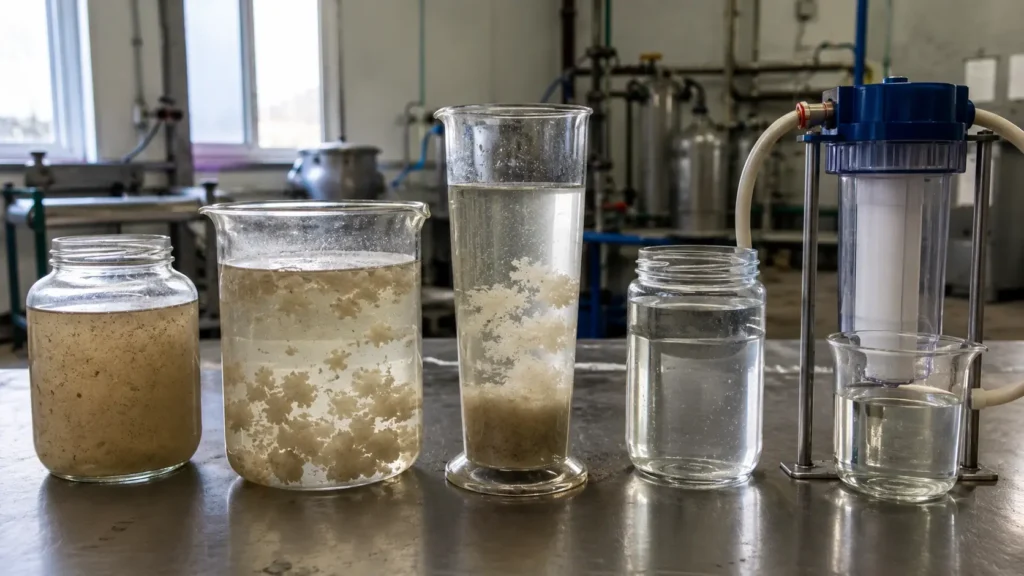
Most cationic polymers used in coagulation and flocculation share one practical requirement: they need to be in solution before they can neutralize charge or bridge particles into removable flocs. Native chitosan complicates that, since it only dissolves in acid. Chitosan hydrochloride chitosan pre-converted to its water-soluble salt form has been studied as a way to simplify that handling step in aqueous treatment systems, though actual treatment performance still depends on the same variables that govern any chitosan-based flocculant: dose, pH, molecular weight, and the specific contaminant involved. Why Polymer Charge Matters in Water Treatment Suspended particles, colloids, and many dissolved contaminants carry a net negative surface charge, keeping them electrostatically repelled and in stable suspension. Cationic polymers disrupt that stability. Chitosan’s protonated amine groups (–NH₃⁺) give it a positive charge in acidic to near-neutral conditions, allowing it to interact with negatively charged particles the same underlying property whether the polymer arrives as native chitosan requiring an acid carrier or as a pre-protonated hydrochloride salt. The practical distinction is handling, not chemistry: getting a cationic polymer fully dissolved and evenly dispersed before dosing affects consistency. A water-soluble salt form removes one variable (acid handling) from that equation, though it doesn’t change the underlying charge-based mechanism once the polymer is in solution. Where Chitosan HCl Fits in a Treatment Train At a high level, a cationic chitosan derivative is typically considered at the coagulation/flocculation stage of a treatment sequence: Influent → Coagulation/Flocculation → Separation (settling or flotation) → Clarification → Further Treatment In this position, the polymer’s job is to destabilize suspended and colloidal material so it aggregates into larger, more easily removed flocs before the water moves on to clarification or downstream polishing steps. This is a general process context, not a prescribed plant design actual treatment train configuration depends on the specific contaminant profile, existing infrastructure, and regulatory requirements for a given facility. Mechanisms: How Chitosan-Based Polymers Actually Remove Contaminants Chitosan-based treatment doesn’t operate through one single mechanism. Depending on conditions, several documented mechanisms can contribute: Charge neutralization — protonated amine groups directly neutralize negative surface charge on suspended particles, reducing electrostatic repulsion and allowing aggregation. Polymer bridging — chitosan chains can physically bridge between particles, pulling them into larger flocs, particularly at higher molecular weight. Sweep flocculation — the polymer forms a network structure that physically captures and settles suspended material, distinct from charge-based interaction alone. Adsorption — amine and hydroxyl groups can bind contaminants (particularly metal ions) through electrostatic attraction and chelation-like interaction, studied somewhat separately from flocculation. Hydrogen bonding and hydrophobic association — research on dye removal has found these mechanisms working alongside charge neutralization for certain dye structures. Research is consistent that the dominant mechanism varies by contaminant type, water chemistry, and polymer structure no single mechanism explains chitosan’s performance across every application. Mechanism Table Mechanism Target Problem Why Chitosan HCl May Help Important Limitation Charge neutralization Suspended colloids, negatively charged particles Protonated amine groups directly reduce particle charge, aggregating material into flocs Effectiveness depends on achieving the right dose relative to particle charge; overdosing can re-stabilize particles Polymer bridging Fine suspended solids, larger floc formation Higher molecular weight chains can bridge multiple particles into larger, more settleable flocs Requires sufficient molecular weight; low-MW material may not bridge effectively Adsorption / metal-ion interaction Dissolved heavy metal ions (e.g., Cr, Pb, Cu, Ni, Cd) Amine groups can bind metal ions through electrostatic and chelation-like interaction Flocculation alone is largely ineffective on fully dissolved species; metals in complexed or dissolved form may require adsorption-specific approaches rather than flocculation Sweep flocculation Turbidity, general suspended solids Polymer network physically captures and settles particulate material Less selective; works alongside rather than instead of charge-based mechanisms Hydrogen bonding / hydrophobic association Certain dye structures Contributes to decolorization for specific dye chemistries alongside charge effects Mechanism contribution varies significantly by dye molecular structure Water Chemistry Determines Whether Any of This Works Well “Water soluble” describes the polymer’s handling property, not a guarantee of treatment performance. Real-world effectiveness depends on pH (chitosan’s charge density is pH-dependent, which is why some research has developed pH-responsive chitosan flocculant designs), molecular weight and DDA (governing whether bridging or charge-neutralization dominates, and how much charge-neutralization capacity is available), dosage (both under- and over-dosing reduce performance excess cationic polymer can re-stabilize particles rather than aggregate them), ionic strength and competing ions, turbidity and suspended solids concentration, contaminant concentration and speciation (particularly for heavy metals, where dissolved versus particulate-bound forms respond very differently), and mixing conditions and contact time. A water-treatment engineer selecting a polymer based on the name “chitosan hydrochloride” alone, without confirming molecular weight, DDA, and viscosity against their specific water matrix, is skipping the step that actually determines performance. Contaminant and Treatment Areas: Established vs. Emerging Suspended solids and turbidity — the most established use case, with chitosan-based coagulation/flocculation extensively studied for reducing turbidity in industrial and municipal contexts. Heavy metals — research has investigated chitosan-based flocculation and adsorption for metals including chromium, lead, copper, nickel, zinc, and cadmium, generally through charge neutralization combined with polymer bridging, or through direct adsorption for dissolved metal species. Performance depends heavily on whether the metal is present in particulate, complexed, or fully dissolved form — flocculation alone is generally ineffective against dissolved species, which require adsorption or chelation-based approaches instead. Dyes — extensively studied, particularly for textile and dye-manufacturing effluent, with documented decolorization efficiencies varying widely by dye structure and treatment conditions; results should be understood as specific to the tested dye rather than generalized across all dye types. Organic matter and sludge conditioning — studied for aiding sludge dewatering and organic matter removal, an established but less publicized application area. Industrial effluent broadly — textile, paper mill, and similar industrial wastewater streams are common research contexts given their combination of suspended solids, dyes, and sometimes metal content. Emerging contaminants — research on chitosan-based flocculants for metallic nanoparticles and other emerging contaminants exists but remains newer and less established. Claims regarding PFAS or microplastic removal specifically require strong, directly
Chitosan Hydrochloride for Drug Delivery
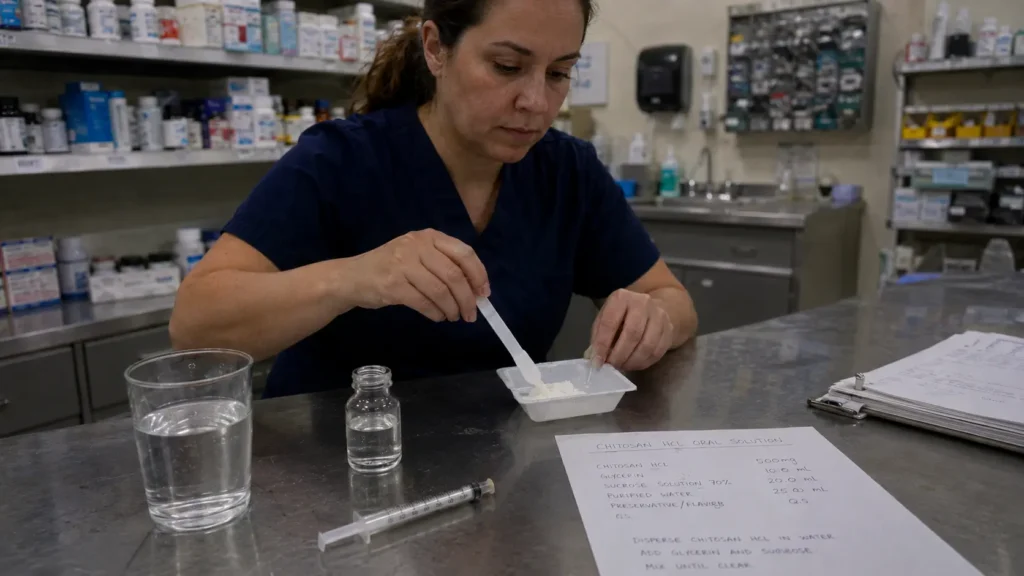
The Problem Chitosan Hydrochloride Is Studied Against Many polymers used to build drug carriers face the same practical obstacle: they need to dissolve, or at least behave predictably, in an aqueous environment at or near physiological pH, while also carrying a surface charge that lets them interact with a drug molecule or a biological membrane. Native chitosan struggles with the first half of that requirement, it’s only soluble in acidic solution, which limits its usefulness in formulations that must be processed or administered near neutral pH. This gap is the starting point for most research interest in chitosan hydrochloride: it’s chitosan modified specifically to remain soluble and cationic across a wider pH range, which is why it keeps appearing in drug-delivery literature rather than the unmodified polymer. Why Polymer Properties Matter Before Application Design A polymer’s suitability for drug delivery isn’t a single yes/no property, it’s a combination of solubility behavior, charge density, and molecular size, and each of those depends on how the material was made. This is worth stating plainly because it’s easy to read “chitosan hydrochloride” as a single defined material when, in research terms, it’s closer to a family of materials that share a chemical backbone but differ meaningfully in molecular weight and degree of deacetylation (DDA) depending on the source chitosan and manufacturing conditions used. For background on how those upstream variables are set during production, see our chitosan hydrochloride manufacturing process article. Where Chitosan Hydrochloride Fits in Drug-Delivery Research Chitosan hydrochloride is the salt form of chitosan, produced by protonating its amino groups with hydrochloric acid. That protonation is what keeps it water-soluble at neutral pH, unlike native chitosan, which requires acidic conditions to dissolve. In practical formulation terms, this means chitosan hydrochloride can often be worked with directly in aqueous, near-neutral systems, without the extra acidification step native chitosan formulations typically require. If you’re deciding between the two forms for a specific formulation, our comparison of Chitosan Hydrochloride vs. Native Chitosan covers that decision directly. For a deeper look at the solubility chemistry itself, see water-soluble shellfish chitosan. Mechanistic Reasons for Research Interest Three overlapping properties explain most of the research attention chitosan hydrochloride receives: Cationic charge. Its protonated amino groups give the polymer a net positive charge in solution, which is the basis for its electrostatic interaction with negatively charged molecules including many drug compounds, nucleic acids, and biological surfaces. Mucoadhesion. That same positive charge allows chitosan hydrochloride to interact electrostatically with the negatively charged sialic acid residues of mucin glycoproteins lining mucosal surfaces (gastrointestinal tract, nasal cavity, buccal cavity, ocular surface). This interaction has been studied as a mechanism for extending a formulation’s residence time at an absorption site, which researchers investigate as a route to improved local exposure though the degree of benefit is formulation- and route-specific, not a fixed property of the material. Ionic gelation capacity. Chitosan hydrochloride’s positive charge allows it to form nanoparticles through ionic gelation, most commonly by combining it with sodium tripolyphosphate (TPP), whose negatively charged phosphate groups crosslink with the polymer’s amino groups to spontaneously form particles without organic solvents or high shear. This mild, aqueous-based process is one of the more frequently cited reasons chitosan and its salt forms appear in nanoparticle drug-delivery literature. A Note on Evidence Strength It’s worth being explicit here: mucoadhesion and ionic-gelation nanoparticle formation are well-documented, reproducible phenomena across a large body of published research. Claims about specific bioavailability improvements, permeability enhancement magnitude, or clinical efficacy are far more study-specific they depend heavily on the drug being delivered, the exact formulation, the administration route, and the test model used, and should not be generalized from one study to “chitosan hydrochloride” as a category. Delivery Systems Where Chitosan Hydrochloride Has Been Studied Nanoparticles. The most extensively documented application. Chitosan-TPP ionic gelation has been used across a range of drug-loaded nanoparticle studies, with reported particle sizes commonly in the tens-to-low-hundreds of nanometers depending on the polymer-to-crosslinker ratio, and encapsulation efficiencies that vary widely by drug and method. Nanoparticle formulations have been investigated across oral, nasal, and ocular routes in the published literature. Microparticles and spray-dried carriers. Spray drying has been used to produce chitosan-based microparticle carriers at larger scale than typical lab-bench ionic gelation, including hydrogel-forming particle systems evaluated for oral drug delivery. Mucoadhesive hydrogels and films. Chitosan hydrochloride’s film- and gel-forming behavior has been studied for topical, buccal, and other mucosal-contact delivery formats, where sustained surface contact is the primary formulation goal. Oral, nasal, and ocular mucoadhesive systems. Across these routes, the shared research rationale is the same: use the polymer’s positive charge to promote adhesion to a mucosal surface and potentially extend local residence time, an approach that has been investigated in nasal, ocular, and oral formulation contexts in the literature reviewed above. Need to compare material properties for your formulation? Review current specifications for Shellfish Chitosan Hydrochloride. Mechanism Table Property Why Researchers Care Potential Drug-Delivery Relevance Important Limitation Water solubility (neutral pH) Enables processing in aqueous systems without acidification Simplifies formulation in near-physiological conditions Solubility and dissolution rate still depend on molecular weight and DDA Positive (cationic) charge Drives electrostatic interactions with anionic molecules and surfaces Basis for mucoadhesion and ionic-gelation nanoparticle formation Charge density varies with DDA and degree of protonation, not fixed across grades Mucoadhesion Extends contact time at mucosal surfaces in vitro and in some in vivo models Investigated for oral, nasal, ocular, and buccal delivery systems Effect size is formulation- and model-specific, not a guaranteed outcome Molecular weight Influences viscosity, particle size, and degradation behavior Lower MW often favors smaller, more uniform nanoparticles Very low MW can reduce mechanical film strength and gel stability Degree of deacetylation (DDA) Determines charge density and functional group availability Higher DDA generally increases mucoadhesive and complexation strength High DDA material can also increase viscosity, complicating processing Biodegradability Reduces long-term accumulation concerns in biomedical use Supports its investigation in implantable and injectable research systems Degradation rate in vivo is not uniform across formulation types Polymer–drug interaction Ionic
Chitosan Hydrochloride Manufacturing Process
How Is Chitosan Hydrochloride Manufactured? Chitosan hydrochloride is produced by converting native chitosan into its hydrochloride salt form a reaction that protonates the polymer’s free amino groups and stabilizes them as a chloride salt. This single chemical step is what gives chitosan hydrochloride its defining practical advantage over native chitosan: reliable solubility in water at neutral pH, without an acid-activation step at the point of use. That’s the short answer. The rest of this article looks at what actually happens during that conversion, which process variables shape the final material’s specification, and how manufacturers verify that a batch meets the spec a buyer is relying on. Starting Material: Why Native Chitosan Matters Before the Salt Ever Forms The hydrochloride salt inherits its core properties from the chitosan it’s made from. Before any acid is introduced, the starting chitosan is already defined by two upstream characteristics that no amount of downstream processing can fully correct: degree of deacetylation (DDA) and molecular weight. Both trace back to how the parent chitin was deacetylated and, ultimately, to the shellfish source material and the deacetylation conditions used to produce it. This matters because DDA and molecular weight aren’t reset during salt formation they carry through into the finished hydrochloride product. A manufacturer working from a poorly characterized or inconsistent starting chitosan cannot produce a consistent hydrochloride salt downstream, regardless of how tightly the reaction step itself is controlled. The Salt Formation Concept Native chitosan is a weak cationic polyelectrolyte. Its free amino groups (–NH₂) only carry a positive charge when protonated, and that protonation only occurs in acidic solution below chitosan’s pKa of roughly 6.1–6.5. Above that pH, the amino groups lose their charge and the polymer becomes insoluble, which is precisely the limitation that makes native chitosan impractical for many neutral-pH industrial and pharmaceutical processes. Reacting chitosan with hydrochloric acid converts a portion of these amino groups into their protonated ammonium form (–NH₃⁺), paired with a chloride counter-ion. Once isolated and dried, this salt form remains water-soluble across a substantially wider pH range than the native polymer, including neutral conditions where unmodified chitosan would simply precipitate out of solution. Research on chitosan protonation behavior has shown that acid type and concentration directly influence how completely this protonation occurs, and that hydrochloric acid produces a stronger protonation effect than weaker organic acids such as acetic acid at comparable concentrations. Process Steps: From Native Polymer to Finished Salt Manufacturing conditions vary between producers depending on raw material source, target specification, and equipment design there is no single universal industrial recipe. At a conceptual level, though, the conversion generally follows this sequence: Native Chitosan → Controlled Protonation / Hydrochloride Salt Formation → Purification → Isolation → Drying → Particle Processing → Quality Characterization → Chitosan Hydrochloride Controlled protonation: Chitosan is brought into contact with hydrochloric acid under controlled conditions, converting amino groups to the protonated ammonium-chloride form. The degree of protonation achieved directly affects the solubility and charge density of the final salt. Purification: Excess acid, residual salts, and unreacted material are removed, typically through washing or filtration steps, to bring the product within acceptable residual-salt and purity limits. Isolation: The dissolved or suspended chitosan hydrochloride is separated from the process liquid. Published methods describe both precipitation-based recovery and spray drying as established isolation routes, with spray drying additionally used at industrial scale to directly produce a dry, free-flowing powder in a single step. Drying: Moisture is reduced to a target specification, since residual moisture affects both shelf stability and how the material is later handled or dissolved by the end user. Particle processing: Depending on the isolation method, the product may require milling or classification to reach a target particle size or mesh specification. Spray-dried material, for instance, is generated directly as spherical agglomerated particles, while precipitated material often requires separate size-reduction steps. Quality characterization: Before release, the batch is tested against defined specification parameters covered in detail below. It’s worth being direct about what this article is and isn’t: these are the conceptual stages reported in the scientific and patent literature for chitosan salt production generally, not a disclosure of Chitosan Global’s specific manufacturing parameters. Exact acid concentrations, reaction times, and temperatures are proprietary to individual manufacturers and are deliberately not detailed here. Want to compare the finished material specifications? See the Chitosan Hydrochloride (Shellfish) product page for current DDA, molecular weight, and viscosity data. Process Variables and Their Impact on Final Material The conditions used at each stage above influence a defined set of measurable outcomes in the finished product: Degree of deacetylation is set primarily by the starting chitosan and is largely preserved through salt formation, though processing conditions can influence how much of it is expressed as effective charge density in solution. Molecular weight can decrease if the polymer is exposed to harsh acid conditions, elevated temperature, or extended processing times, since glycosidic bonds in the chitosan backbone are susceptible to acid hydrolysis. This is one reason process control matters as much as raw-material selection. Viscosity in solution is a downstream function of both molecular weight and concentration, and is one of the most commonly specified parameters for formulators selecting a grade. Residual salts and moisture are governed by the purification and drying steps and affect both shelf stability and the accuracy of other specification tests. Particle size depends on the isolation and processing method — spray-dried material and precipitated-and-milled material typically produce different particle size distributions and morphology, which can matter for dissolution rate and handling. Batch consistency depends on how tightly all of the above are controlled run to run, which is why buyers evaluating suppliers are generally advised to request batch-specific documentation rather than relying on a static specification sheet. Quality and Characterization Parameter Why It Matters How It May Be Evaluated Degree of deacetylation (DDA) Determines charge density and functional activity Potentiometric or conductometric titration; ¹H NMR Molecular weight Affects viscosity, solubility, and application fit Gel permeation chromatography (GPC); viscometry Viscosity Governs handling and processing behavior
Chitosan-Based Produce Water Wash/Rinse: Regulatory Pathways, FIFRA 25(b) Considerations, and Technical Guidance
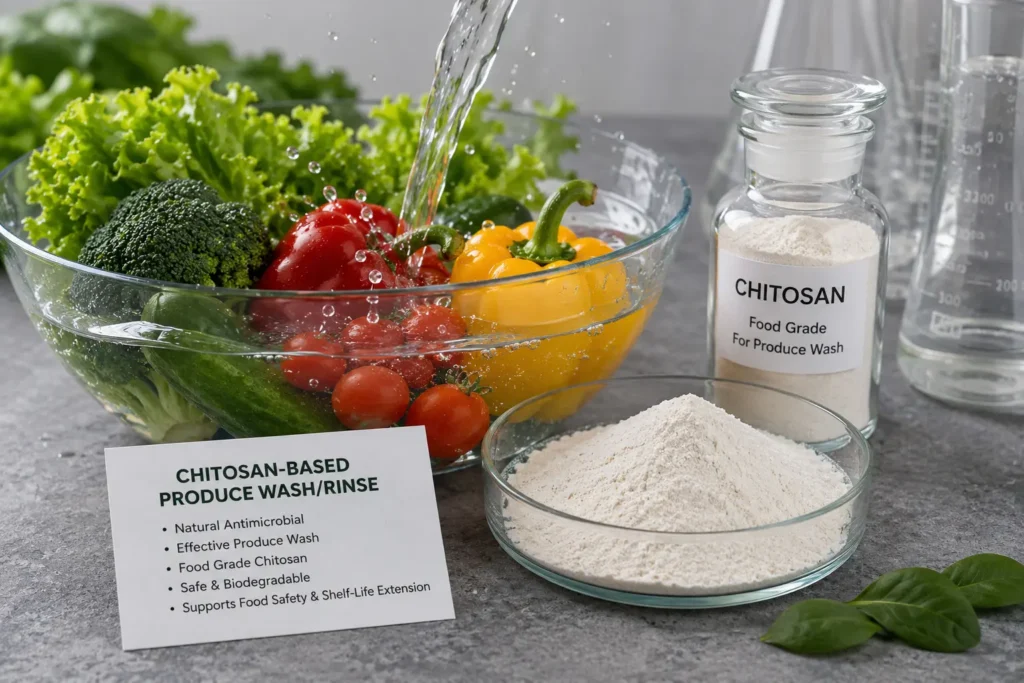
Chitosan Science, Research, Applications & Technical Insight Bringing any new produce-wash ingredient to market in the United States is, in practice, two separate projects run in parallel: a formulation project and a regulatory project. The formulation side asks whether the ingredient performs does it reduce microbial load, does it hold up across a wash cycle, does it meet a food processor’s specifications. The regulatory side asks a narrower but higher-stakes question: under what legal authority can this product make the claims it needs to make, and does that authority extend to every category the company eventually wants to sell into. For chitosan, the answer to that second question is not uniform across food categories. A chitosan-based wash formulated for produce has a defined, currently workable regulatory pathway in the United States. The same wash formulation, applied to raw meat or seafood, does not it sits under an entirely different regulatory authority, with a materially higher bar to clear. Treating these as one project rather than two is one of the more consequential planning mistakes a company can make when scoping a chitosan wash/rinse product line. This article lays out both pathways in detail: the FIFRA 25(b) exemption that governs produce washes, the claims framework that comes with it, the separate FDA/USDA-FSIS framework that governs meat and seafood, and why chitosan’s regulatory status in one category does not transfer to the other. It also covers the scientific basis for chitosan’s antimicrobial activity, since any claim made under either pathway ultimately has to be defensible against that underlying mechanism. Table of Contents Why Chitosan Is Drawing Regulatory Attention as a Produce Wash The Science Behind the Claim: How Chitosan’s Antimicrobial Activity Actually Works The Produce Pathway: FIFRA 25(b) Permitted vs. Disallowed Claims Under 25(b) EPA Product Performance Guidance (Series 810) Regulatory Recommendation — Produce Why Meat and Seafood Need a Different Pathway Why GRAS Isn’t a Shortcut Regulatory Recommendation — Meat & Seafood What This Means for Formulators and Brand Owners Summary Conclusion Supporting Technical Documents FAQ References Why Chitosan Is Drawing Regulatory Attention as a Produce Wash Fresh produce safety sits at an uncomfortable intersection: consumers want food with minimal synthetic residue, but postharvest washing still has to reliably knock down pathogens like E. coli and Salmonella before produce reaches a retail shelf. Chlorine-based washes remain the industry default, but they carry disinfection byproduct concerns and have shown inconsistent performance against certain pathogen loads in commercial-scale trials [4]. That gap is why biopolymer-based alternatives chitosan chief among them have moved from academic interest into active commercial development. Chitosan is a well-studied candidate for this role because of a genuinely unusual chemical property: it’s one of the few naturally occurring biopolymers that carries a net positive charge in mildly acidic conditions, which allows it to interact directly with the negatively charged membranes of many bacteria [1]. A 2021 meta-analysis of postharvest fruit studies found that chitosan treatment produced a statistically significant reduction in postharvest disease incidence and in vitro fungal mycelium growth across the pooled literature, alongside measurable elicitation of host plant defense responses evidence that the effect is reproducible across independent research groups, not an artifact of any single study design. Before getting into what that means for a produce wash formulation, it helps to understand why that mechanism matters commercially and then, in the second half of this guide, what it means for how such a product must be regulated. That regulatory question is the real subject of this article. A chitosan produce wash and a chitosan meat or seafood rinse are chemically similar products, but they sit under two entirely different regulatory frameworks in the United States one administered by the EPA, the other by FDA and USDA-FSIS. Conflating the two, or assuming a produce-wash approval extends to animal protein, is one of the more common and costly missteps in bringing this category of product to market. The Science Behind the Claim: How Chitosan’s Antimicrobial Activity Actually Works Before a produce wash can carry any antimicrobial claim, that claim needs a mechanistic basis regulators and buyers alike will ask why it works, not just that it works. Chitosan’s antimicrobial activity is generally attributed to a combination of mechanisms rather than a single mode of action. The cationic amino groups on the chitosan backbone, protonated under acidic conditions, interact electrostatically with the negatively charged bacterial cell surface, disrupting membrane permeability and causing leakage of intracellular contents [1]. Chitosan can also chelate metal ions such as calcium and iron that bacteria depend on for growth, and in some formulations it has been shown to interfere with microbial gene expression and to promote oxidative stress inside the bacterial cell. In produce-specific applications, this translates into measurable, if variable, pathogen reduction: one formulation study using chitosan nanoparticles as a vegetable wash disinfectant reported reductions of several log units against both E. coli and Salmonella Typhimurium under simulated washing conditions on fresh lettuce, with particle size and molecular weight both influencing performance . A related in-vitro study on chitosan combined with metabolites from Pediococcus pentosaceus similarly found measurable antimicrobial activity against Salmonella Typhimurium and E. coli O157:H7 . It’s worth being precise here: chitosan’s antimicrobial effect is well documented in the literature, but its magnitude is influenced by molecular weight, degree of deacetylation, pH, and formulation approach. This variability is exactly why the regulatory framework discussed below requires efficacy data specific to the finished product and its intended claims, rather than allowing a company to rely on general literature about chitosan as a class. For readers evaluating formulation strategy specifically rather than the regulatory pathway our Handbook chapter on Food Industry Applications goes deeper into how molecular weight and degree of deacetylation (DDA) selection affects both antimicrobial performance and film-forming behavior on produce surfaces, and our Chitosan Coatings on Produce Surfaces article covers the postharvest physiology side in more detail. With the scientific basis established, the next question is how that activity translates into a legally marketable claim in the United States which