
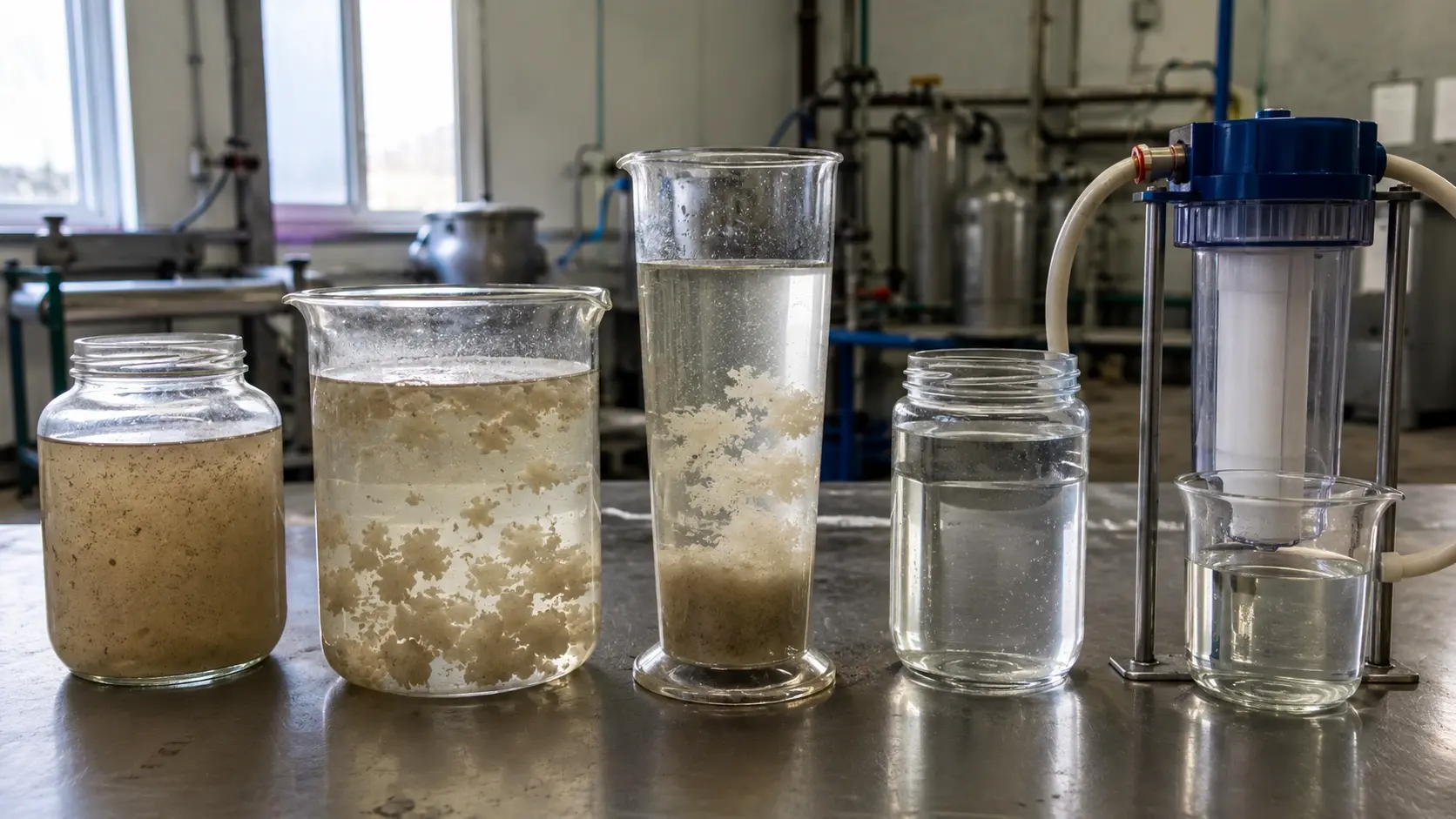
Most cationic polymers used in coagulation and flocculation share one practical requirement: they need to be in solution before they can neutralize charge or bridge particles into removable flocs. Native chitosan complicates that, since it only dissolves in acid. Chitosan hydrochloride chitosan pre-converted to its water-soluble salt form has been studied as a way to simplify that handling step in aqueous treatment systems, though actual treatment performance still depends on the same variables that govern any chitosan-based flocculant: dose, pH, molecular weight, and the specific contaminant involved.
Why Polymer Charge Matters in Water Treatment
Suspended particles, colloids, and many dissolved contaminants carry a net negative surface charge, keeping them electrostatically repelled and in stable suspension. Cationic polymers disrupt that stability. Chitosan’s protonated amine groups (–NH₃⁺) give it a positive charge in acidic to near-neutral conditions, allowing it to interact with negatively charged particles the same underlying property whether the polymer arrives as native chitosan requiring an acid carrier or as a pre-protonated hydrochloride salt.
The practical distinction is handling, not chemistry: getting a cationic polymer fully dissolved and evenly dispersed before dosing affects consistency. A water-soluble salt form removes one variable (acid handling) from that equation, though it doesn’t change the underlying charge-based mechanism once the polymer is in solution.
Where Chitosan HCl Fits in a Treatment Train
At a high level, a cationic chitosan derivative is typically considered at the coagulation/flocculation stage of a treatment sequence:
Influent → Coagulation/Flocculation → Separation (settling or flotation) → Clarification → Further Treatment
In this position, the polymer’s job is to destabilize suspended and colloidal material so it aggregates into larger, more easily removed flocs before the water moves on to clarification or downstream polishing steps. This is a general process context, not a prescribed plant design actual treatment train configuration depends on the specific contaminant profile, existing infrastructure, and regulatory requirements for a given facility.
Mechanisms: How Chitosan-Based Polymers Actually Remove Contaminants
Chitosan-based treatment doesn’t operate through one single mechanism. Depending on conditions, several documented mechanisms can contribute:
- Charge neutralization — protonated amine groups directly neutralize negative surface charge on suspended particles, reducing electrostatic repulsion and allowing aggregation.
- Polymer bridging — chitosan chains can physically bridge between particles, pulling them into larger flocs, particularly at higher molecular weight.
- Sweep flocculation — the polymer forms a network structure that physically captures and settles suspended material, distinct from charge-based interaction alone.
- Adsorption — amine and hydroxyl groups can bind contaminants (particularly metal ions) through electrostatic attraction and chelation-like interaction, studied somewhat separately from flocculation.
- Hydrogen bonding and hydrophobic association — research on dye removal has found these mechanisms working alongside charge neutralization for certain dye structures.
Research is consistent that the dominant mechanism varies by contaminant type, water chemistry, and polymer structure no single mechanism explains chitosan’s performance across every application.
Mechanism Table
| Mechanism | Target Problem | Why Chitosan HCl May Help | Important Limitation |
|---|---|---|---|
| Charge neutralization | Suspended colloids, negatively charged particles | Protonated amine groups directly reduce particle charge, aggregating material into flocs | Effectiveness depends on achieving the right dose relative to particle charge; overdosing can re-stabilize particles |
| Polymer bridging | Fine suspended solids, larger floc formation | Higher molecular weight chains can bridge multiple particles into larger, more settleable flocs | Requires sufficient molecular weight; low-MW material may not bridge effectively |
| Adsorption / metal-ion interaction | Dissolved heavy metal ions (e.g., Cr, Pb, Cu, Ni, Cd) | Amine groups can bind metal ions through electrostatic and chelation-like interaction | Flocculation alone is largely ineffective on fully dissolved species; metals in complexed or dissolved form may require adsorption-specific approaches rather than flocculation |
| Sweep flocculation | Turbidity, general suspended solids | Polymer network physically captures and settles particulate material | Less selective; works alongside rather than instead of charge-based mechanisms |
| Hydrogen bonding / hydrophobic association | Certain dye structures | Contributes to decolorization for specific dye chemistries alongside charge effects | Mechanism contribution varies significantly by dye molecular structure |
Water Chemistry Determines Whether Any of This Works Well
“Water soluble” describes the polymer’s handling property, not a guarantee of treatment performance. Real-world effectiveness depends on pH (chitosan’s charge density is pH-dependent, which is why some research has developed pH-responsive chitosan flocculant designs), molecular weight and DDA (governing whether bridging or charge-neutralization dominates, and how much charge-neutralization capacity is available), dosage (both under- and over-dosing reduce performance excess cationic polymer can re-stabilize particles rather than aggregate them), ionic strength and competing ions, turbidity and suspended solids concentration, contaminant concentration and speciation (particularly for heavy metals, where dissolved versus particulate-bound forms respond very differently), and mixing conditions and contact time.
A water-treatment engineer selecting a polymer based on the name “chitosan hydrochloride” alone, without confirming molecular weight, DDA, and viscosity against their specific water matrix, is skipping the step that actually determines performance.
Contaminant and Treatment Areas: Established vs. Emerging
Suspended solids and turbidity — the most established use case, with chitosan-based coagulation/flocculation extensively studied for reducing turbidity in industrial and municipal contexts.
Heavy metals — research has investigated chitosan-based flocculation and adsorption for metals including chromium, lead, copper, nickel, zinc, and cadmium, generally through charge neutralization combined with polymer bridging, or through direct adsorption for dissolved metal species. Performance depends heavily on whether the metal is present in particulate, complexed, or fully dissolved form — flocculation alone is generally ineffective against dissolved species, which require adsorption or chelation-based approaches instead.
Dyes — extensively studied, particularly for textile and dye-manufacturing effluent, with documented decolorization efficiencies varying widely by dye structure and treatment conditions; results should be understood as specific to the tested dye rather than generalized across all dye types.
Organic matter and sludge conditioning — studied for aiding sludge dewatering and organic matter removal, an established but less publicized application area.
Industrial effluent broadly — textile, paper mill, and similar industrial wastewater streams are common research contexts given their combination of suspended solids, dyes, and sometimes metal content.
Emerging contaminants — research on chitosan-based flocculants for metallic nanoparticles and other emerging contaminants exists but remains newer and less established. Claims regarding PFAS or microplastic removal specifically require strong, directly applicable evidence and should not be assumed from chitosan’s general flocculation properties.
Practical Process Variables Before Selecting a Polymer
Beyond water chemistry, the specific batch matters: molecular weight (affects whether bridging- or charge-neutralization-dominant behavior is expected), DDA (governs charge density), viscosity (affects dosing and mixing behavior), confirmed solubility at your system’s actual pH and concentration, purity (residual content affects batch-to-batch consistency), and dose optimized per system rather than assumed from general literature values. Contaminant characteristics matter too particulate versus dissolved species respond to different mechanisms, as noted above.
For the underlying chemistry of why the hydrochloride form dissolves without added acid, see our water-soluble shellfish chitosan article this post focuses on treatment application, not formulation chemistry.
Chitosan Hydrochloride vs. Native Chitosan for Treatment Systems
The practical advantage of the hydrochloride form here is handling simplicity: it dissolves without a separate acid-dosing step, simplifying dosing equipment and process control in some configurations. This doesn’t change the underlying flocculation or adsorption chemistry once either form is in solution — a fully dissolved native chitosan solution and a fully dissolved hydrochloride solution behave similarly at equivalent DDA and molecular weight. See our full comparison for more on cost and process considerations.
Limitations and a Reality Check
This is a genuinely useful biopolymer for specific treatment contexts, not a universal replacement for established chemistries. Worth weighing honestly: dose optimization is system-specific, since values from one study’s water matrix don’t transfer directly without validation; cost can exceed conventional coagulants like alum at commodity scale, though this varies by region; sludge generation still requires downstream handling, similar to other coagulant chemistries; sensitivity to water chemistry means lab-strong performance may need re-validation at actual plant conditions; polymer variability between batches affects reproducibility, making a batch-specific COA as important here as elsewhere; competing ions and complex effluent matrices can reduce effectiveness beyond what simplified lab studies capture; and laboratory-to-plant translation remains a known challenge across flocculant research generally, making pilot-scale validation a reasonable step before full commercial adoption.
None of this makes the material unsuitable — it means selection and dosing should be validated against your actual water matrix rather than assumed from general literature results.
Final Technical Takeaway
Chitosan hydrochloride’s water solubility solves a handling problem, not a treatment-performance problem the mechanisms that actually remove contaminants (charge neutralization, bridging, adsorption, sweep flocculation) depend on molecular weight, DDA, dose, and water chemistry regardless of which chitosan form is used. For technical buyers evaluating this material for treatment applications, the practical takeaway is to validate against your specific water matrix and contaminant profile, using documented batch specifications, rather than assuming general literature performance transfers directly to your system.
Need to compare polymer specifications for water-treatment testing? Review the Shellfish Chitosan Hydrochloride product page for current documentation.
Frequently Asked Questions
How does Chitosan Hydrochloride work in water treatment? Primarily through charge neutralization and polymer bridging protonated amine groups reduce negative charge on suspended particles, allowing aggregation into removable flocs. Adsorption and sweep flocculation can also contribute depending on conditions.
Is Chitosan HCl a flocculant? Yes, studied as a cationic flocculant, with the water-soluble salt form offering easier handling than native chitosan, which requires an acid carrier to dissolve.
Can Chitosan Hydrochloride remove heavy metals? Research has investigated it for metals including chromium, lead, copper, and others, primarily through charge neutralization/bridging for particulate-bound metals or direct adsorption for dissolved species. Effectiveness depends heavily on the metal’s chemical form in the specific water matrix.
How does pH affect chitosan-based treatment? Significantly. Chitosan’s charge density depends on pH, since its amine groups need protonation to carry positive charge. Performance in near-neutral or alkaline systems can differ substantially from more acidic conditions.
Is water-soluble chitosan better for wastewater treatment than native chitosan? Not necessarily in treatment performance the underlying mechanisms are similar once either form is fully dissolved. The water-soluble form’s advantage is simplified handling and dosing, not inherently superior removal.
What specifications matter for water-treatment testing? Molecular weight, DDA, viscosity, purity, and confirmed solubility at your system’s pH these determine whether charge-neutralization or bridging dominates, and should be validated against your water matrix rather than assumed from general literature.
How is Chitosan Hydrochloride different from Native Chitosan? It’s pre-protonated during manufacturing, so it dissolves in water without added acid. Native chitosan requires acid to reach the same protonated state. Once dissolved, both behave similarly for treatment purposes at equivalent MW and DDA.
Continue Your Research
For the broader material picture, see our Shellfish Chitosan Hydrochloride pillar guide. For how the hydrochloride salt is produced, see our manufacturing process overview. For sourcing and documentation practices, see our supplier evaluation guide, or contact our technical team to discuss your specific treatment application.