
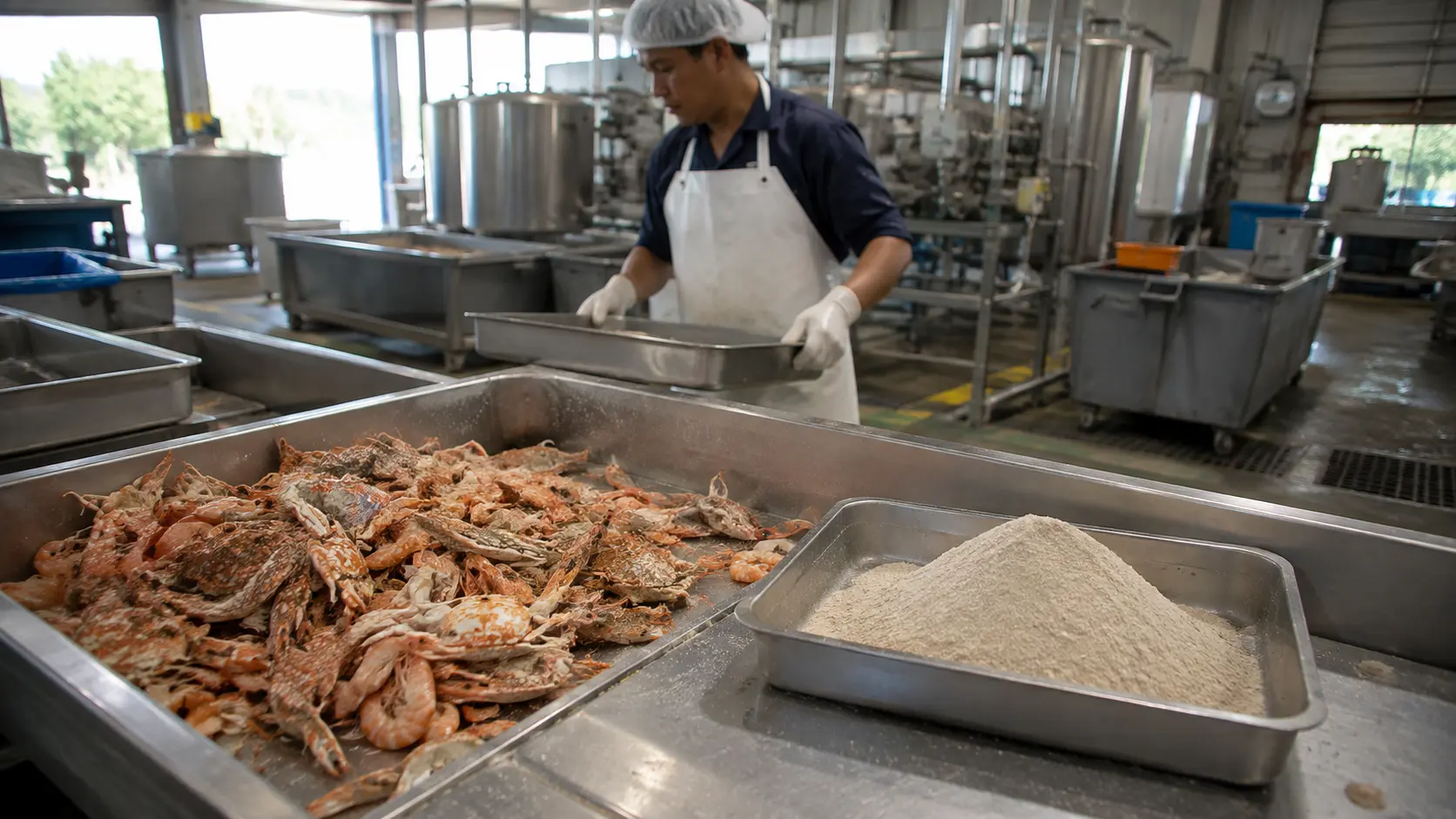
How Is Chitosan Hydrochloride Manufactured?
Chitosan hydrochloride is produced by converting native chitosan into its hydrochloride salt form a reaction that protonates the polymer’s free amino groups and stabilizes them as a chloride salt. This single chemical step is what gives chitosan hydrochloride its defining practical advantage over native chitosan: reliable solubility in water at neutral pH, without an acid-activation step at the point of use.
That’s the short answer. The rest of this article looks at what actually happens during that conversion, which process variables shape the final material’s specification, and how manufacturers verify that a batch meets the spec a buyer is relying on.
Starting Material: Why Native Chitosan Matters Before the Salt Ever Forms
The hydrochloride salt inherits its core properties from the chitosan it’s made from. Before any acid is introduced, the starting chitosan is already defined by two upstream characteristics that no amount of downstream processing can fully correct: degree of deacetylation (DDA) and molecular weight. Both trace back to how the parent chitin was deacetylated and, ultimately, to the shellfish source material and the deacetylation conditions used to produce it.
This matters because DDA and molecular weight aren’t reset during salt formation they carry through into the finished hydrochloride product. A manufacturer working from a poorly characterized or inconsistent starting chitosan cannot produce a consistent hydrochloride salt downstream, regardless of how tightly the reaction step itself is controlled.
The Salt Formation Concept
Native chitosan is a weak cationic polyelectrolyte. Its free amino groups (–NH₂) only carry a positive charge when protonated, and that protonation only occurs in acidic solution below chitosan’s pKa of roughly 6.1–6.5. Above that pH, the amino groups lose their charge and the polymer becomes insoluble, which is precisely the limitation that makes native chitosan impractical for many neutral-pH industrial and pharmaceutical processes.
Reacting chitosan with hydrochloric acid converts a portion of these amino groups into their protonated ammonium form (–NH₃⁺), paired with a chloride counter-ion. Once isolated and dried, this salt form remains water-soluble across a substantially wider pH range than the native polymer, including neutral conditions where unmodified chitosan would simply precipitate out of solution. Research on chitosan protonation behavior has shown that acid type and concentration directly influence how completely this protonation occurs, and that hydrochloric acid produces a stronger protonation effect than weaker organic acids such as acetic acid at comparable concentrations.
Process Steps: From Native Polymer to Finished Salt
Manufacturing conditions vary between producers depending on raw material source, target specification, and equipment design there is no single universal industrial recipe. At a conceptual level, though, the conversion generally follows this sequence:
Native Chitosan → Controlled Protonation / Hydrochloride Salt Formation → Purification → Isolation → Drying → Particle Processing → Quality Characterization → Chitosan Hydrochloride
- Controlled protonation: Chitosan is brought into contact with hydrochloric acid under controlled conditions, converting amino groups to the protonated ammonium-chloride form. The degree of protonation achieved directly affects the solubility and charge density of the final salt.
- Purification: Excess acid, residual salts, and unreacted material are removed, typically through washing or filtration steps, to bring the product within acceptable residual-salt and purity limits.
- Isolation: The dissolved or suspended chitosan hydrochloride is separated from the process liquid. Published methods describe both precipitation-based recovery and spray drying as established isolation routes, with spray drying additionally used at industrial scale to directly produce a dry, free-flowing powder in a single step.
- Drying: Moisture is reduced to a target specification, since residual moisture affects both shelf stability and how the material is later handled or dissolved by the end user.
- Particle processing: Depending on the isolation method, the product may require milling or classification to reach a target particle size or mesh specification. Spray-dried material, for instance, is generated directly as spherical agglomerated particles, while precipitated material often requires separate size-reduction steps.
- Quality characterization: Before release, the batch is tested against defined specification parameters covered in detail below.
It’s worth being direct about what this article is and isn’t: these are the conceptual stages reported in the scientific and patent literature for chitosan salt production generally, not a disclosure of Chitosan Global’s specific manufacturing parameters. Exact acid concentrations, reaction times, and temperatures are proprietary to individual manufacturers and are deliberately not detailed here.
Want to compare the finished material specifications? See the Chitosan Hydrochloride (Shellfish) product page for current DDA, molecular weight, and viscosity data.
Process Variables and Their Impact on Final Material
The conditions used at each stage above influence a defined set of measurable outcomes in the finished product:
- Degree of deacetylation is set primarily by the starting chitosan and is largely preserved through salt formation, though processing conditions can influence how much of it is expressed as effective charge density in solution.
- Molecular weight can decrease if the polymer is exposed to harsh acid conditions, elevated temperature, or extended processing times, since glycosidic bonds in the chitosan backbone are susceptible to acid hydrolysis. This is one reason process control matters as much as raw-material selection.
- Viscosity in solution is a downstream function of both molecular weight and concentration, and is one of the most commonly specified parameters for formulators selecting a grade.
- Residual salts and moisture are governed by the purification and drying steps and affect both shelf stability and the accuracy of other specification tests.
- Particle size depends on the isolation and processing method — spray-dried material and precipitated-and-milled material typically produce different particle size distributions and morphology, which can matter for dissolution rate and handling.
- Batch consistency depends on how tightly all of the above are controlled run to run, which is why buyers evaluating suppliers are generally advised to request batch-specific documentation rather than relying on a static specification sheet.
Quality and Characterization
| Parameter | Why It Matters | How It May Be Evaluated |
|---|---|---|
| Degree of deacetylation (DDA) | Determines charge density and functional activity | Potentiometric or conductometric titration; ¹H NMR |
| Molecular weight | Affects viscosity, solubility, and application fit | Gel permeation chromatography (GPC); viscometry |
| Viscosity | Governs handling and processing behavior in solution | Rotational viscometry at a defined concentration |
| Solubility | Confirms the salt form dissolves as intended at target pH | Visual/turbidity assessment across pH range |
| Moisture content | Affects shelf stability and accurate weight-based dosing | Loss-on-drying or Karl Fischer titration |
| Purity / residual salts | Confirms adequate purification | Ash content, conductivity, or ion chromatography |
| pH (aqueous solution) | Confirms expected salt behavior in solution | Direct pH measurement of a standard solution |
| Particle size | Affects dissolution rate and powder handling | Sieve analysis or laser diffraction |
Structural confirmation that the salt form has formed correctly, and that the polymer backbone remains intact, is commonly performed using Fourier-transform infrared spectroscopy (FTIR), which distinguishes protonated amino groups from the unprotonated native form.
Scale-Up Considerations
Laboratory-scale protonation and isolation methods don’t always translate directly to industrial volumes. Spray drying studies scaling from laboratory to industrial equipment have reported that particle size, morphology, and yield can shift when moving between scales, even when the underlying chemistry is unchanged, which is why reproducibility testing across scales is treated as a distinct validation step rather than an assumption. Manufacturers moving from pilot batches to commercial-scale production need to reconfirm that DDA, molecular weight, and particle characteristics hold within specification at the new scale, not just at the bench.
Why Manufacturing Quality Matters by Application
The process variables above aren’t abstract they determine whether a given batch performs as expected in the application it’s intended for.
In drug delivery formulations, molecular weight and degree of protonation directly affect nanoparticle formation behavior, mucoadhesive performance, and release kinetics see our chitosan hydrochloride for drug delivery resource for application-specific detail.
In water treatment, charge density (governed by DDA and degree of protonation) determines flocculation and chelation efficiency covered in chitosan hydrochloride for water treatment.
In cosmetic and food-contact applications, residual purity and moisture specifications are frequently the deciding factor in whether a batch is fit for a regulated formulation, independent of how well it performs functionally.
For the fuller picture of how chitosan hydrochloride’s properties translate into industry use cases, see the main Chitosan Hydrochloride (Shellfish) resource. If your process would actually be better served by the un-derivatized polymer, compare Chitosan Hydrochloride with Native Chitosan before specifying either.
Chitosan hydrochloride’s usefulness comes down to one chemical event protonating chitosan’s amino groups and stabilizing them as a chloride salt but the quality of the finished material depends on far more than that single step. Starting-material characterization, reaction control, purification, isolation method, and drying all leave a measurable signature on the final DDA, molecular weight, viscosity, and purity a buyer receives. Understanding this process is what separates a specification sheet you can trust from one you’re taking on faith.
Explore Shellfish Chitosan Hydrochloride, request a laboratory sample, review technical documentation, or contact the technical team with process or specification questions.
Frequently Asked Questions
How is chitosan hydrochloride manufactured?
By reacting native chitosan with hydrochloric acid, which protonates the polymer’s amino groups and stabilizes them as a water-soluble chloride salt. The material is then purified, isolated, dried, and characterized before release.
Is chitosan hydrochloride different from native chitosan?
Yes. Native chitosan only dissolves in acidic conditions (below roughly pH 6.1–6.5). Chitosan hydrochloride is the pre-formed salt of chitosan, soluble across a much wider pH range, including neutral water.
Why is hydrochloric acid used specifically?
Hydrochloric acid protonates chitosan’s amino groups more completely than weaker organic acids like acetic acid at comparable concentrations, producing a more stable, more consistently water-soluble salt form.
Does manufacturing affect molecular weight?
It can. Acid exposure, elevated temperature, and extended processing time can hydrolyze the chitosan backbone and reduce molecular weight, which is why process control matters as much as the starting material’s quality.
Why is chitosan HCl more water soluble than native chitosan?
Because its amino groups are already stabilized in protonated form as a chloride salt, rather than depending on the surrounding solution’s pH to protonate them at the point of use.
How is finished chitosan hydrochloride tested?
Common methods include titration or NMR for degree of deacetylation, gel permeation chromatography or viscometry for molecular weight, FTIR for structural confirmation, and standard tests for moisture, purity, and pH.
Can manufacturing methods vary between producers?
Yes. Reaction conditions, purification approach, and isolation method (precipitation versus spray drying, for example) all vary by manufacturer, raw material, and target specification — there’s no single industry-standard method.