
Shellfish COS vs Mushroom COS: Source or Spec – What Actually Decides?
No Products Found!
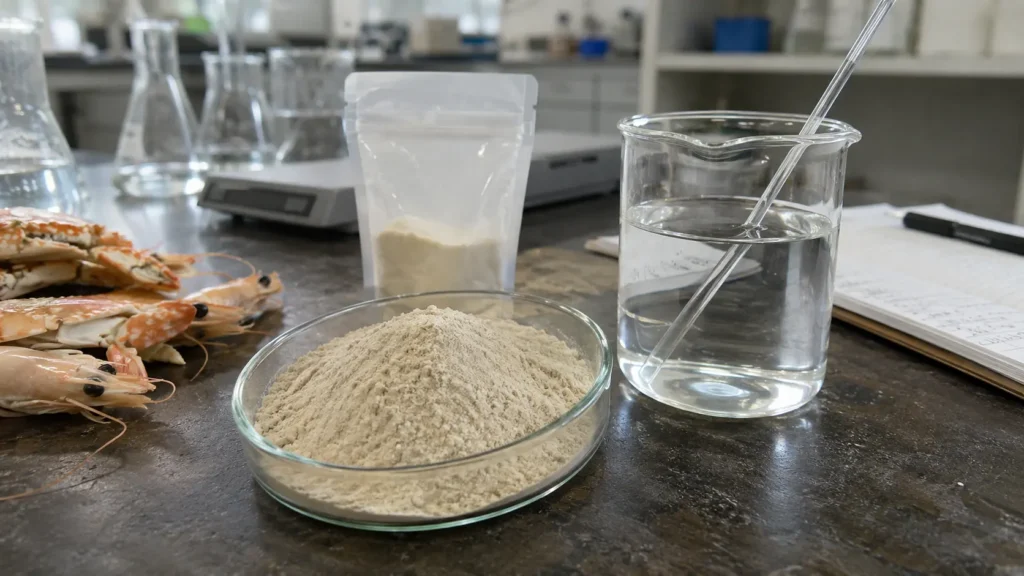
Here is the trap most buyers fall into: they search “shellfish COS vs mushroom COS” expecting a winner, and pick whichever page argues hardest for one side. That is the wrong question. Shellfish COS and Mushroom COS are chemically the same category of material – low-molecular-weight chitosan oligosaccharide pulled from two different starting organisms. The organism tells you almost nothing about how the powder will behave in your formulation; the spec sheet tells you everything. This page is built to get you asking the second question instead of the first – and to tell you the one case where the organism legitimately decides first.
Request a 25 g sample of Shellfish COS | Request a 25 g sample of Mushroom COS
Both are low-molecular-weight chitosan oligosaccharides – same chemistry, same water-soluble behavior, different starting organisms. In the current catalog the documented profiles differ: shellfish COS runs below 5,000 Da at 85-90% DDA across Food, Industrial, and Agricultural grades; mushroom COS runs below 1,000 Da at 95%+ DDA across Food, Nutraceutical, and Industrial grades. The one factor where origin genuinely decides before spec enters the conversation: labeling – shellfish material is neither vegan nor shellfish-allergen-free, and no specification changes that. Everywhere else: molecular weight, DDA, purity, and grade fit decide, and the batch COA is the only document that carries them.
Side by Side: the 8-Factor Comparison
The problem this table solves: the two materials compared on every axis a buyer can act on – with the “why it matters” column deciding which axes apply to you:
| Factor | Shellfish COS | Mushroom COS | Why It Matters |
|---|---|---|---|
| Biological source | Shrimp and crab shell chitin | Fungal (oyster mushroom) chitin | Drives labeling, allergen, and sourcing considerations – not performance by default |
| Molecular weight | Below 5,000 Da | Below 1,000 Da | Lower MW generally means faster dissolution, lower viscosity |
| DDA | 85-90%, grade-dependent | 95%+ (batch: 98.08%) | Higher DDA generally means more available charge sites |
| Solubility | Fully water-soluble | Fully water-soluble | Both remove chitosan’s acid-activation requirement – the shared advantage of the COS form |
| Grades available | Food, Industrial, Agricultural | Food, Nutraceutical, Industrial | Match grade to your regulatory pathway, not to whichever origin sounds cleaner |
| Supply maturity | Long-established, deep grade range | Newer, growing catalog | Shellfish wins on track record; mushroom is catching up on documentation |
| Labeling fit | Not vegan, not allergen-free | Marketed as vegan-friendly, not shellfish-derived | The one factor where origin genuinely decides the outcome, before spec even enters the conversation |
| Sample availability | 25 g sample, COA on request | Sample and COA available | Both support test-before-you-buy |
Numbers reflect current catalog listings – confirm against the batch COA before finalizing either material: Shellfish COS product page and Mushroom COS product page. Peer-reviewed basis for the shared chain-length behavior – oligomers staying soluble across a wider pH range than high-molecular-weight chitosan: the chitosan properties review (PMC8512176).
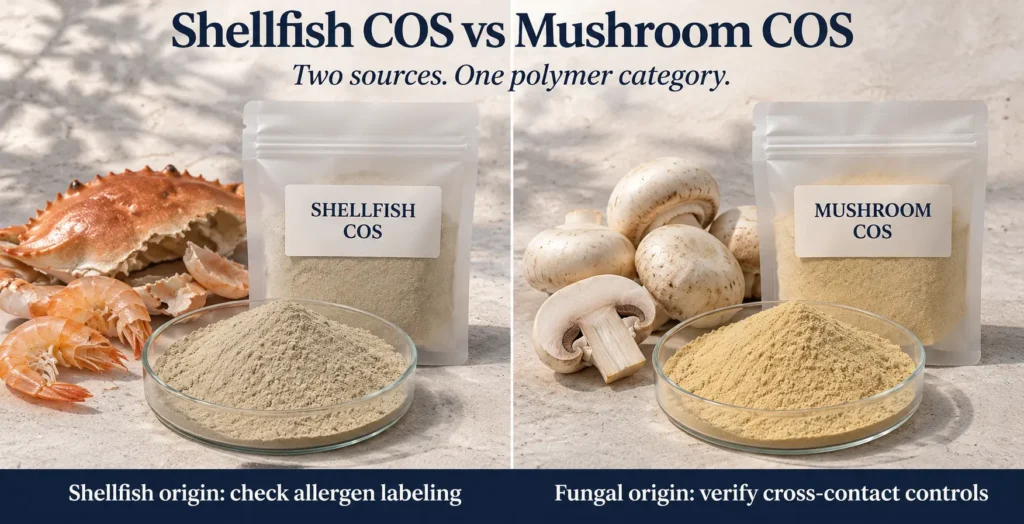
Source or Spec: the Question That Actually Matters in Shellfish COS vs Mushroom COS
Origin decides your sourcing story, your label, and in some cases your certification pathway. It does not decide how the powder dissolves, how it interacts with the rest of your formulation, or what your bioactivity research will show. A Shellfish COS batch and a Mushroom COS batch that happen to land on similar molecular weight, DDA, and purity numbers will generally behave more alike than two batches of the same origin with wildly different specs.
Flip that around and the mistake becomes obvious: choosing shellfish over mushroom (or the reverse) purely on a sourcing preference, then discovering the actual molecular-weight profile does not fit your process, is a completely avoidable procurement error.
Where source does legitimately decide the outcome before spec ever enters the room: labeling. If your product needs a vegan claim or shellfish-allergen-free status, that is a hard filter, not a technical preference – apply it first, then compare specs within whichever origin survives the filter.
What You Are Actually Getting With Shellfish
Shrimp and crab shell is the oldest, deepest chitin supply chain in the industry – decades of processing infrastructure, the widest range of available molecular-weight and DDA grades, and the largest body of comparative research behind it. That is a genuine, verifiable advantage if what you need is grade flexibility or a well-worn regulatory path. It is not automatically cheaper, purer, or higher-performing than the alternative – supply depth and product performance are different claims, and this page only makes the one it can back up. Broader background: the shellfish chitosan oligosaccharide guide.
What You Are Actually Getting With Mushroom
Fungal-origin COS is the newer entrant, and it currently ships at a notably lower molecular weight (sub-1,000 Da vs shellfish’s sub-5,000 Da) and higher DDA in the current catalog – real numbers, not a marketing angle, and worth knowing if your process specifically wants that end of the range. Its main non-technical draw is sourcing positioning: non-crustacean, generally marketed as vegan-compatible. It is not automatically safer, cleaner, or more sustainable just because it is not shellfish-derived – that is a separate claim requiring separate evidence, which this page does not manufacture on mushroom’s behalf. Broader background: the mushroom chitosan oligosaccharide guide.
Molecular Weight and DDA: Neither Direction Is “Better”
Lower molecular weight is not universally superior – it trades faster dissolution and lower viscosity for reduced film-forming and network-building capability. Higher DDA is not universally superior either – some research contexts specifically want a lower DDA. What you are optimizing for determines which number you want, and “which source has the bigger number” is not the optimization you should be running. If you are deciding based on shellfish COS’s molecular-weight range specifically: low molecular weight shellfish COS covers the deeper mechanics.
The Allergen Question, Answered Honestly
Shellfish-derived raw material can raise sourcing, labeling, or customer-policy questions depending on your market, your purification level, and your regulatory jurisdiction – that is a documentation issue, not a settled medical verdict. Whether a purified, processed COS carries meaningful shellfish-allergen risk for end consumers is an application- and regulation-specific determination, and this page is not going to pretend otherwise by declaring shellfish COS either dangerous or definitively safe for allergic consumers.
On the other side: mushroom COS not being shellfish-derived does not automatically make it “allergen-free” as a formal regulatory claim – confirm current certification with your own quality team before either statement goes on a label.
Sustainability: Nobody Gets to Claim the High Ground Here
If a page tells you flatly that one source is “more sustainable,” that page is skipping the actual analysis. Real environmental comparison depends on feedstock, cultivation or shell-processing conditions, chemical inputs, water and energy use, purification yield, waste handling, transportation, and production scale – a full lifecycle picture neither this page nor most competing content actually has for a direct head-to-head. Shellfish processing can utilize existing seafood byproduct streams; mushroom production runs on controlled fungal cultivation. Both are legitimate resource-efficiency stories on their own terms; neither is a documented winner over the other absent real lifecycle data.
Where Application Actually Changes the Calculus
- Functional foods – grade, documentation, and labeling requirements typically decide this before molecular weight does: Shellfish COS for functional foods
- Agriculture and plant applications – dispersion behavior and dose response matter more than origin story: Shellfish COS for plant growth
- Cosmetics, nutraceutical research, technical formulations – selection should follow your viscosity, solubility, and charge requirements against either origin’s current spec – not a general preference for one source over the other
Which One Should You Actually Pick in the Shellfish COS vs Mushroom COS Decision?
Lean shellfish when: you need the widest available grade range, a longer commercial track record, or crustacean origin is not a labeling problem for your product.
Lean mushroom when: vegan or non-crustacean sourcing is a hard requirement, or the current lower-molecular-weight, higher-DDA mushroom spec fits your formulation better than shellfish’s range.
Ignore origin entirely when: neither of the above applies to your project – in that case, spec wins, and you should be comparing molecular weight, DDA, and purity directly rather than reading another origin-comparison article.
Before You Choose, Compare This List
- Source (only if it is a hard labeling requirement – otherwise treat as neutral)
- Molecular weight and distribution
- DDA
- Purity
- Solubility at your working concentration
- Viscosity, where relevant to your process
- Grade fit for your regulatory pathway
- Current batch COA
- SDS
- Sample availability
- Pricing at your required volume
- Bulk supply capacity
- Destination and any import or regulatory requirements
Test Before You Commit
The shellfish COS vs mushroom COS comparison ends the same way every honest one does: in testing, not in the article. Compare specifications → pull both COAs → shortlist the candidate grade(s) that actually fit → order samples → run them under identical conditions in your own process → compare what you actually observe → check commercial pricing at your volume → pick the material → scale up. A strong sample result is a green light to proceed, not a guarantee that commercial-scale batches will match it exactly – build in a verification step regardless of which origin you land on. Start with the 25 g samples.
Frequently Asked Questions
What is the main difference between shellfish COS and mushroom COS?
Biological source and, in the current catalog, molecular weight and DDA – shellfish runs a broader MW range with 85-90% DDA; mushroom currently ships at a lower MW with 95%+ DDA.
Are both chitosan oligosaccharides?
Yes – chemically the same category of material, both produced by depolymerizing chitosan into short water-soluble chains, differing in starting organism.
Is one more water soluble?
Both are fully water-soluble at neutral pH – that is the defining trait of the COS form regardless of source.
Does source affect molecular weight?
Not inherently – molecular weight is set by the depolymerization process, not the organism. Current commercial grades from each source happen to carry different published ranges; compare the actual figures rather than assuming a source-based rule.
Which COS is better for functional foods?
Neither by default – grade, labeling requirement, and documentation typically decide this before molecular weight does: Shellfish COS for functional foods.
Is mushroom COS allergen-free?
It is not shellfish-derived, but “allergen-free” as a formal claim depends on current certification for your specific market – do not assume it without checking.
Can people with shellfish allergy use shellfish COS?
This is an application- and regulation-specific determination, not something this comparison page can settle – confirm with your regulatory or quality team based on your purification level and intended market.
Which COS is more sustainable?
Neither has a documented lifecycle-assessment advantage over the other publicly available – treat any flat claim either direction with skepticism.
What specifications should buyers compare?
Molecular weight, DDA, purity, solubility, and current COA data – the checklist above covers the full list. Both materials are available as samples with COA.
You May Also Like
No Products Found!
Get in Touch
Technical & Custom Solutions
Abhinav Chauhan, PhD – Application Scientist
Stephen Nice – Application Scientist