
Shellfish Chitosan Oligosaccharide: The Short-Chain Chitosan Built for Speed
No Products Found!
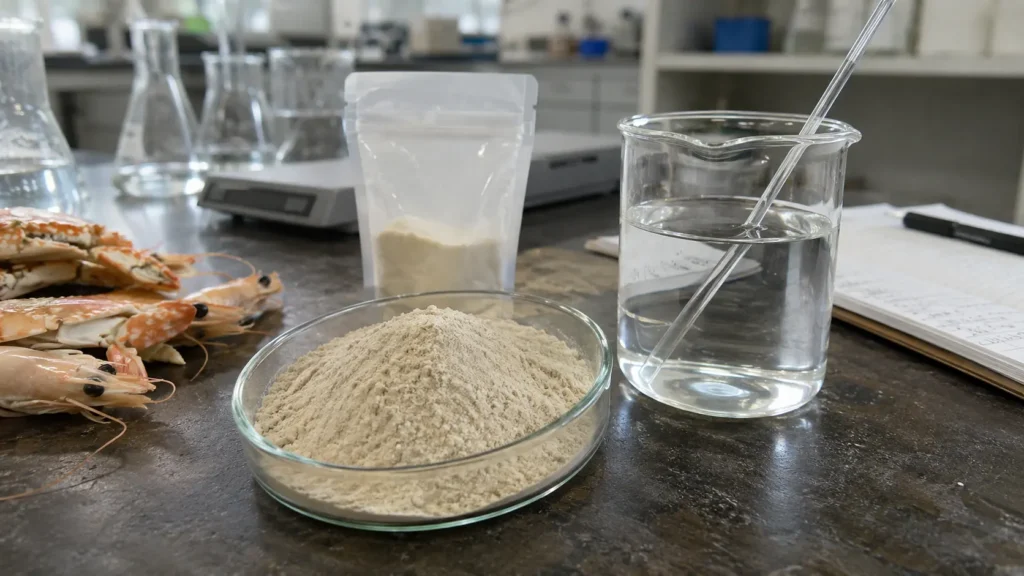
Break a long polymer chain into small enough pieces, and it stops behaving like the material it came from. That’s the entire story of Shellfish Chitosan Oligosaccharide (COS) in one sentence. Standard chitosan is a long, tangled chain that only dissolves in acid. Cut that chain down to fragments under 5,000 Da roughly 2 to 10 sugar units long and you get something that dissolves in plain water, moves faster through a formulation, and behaves differently enough in research settings to have earned its own body of literature separate from chitosan itself.
Chitosan Global’s Shellfish COS comes from shrimp and crab shell, the oldest and most industrially mature chitin source there is. That maturity matters practically: more available grade options, more characterization history, and a supply chain that’s been stress-tested for decades. It also comes with tradeoffs worth knowing before you commit which this page gets into honestly, not just the highlight reel.
Want to see how it behaves in your own system before committing to volume? Start with a 25 g sample enough to test solubility, mixing behavior, and compatibility without a large upfront order.
Buy 25g Sample | View Product Specifications — review the current spec and COA before testing.
Chitosan, Cut Down to Size
Chitin becomes chitosan through deacetylation stripping acetyl groups off the backbone until enough amino groups are exposed to make the polymer reactive and (in acid) soluble. That’s chitosan. COS is one step further: chitosan’s long chain gets broken down, most commonly by enzymatic hydrolysis, into short fragments a linear copolymer of GlcNAc and GlcN units, typically 2 to 10 monomers per chain.
Chain length is the whole story here. A shorter chain means less viscosity, faster dissolution, and a completely different solubility profile COS goes into neutral water on its own, no acid activation required, which native chitosan simply cannot do. That single structural change is why COS gets treated as almost a different ingredient category from chitosan in formulation and research circles, despite sharing the same chemical backbone.
Why Molecular Weight Is the Number That Actually Runs the Show
If you remember one figure from this page, make it molecular weight, not “COS.” A long chitosan chain forms viscous gels and moves slowly across biological membranes. A short COS chain dissolves instantly and diffuses far more readily which is the mechanistic reason COS shows up in dietary supplements, functional beverages, and animal feed where rapid dispersion and measurable activity at low use levels are the point. But “low molecular weight” isn’t a single number it’s a distribution, and two COS batches with the same average MW can still behave differently depending on how tightly that distribution is controlled. For the deeper technical breakdown of what molecular weight actually controls, see our low molecular weight Shellfish COS guide.
What the Spec Sheet Should Say
| Parameter | Food Grade | Industrial Grade | What You’re Actually Checking |
|---|---|---|---|
| Molecular weight | Under 5,000 Da | 5,000–10,000 Da range available | Governs solubility, diffusion, viscosity |
| DDA | ≥90% | ≥85% | Charge density available for interaction |
| Solubility | Fully water-soluble | Fully water-soluble | Confirms neutral-pH performance at your working concentration |
| Purity | Food-grade compliant | Technical-grade | Consistency and regulatory fit |
| Moisture / ash | ≤10% / ≤2% | ≤10% / ≤3% | Handling and shelf stability |
| Heavy metals | Food-grade limits | Industrial-use limits | Suitability for sensitive applications |
| COA | Provided per batch | Provided per batch | The batch you’d actually receive, not a category average |
Two products both labeled “Shellfish COS” can still land in different places on every row above. Grade, batch, and supplier all move these numbers pull the current COA before you assume anything.
The Applications, Without the Padding
Pharmaceutical and biomedical research: low-MW COS gets studied as a component in drug-delivery systems and in nanoparticle formulation research, largely because it dissolves and complexes readily at neutral pH.
Nutraceuticals and functional food: Food Grade COS is used in supplements, functional foods, and fortified beverages, with research interest in gut, cholesterol, and immune-related activity evidence strength varies by claim, and this page doesn’t collapse that variation into one blanket statement. See the full benefit breakdown for what’s actually evidenced at what level.
Animal nutrition and aquaculture: COS is an established feed-ingredient category for poultry, livestock, aquaculture, and pet nutrition, with proposed mechanisms including inhibiting harmful bacterial adhesion and supporting intestinal barrier function an area with real commercial traction.
Agriculture: Industrial Grade COS is studied as a biostimulant and plant elicitor. See Shellfish COS for Plant Growth for the application-specific detail.
Cosmetics, water treatment, coatings: film-forming and flocculant behavior show up in personal-care and industrial formulations, generally tied back to the same solubility and charge properties covered above rather than anything unique to these specific end uses.
Three Sources, One Question Worth Asking First
Shellfish isn’t the only chitin source on the market mushroom (fungal) and Black Soldier Fly (insect) are the two others Chitosan Global also supplies. Before defaulting to shellfish because it’s the most established, ask whether your project actually needs shellfish specifically vegan or allergen-free labeling requirements rule it out immediately, for instance, regardless of how good the spec sheet looks. See Shellfish COS vs Mushroom COS and Shellfish COS vs BSF COS for the direct comparisons molecular weight, DDA, purity, and documentation matter more than origin labels alone, and neither comparison declares a universal winner.
From Shell to Powder
Shrimp and crab shell goes through demineralization (acid wash removing calcium carbonate) and deproteinization (alkaline treatment removing residual protein) before it’s purified chitin. That chitin is deacetylated into chitosan, then broken down into short-chain COS enzymatic hydrolysis is the more common route because it tends to produce cleaner, more soluble oligosaccharides with fewer process residues than acid hydrolysis, though it’s a more expensive process to run at scale. What comes out gets tested for molecular weight, DDA, purity, and microbial limits before it’s classified Food or Industrial Grade. Full process detail: How Shellfish COS Is Manufactured.
The Honest Tradeoff of Shellfish Sourcing
Shrimp and crab shell is the deepest, most characterized chitin supply on the planet — that’s real, and it’s why shellfish COS has more available grades and more research behind it than newer alternative sources. It’s also seasonal and geographically concentrated, mostly in East and Southeast Asian processing hubs, which is a supply-chain risk worth naming rather than glossing over. Batch-level testing and supplier qualification manage that risk on our end, but it’s still a structural fact about this sourcing model, not something that disappears because a supplier says “reliable” on a product page.
Before You Order More Than a Sample
Run a 25 g sample through your own process before scaling. A lab result on paper even a strong COA doesn’t tell you how the material handles in your specific mixing equipment, at your specific pH, alongside your specific other ingredients. Test, evaluate, screen, compare against whatever you’re currently using, and only then decide whether to move to a 1 kg or bulk order.
Order a 25g Shellfish COS Sample request the current COA alongside it.
What This Page Isn’t Claiming
Research on chitosan oligosaccharide broadly includes reported antioxidant, antimicrobial, gut-related, and immune-related activity real research, much of it in vitro or animal-model work, some of it human. None of that automatically transfers to a specific bag of powder without the matching molecular-weight and DDA profile the research actually used. This page treats “chitosan research says X” and “this specific batch will do X in your product” as two different claims, and only makes the first one.
Frequently Asked Questions
What is Shellfish Chitosan Oligosaccharide?
A low-molecular-weight (under 5,000 Da), fully water-soluble chitosan derivative made by enzymatically breaking down chitosan extracted from shrimp and crab shell.
What is Shellfish COS made from?
Shrimp and crab shell chitin, converted to chitosan through deacetylation, then broken into short oligosaccharide chains.
How is COS different from native chitosan?
Chain length. COS is a fraction of chitosan’s size, which is why it dissolves in neutral water while native chitosan needs acid.
Is Shellfish COS water soluble?
Yes, fully that’s the defining functional trait of the oligosaccharide form.
Why does molecular weight matter?
It’s the variable that governs solubility, viscosity, diffusion speed, and how readily the material moves through a formulation or biological system.
What is Shellfish COS used for?
Pharmaceutical and biomedical research, nutraceuticals and functional food, animal feed and aquaculture, agriculture, cosmetics, and water treatment see the applications section above for what’s actually behind each.
How does Shellfish COS compare with Mushroom COS?
Both are low-MW COS; they differ in biological origin, labeling implications (shellfish isn’t vegan or allergen-free), and current available specifications. Full comparison: Shellfish COS vs Mushroom COS.
How is Shellfish COS manufactured?
Shell → chitin (demineralized, deproteinized) → chitosan (deacetylated) → COS (enzymatically depolymerized) → purified, dried, and batch-tested.
Can I buy a 25 g sample?
Yes, free-shipping 25 g samples are available on the product page, alongside 1 kg and bulk options.
What specifications should I check before buying?
Molecular weight, DDA, purity, moisture, ash, and the current batch COA check them against the spec table above and confirm against your specific batch, not the category average.
Ready to See What It Does in Your System?
Reading about chain length only gets you so far. Buy a 25g sample, request the COA, and request bulk pricing once you know it fits start with the product page.
For sourcing and larger-volume procurement, see the Shellfish COS supplier resource.
You May Also Like
No Products Found!
Get in Touch
Technical & Custom Solutions
Abhinav Chauhan, PhD – Application Scientist
Stephen Nice – Application Scientist