Mushroom Quaternary Chitosan: The Complete Technical Guide
No Products Found!
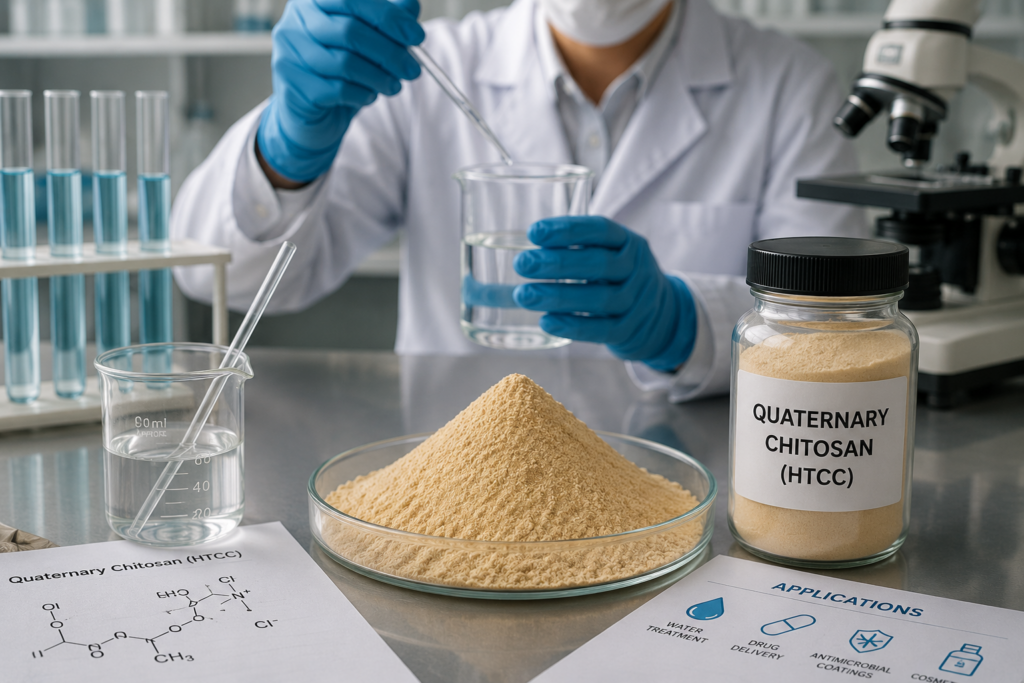
Chitosan has spent three decades as one of the most studied natural polymers in pharmaceutical and biomedical science, prized for its biocompatibility, biodegradability, and mild antimicrobial activity. Yet its single biggest practical limitation has never gone away: native chitosan is only soluble in acidic conditions. Above roughly pH 6.5, its amine groups lose their protonation, the polymer loses its charge, and it precipitates out of solution a serious problem for anyone trying to formulate at neutral or physiological pH.
Quaternary chitosan was developed specifically to solve that problem. And when the starting material is mushroom-derived rather than shellfish-derived, the resulting ingredient addresses two industry pain points at once: pH-independent solubility and sourcing that is allergen-free, vegan, and independent of crustacean supply chains. This guide explains the chemistry, the sourcing rationale, and the formulation and industrial logic behind Mushroom Quaternary Chitosan written for the R&D scientists, formulators, and procurement teams who need to evaluate it as a functional ingredient, not just a spec sheet.
From Native Chitosan to Quaternary Chitosan: A Short History of a Solubility Problem
Chitosan is produced by deacetylating chitin, the structural polysaccharide found in crustacean shells, insect exoskeletons, and fungal cell walls. The deacetylation step converts N-acetylglucosamine units into glucosamine units bearing free primary amine groups. Those amine groups are the source of everything useful about chitosan. its cationic charge, its mucoadhesion, its metal-chelating ability, its antimicrobial activity but they are also its Achilles’ heel. A primary amine only carries a positive charge when it is protonated, and protonation only happens in acidic solution. Chitosan’s biocidal and functional applications are only fully effective in acidic media because of its low solubility in neutral and basic conditions, and the same protonated amine groups responsible for solubility are also the driving force behind its antimicrobial activity.
Formulation chemists have worked around this for years using dilute acetic or lactic acid, or switching to a pre-neutralized salt form such as chitosan hydrochloride, which improves handling but does not remove the fundamental pH dependency of the charge itself. Neither approach gives a polymer that is reliably cationic and water-soluble once a formulation reaches neutral or physiological pH (blood, saliva, most cosmetic emulsions, most food matrices).
Quaternization solved this at the molecular level. Quaternization introduces a quaternary ammonium moiety onto or outside the chitosan backbone through chemical reactions with the primary amino and hydroxyl groups, improving solubility over a wide pH range and expanding the polymer’s range of applications. Unlike a primary amine, a quaternary ammonium nitrogen carries four permanent substituents and a permanent positive charge no protonation step required, no pH sensitivity. The two most established quaternization routes are N,N,N-trimethyl chitosan (TMC), and N-[(2-hydroxy-3-trimethylammonium)propyl] chitosan chloride (HTCC), with more recent work exploring pyridinium and phosphonium-based quaternary salts. The reaction itself involves treating chitosan with a quaternizing agent (commonly methyl iodide for TMC, or glycidyltrimethylammonium chloride for HTCC) under alkaline conditions, converting a variable, pH-reversible charge into a fixed, permanent one.
The commercial consequence is straightforward: by inserting a quaternary moiety, permanent cationic charges are achieved on the polysaccharide backbone, and properties such as water solubility, antimicrobial activity, mucoadhesiveness, and permeability are significantly improved. properties that translate directly into pharmaceutical, cosmetic, food, and industrial value. Readers evaluating the chemistry family in more depth may find our dedicated resource on Trimethyl Chitosan for Oral Delivery useful, since TMC and HTCC share the same underlying quaternization logic but differ in reaction route and resulting substituent structure.
Why Mushroom-Derived Raw Material Is Gaining Ground
Quaternization chemistry is agnostic to the biological source of the starting chitosan but the source matters a great deal for consistency, purity, and downstream regulatory acceptance. Fungal-derived chitosan offers notable advantages over crustacean-based chitosan, including a renewable origin and lower allergenic potential. Several structural and supply-chain factors explain why formulators are increasingly specifying mushroom (commonly Agaricus bisporus) as the source polymer, even before any quaternization takes place:
- No shellfish allergen risk. Shellfish-sourced chitosan carries limited supply chains, seasonal dependence, and allergen risks; fungal chitosan avoids these issues and can be grown on agricultural waste. For pharmaceutical and food-grade applications, removing a known allergen class from the ingredient declaration is a meaningful regulatory and labeling advantage.
- Lower inorganic content, simpler processing. Mushrooms have lower levels of inorganic materials compared with crustacean shells, and fungi have a lower level of calcium carbonate than crustacean waste, so no demineralization treatment is required during processing. Extraction is achieved through mild alkaline and acidic treatments compared with the harsher chemical methods used for crustacean chitosan. A cleaner starting material means a cleaner, more predictable quaternization reaction.
- Batch consistency. Fungal chitosan production can be performed in reactors under fully automated and controlled conditions, giving more consistent product quality than material derived from variable shellfish waste streams, with fermentation providing better batch-to-batch consistency and a much lower molecular weight dispersity. For a manufacturer scaling up a quaternization process, a narrower starting dispersity translates into a narrower, more reproducible degree of substitution in the finished derivative a critical quality attribute for pharmaceutical use.
- High native deacetylation. Fungal chitosan deacetylation degree is routinely over 98%, giving the quaternization reaction more available amine sites to work with and supporting a higher, more uniform degree of quaternization in the finished ingredient.
- Vegan and non-animal sourcing. For brands and manufacturers formulating “clean label,” plant-based, or non-animal-origin products, a fungal starting material removes an entire category of sourcing objections that shellfish-derived chitosan cannot.
These sourcing advantages are inherited by the quaternary derivative: Mushroom Quaternary Chitosan combines a cleaner, more consistent, allergen-free backbone with a permanently cationic functional group layered on top of it.
Permanent Cationic Charge: Why It Matters Industrially
It’s worth pausing on why “permanent cationic charge” is such a heavily emphasized property rather than a marketing flourish. Positive charge density governs three of the most commercially valuable behaviors a polysaccharide can have:
- Electrostatic interaction with negatively charged surfaces. Microbial cell membranes, mucosal surfaces, hair and skin, and many drug or nucleic acid payloads carry a net negative charge at physiological pH. Quaternary ammonium groups are adsorbed at the microbial cell surface, channelize electrostatic interactions, hamper nutrient transport, and cause alteration in cell permeability a mechanism that a pH-dependent polymer simply cannot deliver reliably once the environment moves toward neutral.
- Charge-driven complexation for delivery systems. Quaternary chitosan derivatives are characterized by their permanent cationic charge, which increases their solubility in water and keeps them soluble over a wide range of pH, while also enhancing mucoadhesive and drug-penetration properties. This is the property that makes quaternary chitosan a candidate carrier material for polyelectrolyte complexes, nanoparticles, and hydrogels anywhere a formulation needs a reliably positive partner for an anionic active, nucleic acid, or mucosal surface.
- Antimicrobial performance independent of formulation pH. Because the charge is not protonation-dependent, quaternary chitosan retains antibacterial activity in neutral and alkaline formulations where native chitosan would already have precipitated and lost activity. Our companion resource on Quaternary Chitosan for Antimicrobial Systems goes deeper into dose-response and spectrum-of-activity data for this mechanism.
Native vs. Quaternary Chitosan: A Side-by-Side Comparison
Property | Native (Non-Ionic) Chitosan | Chitosan Hydrochloride (Salt Form) | Mushroom Quaternary Chitosan |
Charge type | pH-dependent (protonated amine) | pH-dependent (pre-neutralized salt) | Permanent, quaternary ammonium |
Solubility | Acidic media only (pH < ~6.5) | Improved handling in water, still pH-sensitive over time | 100% water-soluble across acidic, neutral, and alkaline pH |
Behavior at physiological pH (~7.4) | Insoluble, loses charge and function | Reduced charge density | Fully soluble, fully charged |
Antimicrobial activity at neutral pH | Minimal | Reduced | Retained |
Mucoadhesion | Moderate, pH-dependent | Moderate | Enhanced, charge-independent of pH |
Typical formulation medium | Dilute acid solutions | Water (with pH sensitivity) | Water, buffers, aqueous emulsions |
Best-fit use case | Acidic topical/food matrices | General-purpose water-soluble handling | Neutral/physiological-pH pharma, biomedical, cosmetic systems |
Where Quaternary Fits Among Other Water-Soluble Derivatives
Formulators frequently compare quaternary chitosan against other soluble derivatives before choosing a grade. The distinguishing factor is charge type and permanence:
Derivative | Charge | Solubility Range | Primary Advantage |
Chitosan Hydrochloride | Cationic, pH-sensitive | Broad but not charge-stable | Simple, food/cosmetic-friendly water solubility |
Carboxymethyl Chitosan | Anionic or amphoteric | Broad pH range | Compatible with cationic actives; different complexation chemistry |
Chitosan Oligosaccharide | Cationic, low MW | Excellent solubility, lower viscosity | Bioavailability, smaller molecule penetration |
Trimethyl Chitosan (TMC) | Permanently cationic (quaternary) | Full pH range | High degree of quaternization achievable; strong mucoadhesion |
Quaternary Chitosan (HTCC-type) | Permanently cationic (quaternary) | Full pH range | Stable positive charge plus hydroxyl-propyl spacer for tunable substitution |
Readers evaluating which grade fits an anionic-active formulation may want to review Carboxymethyl Chitosan (Mushroom) as the deliberate anionic counterpart within the same derivative family, or Chitosan Oligosaccharide (Mushroom) where a lower-molecular-weight, higher-bioavailability profile is the priority instead of permanent charge.
Advantages in Neutral and Physiological pH Environments
This is the practical crux of why quaternary chitosan exists. Most of the environments formulators actually work in are not strongly acidic:
- Human physiological fluids (blood, saliva, tears, mucus) sit around pH 6.5–7.4.
- Most cosmetic emulsions are formulated close to skin-neutral pH (~5.5) or above.
- Food matrices vary widely, but many high-value applications (dairy, bakery, neutral beverages) sit at or above pH 6.
- Pharmaceutical parenteral and topical formulations are almost always buffered near physiological pH for compatibility and comfort.
Native chitosan’s insolubility at these pH values effectively excludes it from an enormous share of real-world formulation work unless the formulator is willing to add acid, accept turbidity, or reformulate the entire vehicle around chitosan’s constraints. Quaternary chitosan removes that constraint entirely, which is why the vast majority of research involving HTCC has focused on biomedical and pharmaceutical applications, driven specifically by its biocompatibility, mucoadhesiveness, and water solubility.
Formulation Benefits Compared With Conventional Chitosan
Beyond solubility, formulators report several second-order benefits once a quaternary derivative is substituted into a system:
- Predictable viscosity behavior. Because charge and solubility are decoupled from pH, viscosity and rheology are far more stable across a formulation’s shelf life and across manufacturing conditions (temperature, mild pH drift).
- Improved compatibility with anionic systems. Quaternary chitosan’s fixed positive charge allows for deliberate, controllable electrostatic complexation with anionic polymers, surfactants, or actives a design feature rather than an accident of pH.
- Enhanced antioxidant behavior with higher substitution. Studies on quaternized and diquaternized chitosan derivatives found that antioxidant ability increased in the order double-quaternized > single-quaternized > unmodified chitosan, correlating directly with the number of quaternized groups present.
- Tunable antimicrobial potency via degree of substitution. Higher degrees of quaternization have been shown to improve antibacterial action against organisms such as E. coli and S. epidermidis, while lower degrees of quaternization can instead favor use as a vaccine adjuvant through hydrogen-bonding interactions with unoccupied amino groups. This gives formulators a genuine dial to turn depending on whether the end use prioritizes antimicrobial strength or a gentler, adjuvant-style interaction.
- Mucoadhesion without pH dependency. Because of its amino groups, chitosan naturally carries a cationic charge responsible for permeation-enhancing and mucoadhesive effects, and quaternization preserves and extends this behavior into pH ranges where native chitosan would already have lost its charge.
Industrial Applications
Pharmaceuticals and Drug Delivery
Quaternary chitosan’s permanent charge makes it a preferred building block for controlled-release and targeted-delivery systems. HTCC has been used to formulate albumin-loaded chitosan derivative nanoparticles with a size range between 110 and 180 nm and more than 90% albumin encapsulation efficiency, and more recent work has extended this into mucoadhesive composite nanoparticles for site-specific drug delivery. Mannose-anchored quaternized chitosan combined with thiolated carboxymethyl chitosan has been developed as a mucoadhesive nanoparticle carrier system, and quaternized chitosan hydrogels have been explored in advanced wound-injury treatment contexts combining self-healing, bioadhesive, and antibacterial functionality. For a broader view of how chitosan-family polymers function as excipients and carriers, see Chitosan for Drug Delivery Systems.
Biomedical Engineering
Beyond drug delivery, quaternary chitosan’s biocompatibility and permanent charge support tissue engineering scaffolds, wound-healing hydrogels, and gene-delivery vectors, where a stable positive charge is needed to complex with negatively charged nucleic acids or extracellular matrix components. Immense classy drug delivery systems containing quaternized chitosan have been intended for tissue engineering, wound healing, gene, and vaccine delivery. Chitosan hydrochloride-based nanoparticle systems are a related, complementary approach worth reviewing at Chitosan Hydrochloride for Nanoparticles.
Cosmetics
In cosmetic formulation, permanent cationic charge supports substantivity to hair and skin (both net-negative surfaces), film formation, and conditioning performance across the full pH range typical of shampoos, conditioners, and skin serums without the turbidity or instability risk of a pH-dependent polymer. See Chitosan in Cosmetics for formulation-level detail on chitosan’s broader cosmetic role.
Food Technology
Quaternary chitosan’s stability at food-relevant pH values (many of which sit above chitosan’s native solubility limit) opens applications in antimicrobial coatings, packaging films, and preservation systems where native chitosan would fail to dissolve or perform. Related work with HTCC-anchored materials has shown resilience even under thermal processing: biodegradable HTCC-anchored magnetic cellulose beads have been developed that resist temperatures up to 300°C and show extended antibacterial efficacy against thermoduric bacteria such as Alicyclobacillus acidoterrestris, addressing a known threat to dairy and beverage safety. Explore more in Chitosan in Food Industry.
Biotechnology and Advanced Biomaterials
Quaternary ammonium chitosans are also being incorporated into composite materials nanofiber membranes, mesoporous silica coatings, and ion-exchange systems. HTCC-capped mesoporous silica nanoparticles have shown improved loading efficiency (up to 40.3%, versus 26.7% for uncoated particles) for controlled agrochemical release, and quaternized chitosan/polyvinyl alcohol nanofiber membranes cross-linked with blocked diisocyanate have demonstrated improved antibacterial performance for wound dressings and filtration media. Quaternary chitosan beads have additionally shown strong ion-adsorption behavior with an adsorption capacity of 97.5% for phosphate and 99% for nitrate ions, following the Freundlich isotherm model across a pH range of 3–9, pointing to applications well beyond biomedicine, including water remediation see Chitosan for Water Treatment.
Research Trends and Future Commercial Opportunities
Several trends are converging to make quaternary chitosan and specifically fungal-sourced quaternary chitosan a growth area worth watching:
- Mucoadhesive nanocarrier design continues to expand, with quaternized chitosan increasingly paired with complementary anionic polymers (like thiolated carboxymethyl chitosan) to create composite carriers with tunable release and targeting behavior.
- Injectable and self-healing hydrogels combining quaternized chitosan with materials like oxidized sodium alginate are being explored for regenerative and wound-care applications where bioadhesion and antibacterial protection must coexist.
- Sustainable and fermentation-based fungal chitosan production is maturing rapidly, addressing the reproducibility and supply-chain concerns that have historically limited crustacean-derived material, and setting up fungal feedstocks as the default choice for next-generation quaternized ingredients.
- Vegan and allergen-free ingredient demand across pharma, food, and cosmetics is pushing manufacturers to actively seek non-animal cationic polymers, a category where fungal quaternary chitosan is one of very few genuinely competitive alternatives.
- Green chemistry quaternization routes are an active research area, aiming to reduce the use of methyl iodide and other less desirable reagents in favor of milder, more scalable quaternizing agents relevant to manufacturers thinking about long-term process sustainability and regulatory trajectory.
For manufacturers and formulators evaluating supply partners for these emerging applications, our Chitosan Derivatives Supplier, Water-Soluble Chitosan Supplier, and Industrial Chitosan Manufacturer resources outline sourcing, grading, and documentation considerations relevant to scaling a quaternary chitosan-based formulation from lab to commercial volume.
Frequently Asked Questions
- What is Mushroom Quaternary Chitosan? It is a chitosan derivative made from mushroom-sourced (fungal) chitosan that has been chemically modified to carry a permanent, positively charged quaternary ammonium group, making it fully water-soluble across the entire pH range rather than only in acidic conditions.
- How is quaternary chitosan different from regular (native) chitosan? Native chitosan’s positive charge depends on protonation of its amine groups, which only occurs in acidic solution (roughly below pH 6.5). Quaternary chitosan’s charge comes from a permanently substituted quaternary ammonium nitrogen, so it stays charged and soluble regardless of pH.
- Is Mushroom Quaternary Chitosan the same as HTCC or TMC? HTCC and TMC are the two most established quaternization chemistries used to produce quaternary chitosan. Mushroom Quaternary Chitosan uses the same permanent-charge principle; the specific quaternizing agent and degree of substitution determine which family a given batch belongs to and should be confirmed via the certificate of analysis.
- Why use mushroom-derived chitosan instead of shellfish-derived chitosan for quaternization? Fungal starting material is allergen-free, vegan, generally has a higher and more consistent degree of deacetylation, and comes from a more controllable, lower-mineral-content biomass all of which support a cleaner, more reproducible quaternization reaction and finished product.
- Does Mushroom Quaternary Chitosan dissolve in plain water? Yes. Unlike native chitosan, which requires dilute acid, quaternary chitosan is designed to be 100% water-soluble across acidic, neutral, and alkaline pH without any acidification step.
- Is Mushroom Quaternary Chitosan suitable for pharmaceutical formulations? It is available in pharmaceutical-grade specifications and is widely used in research and formulation work involving nanoparticle carriers, mucoadhesive systems, and hydrogels. Formulators should confirm grade, purity, and documentation requirements against their specific regulatory pathway.
- What is “degree of quaternization” and why does it matter? It refers to the percentage of available amine sites on the chitosan backbone that have been converted to quaternary ammonium groups. Higher degrees of quaternization generally increase water solubility and antimicrobial potency, while lower degrees can favor other interactions, such as adjuvant behavior in vaccine formulations.
- How does quaternary chitosan’s antimicrobial mechanism work? Its permanent positive charge is attracted to the negatively charged surfaces of microbial cell membranes. This electrostatic interaction disrupts membrane permeability and nutrient transport, contributing to antimicrobial activity that — unlike native chitosan — does not depend on an acidic environment.
- Can Mushroom Quaternary Chitosan be used in cosmetic formulations? Yes. Its permanent cationic charge supports substantivity to skin and hair and stable performance across the pH ranges typical of cosmetic emulsions, without the solubility and turbidity issues associated with native chitosan.
- Is it compatible with anionic ingredients or actives? Its cationic charge allows for deliberate electrostatic complexation with anionic polymers or actives, which can be a formulation advantage (for controlled delivery or film formation) but requires compatibility testing, since strong ionic interaction can also cause unwanted precipitation if not managed.
- How does Mushroom Quaternary Chitosan compare with Chitosan Hydrochloride? Chitosan hydrochloride is a salt form that improves water handling but is still ultimately pH-sensitive in its charge behavior over time. Quaternary chitosan’s charge is chemically fixed and does not depend on pH or counter-ion equilibrium.
- What industries use quaternary chitosan derivatives? Pharmaceuticals and biomedical engineering, cosmetics and personal care, food technology and packaging, agriculture and crop protection, water treatment, textiles, and advanced biomaterials such as nanofiber membranes and functional coatings.
- Is fungal quaternary chitosan vegan and allergen-free? Yes, when derived entirely from fungal (mushroom) biomass rather than crustacean shells, it avoids shellfish allergens and animal-derived material, making it suitable for vegan-formulated products.
- What packaging and quantities are available for testing? Sample sizes and bulk quantities, along with the current certificate of analysis, are available on the Mushroom Quaternary Chitosan product page.
- How do I choose between quaternary, trimethyl, carboxymethyl, hydrochloride, and oligosaccharide chitosan for my application? The choice generally comes down to required charge type (cationic vs. anionic vs. amphoteric), pH stability needs, and molecular weight/viscosity targets. As a general guide: choose quaternary or trimethyl chitosan when permanent positive charge across a full pH range is essential; choose carboxymethyl chitosan when an anionic or amphoteric profile is needed; choose chitosan hydrochloride for simpler, cost-effective water solubility without permanent-charge requirements; and choose chitosan oligosaccharide when low molecular weight and high bioavailability matter more than charge permanence.
You May Also Like
- All
- Native Chitosan
- Phosphorylated Chitosan
- Sulphonated Chitosan
- Quaternary Chitosan
- Chitosan Oligosaccharide Hydrochloride
- Chitosan Hydrochloride
- Carboxymethyl Chitosan
- Chitosan Oligosaccharide
Get in Touch
Technical & Custom Solutions
Abhinav Chauhan, PhD – Application Scientist
Stephen Nice – Application Scientist