
Mushroom Phosphorylated Chitosan: The Complete Guide
Why Biomedical Engineers Needed a Better Chitosan
Bone isn’t just hard tissue it’s a carefully engineered composite. Natural bone is made of calcium-deficient carbonated hydroxyapatite as its inorganic phase, combined with collagen as the main organic phase, and any material meant to help bone regenerate has to give the body something to build that mineral phase onto. Plain chitosan, for all its biocompatibility, doesn’t have the right chemical hooks for that job. It can support cells. It can’t recruit calcium and phosphate the way bone’s own matrix does.
That’s the specific gap phosphorylation was developed to close.
No Products Found!
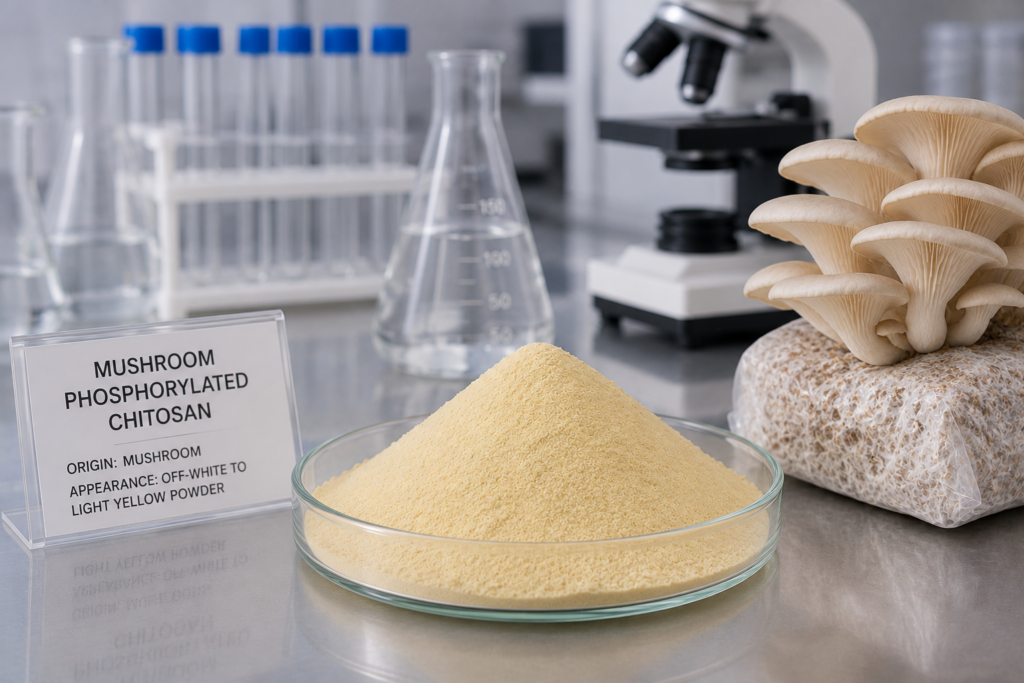
The Science Behind Phosphorylation
Phosphorylation attaches phosphate groups to the chitosan backbone, and the effect goes well beyond a simple chemical label change. Phosphorylation intensifies not just water solubility but also tissue regeneration, flame retardation, ionic conductivity, metal chelation, and drug-carrying ability a remarkably wide functional shift from one modification.
Did You Know? The reason phosphorylated chitosan is so relevant to bone regeneration specifically is structural mimicry, not coincidence. Chitosan’s glucosamine backbone is structurally similar to glycosaminoglycan, a key component of the bone matrix and cell surface that modulates the activity of osteoclastic and osteogenic factors. Add phosphate groups to that already bone-adjacent structure, and you get a polymer actively positioned to participate in the same biomineralization chemistry bone uses to build itself: calcium phosphate including hydroxyapatite, the main mineral component of bones and teeth forms through a natural, bottom-up self-assembly process called biomineralization.
Research Spotlight. Phosphorylation’s benefits aren’t limited to bone. In one study, a highly substituted phosphorylated chitosan derivative demonstrated an in vivo antibacterial effect even more pronounced than the commercial antibiotics ampicillin and gentamicin, while showing neither acute nor subacute toxicity. That’s not “comparable to a lab reagent” that’s outperforming real clinical antibiotics in an animal model, from a modified natural polysaccharide.
How Mushroom-Derived Chitosan Changed the Equation
Here’s the honest part: every published phosphorylation study I found used shellfish or cuttlebone-derived chitosan as the starting material. Nobody has yet published phosphorylated chitosan built specifically from fungal biomass. That’s not a mark against the fungal route it’s the open frontier.
What we know from the broader fungal-chitosan literature carries over directly: a fungal starting material offers lower mineral content, a more consistent starting degree of deacetylation, and complete freedom from crustacean allergen risk all of which matter more, not less, once you’re layering an additional functional group onto the polymer. Phosphorylation reactions are sensitive to exactly the kind of impurities and structural inconsistency that variable shellfish-waste streams introduce; a cleaner substrate going in means a more even, more reproducible degree of substitution coming out.
Expert Opinion. For any material headed toward a bone-contact or biomedical application, batch-to-batch reproducibility in the finished derivative isn’t a nice-to-have it’s often the difference between something that clears a regulatory characterization requirement and something that doesn’t. Starting from a controlled, cultivated fungal substrate gives phosphorylation chemistry a real advantage on that front, independent of the biological mechanism itself.
From Research Lab to Commercial Manufacturing
Not all phosphorylation methods are equal, and the choice of method has real downstream consequences for the finished polymer:
| Phosphorylating Agent | What It Does | Tradeoff |
|---|---|---|
| Phosphoric acid (H₃PO₄) | Common, accessible route | Moderate degree of substitution achievable |
| Phosphorus pentoxide (P₂O₅) | Higher degree of substitution achievable | Using strong acids in combination can drastically decrease the polymer’s molecular weight |
| Phosphorus oxychloride (POCl₃) | Efficient substitution | Requires careful handling, byproduct removal |
| Grafting method | More controlled, targeted substitution | Generally more complex process |
| Urea/DMF-based methods | Used successfully to produce phosphorylated chitosan for wound-healing applications | Urea-based routes can be difficult to purify afterward |
Industry Perspective. The practical lesson for buyers: two suppliers can both sell “phosphorylated chitosan” with meaningfully different molecular weight, degree of substitution, and purity, depending entirely on which synthesis route they used. Asking which method was used — not just the final DS number — tells you a lot about what tradeoffs are baked into that batch.
Where Phosphorylated Chitosan Creates the Highest Value
| Application | Mechanism | Why phosphorylated chitosan specifically |
|---|---|---|
| Bone & dental regeneration scaffolds | Recruits calcium and phosphate ions to form hydroxyapatite in situ | Enzyme-mediated biomineralization approaches have shown enhanced osteogenesis and excellent in vivo tissue integration using phosphate-functionalized chitosan scaffolds |
| Wound healing (including diabetic wounds) | Antioxidant and tissue-regenerative activity | Phosphorylated chitosan has been shown to accelerate dermal wound healing in a diabetic rat model, with good in vitro antioxidant properties |
| Antimicrobial applications | Charge and structural changes enhance antibacterial potency | Documented in vivo effect exceeding standard antibiotics at high substitution |
| Drug and gene delivery | Improved ionic interaction with charged payloads | Complements Chitosan for Drug Delivery Systems mechanisms |
| Flame-retardant materials | Phosphorus-based char formation | Chitosan incorporated into a phosphorylation bath has been shown to provide self-extinguishing behavior in treated fabrics even at low concentrations |
| Metal chelation | Phosphate groups bind metal ions | Relevant to specialty industrial and environmental applications |
What Makes This Derivative Different from Every Other Chitosan
Where quaternary and trimethyl chitosan solve a charge and solubility problem, and carboxymethyl chitosan solves a pH-versatility problem, phosphorylated chitosan solves a biomineralization problem it’s the derivative built specifically to interact with the calcium-phosphate chemistry the human body already uses to build bone and teeth. See Carboxymethyl Chitosan for Hydrogels and Chitosan Hydrochloride for Nanoparticles for how those complementary mechanisms fit into a broader formulation strategy.
Application Decision Matrix
| If your priority is… | Choose |
|---|---|
| Bone/dental scaffold mineral recruitment | Phosphorylated Chitosan (Mushroom) |
| Permanent cationic charge, antimicrobial coatings | Quaternary Chitosan (Mushroom) |
| pH-independent oral/mucosal delivery | Trimethyl Chitosan (Mushroom) |
| Anionic, pH-versatile hydrogel formulation | Carboxymethyl Chitosan (Mushroom) |
| Simple water solubility, general formulation | Chitosan Hydrochloride (Mushroom) |
| High bioavailability, low viscosity | Chitosan Oligosaccharide (Mushroom) |
Common Misconceptions
- “Phosphorylated chitosan is just chitosan with extra phosphate for flavor of chemistry.” In reality, phosphorylation measurably changes molecular weight, thermal stability, and crystallinity phosphorylated chitosan showed less thermal stability and crystallinity than unmodified chitosan as a direct result of the phosphorylation process.</cite> It’s a structurally different material, not a decorated version of the original.
- “More substitution is always better.” Higher degree of substitution generally increases bioactivity for some applications but can come at the cost of reduced molecular weight the right DS depends entirely on the target application, not a universal maximum.
- “All phosphorylated chitosan is interchangeable regardless of source.” Starting material purity and consistency directly affect how evenly the phosphorylation reaction proceeds sourcing is not a neutral variable.
Future Trends in Functional Biomaterials
The literature is moving in two directions simultaneously: toward more controlled, milder synthesis routes that avoid molecular weight loss (addressing the exact tradeoff shown in the synthesis comparison table above), and toward combination chemistries phosphorylated chitosan layered with other functional groups for multi-mechanism biomaterials. A fungal starting material sits well-positioned for both trends, given its lower-impurity profile and more consistent starting deacetylation.
Questions Scientists Ask Before Selecting a Phosphorylated Polymer
1. What is phosphorylated chitosan? Chitosan modified with phosphate groups attached to its backbone, which enhances mineral binding, water solubility, thermal behavior, and several other functional properties.
2. How does phosphorylated chitosan support bone regeneration? Its phosphate groups help recruit calcium and phosphate ions, participating in the same biomineralization chemistry the body uses to form hydroxyapatite, bone’s primary mineral component.
3. Is phosphorylated chitosan the same as hydroxyapatite? No. Hydroxyapatite is the mineral itself; phosphorylated chitosan is an organic polymer designed to help that mineral form and deposit in a controlled way, often used alongside calcium phosphate materials in composite scaffolds.
4. What phosphorylating agents are used to make this derivative? Common agents include phosphoric acid, phosphorus pentoxide, phosphorus oxychloride, and urea/DMF-based methods, each with different tradeoffs in degree of substitution and resulting molecular weight.
5. Does phosphorylation reduce chitosan’s molecular weight? It can, particularly with strong-acid-based methods — this is a known tradeoff that should be weighed against the degree of substitution achieved.
6. Is mushroom-derived phosphorylated chitosan different from shellfish-derived? The phosphorylation chemistry is the same; the meaningful difference is in starting-material purity, consistency, and absence of shellfish allergen risk.
7. What industries use phosphorylated chitosan? Bone and dental tissue engineering, wound care, drug and gene delivery, flame-retardant materials, and metal chelation applications.
8. Is phosphorylated chitosan safe? Research including in vivo animal studies has evaluated phosphorylated chitosan without acute or subacute toxicity findings in specific tested formulations; safety for any particular use should be confirmed through your own regulatory pathway.
9. Can phosphorylated chitosan be used for wound healing? Yes, it has been studied specifically for accelerating dermal wound healing, including in diabetic wound models, with documented antioxidant activity.
10. Does phosphorylated chitosan have antimicrobial properties? Yes, and at higher degrees of substitution, some studies have reported antibacterial effects exceeding standard antibiotic comparators in vivo.
11. What is degree of substitution, and why does it matter? It’s the proportion of available sites on the chitosan backbone that carry phosphate groups. Higher substitution generally increases bioactivity and mineral-binding capacity but can reduce molecular weight.
12. Is phosphorylated chitosan water soluble? Yes, phosphorylation is one of several modifications known to significantly improve chitosan’s water solubility compared to the native, acid-soluble-only form.
13. Can phosphorylated chitosan be used in flame-retardant materials? Yes, phosphorus-containing groups support char-forming, self-extinguishing behavior, which is why phosphorylated chitosan appears in flame-retardant textile and composite research.
14. How is phosphorylated chitosan different from carboxymethyl or quaternary chitosan? Phosphorylated chitosan is specifically engineered for mineral-binding and biomineralization applications, while carboxymethyl chitosan targets anionic/pH-versatile behavior and quaternary chitosan targets permanent cationic charge each solves a different formulation problem.
15. What documentation should I request before purchasing? Degree of substitution, molecular weight, synthesis method used, and batch-to-batch consistency data, not just a single historical COA.
16. Is phosphorylated chitosan used in drug delivery? Yes, its modified ionic interactions support improved drug and gene delivery performance in several studied formulations.
17. Does the mushroom source affect the final derivative’s bone-regeneration performance? Direct fungal-source phosphorylation studies are still limited in the published literature; the expected advantage is in consistency and purity of the starting material rather than a different biological mechanism.
18. How do I request a sample or technical documentation? Visit the Phosphorylated Chitosan (Mushroom) product page, or contact our technical team to discuss your specific application and specification requirements.
From Research Concept to Commercial Reality
Phosphorylation gives chitosan something no other functionalization does: a direct chemical connection to the calcium-phosphate biomineralization process that builds bone and teeth in the human body, backed by real in vivo data on wound healing, antimicrobial performance, and tissue regeneration. Building that chemistry on a mushroom-derived substrate adds the consistency and allergen-free sourcing that biomedical characterization increasingly demands a combination that remains a genuine frontier rather than a settled commodity.
Continue to the Phosphorylated Chitosan (Mushroom) product page to explore specifications, request a research sample, download the COA, or discuss custom manufacturing with our technical team.
You May Also Like
- All
- Native Chitosan
- Phosphorylated Chitosan
- Sulphonated Chitosan
- Quaternary Chitosan
- Chitosan Oligosaccharide Hydrochloride
- Chitosan Hydrochloride
- Carboxymethyl Chitosan
- Chitosan Oligosaccharide
Get in Touch
Technical & Custom Solutions
Abhinav Chauhan, PhD – Application Scientist
Stephen Nice – Application Scientist