Mushroom Chitosan Hydrochloride: Properties, Production & Uses
No Products Found!
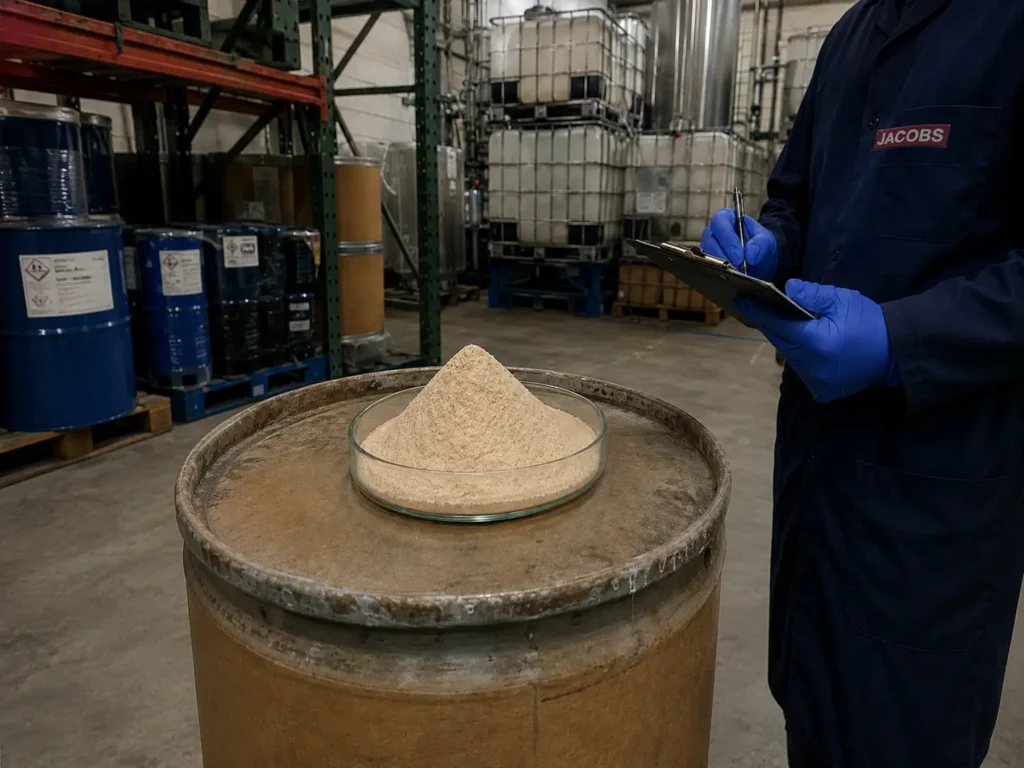
Mushroom chitosan hydrochloride is fungal-derived chitosan converted into its hydrochloride salt – the amine groups along the polymer backbone are pre-protonated with hydrochloric acid during manufacturing, so the material dissolves in water directly, without the formulator adding and managing a separate acid. It solves native chitosan’s core formulation problem: native chitosan only dissolves below roughly pH 6, which rules it out of neutral and near-neutral aqueous systems. This grade keeps the fungal sourcing advantages – no shellfish allergen risk, vegan-compatible, non-seasonal supply – and our batch tests at 98.03% DDA with a viscosity of 20 mPa·s, documented on a batch-specific COA.
What Is Mushroom Chitosan Hydrochloride?
Native chitosan has a formulation problem: it only dissolves in acidic solution. Below roughly pH 6, its amine groups protonate and the polymer goes into solution; above that, it stays undissolved. For a formulator who needs a chitosan-based ingredient to work in a neutral or near-neutral aqueous system, that is not a minor inconvenience – it can rule the material out entirely.
Mushroom chitosan hydrochloride (mushroom chitosan HCl) exists to solve exactly this problem. It is fungal-derived chitosan that has already been converted into its hydrochloride salt form: the amine groups along its backbone are pre-protonated using hydrochloric acid, rather than left in the free-base form that requires an external acid to dissolve.
It is still fundamentally chitosan – the same glucosamine backbone, the same cationic charge behavior in solution – just delivered in a form that removes one formulation step. And because it is sourced from mushroom biomass rather than crustacean shells, it carries the fungal-sourcing advantages: no shellfish allergen risk, vegan compatibility, and non-seasonal, cultivation-based supply.
How the Salt Form Is Made
The conversion starts from purified native mushroom chitosan – the unmodified base polymer described in our native mushroom chitosan guide – and treats it with hydrochloric acid, which protonates the amine groups and forms the chloride salt. The salt is then isolated and dried to a stable powder. No new covalent chemistry is created along the backbone: the polymer chain is unchanged, only its charge state is locked in.
Hydrochloride vs Free-Base Chitosan
The difference between the two forms is where the protonation step happens. Free-base (native) chitosan needs its amine groups protonated at the point of use – the formulator adds acetic, lactic, or another acid and manages that step. The hydrochloride salt arrives already protonated: the acid-formation work happened at the factory, so dissolution in water is direct. Fewer steps at the bench, fewer variables to control – the value is simplicity and pH compatibility, not different chemistry.
Why Convert Chitosan to Its Hydrochloride Salt at All?
The problem this section solves: understanding whether the salt conversion is a gimmick or real chemistry – because that decides whether it belongs in your formulation.
Native chitosan’s solubility limit comes down to chemistry. Chitosan is a weak base with a pKa around 6.5; research indicates it becomes soluble once roughly half of its amine groups are protonated. Above pH 6-6.5, insufficient protonation occurs, hydrogen bonding between polymer chains dominates, and the material stays essentially undissolved in neutral or alkaline water. Converting chitosan to a salt addresses this at the manufacturing stage instead of the formulation stage.
Two research findings sharpen the picture. First, studies on chitosan salt formation have found that HCl-acidified chitosan solutions exhibit measurably lower viscosity than equivalent acetic acid solutions at the same concentration – practically useful where excess viscosity is undesirable. Second, some research has flagged that residual chloride ions can raise toxicity considerations in specific biomedical contexts – a tradeoff worth discussing with your technical team for sensitive applications rather than assuming it is automatically a non-issue.
How Protonation Changes Formulation Behavior – the Five Variables
This is where most explanations of chitosan HCl stop short. Knowing a material is “chitosan hydrochloride” tells you it is designed to be water-soluble – it does not tell you how it will behave in your formulation, because solubility is not a simple yes/no property. Five variables interact:
- pH – even hydrochloride salt forms have practical pH windows where dissolution and stability are optimal; extreme pH shifts within a finished formulation can still affect performance
- Degree of deacetylation (DDA) – more available amine groups mean more protonation sites, affecting both solubility and cationic charge density in solution
- Molecular weight – published research reports commercial chitosan hydrochloride spanning an unusually wide range, from under 1 kDa up to 1,500 kDa depending on source and processing – meaning “chitosan HCl” alone does not tell you what viscosity to expect
- Concentration – viscosity and solution behavior scale with both concentration and molecular weight; a specification that works at 0.5% may behave very differently at 2%
- Ionic environment – proteins, polyelectrolytes, and salts in the formulation interact with chitosan’s cationic charge, affecting solubility, gelation, or precipitation in matrix-specific ways
The practical takeaway: match the batch specification to your formulation, not the salt-form label. For water-solubility troubleshooting specifically, our water-soluble mushroom chitosan guide goes deeper.
Mushroom Chitosan Hydrochloride vs Native Chitosan
The problem this table solves: deciding whether the salt form or the native polymer belongs in your process. The short answer by formulation requirement:
| Formulation Requirement | Native Chitosan | Chitosan Hydrochloride | Why It Matters |
|---|---|---|---|
| Dissolves in neutral/near-neutral water | No – requires added acid | Yes – without an added acidifying step | Simplifies formulation in pH-sensitive or acid-incompatible systems |
| Requires a separate acidifying agent | Yes | No | Fewer formulation variables to manage |
| Typical viscosity at equivalent concentration | Comparable or higher in some acid systems | Often lower, per comparative solvent studies | Relevant where lower viscosity is desired |
| Best fit | Film-forming, coating, and systems where acid is already part of the formulation | Aqueous systems requiring near-neutral pH compatibility | Matches material to formulation chemistry, not just general chitosan use |
For the full comparison including specification ranges and application-specific tradeoffs, see chitosan hydrochloride vs native chitosan.
Where Mushroom Chitosan Hydrochloride Sits in the Chitosan Family
Chitosan hydrochloride is one of several forms engineered to solve specific formulation limitations. Seeing the family prevents the wrong purchase:
- Native chitosan – unmodified; acid-soluble only
- Chitosan hydrochloride – pre-protonated salt; water-soluble without added acid; generally similar molecular-weight range to its source polymer
- Chitosan oligosaccharide – much lower molecular weight, water-soluble, low viscosity; for fast dispersion rather than film-forming behavior
- Carboxymethyl chitosan – carboxyl groups added, extending solubility across a broader pH range including alkaline conditions – unlike the hydrochloride salt, which is specifically about aqueous dissolution near neutral pH
- Quaternary / trimethyl chitosan – permanently charged, retaining cationic behavior even at higher pH where native chitosan and, to a lesser extent, chitosan HCl lose charge density
Simple water solubility near neutral pH points toward chitosan HCl; broader pH-independent solubility or permanent charge points toward a more heavily modified derivative. The full material map: types of chitosan.
Specifications That Define Mushroom Chitosan Hydrochloride Quality
The problem this section solves: “chitosan HCl” labels hide enormous specification spread – the research MW range alone spans three orders of magnitude. What matters is the batch document, not the category.
Our mushroom chitosan hydrochloride tests at approximately 98% DDA (latest batch result: 98.03%), a viscosity of 20 mPa·s, pH 4 in solution (specification range 3-8), 100% through 80 mesh, and easy water solubility – with heavy metals controlled (As ≤2.0 ppm, Pb ≤1.0 ppm, Cd ≤0.5 ppm, Hg ≤0.5 ppm) and microbiology within tight limits (total plate count 223 CFU/g against a <1,000 spec, E. coli and Salmonella negative). Batch values are published on the product page, where the current batch COA is viewable.
Before ordering from any supplier, confirm against current documentation rather than assuming standard values: source (fungal/mushroom origin, disclosed), DDA, molecular weight (batch value), viscosity (at a stated concentration and temperature), purity including residual chloride, confirmed water-solubility percentage and conditions, moisture content, pH of the reconstituted solution, particle characteristics, and a batch-specific Certificate of Analysis – not a generic specification sheet.
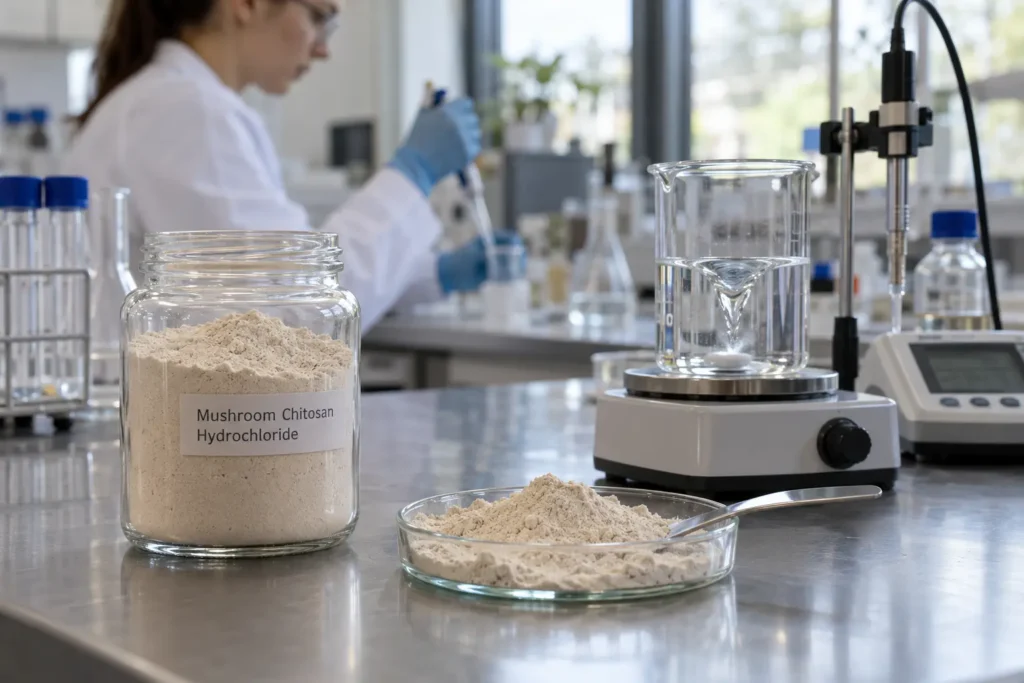
Applications of Mushroom Chitosan Hydrochloride by Industry
Pharmaceutical research and drug delivery – water solubility makes it a practical candidate for aqueous formulation work: mucoadhesive systems, nanoparticle and microparticle carriers, hydrogels, and oral, buccal, nasal, and ocular delivery research, where avoiding a separate acidification step simplifies process development. Full batch documentation is required regardless of salt form; the documentation set regulated applications expect is detailed on our pharmaceutical-grade mushroom chitosan page.
Cosmetics and personal care – the headline use for the salt form: aqueous formulations such as toners, serums, rinse-off products, and hair conditioners, where native chitosan’s acid-dependent solubility would be impractical. Compatibility with surfactants, preservatives, and charged actives should be trialed – anionic ingredients can interact with cationic chitosan and affect clarity or stability. Background: chitosan in cosmetics.
Food and nutraceutical formulation – water solubility supports incorporation into beverage and liquid-supplement formats without an acidic carrier system, subject to market-specific regulatory confirmation. Background: chitosan in the food industry.
Agriculture – aqueous spray formulations benefit from a chitosan form that dissolves readily without extensive acid pre-treatment: seed treatments, foliar applications, and plant-defense elicitor research. Background: chitosan for agriculture.
Water treatment and industrial aqueous systems – a readily soluble cationic polymer for flocculation and separation research, though cost and required purity should be weighed against native chitosan for less sensitive industrial use. Background: chitosan for water treatment and applications of mushroom chitosan for the full industry map.
Peer-reviewed context on the polymer’s behavior: Chitosan: Sources, Processing and Modification Techniques (PMC9322947), the stability review (PMC4413189), and the chitosan/chitosan chlorhydrate matrix study (PMC3556008).
How to Choose – and Where to Buy – Mushroom Chitosan Hydrochloride
A short decision path before ordering:
- Confirm the actual problem is solubility – if your process already runs in controlled acid, native chitosan does the same job without the salt premium
- Match the batch spec, not the category – DDA, molecular weight, viscosity with test conditions, chloride and moisture content, solution pH
- Confirm documentation for your market – batch COA, TDS, MSDS, and any allergen or origin statements your labeling needs
- Trial before scale – a 25 g laboratory sample under your real formulation conditions, then scale the same specification
Mushroom chitosan hydrochloride fits projects that need chitosan functionality in primarily water-based systems without an acid-dissolution stage – and need fungal origin for labeling or allergen reasons. Specifications, pack sizes, and the batch COA are published on the product page – request a laboratory sample there, or contact our technical team with your application requirements. For source qualification criteria, see our mushroom chitosan hydrochloride supplier guide; for ordering paths from sample to bulk, see buy mushroom chitosan hydrochloride.
Frequently Asked Questions
What is mushroom chitosan hydrochloride?
Fungal-derived chitosan converted into its hydrochloride salt form: the amine groups are pre-protonated during manufacturing, so the material dissolves in water without requiring an added acidifying agent.
Does mushroom chitosan hydrochloride dissolve in water?
Yes, generally readily, since the salt form is pre-protonated. Exact solubility and the practical pH range for optimal performance should be confirmed against the specific batch documentation rather than assumed universally.
How is chitosan hydrochloride different from native chitosan?
Native chitosan requires added acid to dissolve, since its amine groups need protonation at the point of use. Chitosan hydrochloride arrives already protonated as a salt, so it dissolves in water directly without a separate acidification step.
How is chitosan hydrochloride different from chitosan oligosaccharide?
Chitosan hydrochloride is generally similar in molecular weight to its source native chitosan, just converted to a water-soluble salt. Chitosan oligosaccharide is a much lower molecular-weight form, which changes viscosity and dispersion behavior independent of salt formation.
Is mushroom-derived chitosan hydrochloride vegan and allergen-free?
Because it derives from fungal biomass rather than crustacean shells, it contains no shellfish material – supporting vegan-compatible and allergen-conscious formulation claims. Specific certifications should be verified for your intended market rather than assumed.
What specifications should I check before buying?
Degree of deacetylation, molecular weight, viscosity, purity including residual chloride, solubility, and moisture content – confirmed via a batch-specific Certificate of Analysis rather than a general product description.
What DDA does your mushroom chitosan hydrochloride have?
Approximately 98% – the latest batch tested at 98.03%. The exact batch result is stated on every COA, viewable on the product page.
Can I get a sample before ordering in bulk?
Yes. A 25 g laboratory sample is available for formulation trials – see our buy mushroom chitosan hydrochloride page for sample, standard, and bulk ordering options.
You May Also Like
- All
- Microplastics
- Water Soluble
- All
- Native Chitosan
- Black Soldier Fly Chitosan
- Chitosan Oligosaccharide Hydrochloride
- Chitosan Oligosaccharide
- Chitosan Hydrochloride
- Carboxymethyl Chitosan
- Quaternary Chitosan
- Trimethyl Chitosan
- Sulphonated Chitosan
- Phosphorylated Chitosan
- Biochar
- Home Cleaning System
Get in Touch
Technical & Custom Solutions
Abhinav Chauhan, PhD – Application Scientist
Stephen Nice – Application Scientist