
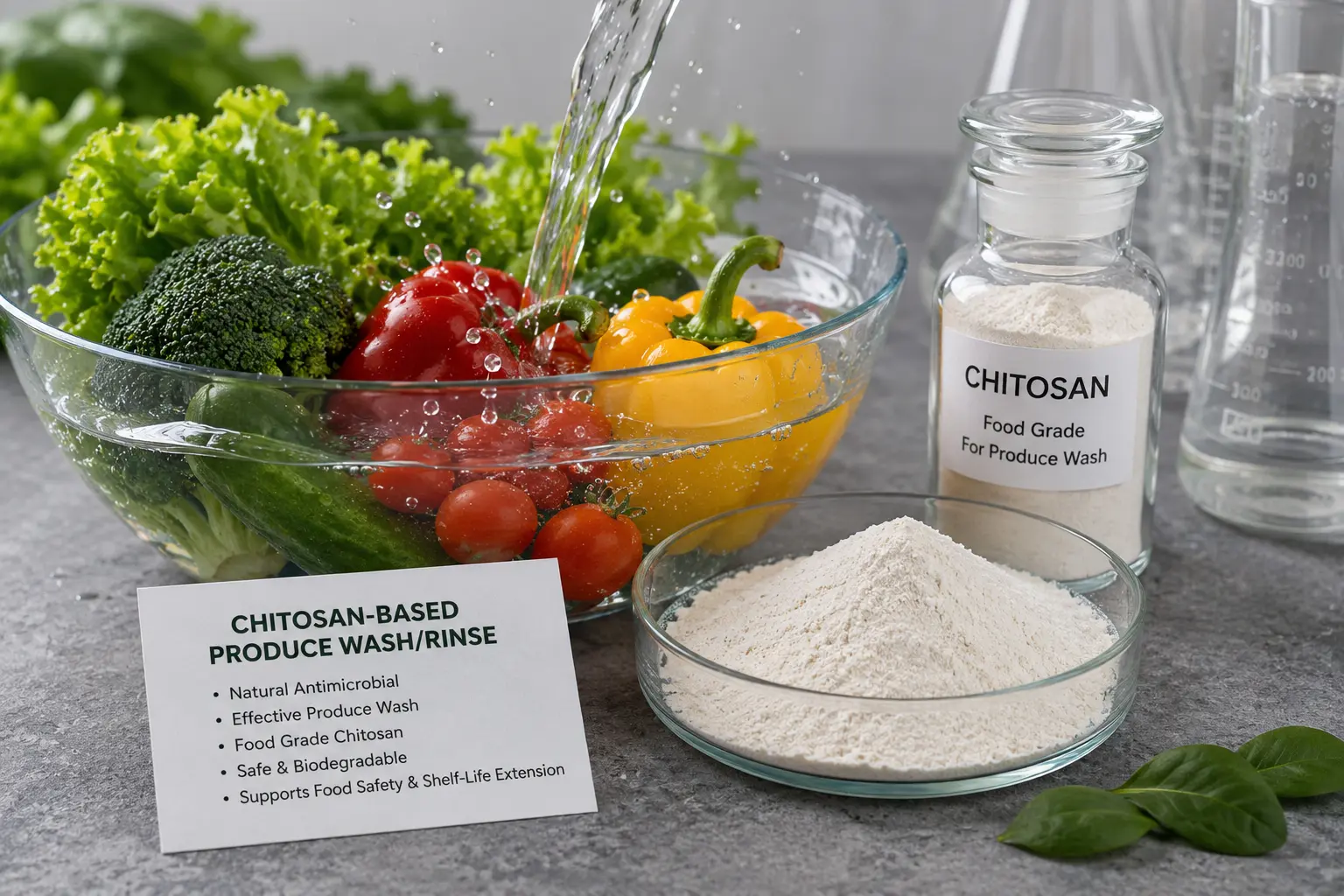
Chitosan Science, Research, Applications & Technical Insight
Bringing any new produce-wash ingredient to market in the United States is, in practice, two separate projects run in parallel: a formulation project and a regulatory project. The formulation side asks whether the ingredient performs does it reduce microbial load, does it hold up across a wash cycle, does it meet a food processor’s specifications. The regulatory side asks a narrower but higher-stakes question: under what legal authority can this product make the claims it needs to make, and does that authority extend to every category the company eventually wants to sell into.
For chitosan, the answer to that second question is not uniform across food categories. A chitosan-based wash formulated for produce has a defined, currently workable regulatory pathway in the United States. The same wash formulation, applied to raw meat or seafood, does not it sits under an entirely different regulatory authority, with a materially higher bar to clear. Treating these as one project rather than two is one of the more consequential planning mistakes a company can make when scoping a chitosan wash/rinse product line.
This article lays out both pathways in detail: the FIFRA 25(b) exemption that governs produce washes, the claims framework that comes with it, the separate FDA/USDA-FSIS framework that governs meat and seafood, and why chitosan’s regulatory status in one category does not transfer to the other. It also covers the scientific basis for chitosan’s antimicrobial activity, since any claim made under either pathway ultimately has to be defensible against that underlying mechanism.
Table of Contents
- Why Chitosan Is Drawing Regulatory Attention as a Produce Wash
- The Science Behind the Claim: How Chitosan’s Antimicrobial Activity Actually Works
- The Produce Pathway: FIFRA 25(b)
- Permitted vs. Disallowed Claims Under 25(b)
- EPA Product Performance Guidance (Series 810)
- Regulatory Recommendation — Produce
- Why Meat and Seafood Need a Different Pathway
- Why GRAS Isn’t a Shortcut
- Regulatory Recommendation — Meat & Seafood
- What This Means for Formulators and Brand Owners
- Summary
- Conclusion
- Supporting Technical Documents
- FAQ
- References
Why Chitosan Is Drawing Regulatory Attention as a Produce Wash
Fresh produce safety sits at an uncomfortable intersection: consumers want food with minimal synthetic residue, but postharvest washing still has to reliably knock down pathogens like E. coli and Salmonella before produce reaches a retail shelf. Chlorine-based washes remain the industry default, but they carry disinfection byproduct concerns and have shown inconsistent performance against certain pathogen loads in commercial-scale trials [4]. That gap is why biopolymer-based alternatives chitosan chief among them have moved from academic interest into active commercial development.
Chitosan is a well-studied candidate for this role because of a genuinely unusual chemical property: it’s one of the few naturally occurring biopolymers that carries a net positive charge in mildly acidic conditions, which allows it to interact directly with the negatively charged membranes of many bacteria [1]. A 2021 meta-analysis of postharvest fruit studies found that chitosan treatment produced a statistically significant reduction in postharvest disease incidence and in vitro fungal mycelium growth across the pooled literature, alongside measurable elicitation of host plant defense responses evidence that the effect is reproducible across independent research groups, not an artifact of any single study design. Before getting into what that means for a produce wash formulation, it helps to understand why that mechanism matters commercially and then, in the second half of this guide, what it means for how such a product must be regulated.
That regulatory question is the real subject of this article. A chitosan produce wash and a chitosan meat or seafood rinse are chemically similar products, but they sit under two entirely different regulatory frameworks in the United States one administered by the EPA, the other by FDA and USDA-FSIS. Conflating the two, or assuming a produce-wash approval extends to animal protein, is one of the more common and costly missteps in bringing this category of product to market.
The Science Behind the Claim: How Chitosan’s Antimicrobial Activity Actually Works
Before a produce wash can carry any antimicrobial claim, that claim needs a mechanistic basis regulators and buyers alike will ask why it works, not just that it works.
Chitosan’s antimicrobial activity is generally attributed to a combination of mechanisms rather than a single mode of action. The cationic amino groups on the chitosan backbone, protonated under acidic conditions, interact electrostatically with the negatively charged bacterial cell surface, disrupting membrane permeability and causing leakage of intracellular contents [1]. Chitosan can also chelate metal ions such as calcium and iron that bacteria depend on for growth, and in some formulations it has been shown to interfere with microbial gene expression and to promote oxidative stress inside the bacterial cell. In produce-specific applications, this translates into measurable, if variable, pathogen reduction: one formulation study using chitosan nanoparticles as a vegetable wash disinfectant reported reductions of several log units against both E. coli and Salmonella Typhimurium under simulated washing conditions on fresh lettuce, with particle size and molecular weight both influencing performance . A related in-vitro study on chitosan combined with metabolites from Pediococcus pentosaceus similarly found measurable antimicrobial activity against Salmonella Typhimurium and E. coli O157:H7 .
It’s worth being precise here: chitosan’s antimicrobial effect is well documented in the literature, but its magnitude is influenced by molecular weight, degree of deacetylation, pH, and formulation approach. This variability is exactly why the regulatory framework discussed below requires efficacy data specific to the finished product and its intended claims, rather than allowing a company to rely on general literature about chitosan as a class.
For readers evaluating formulation strategy specifically rather than the regulatory pathway our Handbook chapter on Food Industry Applications goes deeper into how molecular weight and degree of deacetylation (DDA) selection affects both antimicrobial performance and film-forming behavior on produce surfaces, and our Chitosan Coatings on Produce Surfaces article covers the postharvest physiology side in more detail.
With the scientific basis established, the next question is how that activity translates into a legally marketable claim in the United States which is where the FIFRA 25(b) framework comes in.
The Produce Pathway: FIFRA 25(b)
Clearance for a chitosan-based produce water wash runs through the FIFRA 25(b) exempt route, regulated by the U.S. EPA. This is the minimum-risk pesticide exemption a category designed for products formulated from low-risk active and inert ingredients that meet specific conditions around composition, labeling, and claims.
Three practical requirements apply on top of ingredient eligibility:
- Efficacy data must be in hand before the product goes to market. States may separately require this data to be submitted as part of registration.
- States regulate 25(b)-exempt products differently. A state-by-state compliance map is needed to confirm requirements before commercial launch, since 25(b) exemption at the federal level does not automatically clear every state’s registration requirements.
- Public health claims are off-limits. As with all 25(b) products, an antimicrobial product qualifying under this exemption is not permitted to claim it controls organisms that pose a threat to human health.
That last point is where most label and marketing reviews run into trouble, so it’s worth walking through precisely where the line sits.
Permitted vs. Disallowed Claims Under 25(b)
Non-Public Health Claims (Permitted)
A claim is considered non-public-health when it addresses microorganisms of economic or aesthetic significance organisms whose presence would not normally cause infection or disease in humans. This is the category a 25(b)-exempt produce wash can operate in.
Examples include, but are not limited to:
- Algaecides
- Slimicides
- Preservatives
- Odor-source claims
Disallowed Public Health Claims
A claim crosses into public-health territory and is therefore disallowed under 25(b) when it asserts control over pest microorganisms that threaten human health and whose presence a user cannot readily observe, including organisms infectious to humans anywhere in the inanimate environment.
Examples include claims to:
- Kill or eradicate Mycobacterium tuberculosis
- Kill or eradicate Escherichia coli (E. coli)
- Kill fungi infectious to humans
- “Purify” water
Regulatory Note: These definitions come directly from AAPCO’s FIFRA 25(b) Workgroup efficacy data guidance, as summarized by Bergeson & Campbell, P.C.. Any label or claims language should be checked against this framework before finalization.
EPA Product Performance Guidance
Claim testing for this category follows the EPA’s Series 810 – Product Performance Test Guidelines. These guidelines define how efficacy data supporting allowable claims should be generated, and that same data may be requested again during state-level registration. Given the mechanism-dependent, formulation-specific nature of chitosan’s antimicrobial performance discussed above, generating this data on the actual finished product rather than extrapolating from general chitosan literature is the responsible path to a defensible claim.
Regulatory Recommendation
Move forward. Develop a FIFRA 25(b)-compliant label, secure the efficacy data needed to support any claims made, and obtain state registrations wherever required.
If you’re formulating a produce wash and want to see how molecular weight, viscosity, and degree of deacetylation affect antimicrobial and film-forming performance in a specific chitosan grade, our Technical Resource Library has product-specific COAs, TDS, and specification sheets for each grade we supply. Our team can also walk through which grade best fits a target claim Contact our technical team to start that conversation, or request a sample to begin bench-scale efficacy work.
With the produce pathway established, it’s worth pausing on why the same logic doesn’t carry over to meat and seafood a distinction that trips up more go-to-market plans than any other part of this framework.
Why Meat and Seafood Need a Different Pathway
Unlike produce, where a 25(b) minimum-risk pesticide can sometimes be applied post-harvest, meat and seafood sit under a different regulatory umbrella entirely. These categories are governed by FDA (and, for meat and poultry specifically, USDA-FSIS as well), and they require food additive clearance unless the substance is already approved for that specific use.
To legally apply the same wash or rinse to meat or seafood, three things would be needed:
- An FDA Food Additive Petition
- FSIS approval (applicable to meat and poultry only not seafood)
- Inclusion in FSIS Directive 7120.1 (for meat and poultry)
Why GRAS Isn’t a Shortcut
FDA has historically treated antimicrobial washes used on raw animal products as food additives rather than GRAS substances, unless one of two conditions is met:
- the substance already has a food additive regulation covering that specific use, or
- there is a long history of safe use specifically on raw meat or seafood.
Neither condition currently applies to chitosan. This is a meaningfully different situation from chitosan’s regulatory status in other food categories FDA has, for example, evaluated GRAS notices for chitosan derived from white button mushrooms (Agaricus bisporus) as an antimicrobial in specific packaged and beverage food categories at defined use levels, following scientific-procedures review. That precedent does not extend to raw meat or seafood rinse applications, which remain governed by the food-additive framework described above.
A GRAS route could still be pursued in principle for meat and seafood but for meat products, it would need to go through FSIS, and FSIS does not accept self-affirmed GRAS determinations. FDA concurrence with the GRAS affirmation is required before it can proceed.
Regulatory Recommendation
Do not proceed with meat/seafood at this time. Prioritize the produce wash pathway first, and pursue an FDA-affirmed GRAS determination for chitosan on meat and seafood as a later-phase initiative.
For teams already working in meat and seafood preservation more broadly independent of the wash/rinse application discussed here our guide on Chitosan for Meat Preservation covers current, compliant approaches to shelf-life extension in that category.
What This Means for Formulators and Brand Owners
The practical takeaway is that a single “chitosan wash” strategy doesn’t transfer cleanly across food categories. Produce has a defined, workable exemption pathway today, grounded in an antimicrobial mechanism with real supporting literature. Meat and seafood do not have an equivalent shortcut and treating them the same in a go-to-market plan risks both compliance exposure and wasted development spend.
For teams building out a produce-wash product, the sequence generally looks like this:
- Confirm the intended claims fall on the non-public-health side of the line.
- Generate efficacy data on the finished formulation, aligned with EPA Series 810.
- Build the FIFRA 25(b)-compliant label.
- Cross-check target-state requirements before registration.
- Hold meat/seafood expansion until a GRAS/food-additive strategy is in place.
If you’re weighing which chitosan grade fits a wash/rinse formulation native chitosan, chitosan hydrochloride, or a chitosan oligosaccharide molecular weight and degree of deacetylation are the two variables most consistently linked to antimicrobial performance in the literature . Our team can walk through those trade-offs relative to your target claims. Contact our technical team or request pricing to start that conversation, or explore our current grades in the product catalog.
Summary
A chitosan-based produce water wash can move forward today under the EPA’s FIFRA 25(b) minimum-risk exemption, provided claims stay within the non-public-health category, efficacy data aligned with EPA Series 810 is on file, and state-specific requirements are confirmed. A chitosan-based meat or seafood rinse cannot use this same pathway: it requires FDA food additive clearance and, for meat and poultry, FSIS approval under Directive 7120.1. GRAS is not a practical shortcut for either category and for meat specifically, FSIS requires FDA concurrence rather than accepting a self-affirmed GRAS determination. The current recommendation is to proceed with produce and hold meat/seafood for a later-phase GRAS strategy.
Conclusion
Chitosan’s positive charge and documented antimicrobial mechanism make it a scientifically credible candidate for produce wash applications, and the FIFRA 25(b) pathway gives that application a workable, defined route to market today. The same cannot yet be said for meat and seafood, where the regulatory bar FDA food additive clearance, FSIS approval, and the absence of a self-affirmed GRAS option is considerably higher and not yet cleared for chitosan. Companies building a commercialization roadmap should treat these as two separate projects on two separate timelines, not as a single expansion plan.
Related Products
Companies evaluating chitosan for produce wash applications may also be interested in:
Available next steps: Buy Product · Request Sample
Related Reading
- Chitosan in Food Industry: The Complete Guide
- Chitosan Food Preservative: A Practical Guide for Food Manufacturers
- Chitosan Shelf Life Extension: Complete Guide
- Chitosan Edible Coating for Food Preservation
- How Chitosan Coatings Work on Produce Surfaces
- Chitosan for Meat Preservation
Continue in the Chitosan Derivatives Handbook
For readers who want the underlying formulation science behind this regulatory framework, the Chitosan Handbook covers:
- Food Industry Applications — how molecular weight and DDA drive antimicrobial and film performance
- Regulatory Considerations — a broader look at chitosan’s regulatory status across food, agriculture, and industrial uses
- Product Selection — matching a chitosan grade to a specific claim and application
Read the free chapter preview →
Supporting Technical Documents
Regulatory and formulation decisions for a produce-wash project both depend on having accurate, grade-specific documentation in hand — not general literature values.
Documentation Available by Grade
For each chitosan grade under evaluation, the following are available through our Technical Resource Library:
- Certificate of Analysis (COA)
- Product Specifications and Typical Analysis
- Molecular Weight Guide
- Degree of Deacetylation (DDA) Guide
Need a document that isn’t listed? Contact our technical team quality documentation can be pulled together for any grade in our catalog on request.
Frequently Asked Questions
Is a chitosan-based produce wash regulated as a pesticide? Yes. A chitosan-based produce water wash qualifies for the FIFRA 25(b) minimum-risk pesticide exemption, regulated by the EPA, provided the product and its claims meet 25(b) conditions.
Can a chitosan produce wash claim to kill E. coli or purify water? No. Claims like these are considered public health claims, which are not permitted under a FIFRA 25(b) exemption. Permitted claims are limited to non-public-health categories such as algaecide, slimicide, preservative, or odor-control claims.
Does a chitosan produce wash need approval in every state? Requirements vary by state. Because states regulate 25(b)-exempt products differently, a state-by-state compliance check is necessary before commercial registration and launch.
Can the same chitosan wash be used on meat or seafood? Not without separate clearance. Meat and seafood fall under FDA (and, for meat/poultry, USDA-FSIS) jurisdiction and require food additive clearance a different pathway from the EPA’s 25(b) exemption used for produce.
Why can’t chitosan simply be classified as GRAS for meat and seafood rinses? FDA has historically treated antimicrobial washes on raw animal products as food additives, not GRAS, unless the substance already has a food additive regulation for that use or a long history of safe use on raw meat/seafood neither of which currently applies to chitosan. FSIS also does not accept self-affirmed GRAS for meat applications; FDA concurrence is required.
What actually makes chitosan antimicrobial? Its cationic amino groups interact electrostatically with negatively charged bacterial cell membranes, disrupting permeability; it can also chelate metal ions bacteria need for growth and, in some formulations, interfere with microbial gene expression. Performance varies with molecular weight, degree of deacetylation, and pH.
References
- Khubiev, O.M., Egorov, A.R., Kirichuk, A.A., Khrustalev, V.N., Tskhovrebov, A.G., & Kritchenkov, A.S. (2023). Chitosan-Based Antibacterial Films for Biomedical and Food Applications. International Journal of Molecular Sciences, 24(13), 10738. DOI: 10.3390/ijms241310738
- Saberi Riseh, R., Vatankhah, M., Hassanisaadi, M., & Kennedy, J.F. (2023). Chitosan-based nanocomposites as coatings and packaging materials for the postharvest improvement of agricultural product: A review. Carbohydrate Polymers, 309, 120666. DOI: 10.1016/j.carbpol.2023.120666
- Muñoz-Tebar, N., Pérez-Álvarez, J.A., Fernández-López, J., & Viuda-Martos, M. (2023). Chitosan Edible Films and Coatings with Added Bioactive Compounds: Antibacterial and Antioxidant Properties and Their Application to Food Products: A Review. Polymers, 15(2), 396. DOI: 10.3390/polym15020396
- Paomephan, P., Assavanig, A., Chaturongakul, S., Cady, N.C., Bergkvist, M., & Niamsiri, N. (2018). Insight into the antibacterial property of chitosan nanoparticles against Escherichia coli and Salmonella Typhimurium and their application as vegetable wash disinfectant. Food Control, 86, 294–301. DOI: 10.1016/j.foodcont.2017.09.021
- Enciso-Martínez, Y., et al. (2022). Antimicrobial effect of chitosan and extracellular metabolites of Pediococcus pentosaceus CM175 against Salmonella Typhimurium and Escherichia coli O157:H7. Journal of Food Safety, 42(3), e12968. DOI: 10.1111/jfs.12968
- Rajestary, R., Landi, L., & Romanazzi, G. (2021). Chitosan and Postharvest Decay of Fresh Fruit: Meta-Analysis of Disease Control and Antimicrobial and Eliciting Activities. Comprehensive Reviews in Food Science and Food Safety, 20(1), 563–582. DOI: 10.1111/1541-4337.12672
Ready to Move Forward?
Whether you’re evaluating chitosan for produce washing, mapping out state regulatory requirements, or planning a longer-term meat/seafood strategy, our technical team can support each stage.
Explore more: Buy Chitosan Read the Chitosan Handbook · Contact Technical Support · Request Commercial Pricing
steve@chitosanglobal.com +1 (423) 202-6145