
Shellfish COS vs Black Soldier Fly COS: Crustacean vs Insect Chitosan Oligosaccharide
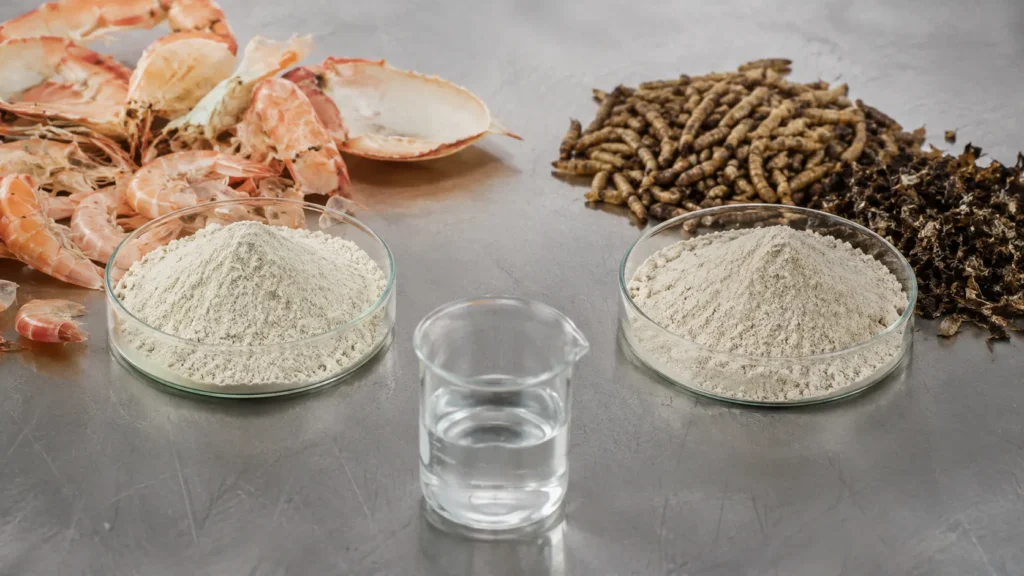
Shellfish COS vs Black Soldier Fly COS
Shellfish COS comes from shrimp and crab shell chitin the industry’s oldest, deepest chitosan oligosaccharide supply. Black Soldier Fly (BSF) COS comes from Hermetia illucens insect chitin a newer, deliberately farmed alternative. Both end up as the same category of material: short-chain, water-soluble chitosan oligosaccharide. The organism they started as tells you about supply chain and labeling, not about how the finished powder will perform in your formulation. That’s determined by molecular weight, DDA, and purity numbers you compare directly, not infer from which animal or insect the chitin came from.
Already comparing COS sources? Review the current Shellfish COS specification and where a BSF COS specification is available, request it directly from our technical team before choosing a material.
Quick Comparison
| Factor | Shellfish COS | BSF COS | Why It Matters |
|---|---|---|---|
| Biological source | Shrimp & crab shell chitin | Hermetia illucens (Black Soldier Fly) exoskeleton chitin | Determines feedstock model and labeling implications |
| COS form | Water-soluble, short-chain oligosaccharide | Water-soluble, short-chain oligosaccharide | Both share the core functional advantage of the COS form |
| Molecular weight | Below 5,000 Da (current catalog listing) | Grade dependent / verify current specification | Governs solubility, viscosity, diffusion |
| DDA | 85–90%, grade-dependent | Grade dependent / verify current specification | Governs available charge density |
| Commercial maturity | Long-established, deep grade range, decades of characterization | Newer entrant, growing documentation base | Shellfish leads on track record and available options |
| Raw-material supply model | Seafood-processing by-product, seasonal, geographically concentrated | Controlled, closed-loop insect rearing — feedstock volume set by production capacity, not harvest season | Different supply-risk profiles, not a quality difference |
| Source traceability | Established shell supply chain | Closed-loop rearing supports batch-level traceability by design | Both support documentation; the traceability model differs |
| Sample availability | 25 g sample, COA on request | Contact for current availability | Shellfish is immediately orderable; confirm BSF sample status directly |
Shellfish figures reflect the current product catalog; BSF COS specification data should be requested and verified directly with our technical team rather than assumed from this table, since we’re not treating unverified figures as fact here.
Does Insect vs Shellfish Origin Change COS Performance?
Origin shapes your raw-material story, your documentation trail, and depending on your market your labeling options. It does not, by itself, determine viscosity, solubility, or bioactivity outcomes. A Shellfish COS batch and a BSF COS batch that happen to share similar molecular weight, DDA, and purity will generally behave more alike than two batches of the same origin with very different specifications. This is worth internalizing before you spend time comparing marketing pages instead of spec sheets: the organism is a procurement variable, not a performance variable.
What Shellfish COS Brings to the Table
Decades of commercial production, the widest range of available molecular-weight and DDA grades on the market, and a research base deep enough that most formulation questions already have prior art to reference. That’s a genuine, checkable advantage for buyers who value supply depth and regulatory precedent over sourcing novelty. It is not automatically cheaper or higher-performing than an insect-derived alternative those are separate claims this page isn’t making on shellfish’s behalf. Broader background: Shellfish Chitosan Oligosaccharide guide.
What BSF COS Brings to the Table
Black Soldier Fly is farmed specifically for chitin production in closed, controlled facilities a fundamentally different supply model from harvesting shellfish by-product, and one that removes the seasonal and geographic concentration risk shellfish sourcing carries. Related BSF-derived material from Chitosan Global’s catalog (chitosan hydrochloride, TMC) is documented as insect-derived, non-marine, and free of shellfish allergen concerns tied to crustacean sourcing specifically. What we won’t do here is call it vegan an insect is an animal, and vegan certification for insect-derived ingredients varies by certifying body, so confirm with your specific certifier before making that claim on a label. We also won’t claim it’s automatically more sustainable, higher purity, or better-performing than shellfish COS without lifecycle or comparative testing data to back that up see the sustainability section below for why.
Molecular Weight and DDA: The Numbers That Actually Decide Fit
Lower molecular weight generally means faster dissolution and lower viscosity useful where you need quick, neutral-pH dispersion. It’s not automatically the better choice everywhere; some formulations specifically want more chain length and structure. Higher DDA generally means more available charge sites for electrostatic interaction — also not universally “better,” since some research and formulation contexts deliberately target a lower DDA. Whichever source you’re leaning toward, request the actual current molecular-weight and DDA figures rather than assuming a value based on the organism. For deeper mechanics specific to the shellfish side, see low molecular weight Shellfish COS.
Solubility — Same Category, Compare the Numbers
Both are COS-form materials, so both are built to dissolve at neutral pH without the acid activation native chitosan requires. That shared trait is a function of the oligosaccharide form itself, not of either source specifically — don’t assume one dissolves meaningfully “better” than the other without comparing actual solubility data for your working concentration.
Sustainability: Don’t Trust Either Flat Claim
Neither “BSF is more sustainable” nor “shellfish is more sustainable” holds up without real lifecycle data behind it, and this page isn’t going to manufacture that data for either side. What’s actually true: shellfish-derived chitosan can utilize existing seafood-processing by-product streams, which is a legitimate resource-efficiency argument. BSF rearing is a controlled, purpose-built production system, which is a legitimate supply-consistency argument but purpose-built rearing also carries its own feed, energy, and facility inputs that a by-product stream doesn’t. Full environmental comparison requires accounting for feedstock, extraction chemistry, deacetylation and depolymerization energy use, water use, waste handling, transport, and yield across both systems data neither this page nor most comparison content online actually has in hand for a direct head-to-head.
Source, Allergen, and Labeling Considerations
Shellfish-derived COS can raise sourcing, labeling, or customer-policy questions depending on your market, purification level, and jurisdiction a documentation issue, not a settled medical claim about allergen risk in a purified derivative. Confirm with your regulatory team rather than assuming either way. BSF-derived material removes the shellfish-specific allergen question by definition, but that doesn’t make it a blanket “allergen-free” or automatically-compliant ingredient for every market insect-derived ingredients carry their own regulatory novel-food and labeling considerations in some jurisdictions that shellfish, as a long-established ingredient category, generally doesn’t. Verify current documentation for your specific target market before assuming either source is the simpler regulatory path.
Application Decision
Functional foods: grade, documentation, and regulatory novelty (shellfish is established; insect-derived ingredients may face novel-food review in some markets) typically decide this ahead of molecular weight. Shellfish-specific detail: Shellfish COS for Functional Foods.
Agriculture and plant growth: dose-response and dispersion behavior matter more than origin story here. See Shellfish COS for Plant Growth if that’s your project.
Cosmetics, biomaterials, industrial formulations: match your viscosity, solubility, and charge requirement against whichever source’s current spec fits not a general preference for either origin.
Which One Should You Choose?
Lean shellfish when: you need the widest available grade selection, an established regulatory track record, or crustacean origin isn’t a problem for your labeling.
Lean BSF when: your project specifically needs a non-marine, insect-derived chitin source for supply-chain or sustainability-narrative reasons, and you can confirm current BSF COS specification and availability directly with our team.
Ignore origin when: neither applies compare molecular weight, DDA, and purity directly instead of reading another sourcing comparison.
Before You Choose, Compare
- Biological source (only where it’s a hard requirement)
- Molecular weight and distribution
- DDA
- Purity, moisture, ash
- Solubility at your working concentration
- Viscosity, where relevant
- Grade fit for your regulatory pathway
- Current COA and SDS
- Sample availability and MOQ
- Bulk supply capacity and lead time
- Landed cost at your required volume
- Destination-specific regulatory requirements (including novel-food status if applicable)
Test Before You Scale
Review both specifications → compare COAs → shortlist candidate grades → order samples → test under identical conditions → compare what you observe → check commercial supply at your volume → choose → scale up.
Want to test Shellfish COS first? Start with a 25 g sample before moving to a larger quantity.
Buy 25g Sample · Request Current COA · Ask About BSF COS Availability · Request Bulk Pricing
Frequently Asked Questions
What is the difference between Shellfish COS and BSF COS?
Biological source (crustacean shell vs. insect exoskeleton) and, correspondingly, feedstock supply model — shellfish relies on seafood-processing by-product, BSF on purpose-built insect rearing. Technical specifications should be compared directly rather than assumed from origin.
What is BSF COS made from?
Chitin extracted from Hermetia illucens (Black Soldier Fly) exoskeleton material, processed into chitosan and then depolymerized into short-chain oligosaccharide.
Is Shellfish COS better than Black Soldier Fly COS?
Neither is universally better. Shellfish offers supply depth and regulatory precedent; BSF offers a controlled, non-marine feedstock model. Fit depends on your specification and sourcing requirements, not a general ranking.
Does biological source affect molecular weight?
Not inherently — molecular weight is set by the depolymerization process. Request the current figure for whichever source you’re evaluating rather than assuming based on origin.
Are both COS materials water soluble?
Yes, water solubility at neutral pH is the defining trait of the COS form for both sources.
Is BSF COS more sustainable?
Not established either way without direct lifecycle data comparing the two specific production systems treat flat claims in either direction with skepticism.
Is BSF COS vegan?
No, it’s insect-derived, and insects are animals. Some certifiers accept insect-derived ingredients under specific frameworks and some don’t; confirm with your certifier before making a vegan claim.
What specifications should buyers compare?
Molecular weight, DDA, purity, solubility, and current COA data for whichever materials you’re evaluating see the checklist above.
Which is better for functional foods?
Depends on your market’s regulatory posture toward insect-derived ingredients as much as on the material itself shellfish carries less regulatory novelty in most established markets. See Shellfish COS for Functional Foods.
Can I test Shellfish COS before ordering bulk?
Yes, a 25 g sample with free shipping is available on the product page.
You May Also Like
No Products Found!
Get in Touch
Technical & Custom Solutions
Abhinav Chauhan, PhD – Application Scientist
Stephen Nice – Application Scientist