
Shellfish-Derived Chitosan Oligosaccharide: Industrial Applications & Technical Reference Guide
No Products Found!
A More Info resource for scientists, formulators, manufacturers, and procurement teams evaluating marine-sourced chitosan oligosaccharide (COS) for industrial, pharmaceutical, agricultural, and environmental use.
Shellfish-derived chitosan oligosaccharide is the oldest and most industrially established form of COS, with a supply chain, characterization literature, and regulatory track record that newer sources are still catching up to. This guide is built for people who need to understand why it’s used the way it is, the chemistry behind its solubility, the reasoning behind its dominance in specific application categories, and the technical trade-offs against other chitosan derivatives rather than a product specification sheet.
1. Why Shellfish COS Became the Industry Standard
Chitin — the parent biopolymer of all chitosan is the second most abundant natural polysaccharide on Earth after cellulose, and crustacean shell waste (shrimp, crab, lobster) remains its most concentrated, commercially accessible source. That’s the practical reason shellfish-derived material became the reference standard: seafood processing generates a continuous, high-volume, geographically distributed byproduct stream that scaled with global crustacean consumption long before fungal or insect-derived alternatives had commercial extraction infrastructure.
Beyond supply logistics, three technical factors cemented its industrial dominance:
- Decades of characterization data. Shellfish chitosan and its oligosaccharide derivatives have the deepest body of peer-reviewed structure-activity research of any chitosan source, which matters directly for regulatory submissions, patent freedom-to-operate searches, and formulation risk assessment.
- Established extraction chemistry. The demineralization–deproteinization–deacetylation sequence used on crustacean shells is a mature, scalable industrial process with well-documented yield and purity benchmarks.
- Wide molecular weight and DDA range availability. Because production volume is high, suppliers can offer a broader range of degree of deacetylation (DDA) and molecular weight cuts than lower-volume alternative sources typically can.
None of this means shellfish COS is automatically the right choice for every application allergen exposure and marine sourcing variability are real constraints discussed below but it explains why it remains the reference material against which newer chitosan sources are benchmarked.
2. Molecular Structure and the Water-Solubility Advantage
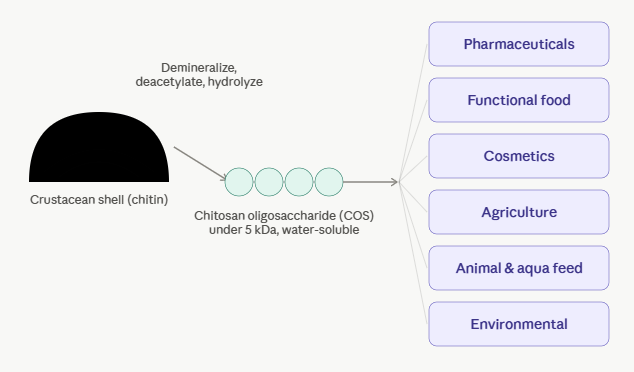
Chitosan oligosaccharide is structurally identical across sources at the molecular level: a linear copolymer of β-(1,4)-linked D-glucosamine and N-acetyl-D-glucosamine units, produced by depolymerizing native chitosan down to short chains, generally under 5,000 Da (roughly 2–20 monomer units).
What changes the functional behavior is the interaction between three variables that any technical buyer should ask a supplier to specify not just “chitosan oligosaccharide” as a category label:
Variable | What it controls | Why it matters |
Molecular weight (MW) | Chain length, viscosity, diffusion rate | Lower MW = better solubility, higher relative charge density, easier membrane/tissue penetration |
Degree of deacetylation (DDA) | Ratio of free amine to acetylated groups | Higher DDA = more protonatable amino groups = stronger cationic charge at a given pH |
Degree of polymerization (DP) distribution | Spread of chain lengths within a batch | A narrow DP distribution gives more predictable, reproducible bioactivity than a wide one |
Native chitosan requires acidic conditions (typically pH below 6) to protonate its amine groups and dissolve; above that pH, it precipitates out of solution. This is the single biggest practical limitation of chitosan in neutral-pH industrial and biological systems. Depolymerizing the chain into oligosaccharide fragments solves this: shorter chains have a smaller hydrodynamic radius and a proportionally higher density of accessible amino groups, which keeps the material dissolved and cationically active across a much wider pH window, including neutral and mildly alkaline conditions.
That single property change full solubility independent of pH is what unlocks most of the applications covered in this guide. It is also why chitosan oligosaccharide hydrochloride, a stabilized salt form, is frequently specified in acidic beverage or low-pH process environments where solubility consistency under variable pH is a formulation risk. For teams evaluating whether the standard oligosaccharide or its stabilized salt form is the better fit, comparing against a chitosan hydrochloride specification sheet is a useful next step.
3. Production from Marine Chitin: The Process Behind the Material
Understanding the production sequence matters for procurement teams writing raw-material specifications, because each processing step introduces a controllable quality variable.
Step 1 — Demineralization. Crustacean shells are treated with dilute acid to dissolve calcium carbonate, the mineral component that gives shells their rigidity.
Step 2 — Deproteinization. Alkaline or enzymatic treatment removes structural protein bound to the chitin matrix, isolating raw chitin.
Step 3 — Deacetylation. Chitin is treated with concentrated alkali (commonly sodium hydroxide) under controlled temperature and time to convert N-acetylglucosamine units to glucosamine, producing chitosan at a target DDA typically 75% or higher for commercial chitosan, and 90%+ for oligosaccharide-grade material.
Step 4 — Depolymerization. The high molecular weight chitosan chain is broken down via acid hydrolysis, oxidative degradation, or increasingly, for pharmaceutical and food-grade material — enzymatic hydrolysis using chitosanase, which offers better control over the final DP distribution and avoids harsh chemical byproducts.
Step 5 — Purification and standardization. The resulting oligosaccharide fraction is filtered, decolorized, and standardized to target MW range and purity specification before drying to powder form.
The choice of depolymerization method (acid vs. enzymatic) is one of the more consequential and least discussed specification questions for buyers. Enzymatic hydrolysis produces a narrower, more reproducible DP distribution and avoids the trace byproducts associated with strong acid treatment, which matters more in pharmaceutical and food-grade applications than in bulk agricultural or industrial-grade use, where cost efficiency typically outweighs distribution tightness.
4. Industrial Processing Benefits
For process engineers integrating COS into manufacturing systems, the practical advantages show up in handling and compatibility, not just bioactivity:
- Low-viscosity aqueous handling. Unlike high molecular weight chitosan, COS solutions remain low-viscosity at commercially relevant concentrations, simplifying pumping, mixing, and metering in continuous processing lines.
- Neutral-pH compatibility. Full solubility outside the acidic range means COS can be dosed directly into neutral or near-neutral process streams without a separate acid-carrier step.
- Reactive functional handle. The primary amine groups on each glucosamine unit provide a consistent site for further chemical modification, quaternization, carboxymethylation, or trimethylation allowing manufacturers to tune charge, solubility, or reactivity for a specific downstream use without switching raw materials.
- Thermal and shear stability sufficient for standard industrial mixing and spray-drying operations, though as with any bioactive polysaccharide — prolonged exposure to high heat or extreme pH should be validated against the specific application’s process parameters.
Because the free amine group is the functional handle for most downstream chemistry, manufacturers frequently select a modified derivative rather than base COS depending on the target charge profile: carboxymethyl chitosan for an anionic, metal-chelating variant; trimethyl chitosan for permanently cationic, pH-independent charge in mucoadhesive or gene-delivery systems; or quaternary chitosan for enhanced antimicrobial and surface-binding performance in textile, coating, or personal care applications.
5. Pharmaceutical and Nutraceutical Applications
Shellfish COS has one of the deepest safety and performance data sets of any excipient-grade polysaccharide, which is a meaningful advantage in pharmaceutical development where regulatory starting-material history shortens review timelines.
Documented application patterns:
- Mucoadhesive drug delivery systems — the cationic amine groups bind electrostatically to the negatively charged mucin layer, extending gastrointestinal, nasal, or ocular residence time for the active ingredient.
- Nanoparticle and nanocarrier platforms — COS complexes with anionic drugs, peptides, and nucleic acids to form nanocarriers used in controlled-release and targeted-delivery research, including oncology and RNA therapeutic applications.
- Oral bioavailability enhancement — by transiently opening epithelial tight junctions, COS has been studied as a paracellular permeability enhancer for poorly absorbed small-molecule drugs.
- Nutraceutical positioning — COS is used in gut-health and cholesterol-management supplement formulations, where its cationic charge supports interaction with bile acids and lipids in the gut lumen.
Formulators working specifically with nanoparticle delivery systems will often move from base COS to a salt or quaternized derivative for improved particle stability see chitosan hydrochloride for nanoparticles for the technical rationale behind that substitution, and the broader chitosan for drug delivery systems overview for delivery-format context across the chitosan derivative family.
6. Functional Food Development
In food science, COS is used as a targeted functional additive rather than a bulk ingredient, largely because of its water solubility and mild bioactivity profile:
Function | Mechanism | Typical Use Case |
Prebiotic-adjacent gut support | Selective fermentation by beneficial gut bacteria | Functional beverages, gut-health supplements |
Natural preservative support | Cationic disruption of microbial cell membranes | Shelf-stable functional foods, minimally processed products |
Lipid and cholesterol binding | Electrostatic interaction with bile acids and fats | Cholesterol-management functional foods |
Clarity in beverage systems | Full solubility at neutral pH avoids haze formation | Clear functional drinks, fortified waters |
The allergen question is unavoidable in this category: because shellfish COS is derived from crustacean shell waste, products formulated with it require crustacean allergen labeling in most regulatory jurisdictions, even though the finished oligosaccharide contains negligible residual shellfish protein after purification. This is the primary reason some food brands specifically request non-crustacean sourcing for allergen-sensitive or vegan product lines a distinction worth flagging early in ingredient selection rather than discovering during label review. For a broader view of how chitosan-family ingredients are used across the category, see chitosan in the food industry.
7. Cosmetic Ingredient Applications
Cosmetic chemists formulate with shellfish COS primarily for its film-forming, moisture-binding, and mild antimicrobial behavior:
- Humectant and barrier-support function in skincare, due to the hygroscopic nature of the oligosaccharide chain.
- Preservative-boosting in reduced-preservative or “clean” formulations, supplementing (not replacing) a full preservative system.
- Haircare and scalp applications, where the cationic charge provides conditioning and antistatic effects on keratin surfaces, along with mild antimicrobial activity relevant to scalp health.
- Compatibility with quaternized derivatives for enhanced substantivity quaternary chitosan variants adhere more strongly to negatively charged hair and skin surfaces than unmodified COS, which is why many rinse-off and leave-on haircare formulations specify the quaternized form over base oligosaccharide.
Because allergen disclosure requirements differ between cosmetic and food regulatory frameworks in most markets, cosmetic formulators generally have more sourcing flexibility on this point than food brands do, though ingredient transparency expectations from consumers are pushing more brands toward disclosed, traceable sourcing regardless of category.
8. Agricultural Biostimulant Technologies
COS functions in agriculture through two complementary mechanisms: direct antimicrobial activity against plant pathogens, and indirect activity as a defense elicitor that activates the plant’s own systemic resistance pathways via pattern-recognition receptors that detect chitin fragments as a signal of fungal attack.
Established use patterns:
- Seed treatment — improves germination rate and early seedling vigor.
- Foliar application — supports stress tolerance (cold, drought, salinity) and pathogen resistance in a growing crop.
- Post-harvest treatment — extends storage life by suppressing surface fungal colonization on fruit and vegetables.
- Soil amendment and bioremediation support — chitosan’s metal-chelating capacity has been studied for immobilizing heavy metals in contaminated soils as part of integrated soil-health programs.
Because COS acts as a biological elicitor rather than a direct-kill pesticide, it fits naturally into resistance-management and residue-reduction strategies used in integrated pest management and organic-adjacent production systems. For formulation-specific guidance, see chitosan oligosaccharide for plant growth enhancement and chitosan for plant defense and crop protection systems. Procurement teams sourcing at scale should also review chitosan oligosaccharide supplier options for agricultural applications and the broader chitosan for agriculture and plant protection systems resource.
9. Animal Nutrition and Aquaculture Applications
This is one of the highest-growth application categories for shellfish COS, driven by regulatory pressure to reduce antibiotic growth promoters across livestock and aquaculture production.
Reported mechanisms across species:
- Stimulation of digestive enzyme activity, improving feed conversion ratio.
- Immunomodulation through macrophage activation and cytokine signaling.
- Binding of mycotoxins and heavy metal ions in the gastrointestinal tract.
- Improved intestinal villus structure and microbiota balance, supporting nutrient absorption.
Aquaculture presents a particularly strong fit for shellfish-sourced material specifically: because COS is already structurally related to the chitin naturally present in crustacean and insect feed components, its inclusion doesn’t introduce a novel allergen or metabolic burden for aquatic species the way it might in monogastric livestock. Reported production trials across species show measurable gains in weight gain and feed conversion at moderate inclusion rates, though dose-response is species-specific and non-linear excessive inclusion has been associated with growth inhibition in several trials, which underscores the importance of species-specific dosing data over a universal inclusion rate.
Species-specific resources: chitosan oligosaccharide for poultry feed, chitosan feed additive for pig growth, and chitosan for shrimp immunity.
10. Environmental and Biotechnology Applications
Beyond agriculture and biomedical use, shellfish COS and its parent chitosan have a substantial footprint in environmental engineering an application area that’s frequently underserved in COS marketing content despite strong scientific grounding.
- Heavy metal biosorption and chelation. The free amino groups on chitosan and COS chelate transition metal ions (lead, cadmium, arsenic, copper, chromium) from industrial effluent, offering a biodegradable alternative to synthetic chelating resins. Research on shrimp-shell-derived chitosan has demonstrated strong metal adsorption capacity even from relatively mild, low-cost processing conditions, making it economically attractive for wastewater pretreatment.
- Coagulation and flocculation. The cationic charge on chitosan-based materials neutralizes negatively charged suspended particles in water, causing them to aggregate and settle a mechanism used in both municipal water clarification and industrial wastewater pretreatment as a biodegradable alternative to synthetic polyacrylamide flocculants.
- Enzyme immobilization. Chitosan’s amine and hydroxyl groups provide covalent and ionic binding sites for immobilizing industrial enzymes, improving their operational stability, reusability, and substrate affinity in biocatalysis applications.
- Biosensor and bioelectronic substrates. The gel-forming, film-forming, and electron-donating properties of chitosan-based materials have found emerging use in fuel cells, supercapacitors, and biosensor platforms, an area of active academic research with growing commercial interest.
For teams evaluating COS specifically for chelation-heavy environmental applications, the carboxymethylated derivative is often the better technical fit than base oligosaccharide, since carboxymethylation adds anionic chelation sites alongside the native cationic amine groups, broadening the range of metal species the material can bind see carboxymethyl chitosan for the technical distinction.
11. Future Commercial Opportunities
Several trends are shaping where shellfish COS is headed commercially:
- Enzymatic depolymerization scale-up. As chitosanase-based production becomes more cost-competitive with acid hydrolysis, expect narrower, more reproducible DP distributions to become the industry-standard specification rather than a premium option, particularly for pharmaceutical and food-grade material.
- Functionalized derivative growth. Quaternized, trimethylated, and carboxymethylated COS variants are expanding the addressable application space targeted gene delivery, permanently cationic antimicrobial coatings, and multi-functional chelating agents beyond what unmodified COS can achieve.
- Environmental remediation demand. Tightening industrial wastewater discharge regulations in multiple markets are increasing demand for biodegradable heavy-metal chelating agents, a category where chitosan-based materials compete directly against synthetic ion-exchange resins on both cost and environmental profile.
- Antibiotic-reduction policy tailwinds in livestock and aquaculture feed continue to be one of the strongest volume drivers for COS globally, and this is expected to accelerate as more markets implement antibiotic growth promoter restrictions.
- Traceability and allergen-transparent sourcing are becoming competitive differentiators as food and cosmetic brands respond to consumer demand for clearer origin labeling, even in categories where crustacean-sourced material remains the technical standard.
For a broader view of how shellfish COS fits within the full chitosan derivative family — including hydrochloride, carboxymethyl, trimethyl, and quaternary forms — the chitosan derivatives supplier resource maps out how these materials are typically specified and sourced, and water-soluble chitosan supplier covers procurement considerations specific to fully water-soluble grades. For food-grade sourcing specifically, see food-grade chitosan supplier.
Frequently Asked Questions
- What’s the difference between chitosan and chitosan oligosaccharide (COS)? Chitosan is a high molecular weight polymer soluble only in acidic conditions. COS is produced by depolymerizing chitosan into short chains, typically under 5,000 Da, making it fully water-soluble at neutral pH with a proportionally higher charge density.
- Why is shellfish-derived COS still the industry benchmark? It has the deepest characterization and safety data set of any chitosan source, an established large-scale extraction process, and the broadest availability of molecular weight and DDA specifications, which together make it the reference material most regulatory and technical comparisons are built around.
- Does shellfish COS trigger shellfish allergies? Purified COS contains negligible residual crustacean protein, but because it originates from crustacean shell waste, most regulatory frameworks still require shellfish allergen labeling on finished products, which is an important consideration for allergen-sensitive product lines.
- What molecular weight range defines chitosan oligosaccharide? Generally under 5,000 Da, corresponding to roughly 2–20 linked glucosamine units, though suppliers may offer narrower cuts within that range depending on the target application.
- How does degree of deacetylation (DDA) affect performance? Higher DDA means more free amino groups available for protonation, which increases cationic charge density and generally strengthens antimicrobial, chelating, and mucoadhesive activity DDA and molecular weight should both be specified together, not treated as a single “COS” category.
- What’s the difference between acid hydrolysis and enzymatic hydrolysis in production? Acid hydrolysis is more established and lower-cost but produces a wider distribution of chain lengths. Enzymatic hydrolysis using chitosanase gives tighter control over the final degree of polymerization and avoids harsh chemical byproducts, which matters more in pharmaceutical and food-grade specifications than in bulk industrial or agricultural grades.
- Can COS be used for heavy metal removal in wastewater treatment? Yes. The free amino groups chelate transition metal ions such as lead, cadmium, and copper, and chitosan-based materials are used both as chelating agents and as biodegradable flocculants in water and wastewater treatment.
- Which chitosan derivative is best for metal chelation applications? Carboxymethyl chitosan is often preferred over base COS for chelation-heavy environmental applications because carboxymethylation adds anionic binding sites alongside the native cationic amine groups, broadening the range of metal ions the material can bind.
- Is COS suitable for pharmaceutical-grade drug delivery systems? Yes, it’s one of the most studied excipient classes for mucoadhesive and nanoparticle-based delivery systems, though pharmaceutical use still requires grade-specific purity, endotoxin, and impurity testing regardless of source, and shellfish origin’s long characterization history can help simplify regulatory documentation.
- What’s the difference between COS and quaternary chitosan? Quaternary chitosan carries a permanently positive charge (independent of pH) through chemical quaternization of the amine groups, giving it stronger, more consistent antimicrobial and surface-binding performance than base COS, which relies on pH-dependent protonation for its charge.
- Is there an optimal inclusion rate for COS in animal feed? Dose-response is species-specific and generally non-linear. Moderate inclusion levels have shown measurable gains in growth performance and feed conversion across multiple species trials, while excessive levels have been associated with growth inhibition, so species-specific trial data should guide inclusion rates.
- Why does COS work well in aquaculture specifically? Because COS is structurally related to chitin naturally present in the diet and exoskeletons of many aquatic feed components, its inclusion doesn’t introduce a novel allergen or unfamiliar metabolic burden for aquatic species, unlike its introduction into some monogastric livestock diets.
- Can shellfish COS be used in vegan or allergen-free product formulations? No — because it’s derived from crustacean shell waste, it cannot be marketed as vegan or allergen-free. Brands targeting those claims typically source COS from fungal or other non-animal biomass instead.
- How is COS typically supplied for industrial or food-grade use? Most commercial shellfish-derived COS is supplied as a dry powder, characterized by molecular weight range, degree of deacetylation, and solubility specification, with grade options (food, pharmaceutical, agricultural, industrial) determined by purity and testing requirements.
- What determines whether a formulator should use base COS versus a modified derivative like trimethyl or quaternary chitosan? The deciding factor is usually the target pH environment and required charge consistency: base COS relies on pH-dependent protonation for its cationic charge, while trimethyl and quaternary derivatives carry a permanent positive charge regardless of pH, which matters in applications like gene delivery or antimicrobial coatings where consistent charge across variable conditions is required.
This guide is intended as an independent technical and industry reference. For sourcing shellfish-derived chitosan oligosaccharide, technical specifications, or formulation support, see the Chitosan Oligosaccharide (Shellfish) product page or contact Chitosan Global directly.
You May Also Like
No Products Found!
Get in Touch
Technical & Custom Solutions
Abhinav Chauhan, PhD – Application Scientist
Stephen Nice – Application Scientist