
The Moment a Formulation Stops Working — And What Fixes It
Every formulator working with chitosan eventually hits the same wall. The batch dissolves fine in the acidic test solution. Then it goes into the actual product a neutral-pH cream, a buffered oral suspension, a food matrix sitting comfortably above pH 6 and the chitosan starts dropping out. Not failing dramatically. Just quietly precipitating, clouding the formulation, and taking its antimicrobial and mucoadhesive activity down with it.
Mushroom Chitosan Hydrochloride exists to make sure that moment never happens.
No Products Found!
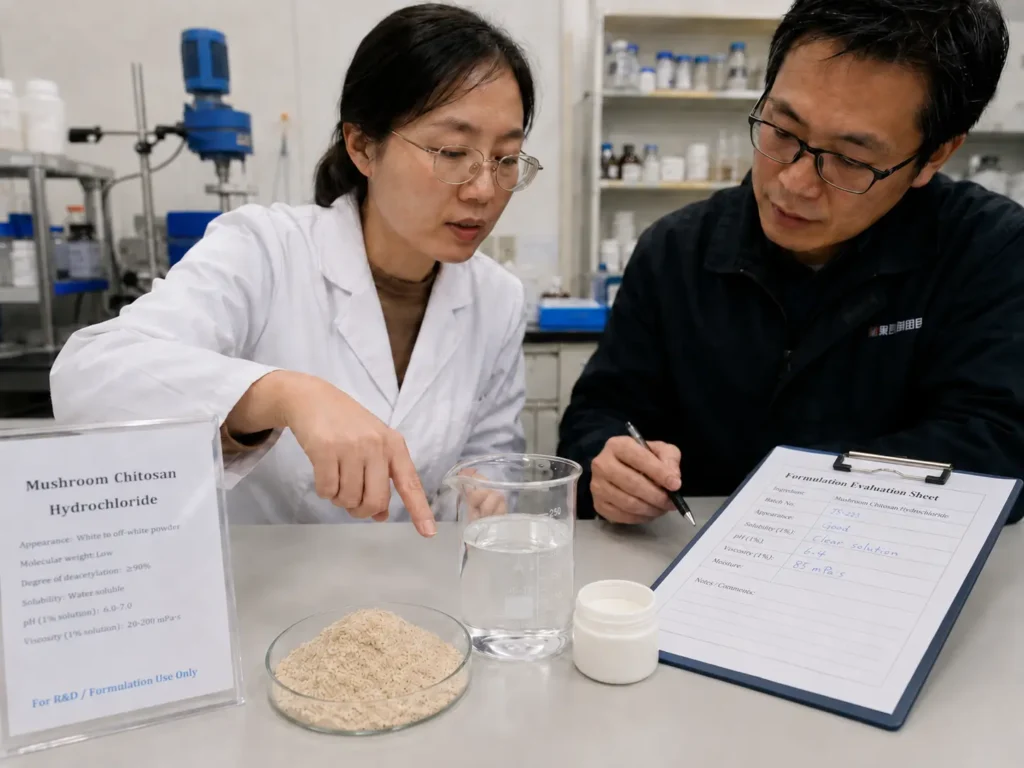
What Happens Inside a Formulation When Water Solubility Becomes Critical
Native chitosan’s positive charge depends entirely on protonation of its free amine groups a reaction that only occurs in acidic conditions. Push the pH above roughly 6.5, and that protonation reverses. The polymer loses its charge, and with it, its solubility, its mucoadhesive pull, and a meaningful share of its antimicrobial activity. For a formulator, this isn’t an abstract chemistry fact. it’s the specific reason a promising lab-scale trial can fail the moment it moves into a real product matrix.
Did You Know? Chitosan hydrochloride solves this not by changing chitosan’s fundamental charge chemistry, but by pre-forming the salt. Chitosan hydrochloride is produced by introducing hydrochloric acid to the chitosan structure, a process that enhances the polymer’s solubility in water and stabilizes it in a form that doesn’t require an acidic environment to stay dissolved and functional.
Why Formulators Choose Chitosan Hydrochloride Instead of Native Chitosan
The functional payoff is broader than solubility alone. Chitosan hydrochloride is known for its hemostatic properties, mucoadhesion, and antimicrobial effects, and its water solubility makes it easy to incorporate into applications such as drug delivery, wound healing, and food preservation three application areas where native chitosan’s acid-dependency is a genuine, recurring obstacle.
Research Spotlight. Degree of deacetylation (DDA) remains the single biggest performance lever, salt form or not. A higher DDA means a greater percentage of acetyl groups have been removed from the chitin structure, resulting in better solubility, bioactivity, and charge density so two chitosan hydrochloride batches with different DDA values will behave meaningfully differently in the same formulation, even at identical concentrations.
Why Pharmaceutical Companies Are Moving Toward Mushroom-Derived Water-Soluble Polymers
Sourcing consistency compounds through every downstream processing step, and salt formation is no exception. A cleaner, more consistently deacetylated starting material produces a more uniform hydrochloride salt fewer batch-to-batch surprises in solubility behavior, viscosity, and charge density. Fungal starting material also removes shellfish allergen risk entirely, which matters increasingly for pharmaceutical and food-adjacent products where allergen labeling is a real regulatory and consumer-trust issue, not a nice-to-have.
Industry Perspective. There’s a real pricing signal here worth being transparent about. Fungal-source chitosan hydrochloride is typically priced higher than sea-source material not as an arbitrary premium, but reflecting the more controlled, consistent production process behind it. Buyers evaluating cost should weigh that premium against the batch-to-batch reproducibility they’re actually getting, not just the per-kilogram number.
Which Formulation Challenges Does This Derivative Solve?
| Challenge | Native Chitosan | Chitosan Hydrochloride (Mushroom) |
|---|---|---|
| Solubility above pH 6.5 | Fails — precipitates | Maintained |
| Antimicrobial activity at neutral pH | Reduced/lost | Retained |
| Mucoadhesion in physiological environments | Inconsistent | Reliable |
| Formulation into aqueous emulsions | Requires acid pre-treatment | Direct incorporation |
| Shellfish allergen risk | Present (if sea-sourced) | None (fungal source) |
| Batch reproducibility | Variable (mixed shellfish waste streams) | Higher (controlled fungal cultivation) |
How R&D Teams Compare Chitosan Hydrochloride With Other Modified Derivatives
| If your priority is… | Best fit |
|---|---|
| Simple, broad-use water solubility | Chitosan Hydrochloride (Mushroom) |
| Very high bioavailability, low viscosity | Chitosan Oligosaccharide (Mushroom) |
| Anionic/amphoteric behavior, hydrogel systems | Carboxymethyl Chitosan (Mushroom) — see Carboxymethyl Chitosan for Hydrogels |
| Permanent cationic charge, antimicrobial performance at any pH | Quaternary Chitosan (Mushroom) |
| Oral/mucosal permeation enhancement | Trimethyl Chitosan (Mushroom) — see Trimethyl Chitosan for Oral Delivery |
Expert Insight. Chitosan hydrochloride is usually the right starting point for evaluation, not the final answer for every application. it solves the solubility problem with the least structural modification, which makes it the simplest, most cost-effective option when you don’t specifically need a permanent charge or a different charge polarity. If your formulation needs more than solubility a specific mechanism like mucoadhesion enhancement or nanoparticle self-assembly see Chitosan Hydrochloride for Nanoparticles for how the salt form specifically supports that use case, or Chitosan for Drug Delivery Systems for the broader mechanism landscape.
Industry Case Study: The Digestive Health Application
Chitosan hydrochloride’s water solubility and toxin/heavy-metal binding capacity have made it a preferred ingredient in gut-health formulations but sourcing matters more here than almost anywhere else. As Chitosan Global has stated directly: only mushroom or insect-derived chitosan capsules are generally recommended for human consumption, specifically because of the variability of shellfish raw material supply. That’s a direct, practical example of why source consistency isn’t an abstract quality concern. it determines which finished-product categories a given batch can legitimately serve.
What Should Buyers Evaluate Before Selecting a Supplier?
- Degree of deacetylation, reported per batch — not a single historical average.
- Source consistency documentation — fungal cultivation records vs. mixed shellfish waste sourcing.
- Molecular weight and viscosity data alongside DDA — these interact; DDA alone is incomplete.
- Certificate of Analysis for the specific lot, including purity and contaminant screening.
- Allergen status confirmation in writing, not just an assumed “mushroom-derived” label.
- Batch-to-batch reproducibility data, ideally across multiple lots, not one sample.
Where Future Commercial Demand Is Heading
Demand is shifting in a consistent direction: away from generic “chitosan” sourcing toward specified, characterized, source-transparent material driven by growing allergen-labeling scrutiny, increasing pharmaceutical characterization requirements, and clean-label pressure in food and cosmetics. Mushroom-derived chitosan hydrochloride sits well inside that shift, offering the simplest possible upgrade path from native chitosan for teams that need water solubility without redesigning their entire formulation around a more complex derivative.
Frequently Asked Questions
1. What is mushroom chitosan hydrochloride? It’s a water-soluble salt form of chitosan, made by treating fungal (mushroom)-derived chitosan with hydrochloric acid, which stabilizes its solubility and charge independent of the acidic conditions native chitosan requires.
2. How is chitosan hydrochloride different from native chitosan? Native chitosan only dissolves and carries charge in acidic conditions; chitosan hydrochloride is pre-formed as a salt, giving it more reliable water solubility across a broader range of conditions.
3. Is chitosan hydrochloride the same as quaternary chitosan? No. Chitosan hydrochloride is a salt form with charge behavior still somewhat influenced by its environment; quaternary chitosan carries a permanent, pH-independent cationic charge through a different chemical modification entirely.
4. Why choose mushroom-derived over shellfish-derived chitosan hydrochloride? Fungal sourcing removes shellfish allergen risk and generally offers more consistent starting material, translating into more reproducible salt-form behavior batch to batch.
5. Is mushroom chitosan hydrochloride vegan? Yes, as a fungal-derived material, it contains no animal-origin ingredients.
6. What is degree of deacetylation, and why does it matter here? It’s the percentage of acetyl groups removed from the chitin structure during processing. Higher DDA generally means better solubility, bioactivity, and charge density in the finished chitosan hydrochloride.
7. Is chitosan hydrochloride suitable for pharmaceutical use? It’s widely used as a pharmaceutical excipient for its water solubility, mucoadhesive, and hemostatic properties; specific regulatory suitability should be confirmed for your intended use.
8. Does chitosan hydrochloride have antimicrobial properties? Yes, its antimicrobial effects are one of its most cited functional properties, particularly valuable in food preservation and wound-care applications.
9. Can chitosan hydrochloride be used in food products? Yes, its water solubility and antimicrobial activity support use as a food preservative and functional ingredient for shelf-life extension.
10. Is chitosan hydrochloride hemostatic? Yes, this is one of its well-documented properties, relevant to wound-care and medical-device applications.
11. Why is fungal-source chitosan hydrochloride more expensive than sea-source? The price difference generally reflects the more controlled, consistent cultivation and processing behind fungal-source material, rather than an arbitrary markup.
12. Can chitosan hydrochloride be used for gut health/digestive applications? Yes, and sourcing matters specifically here mushroom or insect-derived material is generally recommended over shellfish-derived for human consumption, due to shellfish supply variability.
13. What molecular weight range is available for chitosan hydrochloride? Molecular weight varies by grade and intended application; request batch-specific data rather than assuming a standard figure across suppliers.
14. How do I know if a chitosan hydrochloride supplier is reliable? Look for batch-specific COAs, documented DDA and molecular weight, transparent sourcing, and evidence of batch-to-batch reproducibility across multiple lots, not just one sample.
15. Is chitosan hydrochloride mucoadhesive? Yes, mucoadhesion is one of its core functional properties, relevant to oral and topical drug delivery applications.
16. How does chitosan hydrochloride compare to chitosan oligosaccharide? Chitosan hydrochloride offers simple, broad-use water solubility at standard molecular weight; chitosan oligosaccharide is lower molecular weight, offering higher bioavailability and lower viscosity for different application needs.
17. Can chitosan hydrochloride be used in cosmetic formulations? Yes, its water solubility and film-forming behavior support use in cosmetic and personal-care formulations.
18. How do I request a sample or bulk pricing? Visit the mushroom chitosan hydrochloride product page, or contact our technical team directly to discuss your specific application, required specifications, and volume.
Ready to Formulate with Mushroom Chitosan Hydrochloride?
The technical case is straightforward: if your formulation operates anywhere near or above neutral pH which most pharmaceutical, cosmetic, and food matrices do native chitosan’s acid-dependency is a real, recurring formulation risk. Chitosan hydrochloride removes that risk with the simplest possible modification, and sourcing it from mushroom biomass adds allergen-free, more consistent, better-characterized material on top of that fix.
This derivative is the right starting point for formulators who need reliable water solubility without redesigning their entire approach around a more complex charge-modified derivative. Explore technical specifications, request a laboratory sample, download the COA, or speak with a formulation expert to start your development project.
You May Also Like
No Products Found!
Get in Touch
Technical & Custom Solutions
Abhinav Chauhan, PhD – Application Scientist
Stephen Nice – Application Scientist