
Benefits of Shellfish Chitosan Oligosaccharide: Sorting Real Evidence from Marketing Copy
No Products Found!
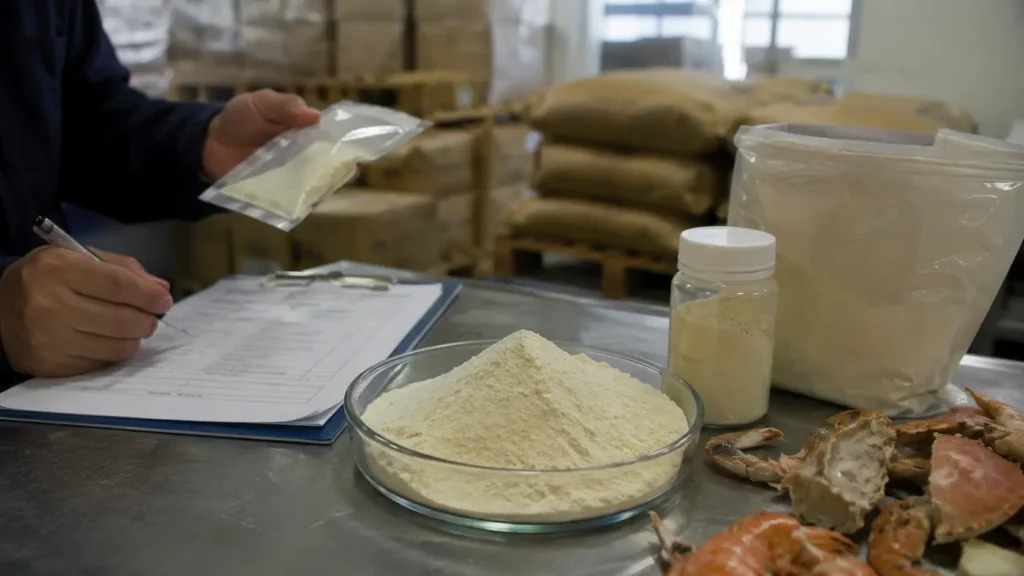
Search “chitosan oligosaccharide benefits” and you’ll find pages that list antioxidant, antimicrobial, gut-health, immune, and plant-growth effects back to back, as if they’re all equally proven and all equally guaranteed by any bag of powder with “COS” on the label. They’re not. Some of what follows is settled material chemistry Shellfish COS genuinely does dissolve faster and process easier than native chitosan, full stop, no asterisk needed. Some of it is animal-model research that’s promising but hasn’t reached humans. Some of it is a single human study in a narrow patient population that gets cited everywhere as if it applies to everyone. This page sorts those apart instead of blending them into one confident bullet list.
Evaluating Shellfish COS for a formulation or research project? Review the current product specification, request the COA, or start with a 25 g sample.
Buy 25g Sample · Request Current COA
The Evidence Ladder
Before the details, the framework this page uses throughout:
| Rung | What It Means | What It Doesn’t Mean |
|---|---|---|
| Material science | Measured, physical, repeatable chain length, solubility, viscosity | Not a biological claim |
| In vitro | Observed in a dish or cell culture | Doesn’t confirm it happens in a living organism |
| Animal model | Observed in a living organism, usually rodent | Doesn’t confirm the same effect, dose, or mechanism in humans |
| Human limited | A real human study exists, but scoped to a specific population/protocol | Not general-population evidence |
| Emerging | Active research area, findings still developing | Not settled enough for a firm consumer claim |
Every claim below gets one of these tags. If a page you’re reading elsewhere doesn’t tag its claims this way, that’s worth noticing.
Benefit Evidence Table
| Benefit / Property | Evidence Type | Why It Matters | Important Limitation |
|---|---|---|---|
| Water solubility | Material science | Dissolves at neutral pH, no acid step needed | Depends on molecular weight and concentration |
| Low viscosity | Material science | Easier pumping, mixing, dispersion | Trade-off against film-forming capacity |
| Antioxidant activity | In vitro / animal, one limited human study | Investigated for oxidative-stress-related research | Human evidence scoped to a specific patient population |
| Antimicrobial activity | In vitro, condition-dependent | Studied for food, agricultural, biomaterials contexts | Highly dependent on MW, DDA, concentration, target organism |
| Prebiotic / gut-microbiota effects | Animal, limited human | Investigated for supporting beneficial bacteria genera | Mostly preclinical; not an established clinical claim |
| Immune-modulation | In vitro / animal | Investigated for cytokine and immune-cell effects | Not established as a human immune-support therapy |
| Plant defense elicitation | Well-documented in vitro and field-level plant studies | Activates plant immune pathways, reduces pathogen load in tested crops | Effectiveness depends heavily on concentration, DP, and plant species — not universal across all crops or doses |
| Seed germination / root development | Multiple published plant studies | Reported biostimulant effect across several crop species | Effect size varies by species, concentration, and application method |
What’s Actually Just Chemistry
Start with the part that needs no hedging. Chitosan is a long polymer that only dissolves in acid. Shellfish COS is that same polymer chain, broken down into fragments short enough to dissolve directly in neutral water. That’s not a “reported effect” it’s the defining structural change of the oligosaccharide form, and it’s why COS shows up anywhere aqueous processing matters: functional beverages, spray-tank agriculture, liquid research systems. Lower molecular weight, lower viscosity, faster dispersion these are measurable, repeatable material properties, not biological claims requiring hedged language. For the mechanics of exactly what molecular weight controls and why, see low molecular weight Shellfish COS.
Antioxidant Research: One Real Human Study, Widely Overstated
COS has been investigated for antioxidant activity mostly in vitro and in animal models. There is a genuine human study worth knowing: research in coronary heart disease patients found COS supplementation associated with increased serum antioxidant markers, linked to a shift toward more probiotic-favorable gut bacteria suggesting the antioxidant effect may run through the gut rather than being a direct free-radical-scavenging chemical mechanism. That’s a real finding in real people. It’s also one study, in one patient population, with one supplementation protocol. Citing it as proof that “Shellfish COS has antioxidant benefits” for a general population is a bigger claim than the study supports.
Antimicrobial Research: Real, But Not a Fixed Number
COS antimicrobial activity is documented in vitro, and the proposed mechanism cationic charge disrupting negatively charged microbial cell surfaces is consistent with the broader chitosan literature. What’s not fixed is the magnitude: activity varies with molecular weight, DDA, concentration, and which organism you’re testing against. There is no single “X% antimicrobial efficacy” figure that applies across grades or applications. Any specific performance claim needs testing under your own conditions, not a borrowed number from a different study.
Gut and Microbiome Research: Genuinely Active, Not Yet Settled
Recent literature describes COS as a “new potential prebiotic,” with animal and in vitro work showing it can selectively favor beneficial gut bacteria genera like Lactobacillus and Bifidobacterium, and animal models linking COS supplementation to improved intestinal barrier integrity and short-chain fatty acid production. This is a legitimately promising, currently active research direction. It is not the same as a settled human clinical finding that applies broadly the human evidence base remains the single CHD study referenced above plus a handful of related work, not a body of confirmatory trials.
Immune-Related Research: Cell and Animal Data, Not a Human Immunity Claim
Chitosan and COS have been studied for effects on immune cell activity and cytokine profiles, primarily in cell-based and animal models. That’s preclinical mechanism research. It does not support a “boosts immunity” claim on a human product label, and this page isn’t making that claim.
Plant and Agricultural Research: The Strongest Evidence Base on This Page
This is worth calling out directly: COS’s role in agriculture is backed by more field-relevant, multi-species evidence than most of its other reported benefits. Chitosan oligosaccharide functions as a recognized elicitor of plant systemic defense activating pathogenesis-related responses and phytoalexin production across documented crop systems and the effect is well-established enough that reviews describe chitosan’s effectiveness as determined by specific, controllable variables: origin, DDA and acetylation pattern, molecular weight, pH, concentration, and solubility. Separate published work shows degree of polymerization specifically affecting elicitor performance one study found a DP5 oligochitosan fraction produced the strongest defense response against a tested pathogen, evidence that “COS” isn’t one fixed active ingredient even within the plant-research literature. Seed-priming and foliar studies across wheat, maize, tomato, and lentil report improved germination, root development, and stress resilience, though effect size still depends on concentration and application method a 2% concentration and a 0.5% concentration are not interchangeable in the cited research. For the application-specific detail, see Shellfish COS for Plant Growth and Agricultural Research.
Why “Shellfish COS” Isn’t One Material
Every table above hides a variable most marketing pages skip: molecular weight, molecular-weight distribution, DDA, and purity all shift what a given COS batch actually does. A study reporting an antimicrobial or antioxidant result used a specific fraction often a narrow degree-of-polymerization range under specific conditions. A different Shellfish COS batch, even from the same supplier, can sit outside that range. This is precisely why the plant-defense research above found DP5 outperforming other fractions against a specific pathogen: the oligosaccharide’s degree of polymerization is doing real work, and “COS” as a category name doesn’t capture it.
Source Doesn’t Guarantee an Advantage Either
Shellfish origin doesn’t automatically make a COS batch more bioactive than Mushroom or BSF-derived COS the deciding variables are still molecular weight, DDA, and purity, not which organism the chitin came from. See Shellfish COS vs Mushroom COS or Shellfish COS vs BSF COS if source selection is part of your decision.
The Reality Check Before You Formulate
A published result used a specific molecular weight, DDA, purity, and concentration not “chitosan oligosaccharide” as an abstract category. Before assuming any finding above applies to a specific batch, verify:
| Parameter | Why It May Affect Reported Benefits |
|---|---|
| Molecular weight | Chain length is directly tied to reported bioactivity strength in several studies above |
| Molecular-weight distribution | A wide distribution mixes active and less-active fractions unpredictably |
| DDA | Charge density affects both antimicrobial and elicitor mechanisms |
| Purity | Impurities can confound both biological and formulation testing |
| Solubility | Confirms the material performs as expected at your working concentration |
| Concentration | Effect size in the plant-research literature specifically depends on dose |
| Grade | Food, Industrial, and Agricultural grades carry different testing and documentation scope |
| Source | Confirms shellfish origin, not a substituted feedstock |
| COA | The only document that tells you what’s actually in your batch |
Verify these against the current Shellfish COS product specification rather than assuming a general literature result carries over.
Test the Claim Yourself
Research can identify promising properties, but your own application testing is the best way to evaluate material fit. A 25 g sample is enough to check solubility, handling, and where relevant early screening for your specific application before you commit to a larger order.
Test a 25g Sample in Your Own Formulation
Frequently Asked Questions
What are the main benefits of Shellfish COS?
As settled material chemistry: water solubility and low viscosity. As active research areas with varying evidence strength: antioxidant, antimicrobial, gut-microbiota, immune-modulation, and most robustly documented plant-defense and biostimulant activity.
Why does low molecular weight matter?
It’s the structural reason COS dissolves in neutral water and disperses quickly, and it’s also directly linked to bioactivity strength in several cited studies shorter, more specific oligosaccharide fractions have outperformed broader mixtures in plant-defense research.
Is Shellfish COS water soluble?
Yes fully, at neutral pH, without acid pretreatment. This is the one claim on this page with no evidence caveat attached.
Does Shellfish COS have antioxidant activity?
Investigated in vitro and in animal models, with one human study in coronary heart disease patients showing increased antioxidant markers linked to gut-microbiota shifts. Not established as a general-population effect.
Is Shellfish COS antimicrobial?
Studied in vitro with a real, documented mechanism (cationic charge disrupting microbial membranes), but the magnitude varies by molecular weight, DDA, concentration, and target organism no fixed performance number applies.
Is Shellfish COS a prebiotic?
Described in recent literature as a “new potential prebiotic” based on animal and limited human evidence. An active, promising research area not yet a settled clinical claim.
Can Shellfish COS support plant growth?
Yes, this is the most extensively documented benefit area on this page, with published seed-germination, root-development, and pathogen-defense evidence across multiple crop species. See Shellfish COS for Plant Growth for the application-specific detail.
Do all COS grades have the same benefits?
No. Molecular weight, DDA, and purity vary by grade and batch, and several studies cited above show bioactivity changing meaningfully with these variables always verify against the specific batch’s COA.
Can I test a 25 g sample before buying bulk?
Yes, with free shipping, through the product page.
You May Also Like
No Products Found!
Get in Touch
Technical & Custom Solutions
Abhinav Chauhan, PhD – Application Scientist
Stephen Nice – Application Scientist