

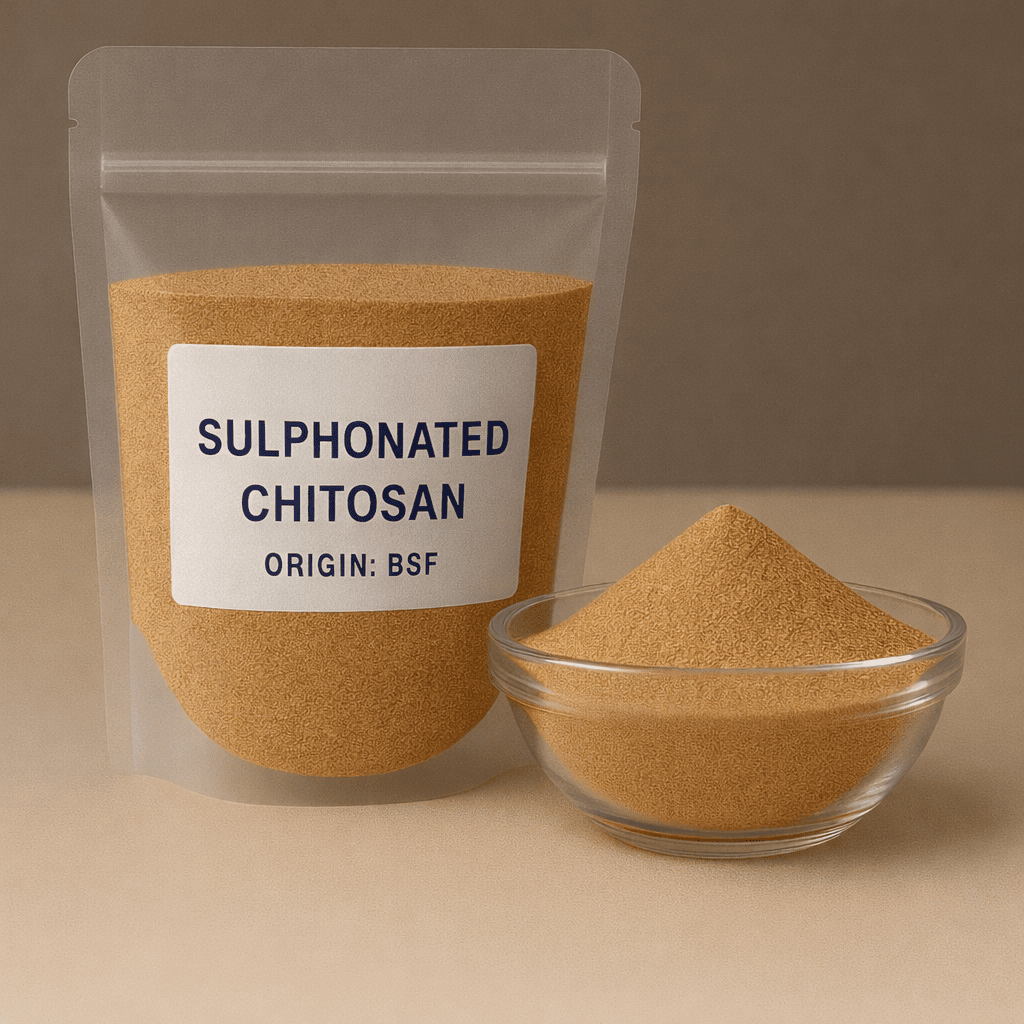


Description
Sulphonated Chitosan — Shellfish-Derived, Water-Soluble Anionic Chitosan Derivative
Sulphonated chitosan (also written sulfonated chitosan) is one of the most scientifically advanced water-soluble chitosan derivatives available today. Produced by introducing sulfonic acid groups (–SO₃H) directly onto the chitosan backbone, this anionic modification unlocks capabilities that unmodified chitosan simply cannot match: broad-spectrum heavy metal chelation at neutral to near-alkaline pH, superior dispersion in aqueous systems, and a unique combination of antimicrobial, antioxidant, and anticoagulant bioactivity.
At Chitosan Global, we supply pharmaceutical-grade and industrial-grade sulphonated chitosan derived from premium shellfish sources (shrimp, crab, and lobster) and from Black Soldier Fly (BSF) insect chitin. Whether your application is industrial wastewater treatment, biomedical research, or advanced material science, this is the sulphonated chitosan specification that delivers.
Explore the full range of types of chitosan derivatives →
1. What Is Sulphonated Chitosan? Chemistry & Synthesis
Chitosan is a linear polysaccharide composed of D-glucosamine and N-acetyl-D-glucosamine units linked by β-(1→4) bonds, obtained by the alkaline deacetylation of chitin — the structural biopolymer found in shellfish exoskeletons and insect cuticles. In its unmodified form, chitosan is cationic (positively charged) and soluble only under acidic conditions (pH < 6), which limits its industrial applicability.
Sulphonation transforms this profile entirely. The chemical modification involves the controlled introduction of sulfonate (–SO₃H) or sulfate (–OSO₃H) groups onto the chitosan backbone — specifically at the C-2 amino position (N-sulfonation), the C-3 secondary hydroxyl position, or the C-6 primary hydroxyl position (O-sulfonation), depending on reaction conditions and the sulfonating agent used.
Key synthesis routes include:
- Chlorosulfonic acid / DMF complex method — achieves high degree of substitution (DS ≥ 1.0) with predominantly O-sulfonation, producing the strong anionic character prized in water treatment and metal binding applications
- Sulfur trioxide / pyridine complex — milder reaction conditions, suitable for pharmaceutical-grade derivatives with controlled DS
- Sulfamic acid method — green chemistry approach, lower DS, preferred for food-contact and nutraceutical applications
The degree of sulfonation (degree of substitution, or DS) directly controls solubility, charge density, and performance:
| DS Range | Solubility at pH 7 | Charge Density | Typical Application |
| 0.1 – 0.3 | Partially water-soluble | Low–Moderate anionic | Nutraceutical, food-grade |
| 0.5 – 0.8 | Fully water-soluble | Moderate anionic | Cosmetic, wound care |
| 0.9 – 1.2 | Fully water-soluble | High anionic | Water treatment, drug delivery |
| ≥ 1.2 | Fully water-soluble | Very high anionic | Anticoagulation, biomedical |
2. Technical Specifications
Our shellfish-derived sulphonated chitosan meets the following standard specification. Custom DS, molecular weight, and particle size are available on request.
| Parameter | Specification |
| Source Material | Shellfish chitin (shrimp/crab/lobster) | BSF insect chitin (available) |
| CAS Number | 9012-76-4 (parent chitosan) |
| Molecular Weight | 50,000 – 300,000 Da (customizable) |
| Degree of Deacetylation (DDA) | ≥ 85% |
| Degree of Sulfonation (DS) | 0.8 – 1.2 (standard) | Custom DS available |
| Appearance | Light cream to off-white powder |
| Solubility | Fully water-soluble at pH 4–10 |
| Charge Type | Anionic (negatively charged at physiological pH) |
| Effective pH Range | 4 – 10 (optimal heavy metal removal: pH 5–8) |
| Moisture Content | ≤ 10% |
| Ash Content | ≤ 2% |
| Heavy Metals (Pb, As, Hg, Cd) | < 10 ppm (each) |
| Residual Protein | < 0.1% |
| Particle Size | 80–120 mesh standard | Fine mesh available on request |
| Typical Dosage Range | 5–100 ppm (water treatment) | Per formulation (biomedical) |
| Storage Conditions | Cool, dry, <25°C, away from light. Shelf life: 24 months sealed. |
| Certificate of Analysis (COA) | Available with every batch. Full analytical documentation provided. |
3. Key Properties & Performance Advantages
The sulfonic acid groups introduced during sulphonation are permanent, strong-acid functional groups that remain ionized across virtually the entire practical pH range (pKa ≈ 1). This is the fundamental chemical advantage of sulphonated chitosan over all other chitosan derivatives, and the reason it outperforms competing materials in demanding applications.
3.1 Superior Solubility
Native chitosan dissolves only in dilute acidic solution (pH < 6). Carboxymethyl chitosan (CMC) achieves broad solubility but with weaker charge density. Sulphonated chitosan is fully water-soluble across pH 4–10, making it compatible with industrial wastewater streams, physiological buffers, and neutral formulation environments.
Water-Soluble Chitosan Supplier →
3.2 High-Capacity Metal Ion Chelation
The amine groups (–NH₂) and sulfonate groups (–SO₃⁻) in sulphonated chitosan act as cooperative chelation sites for heavy metal cations (Pb²⁺, As³⁺, Cd²⁺, Hg²⁺, Cu²⁺, Ni²⁺, Cr³⁺). Research published in ScienceDirect confirms that sulfonation significantly enhances metal ion adsorption capacity compared to unmodified chitosan, enabling removal efficiencies of 85–98% for target metals at optimized dosages. The Langmuir isotherm model typically describes this adsorption behavior, indicating monolayer coverage with a maximum adsorption capacity of 100–400 mg/g depending on target metal and DS.
Chitosan for Water Treatment →
Heavy Metal Removal with Chitosan →
3.3 Broad Antimicrobial, Antiviral & Antifungal Activity
The polyampholytic nature of sulphonated chitosan carrying both residual amino groups (cationic) and sulfonate groups (anionic) creates a dual-mechanism antimicrobial effect. The cationic amino groups disrupt negatively charged bacterial cell membranes. Research on sulfonated chitosan derivatives has documented activity against Gram-positive and Gram-negative bacteria, antifungal properties against common mold species, and notably anti-HIV-1 activity attributed to the sulfonate groups’ structural mimicry of heparin. This makes sulphonated chitosan an outstanding candidate for antimicrobial coatings, packaging films, and biomedical devices.
3.4 Antioxidant Activity
Sulfonic group introduction significantly enhances the radical-scavenging capacity of chitosan. Studies (Huang, Mendis & Kim, 2005) confirm that sulfonated chitosan demonstrates measurable antioxidant activity via DPPH and ABTS assays, making it relevant for cosmetic formulations, functional food ingredients, and biomedical applications where oxidative stress is a concern.
3.5 Anticoagulant / Blood Compatibility
One of the most scientifically compelling properties of sulphonated chitosan is its heparin-like anticoagulant activity. Sulfonate groups on the chitosan backbone structurally mimic the active sites on heparin that inhibit thrombin and Factor Xa in the coagulation cascade. This property is being actively researched for surface coatings on medical devices, blood-contacting materials, and wound dressings, representing a high-value pharmaceutical and medical device application with significant commercial upside.
Chitosan for Drug Delivery Systems →
4. Applications — Where Sulphonated Chitosan Delivers Results
Explore all chitosan applications across industries →
4.1 Industrial Wastewater & Water Treatment
Sulphonated chitosan is the most capable naturally-derived flocculant/coagulant for complex industrial wastewater. Its full water solubility ensures homogeneous distribution throughout treatment systems, while its high anionic charge density enables it to interact with both cationic metal ions and cationic dye molecules simultaneously.
- Textile wastewater treatment: Removes cationic dyes (methylene blue, crystal violet) with efficiency of 90–97% at 10–50 ppm dosage. Compliant with EPA and EU discharge limits.
- Mining and smelting effluent: Chelates lead (Pb), arsenic (As), mercury (Hg), and cadmium (Cd) to concentrations below 0.01 ppm at optimized pH
- PFAS and emerging contaminant removal: Sulfonate groups show affinity for long-chain PFAS compounds, an emerging research area
- Municipal water clarification: Functions as a primary or secondary flocculant replacing or complementing alum, reducing sludge volume by 30–50%
- Oil-water separation: Destabilizes oil-water emulsions in produced water streams from petroleum processing
Chitosan Flocculant for Water Treatment →
Microplastic Removal with Chitosan →
4.2 Pharmaceutical & Biomedical Applications
The pharmaceutical market for sulphonated chitosan is among the fastest-growing application segments, driven by demand for natural, biodegradable, and biocompatible materials in drug delivery and medical devices.
- Controlled drug delivery: Polyelectrolyte complexes with cationic drugs and drug carriers; pH-responsive release systems for oral, transdermal, and targeted delivery
- Hemocompatible coatings: Applied to catheters, stents, dialysis membranes, and implantable devices to reduce thrombogenicity
- Gene delivery vectors: Polyelectrolyte nanoparticles for nucleic acid delivery
- Wound healing matrices: Combines antimicrobial properties with tissue compatibility and bioabsorbability
- Bone regeneration scaffolds: Sulfonate groups promote osteoblast adhesion and calcification
Chitosan for Drug Delivery Systems →
4.3 Cosmetics & Personal Care
Sulphonated chitosan’s high water solubility and film-forming capability make it directly applicable in cosmetic formulations without the need for acid-adjusted pH environments required by standard chitosan.
- Hair care: Anti-static agent, conditioning polymer, film former; improves wet combing force by up to 40%
- Skin care: Moisturizing polymer; forms breathable, antimicrobial film on skin surface
- Preservative system support: Antimicrobial activity extends preservative efficacy and reduces preservative loading
4.4 Agriculture & Food Preservation
Sulphonated chitosan can serve as a soil amendment and crop treatment where its anionic character enables compatibility with cationic micronutrients and plant growth stimulants in co-formulation. In food applications, its superior water solubility enables use as a natural preservative coating and antimicrobial food-contact material.
Chitosan in the Food Industry →
4.5 Catalysis & Advanced Materials
- Support material for transition metal catalysts in green chemistry
- Hydrogel networks with tunable mechanical and swelling properties
- Ion exchange membranes for electrochemical systems
- Filler/compatibilizer in biopolymer composites
5. Sulphonated Chitosan vs. Other Chitosan Derivatives
Choosing the right chitosan derivative depends on your application, required solubility profile, charge type, and target functional properties. This comparison table maps each major derivative to its optimal use case.
| Property | Sulphonated Chitosan | Carboxymethyl Chitosan | Trimethyl Chitosan (TMC) | Quaternary Chitosan | Chitosan HCl | Chitosan Oligosaccharide |
| Charge Type | Anionic | Anionic | Cationic | Cationic | Cationic | Neutral/Cationic |
| Solubility (pH 7) | Full | Full | Full | Full | Limited | Full |
| Heavy Metal Removal | ★★★★★ | ★★★★ | ★★ | ★★ | ★★★ | ★★ |
| Antimicrobial Activity | ★★★★ | ★★ | ★★★★ | ★★★★★ | ★★★ | ★★★ |
| Anticoagulant Activity | ★★★★★ | ★★ | ★ | ★ | ★ | ★ |
| Drug Delivery | ★★★★ | ★★★★ | ★★★★★ | ★★★ | ★★★ | ★★★ |
| Industrial Suitability | ★★★★★ | ★★★ | ★★ | ★★★ | ★★★ | ★★ |
| Biomedical Grade | ★★★★★ | ★★★★ | ★★★★★ | ★★★ | ★★★★ | ★★★★ |
6. Manufacturing Process & Shellfish Source Advantage
Our shellfish-derived sulphonated chitosan begins with pharmaceutical-quality chitin extracted from responsibly sourced shrimp and crab shells, primarily from North Atlantic and Pacific seafood processing facilities certified under ISO 22000 food safety management systems.
The manufacturing process:
- Chitin extraction via deproteinization (NaOH treatment) and demineralization (HCl treatment) of shellfish shells
- Purification: bleaching, washing to neutral pH, drying
- Deacetylation: controlled alkaline hydrolysis to achieve DDA ≥ 85%
- Sulfonation: reaction with chlorosulfonic acid/DMF complex in controlled anhydrous conditions at 0–5°C to prevent polymer degradation; reaction time 1–2 hours
- Neutralization and precipitation in methanol; filtration, washing
- Dissolution in water; filtration to remove insoluble impurities
- Lyophilization (freeze-drying) or spray-drying to produce fine powder
- Quality testing: FTIR confirmation of –S=O stretching at 1240 cm⁻¹ and C–O–S at 800 cm⁻¹; elemental analysis for DS determination; ICP-OES for heavy metals; microbial count
- Batch release, COA generation, and packaging
Shellfish vs. Insect (BSF) Source
| Parameter | Shellfish (Shrimp/Crab) | BSF Insect Chitin |
| DDA achievable | 85–98% | 80–92% |
| Molecular weight range | Very wide (50k–500k Da) | Moderate (50k–300k Da) |
| Allergen consideration | Shellfish allergen declaration required | Insect allergen; allergen-free vs shellfish |
| Regulatory status | Established (GRAS, EU approved) | Novel; regulatory varies by region |
| Scalability | Very high — global supply chain | High — sustainable emerging supply |
| Best for | Pharmaceutical, food-contact, established industrial | Vegan, allergen-sensitive, sustainability-focused |
7. Quality Control & Certifications
Every batch of Chitosan Global sulphonated chitosan undergoes a rigorous analytical testing protocol before shipment. Our quality management systems are aligned with ISO 9001 and GMP guidelines.
COA Parameters (Standard)
- Identity: FTIR spectrum with –S=O peak confirmation at 1240 cm⁻¹
- Degree of Deacetylation (DDA): ≥ 85% by potentiometric titration or ¹H-NMR
- Degree of Sulfonation (DS): 0.8–1.2 by elemental analysis (S content)
- Molecular Weight: GPC/SEC measurement, expressed as weight-average Mw
- Moisture: ≤ 10% by Karl Fischer or loss on drying at 105°C
- Ash Content: ≤ 2% by gravimetric method
- Heavy Metals (Pb, As, Hg, Cd): < 10 ppm each by ICP-MS
- Residual Protein: < 0.1% by Bradford/BCA assay
- Microbial Total Count: < 1000 CFU/g; absence of Salmonella, E. coli
- pH (1% solution): 5.0–7.5
Available Certifications
- COA (Certificate of Analysis) — provided with every batch
- SDS (Safety Data Sheet) — available on request
- Shellfish allergen declaration — standard for shellfish-derived batches
- ISO 9001 aligned manufacturing process
- Halal and Kosher certifications available on request for select grades
- Pharmaceutical grade (excipient grade) available — GMP documentation package
8. Packaging, Storage & Shipping
| Pack Size | Packaging Type | Shelf Life | Shipping |
| 25 g (Sample) | HDPE jar, heat-sealed with desiccant | 24 months from manufacture | Free shipping (Only For USA) |
| 1 kg | Foil-lined kraft bag, resealable | 24 months from manufacture | $60 FedEx + 15% tariff |
| 100–500 kg | 25 kg fiber drums with PE liner | 24 months from manufacture | Contact for freight terms |
| 500 kg+ | Custom bulk packaging available | 24 months from manufacture | EXW, FOB, CIF available |
Storage: Store in cool, dry conditions below 25°C. Keep sealed until use. Avoid direct sunlight and humidity. Reseal immediately after use. Do not store near strong oxidizing agents.
9. Why Industrial and Pharmaceutical Buyers Choose Chitosan Global
As a specialized division of Shield Nutraceuticals and a dedicated industrial chitosan manufacturer with supply chain reach across North America, Europe, and Asia-Pacific, Chitosan Global brings unique advantages to B2B procurement.
- Single-source accountability: From raw chitin sourcing through sulfonation, QC, and global logistics — we own the supply chain, reducing your vendor risk
- Consistent batch-to-batch quality: Tight DS and molecular weight control means reliable performance in your processes
- Flexible MOQ: Sample quantities from 25g allow formulation testing before bulk commitment — no other major supplier offers this
- Technical support: Direct access to our formulation scientists via steve@chitosanglobal.com or +1 423 202 6145 for application troubleshooting
- Custom specifications: Need a specific DS, molecular weight cutoff, or particle size distribution? We develop to spec
- Transparent pricing: Published price per kg with no hidden fees; bulk pricing from 100 kg
- Fast COA delivery: Certificate of Analysis provided within 24 hours of order confirmation
Industrial Chitosan Manufacturer →
Real-World Application Examples
- Textile manufacturer in Bangladesh: replaced PAC (polyaluminium chloride) flocculant with sulphonated chitosan in reactive dye wastewater — achieved 93% color removal and 60% reduction in sludge volume
- Environmental remediation firm in Germany: deployed sulphonated chitosan in combination with biochar for mercury-contaminated groundwater — achieved sub-0.001 ppm Hg in treated effluent
- Pharmaceutical R&D lab in USA: evaluated sulphonated chitosan for hemocompatible catheter coating — passed ISO 10993 cytotoxicity and hemocompatibility screening
10. Frequently Asked Questions (FAQ)
What is sulphonated chitosan and how does it differ from regular chitosan?
Sulphonated chitosan is a chemically modified form of chitosan in which sulfonic acid groups (–SO₃H) have been covalently attached to the chitosan backbone. This transformation converts the naturally cationic chitosan into an anionic polyelectrolyte. The key practical differences are: (1) full water solubility at neutral and alkaline pH, (2) dramatically higher heavy metal chelation capacity, (3) heparin-like anticoagulant activity, and (4) enhanced antioxidant properties. Regular chitosan is insoluble above pH 6 and lacks these functional advantages.
What heavy metals does sulphonated chitosan remove from water?
Sulphonated chitosan effectively chelates lead (Pb²⁺), arsenic (As³⁺/As⁵⁺), mercury (Hg²⁺), cadmium (Cd²⁺), copper (Cu²⁺), nickel (Ni²⁺), zinc (Zn²⁺), and chromium (Cr³⁺/Cr⁶⁺). The cooperative effect of amine and sulfonate groups creates dual chelation sites that bind these metals far more efficiently than unmodified chitosan, particularly in the pH range 5–8 where industrial wastewater treatment typically operates.
What is the recommended dosage for wastewater treatment?
Typical dosage ranges from 5 to 100 ppm (mg/L) depending on initial contaminant concentration, target removal efficiency, water matrix chemistry, and contact time. We recommend jar testing at 10, 25, and 50 ppm with your specific wastewater matrix to determine the optimal dose. Our technical team can assist with experimental protocol design.
What is the shelf life of sulphonated chitosan?
Properly stored (sealed, below 25°C, low humidity, away from light), sulphonated chitosan has a shelf life of 24 months from date of manufacture. Our packaging includes desiccant to control humidity during transit and storage.
Is sulphonated chitosan biodegradable and environmentally safe?
Yes. Like all chitosan derivatives, sulphonated chitosan is fully biodegradable under environmental conditions through the action of chitosanases and lysozymes present in soil and water. The sulfonate groups are released as inorganic sulfate, a naturally occurring and non-toxic compound. It is non-toxic to aquatic organisms at normal treatment concentrations.
Can sulphonated chitosan be used in pharmaceutical applications?
Yes, provided pharmaceutical-grade material (GMP-compliant, stringent heavy metal limits, residual solvent testing) is used. Our pharmaceutical-grade sulphonated chitosan comes with a full GMP documentation package including COA, SDS, and specification sheet aligned with relevant pharmacopoeial standards. Contact us for pharmaceutical grade availability and pricing.
Does sulphonated chitosan contain shellfish allergens?
Shellfish-derived sulphonated chitosan is manufactured from shrimp/crab chitin and may contain trace levels of shellfish allergen proteins. We provide an allergen declaration with each batch. For allergen-sensitive applications or markets, our BSF (Black Soldier Fly) insect-derived sulphonated chitosan is available as an alternative. it is free from shellfish allergens.
What is the difference between sulphonated chitosan and sulphated chitosan?
These are chemically distinct compounds that are often confused. Sulphated chitosan contains ester-type sulfate groups (–OSO₃H) formed via esterification of hydroxyl groups these are hydrolytically labile and can be cleaved in acidic conditions. Sulphonated chitosan contains sulfonate groups (–SO₃H) formed via direct carbon-sulfur bonding or via sulfonamide linkages these are more hydrolytically stable. Sulphonated chitosan is preferred for industrial water treatment; sulphated chitosan is more commonly studied for anticoagulant applications mimicking heparin sulfate.
What documentation is provided with bulk orders?
Every bulk order includes: Certificate of Analysis (COA) with FTIR spectrum, DDA, DS, molecular weight, moisture, ash, heavy metals, residual protein, and microbial count; Safety Data Sheet (SDS); allergen declaration; packing list and shipping documentation. Custom documentation (GMP batch records, traceability documentation) available for pharmaceutical and regulated applications.
How do I request a sample or bulk quote?
Contact Steve Nice directly at steve@chitosanglobal.com or call +1 423 202 6145. For bulk pricing (100 kg+), provide your target application, quantity, and any custom specification requirements and we will respond within 24 business hours.
REQUEST YOUR SAMPLE OR BULK QUOTE
steve@chitosanglobal.com | +1 423 202 6145 | 25g Sample from $70 with Free Shipping
COA provided with every order. Response within 24 hours. Global shipping available.
Related Chitosan Derivatives
Trimethyl Chitosan for enhanced drug delivery and mucosal absorption →
Carboxymethyl Chitosan for cosmetic and wound care formulations →
Quaternary Chitosan for permanent antimicrobial coatings and fiber manufacturing →
Chitosan Hydrochloride for pharmaceutical and nutraceutical applications →
Chitosan Oligosaccharide (COS) for nutraceutical, gut health, and agricultural applications →

Reviews
There are no reviews yet.