

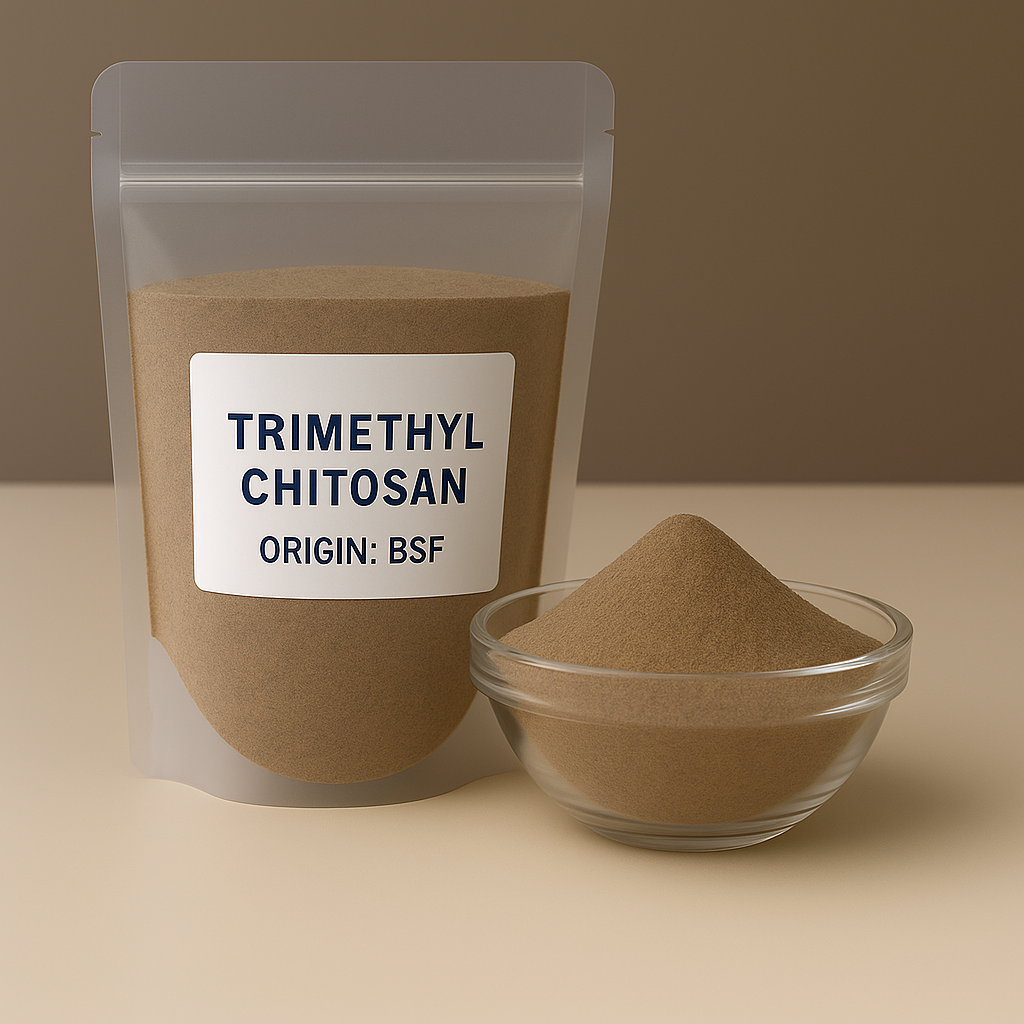

Description
What Is Trimethyl Chitosan (TMC)?
Trimethyl Chitosan is produced by the reductive N-methylation of chitosan specifically, the progressive addition of three methyl groups to the primary amine on the C-2 position of each glucosamine unit. The result is a quaternary ammonium polysaccharide that retains chitosan’s natural biocompatibility and biodegradability while gaining critical new properties:
- pH-independent water solubility — soluble from pH 1.0 to 9.0, unlike regular chitosan (soluble only below pH 6.5)
- Permanent positive charge — the quaternary nitrogen cannot be deprotonated, ensuring consistent cationic behavior in all physiological environments
- Enhanced mucoadhesion — strong electrostatic interaction with negatively charged mucin glycoproteins
- Paracellular permeability enhancement — reversibly modulates epithelial tight junction proteins (ZO-1, occludin, claudins), enabling paracellular transport of drugs
These properties collectively make TMC the preferred polymer when standard chitosan fails at intestinal, nasal, or vaginal pH conditions.
Systematic Name: N,N,N-Trimethyl Chitosan Chloride CAS Number: 52349-26-5 Synonyms: TMC chitosan, chitosan trimethyl, N-trimethyl chitosan, trimethylammonium chitosan, quaternized chitosan
Chemical Properties and Technical Specifications
| Parameter | Specification |
|---|---|
| Chemical Name | N,N,N-Trimethyl Chitosan Chloride |
| CAS Number | 52349-26-5 |
| Source Material | Black Soldier Fly (BSF) Chitin — Hermetia illucens |
| Degree of Quaternization (DQ) | 40–70% (custom DQ available on request) |
| Molecular Weight | Low / Medium / High (specify on order) |
| Appearance | Light tan to off-white free-flowing powder |
| Solubility | Fully water-soluble, pH 1.0–9.0 |
| Zeta Potential (aqueous) | +20 to +40 mV (typical, varies by DQ and MW) |
| Nanoparticle Size (with TPP) | 100–300 nm (ionic gelation method) |
| Moisture Content | ≤ 10% |
| Grade | Pharmaceutical / Research / Industrial |
| Sterility | Non-sterile (sterilization guidance provided) |
| Storage | Cool, dry, dark conditions; 2–8°C recommended |
| Shelf Life | 24 months from date of manufacture |
| Shipping | International — FedEx, DHL, air freight for bulk |
Understanding Degree of Quaternization (DQ)
The Degree of Quaternization is the single most important specification when selecting TMC for your application. It describes what percentage of the chitosan amino groups have been fully trimethylated.
- DQ 25–40%: Lower charge density; suitable for pH-sensitive release systems where gradual dissolution is needed; lower cytotoxicity profile; used in TMC-cysteine conjugates for thiolated nanoparticles
- DQ 40–55%: Optimal balance for most oral and nasal drug delivery applications; maximizes permeation enhancement while maintaining acceptable toxicity window; most widely studied DQ range in the literature
- DQ 60–80%: Highest charge density; strongest paracellular permeation; preferred for peptide/protein oral bioavailability and vaccine adjuvancy; requires attention to dose-dependent cytotoxicity at high concentrations
Our standard product ships at DQ 40–70%. Custom DQ batches are available for projects requiring a specific range contact us with your target specification.
How Trimethyl Chitosan Works: The Science of Permeation Enhancement
TMC’s superiority in drug delivery is grounded in a well-established, peer-reviewed mechanism documented across hundreds of in vitro and in vivo studies.
Mechanism 1 — Tight Junction Modulation: Epithelial cells lining the intestinal, nasal, and respiratory tracts are joined by tight junction protein complexes including ZO-1, occludin, and claudin-4. TMC’s permanent positive charge allows it to electrostatically interact with the negatively charged residues on these junction proteins. This reversibly widens paracellular spaces, enabling hydrophilic macromolecules (peptides, proteins, nucleic acids) to cross biological barriers that would otherwise exclude them. This effect is pH-independent uniquely, it works at the neutral pH of the small intestine (pH 6.6–7.4), where standard chitosan salt forms are inactive.
Mechanism 2 — Mucoadhesion: The permanent positive charge on TMC binds electrostatically to negatively charged sialic acid residues and sulfate groups on mucin glycoproteins. This increases mucosal residence time of drug-loaded nanoparticles from minutes to several hours, prolonging the absorption window and improving bioavailability of poorly absorbed actives.
Mechanism 3 — Endosomal Escape (Gene Delivery): In gene delivery applications, TMC nanoparticles or polyplexes are taken up by cells via endocytosis. The “proton sponge effect” where the cationic polymer buffers the dropping pH inside endosomes destabilizes the endosomal membrane and releases the cargo (siRNA, plasmid DNA, mRNA) into the cytoplasm before lysosomal degradation occurs.
Applications of Trimethyl Chitosan
1. Oral Drug Delivery — Peptides and Proteins
One of the greatest unmet challenges in pharmaceutical science is the oral delivery of peptide and protein therapeutics insulin, GLP-1 agonists, calcitonin, heparin which are destroyed by gastrointestinal enzymes and cannot cross the intestinal epithelium without a carrier. TMC nanoparticles formulated by ionic gelation with tripolyphosphate (TPP) have achieved insulin bioavailabilities of 5–15% in animal models, representing a clinically meaningful improvement over unformulated oral insulin (<1%). A 2026 study published in Pharmaceutics demonstrated that thiolated TMC grafted with β-cyclodextrin nanoparticles achieved mucus adhesion and efficient intestinal permeation for oral insulin, with significant blood glucose lowering in STZ-induced diabetic animal models.
2. Nasal Vaccine Delivery and Mucosal Immunization
Intranasal administration of antigens offers significant advantages over injections: it stimulates both systemic IgG and secretory IgA (sIgA) mucosal immunity, requires smaller antigen doses, and eliminates needle-related compliance barriers. TMC nanoparticles loaded with tetanus toxoid, influenza antigens, and Bordetella pertussis antigens have demonstrated robust immunogenic responses in pre-clinical models. TMC functions as both a delivery vehicle and an adjuvant its ability to enhance antigen uptake by dendritic cells and prolong mucosal residence time makes it uniquely suited for next-generation mucosal vaccine platforms. Published research confirms TMC-based nasal formulations significantly outperform aluminum hydroxide-adjuvanted parenteral vaccines in generating mucosal sIgA responses.
3. Gene Delivery — siRNA, mRNA, and Plasmid DNA
TMC’s high positive charge density allows it to condense negatively charged nucleic acids into stable polyplexes and nanoparticles. The resulting complexes protect genetic cargo from nuclease degradation, facilitate cellular uptake via electrostatic interaction with the cell membrane, and through the proton sponge mechanism achieve endosomal escape. TMC has been applied to siRNA delivery for cancer gene silencing, plasmid DNA delivery for hepatitis B DNA vaccines, and is currently being explored for mRNA vaccine formulations as a non-lipid alternative to lipid nanoparticles (LNPs). For researchers requiring a biodegradable, non-viral gene delivery vector without the immunogenicity concerns of viral vectors, TMC represents a highly attractive option.
4. Nanoparticle Formulation — Ionic Gelation with TPP
TMC readily forms stable nanoparticles in the 100–300 nm range by ionic gelation with sodium tripolyphosphate (TPP) at room temperature under mild conditions, without organic solvents. Standard formulation conditions:
- TMC concentration: 0.5–2.0 mg/mL in deionized water
- TPP:TMC weight ratio: typically 1:4 to 1:6
- Mixing: dropwise addition of TPP into TMC solution under magnetic stirring
- Resulting particle size: 150–250 nm (PDI <0.3) | Zeta potential: +20 to +35 mV
These nanoparticles achieve encapsulation efficiencies of 70–95% for proteins and peptides, and 60–90% for small hydrophilic drugs. Payload release is sustained over 6–24 hours depending on DQ and crosslink density.
5. Wound Healing and Antimicrobial Coatings
TMC’s permanent cationic charge gives it potent broad-spectrum antimicrobial activity against Gram-positive bacteria (S. aureus, S. epidermidis), Gram-negative bacteria (E. coli, P. aeruginosa), and fungi (C. albicans). Unlike parent chitosan, TMC maintains this activity at wound-site pH (neutral to slightly alkaline). TMC-coated wound dressings and hydrogel formulations demonstrate superior biofilm inhibition compared to unmodified chitosan, making TMC an ideal active ingredient for advanced wound management materials, surgical meshes, and antimicrobial medical device coatings.
6. Tissue Engineering Scaffolds and Hydrogels
TMC crosslinked with glycerophosphate or alginate forms injectable or moldable hydrogels that are cell-compatible and mechanically tunable. The positive charge of TMC supports cell adhesion (cells are negatively charged) and promotes osteogenic and chondrogenic differentiation in relevant progenitor cell populations. Published scaffold studies show TMC/hydroxyapatite composites support bone regeneration, while TMC/collagen blends support skin and corneal tissue engineering.
7. Cosmetic Skin Permeation Enhancement
In cosmetic formulations, TMC functions as a conditioning polymer and permeation enhancer for active ingredients including retinol, hyaluronic acid, peptides, and botanical extracts. Its mucoadhesive and film-forming properties improve ingredient retention on skin and hair surfaces, while its cationic character provides excellent substantivity on negatively charged keratin. TMC is particularly effective in leave-on skin care serums and hair conditioning formulas where prolonged deposition of actives is desired.
8. Agricultural Biocontrol Formulations
As an insect-derived biopolymer, BSF-sourced TMC is especially relevant for sustainable agricultural applications including seed coating, foliar sprays, and soil amendments. The permeation-enhancing properties of TMC improve uptake of biocontrol agents and plant growth regulators, while its antimicrobial activity provides post-application protection against fungal and bacterial pathogens.
Why Choose Insect-Derived (BSF) Trimethyl Chitosan?
Traditional chitosan is derived from the shells of marine crustaceans (shrimp, crab, krill). While functionally equivalent in many applications, crustacean-derived chitosan carries a risk of shellfish allergen contamination — a serious concern for pharmaceutical, nutraceutical, and cosmetic products.
Our TMC is derived from Black Soldier Fly (Hermetia illucens) larvae an insect species with no phylogenetic relationship to shellfish and no documented cross-reactivity with shellfish allergens. BSF chitin is also produced via circular bioeconomy processes (larvae fed organic substrates), offering significant sustainability advantages:
- Lower environmental footprint — 80% less land and water use than marine harvesting
- No shellfish allergen contamination risk
- Year-round, batch-consistent supply — not subject to seasonal or geographic fishing variability
- Traceable, auditable supply chain from larva to final product
For pharmaceutical developers targeting EU and US markets where clean-label and allergen-free claims matter, BSF-origin TMC provides a clear regulatory and marketing advantage.
TMC vs. Other Chitosan Derivatives: Which to Choose?
| Property | TMC (This Product) | Chitosan HCl | Carboxymethyl Chitosan | Regular Chitosan |
|---|---|---|---|---|
| Solubility | pH 1–9 (permanent) | pH 1–7 (salt-dependent) | pH 6–10 (anionic) | pH < 6.5 only |
| Charge | Permanent cationic (+) | Conditionally cationic | Anionic (−) | Conditionally cationic |
| Mucoadhesion | Excellent (all pH) | Good (acidic pH) | Moderate | pH-limited |
| Paracellular Enhancement | Excellent | Good | Poor | pH-limited |
| Gene Delivery | Excellent | Moderate | Not suitable | Limited |
| Wound Healing | Excellent | Good | Excellent | Good |
| Hydrogel Formation | Yes (with crosslinkers) | Yes | Excellent | Yes |
| pH Working Range | Widest | Moderate | Alkaline preferred | Narrow |
| Recommended For | Drug delivery, nanoparticles, vaccines, gene delivery | Pharmaceutical solubilization, agriculture | Wound care, hydrogels, eye drops | Food, agriculture, basic pharma |
Ordering, Bulk Supply and Wholesale Pricing
We supply TMC at commercial scale from sample quantities through metric ton orders, with flexible delivery timelines and international logistics:
- 25g Sample — $67.25, free shipping. Ideal for feasibility testing and formulation development.
- 1 kg — $185/kg. Suitable for pre-clinical research scale-up and formulation development batches.
- 100–500 kg — $168/kg. Commercial pilot production and IND-enabling studies.
- 500 kg – 1 ton+ — $150/kg. Long-term B2B manufacturing partnerships.
Custom specifications available:
- Specific degree of quaternization (DQ 25%, 40%, 55%, 70%)
- Molecular weight fractions (low: <50 kDa; medium: 50–200 kDa; high: >200 kDa)
- Reduced endotoxin grade for injectable/parenteral research
- Third-party analytical testing included on request
Documents provided with every order:
- Certificate of Analysis (COA) including DQ by ¹H NMR, moisture, appearance, solubility
- Safety Data Sheet (SDS/MSDS)
- Specification Sheet
Contact: steve@chitosanglobal.com Phone: 423-202-6145 Shipping: Worldwide via FedEx and DHL
Frequently Asked Questions
1. What is the CAS number for trimethyl chitosan?
The CAS number for N,N,N-Trimethyl Chitosan Chloride is 52349-26-5. This applies to the standard chloride salt form of TMC, which is the most commercially available and widely studied variant. When ordering from suppliers or citing in research, always confirm the counterion (chloride is standard).
2. What is the difference between trimethyl chitosan (TMC) and regular chitosan?
Regular chitosan is only soluble in acidic solutions (pH below 6.5) because its amine groups must be protonated to carry a positive charge. At the neutral or alkaline pH of the small intestine, chitosan is essentially insoluble and loses its charge limiting its drug delivery utility. TMC has three permanent methyl groups on every nitrogen, creating a quaternary ammonium salt that cannot be deprotonated. This gives TMC complete water solubility and consistent cationic charge from pH 1 through pH 9, enabling it to work where chitosan cannot.
3. What degree of quaternization should I use for oral drug delivery?
Research has established that a degree of quaternization of 40–55% offers the optimal balance for oral drug delivery. At this range, TMC strongly enhances tight junction permeability and mucoadhesion without the dose-limiting cytotoxicity observed at very high DQ values (>70%). For purely aqueous solubility, higher DQ is better. For controlled-release oral dosage forms where you want gradual dissolution, a DQ of 25–35% is preferable. Contact our technical team with your therapeutic target and we can recommend the right specification.
4. What is the difference between TMC and chitosan hydrochloride?
Chitosan hydrochloride (CS·HCl) is a simple acid addition salt the amine groups are protonated by HCl. This improves solubility compared to base chitosan, but the salt is still pH-sensitive and loses solubility above pH 6.5–7.0. TMC has permanently methylated amines (quaternary nitrogen), making it pH-independent. For drug delivery applications that operate at intestinal or physiological pH, TMC is significantly more effective than chitosan HCl.
5. How do you make trimethyl chitosan nanoparticles?
TMC nanoparticles are most commonly prepared by ionic gelation with sodium tripolyphosphate (TPP). Dissolve TMC (0.5–2 mg/mL) in deionized water. Prepare a separate TPP solution (0.1–0.5 mg/mL). Add TPP dropwise into the TMC solution under gentle magnetic stirring at room temperature. Nanoparticles form spontaneously in minutes. Typical result: 150–250 nm particle size, PDI <0.3, zeta potential +20 to +35 mV. Drug loading is achieved by dissolving the drug in either the TMC or TPP phase before mixing. Scale-up protocols are available contact us.
6. Can TMC be used for vaccine delivery?
Yes. TMC is one of the most studied chitosan derivatives for nasal and mucosal vaccine delivery. It acts simultaneously as a nanoparticle matrix, a mucoadhesive agent to increase antigen residence time, and an adjuvant that enhances dendritic cell uptake and stimulates both systemic IgG and secretory IgA responses. TMC nanoparticles encapsulating tetanus toxoid, influenza antigens, and pertussis antigens have shown strong immunogenicity in pre-clinical rabbit and mouse models via intranasal administration.
7. What is the zeta potential of trimethyl chitosan nanoparticles?
TMC nanoparticles prepared by TPP ionic gelation typically display a zeta potential of +20 to +40 mV in deionized water, depending on the degree of quaternization, molecular weight, and TMC:TPP ratio. Zeta potential above +20 mV indicates good colloidal stability against aggregation. The positive surface charge also promotes interaction with negatively charged cell membranes, facilitating cellular uptake. Zeta potential values closer to neutral (< +10 mV) may indicate over-crosslinking or charge shielding from drug encapsulation.
8. Is trimethyl chitosan safe? What is its toxicity profile?
TMC has a well-established safety profile in the scientific literature. It is non-toxic to mammalian cells at typical drug delivery concentrations (below 0.5 mg/mL in most studies). Cytotoxicity is dose- and DQ-dependent: higher DQ grades (>70%) show more cytotoxicity at elevated concentrations, so formulation optimization is important. TMC is biodegradable it is degraded by lysozyme and chitinases in biological fluids to non-toxic oligomers and amino acids. It is considered biocompatible under ISO 10993 standards when tested as a medical device component. As with all polymers, full toxicological characterization is recommended for each specific application and formulation.
9. What molecular weight of TMC should I choose for gene delivery?
For siRNA and plasmid DNA delivery, low to medium molecular weight TMC (20–100 kDa) typically forms the most effective polyplexes small enough for cellular uptake yet positively charged enough for nucleic acid condensation. Higher molecular weight TMC can achieve better cell binding but may impede endosomal escape and cytoplasmic release. For mRNA delivery, medium molecular weight with DQ ≥50% is most frequently reported. We offer custom MW cuts state your target therapeutic application when ordering.
10. How does TMC enhance paracellular permeability at intestinal pH?
At the neutral pH of the small intestine (pH 6.6–7.4), standard chitosan is insoluble and inactive as a permeation enhancer. TMC, with its permanent cationic quaternary ammonium groups, electrostatically interacts with the negatively charged residues on tight junction proteins specifically ZO-1, occludin, and claudin-4. This reversible interaction transiently opens the paracellular pathways between epithelial cells, allowing hydrophilic macromolecules (peptides, proteins) to cross. The effect is reversible: once TMC is removed or diluted, tight junctions re-form without permanent damage.
11. What is the difference between TMC and carboxymethyl chitosan (CMC)?
TMC is a cationic derivative (positive charge); carboxymethyl chitosan is an anionic derivative (negative charge). This fundamental difference determines application suitability. TMC is best for applications requiring mucoadhesion at mucosal surfaces (predominantly negative charge), paracellular transport enhancement, gene delivery, and cationic nanoparticle formation. CMC is better suited for hydrogel formation, wound dressing applications, eye drops, and situations where an anionic polymer is needed. TMC and CMC can be combined as a polyelectrolyte complex.
12. Can trimethyl chitosan be used in cosmetic formulations?
Yes. TMC functions excellently in cosmetics as a conditioning polymer, film-former, and permeation enhancer. Its positive charge provides substantivity on negatively charged keratin in hair and skin, improving deposition efficiency of actives. In skin serums, TMC enhances penetration of peptides, antioxidants, and retinoids. In hair conditioners, it provides detangling, smoothing, and moisturizing effects. It is particularly effective in combination with hyaluronic acid and plant peptide actives.
13. What is the difference between insect-derived and shrimp-derived TMC?
Functionally, TMC from both sources has equivalent chemical properties when produced to the same degree of quaternization and molecular weight. The key difference is allergen risk: shrimp/crab-derived chitin retains trace shellfish allergen proteins that can cause reactions in sensitive individuals. Insect (BSF)-derived chitin has no known cross-reactivity with shellfish allergens, making BSF-TMC the preferred choice for pharmaceutical products, nutraceuticals, and cosmetics where allergen-free claims are commercially or regulatory important.
14. How should trimethyl chitosan be stored?
Store TMC powder in a sealed container in a cool (2–8°C), dry (RH <60%), dark environment. Avoid prolonged exposure to heat (>40°C), humidity, and direct sunlight, which can cause yellowing, increased moisture content, and potential DQ degradation over time. Under recommended conditions, shelf life is 24 months from date of manufacture. Once dissolved in aqueous solution, TMC solutions should be prepared fresh or stored refrigerated and used within 2–4 weeks to avoid microbial contamination.
15. How does TMC from Black Soldier Fly compare to other insect-derived chitosan sources?
BSF (Hermetia illucens) larvae are the most commercially scalable insect chitin source globally. BSF chitin yields are high (8–12% dry weight), and the processing conditions produce a consistently low-ash, low-protein chitin that translates to high-purity, pharmaceutical-appropriate chitosan and TMC derivatives. Compared to house cricket (Acheta domesticus) or mealworm (Tenebrio molitor) derived chitin, BSF delivers superior batch-to-batch consistency due to controlled-environment industrial rearing, making it the optimal insect source for regulated pharmaceutical and biomedical applications.
Related Products
- Quaternary Chitosan (Antimicrobial Systems Grade) — high-DQ quaternized chitosan for antimicrobial coatings and fiber applications
- Carboxymethyl Chitosan — anionic CMC for hydrogels, wound dressings, and polyelectrolyte complexes
- Chitosan Hydrochloride — water-soluble chitosan salt for agricultural and basic pharma use
- Chitosan Oligosaccharide (COS) — low molecular weight chitosan fragments for nutraceutical and gut health applications
- Soldier Fly Base Chitosan — high-purity BSF chitosan for custom derivative synthesis
Scientific References
- Thanou, M. et al. (2001). Enhancement of paracellular drug transport with highly quaternized N-trimethyl chitosan chloride in neutral environments. J. Pharm. Sci. 90(7):991–998.
- Verheul, R.J. et al. (2009). Trimethylated chitosan is an effective adjuvant substance for intranasal immunization against influenza. Vaccine, 27(22):2858–2866.
- Hamman, J.H. (2010). Chitosan based polyelectrolyte complexes as potential carrier materials in drug delivery systems. Mar. Drugs, 8(4):1305–1322.
- de Oliveira Pedro, R. et al. (2019). N,N,N-Trimethyl chitosan: An advanced polymer with myriad of opportunities in nanomedicine. Carbohydrate Polymers, 215:317–336.
- Yu, L. et al. (2026). Efficient oral insulin delivery through thiolated trimethyl chitosan-grafted β-cyclodextrin nanoparticles. Pharmaceutics, 18(1):97.
For application-specific technical consultation, contact steve@chitosanglobal.com or call +1 423-202-6145.
Reviews
There are no reviews yet.