
Shellfish CMCS vs Mushroom CMCS: Which Carboxymethyl Chitosan Should You Choose?
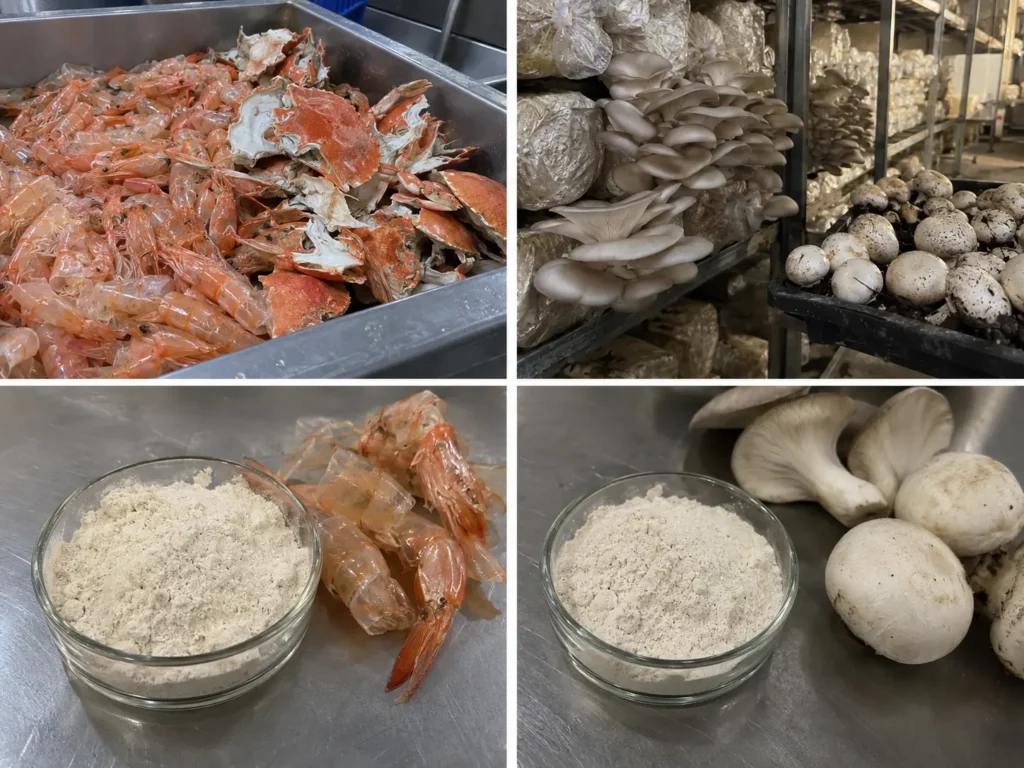
Two powders can carry almost the same name: Carboxymethyl Chitosan (CMCS). Both can be designed for water-based formulation. Both contain carboxymethyl functionality. Both may be investigated for coatings, films, hydrogels, food systems, cosmetics, and other technical applications. Yet one important detail separates them before formulation even begins: where the original chitosan comes from. Shellfish CMCS begins with crustacean-derived chitosan. Mushroom CMCS begins with fungal-derived chitosan. That difference can affect sourcing requirements, vegan positioning, shellfish-allergen considerations, supply strategy, and potentially the physicochemical characteristics of the starting chitosan. Research comparing fungal and crustacean chitosan shows that source can be associated with differences in properties such as molecular weight, viscosity, degree of deacetylation, and material behavior—but the exact outcome depends on the specific grade and production process. So which should you buy? The useful answer is not simply “mushroom” or “shellfish.” It is: Choose the source and specification that solve your formulation and market requirements. Want to Compare the Actual Materials? Specifications tell you more than source names alone. Review the two products, request the relevant COA, and test the material under your own formulation conditions. View Shellfish Carboxymethyl Chitosan View Mushroom Carboxymethyl Chitosan For a new formulation, a sensible path is: Compare Specifications → Review COAs → Test Small Samples → Evaluate Performance → Select Source → Scale The 30-Second Comparison Factor Shellfish CMCS Mushroom CMCS Original Chitosan Source Crustacean / marine Fungal / mushroom Typical Feedstock Shrimp, crab or other crustacean material Fungal biomass Animal Derived Yes No Vegan Positioning No Yes Shellfish-Origin Concern Relevant Avoided Water-Soluble Derivative Yes, depending on grade/specification Yes, depending on grade/specification Key Technical Specs DS, DDA, MW, viscosity, purity DS, DDA, MW, viscosity, purity Supply Consideration Established marine chitin industry Controlled fungal-production potential Best Choice Depends on application and sourcing requirements Depends on application and sourcing requirements The biggest mistake would be choosing from this table alone. Origin narrows the choice. The specification finishes it. First Difference: Where the Chitosan Begins Shellfish and mushroom CMCS arrive at the same derivative family through different starting materials. Shellfish Route Crustacean Source → Chitin → Chitosan → Carboxymethylation → Shellfish CMCS Shellfish chitosan has traditionally been produced from crustacean sources such as shrimp and crab shells. This gives manufacturers access to an established marine chitin supply chain. For more on this source pathway, read Marine Carboxymethyl Chitosan. Mushroom Route Fungal Biomass → Fungal Chitosan → Carboxymethylation → Mushroom CMCS Fungal chitosan does not depend on crustacean raw materials. Reviews of fungal chitosan production highlight potential advantages such as lower mineral content and the possibility of controlled production without the same seasonal dependence associated with marine feedstocks. However, industrial-scale fungal production can also face cost, yield, and standardization challenges. That makes this a sourcing trade-off not a simple winner-versus-loser comparison. Does Carboxymethylation Make Them the Same? No. Carboxymethylation creates the CMCS derivative, but it does not erase every characteristic of the starting polymer or manufacturing process. The finished material can still vary in: Degree of Substitution (DS); Degree of Deacetylation (DDA); molecular weight; viscosity; substitution pattern; purity; moisture; ash; solution behavior. This is why two CMCS products from the same source can potentially differ substantially. And two CMCS products from different sources may sometimes be closer technically than their source labels suggest. So instead of asking: Which origin has better CMCS? ask: Which actual grade meets our target specification? Shellfish CMCS: Where Does It Make Sense? Shellfish CMCS can be a practical choice when crustacean origin does not conflict with the product or market requirements. It may be worth evaluating when: an established marine chitosan supply chain is preferred; shellfish origin is acceptable; the available grade matches the required technical specification; cost is an important procurement consideration; previous development work already uses marine chitosan. Chitosan Global currently lists Shellfish CMCS as a water-soluble derivative with sample and bulk purchasing pathways. For procurement information, see the Shellfish Carboxymethyl Chitosan Supplier guide. Mushroom CMCS: Where Does It Make Sense? Mushroom CMCS becomes particularly interesting when biological origin itself is part of the product specification. It may be considered when: a non-crustacean source is required; vegan positioning matters; shellfish-derived raw materials need to be avoided; controlled fungal sourcing fits the procurement strategy; a fungal CMCS specification performs better in the target formulation. Published reviews note that fungal chitosan can offer advantages including controlled physicochemical characteristics and less dependence on seasonal crustacean supply, although economics and industrial-scale production remain important considerations. Explore Mushroom Carboxymethyl Chitosan What About Shellfish Allergies? This is one area where wording needs to be precise. Shellfish CMCS is shellfish-derived. Therefore, projects with shellfish-origin restrictions should review the supplier’s allergen documentation, residual-protein information where relevant, applicable regulations, and finished-product requirements. It is safer to describe Mushroom CMCS as: non-shellfish-derived rather than assuming that every fungal CMCS product is automatically “allergen-free” for every person, formulation, and jurisdiction. If avoiding shellfish-derived raw material is a firm requirement, Mushroom CMCS provides a clear source advantage. Is Mushroom CMCS More Sustainable? Not automatically. Fungal production can reduce dependence on marine crustacean feedstocks and may offer controlled year-round production advantages. Research reviews identify these as meaningful reasons for growing interest in fungal chitosan. But sustainability depends on the entire production system. For Mushroom CMCS, consider: fungal cultivation; feedstock; energy; extraction; purification; water consumption; drying. For Shellfish CMCS, consider: utilization of seafood-processing by-products; demineralization; deproteinization; chemical use; water; transportation; waste treatment. Therefore: “Fungal” does not automatically mean greener, and “marine” does not automatically mean less sustainable. A serious comparison requires life-cycle data from the actual supply chains. Which Has Better Water Solubility? Source alone cannot answer this reliably. Carboxymethylation is what gives CMCS its improved aqueous behavior compared with native chitosan. The resulting solubility can depend on factors including: DS; substitution pattern; molecular characteristics; pH; concentration; ionic strength. Therefore, avoid selecting Mushroom or Shellfish CMCS solely because one supplier says its origin is “more soluble.” Compare the actual technical specification and then test it. For the chemistry behind this behavior, read Why Carboxymethyl Chitosan Is Water