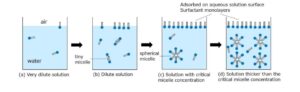
Surfactants, Micelles, and Why Their Performance Matters
What Are Surfactants?
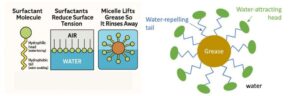
Surfactants (short for surface-active agents) are special molecules that make cleaning possible by helping water interact with oil, grease, and dirt.
A surfactant is like a two-sided connector:
- One end loves water (hydrophilic)
- One end loves oil and grease (hydrophobic)
Because of this, surfactants can link water and oil together, even though they normally don’t mix.
Why Surfactants Are Called “the Workhorse” of Cleaners
Surfactants earn the title “workhorse” because they perform the essential, heavy-lifting tasks that make cleaning possible. Without them, most cleaners would do very little beyond moving water around.
1) They Do the Actual Cleaning Work
Water alone cannot remove grease effectively. it beads up and slides off oils. Surfactants change that by:
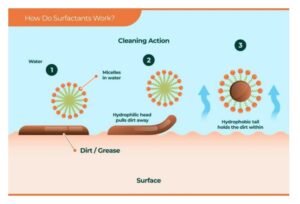
- Breaking apart grease
- Surrounding oil with micelles
- Lifting dirt off surfaces
- Keeping it suspended so it can be rinsed away
In other words, they are the ingredient that physically removes contamination, not just spreads liquid.
2) They Enable Everything Else to Work
Surfactants don’t just clean they unlock the performance of the entire formula:
- Help water spread evenly across surfaces
- Allow other ingredients (enzymes, solvents, builders) to reach dirt
- Improve penetration into pores, fibers, and crevices
Without surfactants, even advanced ingredients struggle to reach their target.
3) They Operate at the Molecular Level
Surfactants work where you cannot see:
- At the interface between oil and water
- On microscopic films of grease
- Inside tiny surface irregularities
They act continuously during cleaning breaking, lifting, and dispersing contaminants at a molecular scale.
4) They Work Throughout the Entire Cleaning Process
From start to finish, surfactants are active:
- Initial contact → reduce surface tension so liquid spreads
- Activation (CMC) → form micelles that trap oils
Clean Interpretation
mother ferment compared to SLS:
- ~44× more efficient activation
- Cleaning begins at ~98% lower concentration
mother ferment compared to plant-based surfactants:
- ~4× to 19× more efficient
- Cleaning begins at ~74–95% lower concentration
What “Faster” Really Means in Practice
A lower CMC translates to:
- Immediate surface activation upon contact
- Faster spreading and penetration
- Reduced dwell time needed
- More cleaning per drop
A system that activates at dramatically lower concentration doesn’t just use less, it begins working sooner, spreads faster, and cleans more efficiently from the very first contact.
Sources:
SLS and Plant Based Surfactants: https://surfactant.alfa-chemistry.com/critical-micelle-concentration-cmc-lookup-table.html?utm_source
Bioferment Technology – Augustine Scientific Report, March 12, 2022.
7) Post-Critical Micelle Concentration Plateau Surface Tension — Why It Matters
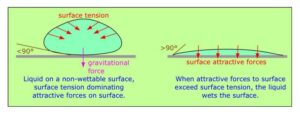
As concentration increases:
- Surface tension drops rapidly
- Then reaches a plateau (a stable minimum level)
What This Means
At the plateau:
- Surfaces are fully coated with surfactant
- Water spreads easily across surfaces
- Oils are efficiently lifted and emulsified
Key Insight – The lower the plateau surface tension, the better the cleaning performance
Surface Tension Is Measured in mN/m
Surface tension is a force per unit length, measured in:
- millinewtons per meter (mN/m)
This unit describes how strongly a liquid surface resists spreading.
Example
- Pure water ≈ 72 mN/m (high tension, forms droplets)
- Effective surfactants reduce this dramatically
Meaning in Practice
- Lower mN/m → better spreading
- Better spreading → more surface coverage
- More coverage → more effective cleaning
Surface Tension Industry Benchmarks
CMC (Typical Ranges) source:
https://www.kruss-scientific.com/en/know-how/glossary/critical-micelle-concentration-cmc-and-surfactant-concentration
Bioferment Technology – Augustine Scientific Report, March 12, 2022.
Surface Tension at CMC
- SLS: ~33–40 mN/m
- Plant-based systems: ~30–40 mN/m
- mother ferment biosurfactant blend: ~23.13 mN/m
Result:
- 30–42% lower than SLS
- 8–34% lower than plant-based systems
What This Means for Cleaning Efficiency
1) Faster Surface Coverage
Lower surface tension allows liquid to:
- Spread instantly instead of beading
- Cover more area with less product
Result: quicker cleaning action from first contact
2) Deeper Penetration
Lower tension enables liquid to:
- Enter microscopic pores and crevices
- Reach trapped grease and residues
Result: more thorough cleaning, not just surface-level
3) Better Grease Breakdown
Improved wetting allows:
- Stronger interaction between surfactant and oil
- Faster micelle formation around contaminants
Result: grease lifts more easily and completely
4) Less Product Needed
Because the liquid spreads and works more efficiently:
- Smaller amounts achieve full coverage
- Reduced need for reapplication
Result: higher efficiency per use
5) Reduced Residue
Better dispersion and rinsing leads to:
- Less leftover film
- Cleaner final surface
Final Insight
A reduction of 20–40% in surface tension is not incremental, it represents a step-change in how effectively a cleaner can reach, lift, and remove contamination.
- Greater efficiency
- Reduced chemical impact
This represents the direction of next-generation, high-performance, non-toxic cleaning technologies.