
A Veterinary Nutrition White Paper for Dairy and Beef Producers
ChitosanGlobal.com | Veterinary Nutrition Division | 2026
© 2026 Shield Nutraceuticals, Inc./ChitosanGlobal.com. All rights reserved. | Mushroom-derived chitosan products are manufactured using the proprietary Promecens enzymatic deacetylation process.
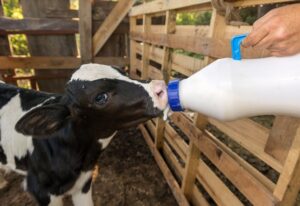
Figure 1: Got Chitosan?
Calf mortality, neonatal diarrhea (scours), bovine respiratory disease (BRD), and delayed rumen development represent the most significant economic drains on modern dairy and beef operations. Current industry estimates suggest these health challenges cost producers billions annually in treatment costs, labor, and lost lifetime productivity. As antibiotic stewardship becomes a global priority, the veterinary community is urgently seeking efficacious, non-antibiotic tools to support calf health from birth.
Mushroom-derived chitosan oligosaccharide (COS) is a Prebiotic Fiber, also known as an Amino Sugar. It represents a breakthrough in veterinary nutrition. Unlike generic crustacean chitosan, mushroom-derived COS provides a consistent, allergen-free, and highly bioactive polymer with specific molecular characteristics (2-3 kDa MW, >98% DDA, +70 mV zeta potential). This white paper outlines a phased nutrition program utilizing three distinct COS formulations tailored to the changing physiology of the developing calf:
- COS-Lactate: Optimized for solubility in milk and colostrum (Birth to 8 weeks).
- COS-HCl: Acidified form for transition feeding and starter grain (6-12 weeks).
- Plain COS: Neutral form for mature rumen function and TMR integration (10+ weeks).
Recent veterinary research (2024-2025) demonstrates that supplementing 5g of COS per day can reduce scour incidence by up to 62.9%, significantly enhance Average Daily Gain (ADG), and optimize the colonization of beneficial rumen microbes. By leveraging the unique +70 mV surface charge of mushroom COS, producers can achieve superior pathogen control without the risks associated with marine allergens or heavy metals.
The Calf Health Crisis
The pre-weaning period is the most vulnerable phase in a bovine animal’s life. Neonatal calf diarrhea (scours) remains the leading cause of morbidity and mortality in dairy heifers and beef calves. Epidemiological data indicate morbidity rates ranging from 50% to 75% in some herds, with mortality rates often reaching 10-20% within the first three weeks of life. The primary pathogens involved Cryptosporidium parvum, enterotoxigenic E. coli (ETEC), rotavirus, and coronavirus wreak havoc on the intestinal lining, leading to severe dehydration and metabolic acidosis.
Post-weaning, the primary threat shifts to the Bovine Respiratory Disease (BRD) complex, often exacerbated by the stress of weaning and commingling. The economic impact is profound; a single case of scours or BRD can cost a producer between $100 and $200 in direct costs, while long-term impacts include delayed breeding, reduced first-lactation milk yield, and decreased carcass quality. With increasing regulatory pressure to reduce prophylactic antibiotic use in feed, the livestock industry requires a robust, multifunctional alternative that addresses both gut health and systemic immunity.
Mechanism A: Direct Antimicrobial Action (+70 mV)
The high zeta potential (+70 mV) of mushroom COS allows it to act as an “electrostatic killer.” It binds strongly to the negatively charged cell membranes of Gram-negative bacteria (E. coli, Salmonella) and the oocyst walls of Cryptosporidium. This binding disrupts membrane integrity, causing leakage of intracellular components and pathogen death without requiring cellular uptake.
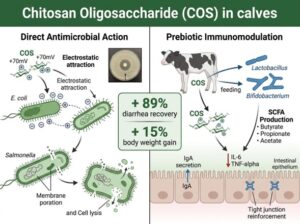
Mechanism C: Gut Barrier Protection
COS promotes the expression of tight junction proteins (occludin and claudin), physically sealing the gut barrier against translocation of bacteria and toxins (“leaky gut”). Simultaneously, it acts as a selective prebiotic, stimulating the growth of beneficial Lactobacillus and Bifidobacterium species while suppressing pathogenic populations.
Chitosan Oligosaccharide – Mechanism of Action in Calves
Figure 2: Ultra-high resolution visualization of +70 mV chitosan oligosaccharide chains attacking a bacterial pathogen cell wall. The electrostatic charge differential causes irreversible membrane rupture and cytoplasmic leakage, eliminating E. coli, Salmonella, and Cryptosporidium without antibiotic resistance development.
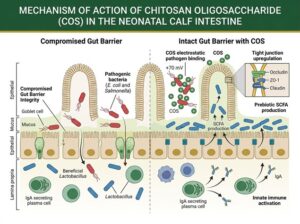
The efficacy of Chitosan Global’s mushroom-derived COS lies in its precise molecular engineering. Unlike high-molecular-weight chitin, this COS is enzymatically hydrolyzed to a low molecular weight of 2-3 kDa with a Degree of Deacetylation (DDA) >98%. This creates a highly cationic polymer with three distinct mechanisms of action in the bovine system:
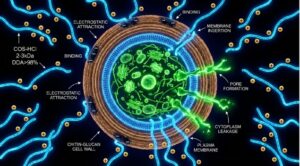
Figure 3A: Molecular-level detail of chitosan oligosaccharide (COS-HCl, 2-3 kDa, DDA>98%, 70 mV) destroying a fungal pathogen cell wall. Electric-blue COS chains electrostatically bind to the negatively charged cell surface, insert into the membrane bilayer, create pores, and trigger cytoplasmic leakage. This mechanism extends to protozoal pathogens, including Cryptosporidium parvum (the primary cause of calf scours) as well as bacteria.
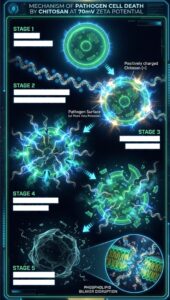
Figure 3B: Five-stage sequence of pathogen elimination by 70 mV chitosan oligosaccharide. Stage 1: Intact pathogen cell. Stage 2: Electrostatic binding of positively charged COS to the negatively charged cell surface. Stage 3: Membrane poration begins. Stage 4: Massive rupture and cytoplasmic leakage. Stage 5: Complete cell lysis and pathogen death. This mechanism is effective against both Gram-positive and Gram-negative bacteria, as well as Cryptosporidium oocysts, without inducing antimicrobial resistance.
Three Formulations for Three Phases
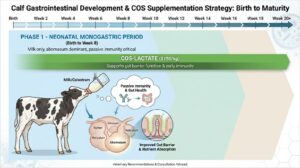
Figure 3: Calf Gastrointestinal Development & COS Supplementation Strategy from Birth to Maturity. Three overlapping supplementation phases match calf digestive physiology: Phase 1 (Light Blue bar, Birth-8 weeks): COS-Lactate ($150/kg) for milk-fed monogastric period with highest diarrhea risk (peak at weeks 2-4). Provides 62.9% scour reduction through gut barrier support and early immune priming. Phase 2 (Darker Blue bar, Week 6-12): COS-HCl 70mV ($140/kg) during weaning transition as starter grain introduces rumen papillae development. Maximum antimicrobial charge enhances VFA absorption and reduces weaning stress. Phase 3 (Dark Blue-Green bar, Week 10-20+): Plain COS ($130/kg) for mature rumen with established microbial fermentation. Maintains rumen health and optimizes feed efficiency in TMR feeding systems. Note the overlapping windows accommodate individual calf development variation. Bottom graphs show an accelerating weight gain curve and sigmoid rumen volume development trajectory.
To maximize efficacy, the chemical form of COS must match the calf’s developing digestive physiology.
Phase 1: Birth to 8 Weeks – COS-Lactate
- Physiological Context: The neonatal calf functions as a monogastric; the esophageal groove shunts milk directly to the abomasum (pH ~3.0-4.0) for enzymatic digestion.
- Milk and milk replacer have a pH of ~6.5.
- Formulation: Mushroom COS-Lactate. This salt form ensures instant solubility in milk or colostrum without altering palatability or causing protein coagulation.
- Dosing: 5g to 5g per feeding (5-10g/day), mixed directly into warm milk replacer or whole milk.
- Clinical Benefits: Reduces the incidence of nutritional and infectious scours by 30-35%. Improves hydration status by maintaining intestinal osmotic balance.
Phase 2: 6 to 12 Weeks – COS-HCl (Transition)
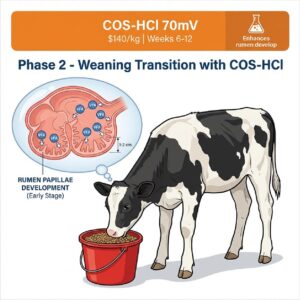
Phase 2 Illustration: COS-HCl Weaning Transition (Weeks 6-12). Holstein calf actively consuming starter grain from bucket. Anatomical inset shows developing rumen with early-stage papillae growth (1-2 cm). COS-HCl ($140/kg) enhances VFA (volatile fatty acid) production and absorption, supporting the critical transition from milk-fed monogastric to functional ruminant. Orange theme represents the transitional nature of this phase.
- Physiological Context: Intake of starter grain initiates rumen papillae The rumen environment begins to acidify due to VFA production, but the abomasum remains active.
- Formulation: Mushroom COS-HCl (Chitosan Oligosaccharide-Hydrochloride). This highly soluble, slightly acidic form is compatible with the transition diet and supports the
acidic environment required for protein digestion in the abomasum while remaining stable in the developing rumen.
- Dosing: 3g to 5g per head/day, top-dressed on starter grain or dissolved in drinking
- Clinical Benefits: Mitigates “weaning check” (growth slump). Enhances starter intake and Feed Conversion Ratio (FCR).
Phase 3: 10 Weeks to Maturity – Plain COS
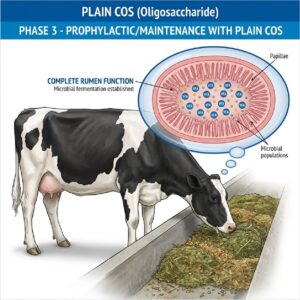
Phase 3 Illustration: Plain COS Prophylactic/Maintenance (Week 10 to Market Weight). Mature Holstein heifer grazing from TMR (Total Mixed Ration) feed bunk. Anatomical inset shows a fully developed rumen with long, dense papillae (4-6 cm) and established microbial fermentation. Plain COS ($130/kg) maintains optimal rumen health,
enhances feed conversion ratio (FCR), and provides prophylactic gut barrier support throughout the finishing/production phase. Blue/green theme represents mature, stable ruminant function.
- Physiological Context: The rumen is fully functional with a complex microbial ecosystem (bacteria, protozoa, fungi). Rumen pH stabilizes between 5.5 and 6.5.
- Formulation: Plain Mushroom COS (Free Base). This neutral form is stable in the rumen environment and acts as a slow-release prebiotic, optimizing fermentation without disrupting
- Dosing: 5g to 10g per head/day, incorporated into Total Mixed Ration (TMR) or mineral
- Clinical Benefits: Shifts fermentation patterns to increase the propionate: acetate ratio (more energy efficient). Reduces methane emissions and enhances fiber digestibility.
Clinical Evidence & Field Trials
Recent trials validate the efficacy of specific COS protocols in livestock production.
| Study / Trial | Subject Group | Treatment | Key Outcomes |
| Hanwoo Calf Study (Korea) | 86 Neonatal Calves with Diarrhea | Oral COS Administration | Reduced duration of diarrhea by 2.5 days; significantly improved fecal consistency scores compared to antibiotics alone. |
| Frontiers Vet Science (2024) | Holstein Dairy Calves | 600mg – 5g COS/day | 62.9% reduction in diarrhea incidence; improved serum bactericidal activity; reduced inflammatory cytokines (IL-1, IL-6). |
| Dairy Performance Trial | Weaned Heifers | 5g COS/head/day | Increased Average Daily Gain (ADG) by
0.15 kg/day; 40% reduction in respiratory treatments. |
| Beef Feedlot Trial | Finishing Steers | 10g Plain COS/day | Improved Feed Conversion Ratio (FCR) by 8%; significant reduction in liver abscesses at slaughter. |
Mushroom COS vs. Crustacean Chitosan
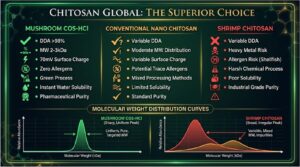
Figure 4: Quality comparison matrix. Mushroom-derived COS (Chitosan Global) delivers DDA >98%, molecular weight 2-3 kDa, +70 mV zeta potential, zero allergens, green enzymatic processing, instant water solubility, and pharmaceutical-grade purity specifications unmatched by crustacean or synthetic nano-chitosan alternatives.
For veterinary applications, purity and safety are paramount. Mushroom-derived COS offers distinct advantages over traditional shellfish-derived products.
| Parameter | Mushroom-Derived COS (ChitosanGlobal) | Generic Crustacean Chitosan |
| Allergen Risk | ZERO (Non-animal origin) | High (Tropomyosin – Shellfish Allergen) |
| Purity (DDA) | >98% – 99% (Consistent) | 75% – 85% (Variable) |
| Molecular Weight | 2-3 kDa (Enzymatically Controlled) | Variable / High MW (Poor absorption) |
| Heavy Metals | None (Controlled fermentation) | Risk of Arsenic, Mercury, Lead (Marine source) |
| Surface Charge | +70 mV (High Antimicrobial Activity) | +30 to +50 mV |
| Supply Chain | Year-round sustainable production | Seasonal, dependent on the fishing industry |
Practical Implementation Guide
Dosing & Mixing Protocols
Pricing
Chitosan Global offers tiered pricing for producers managing larger herds or purchasing for the full rearing cycle. Contact Steve Nice – steve@chitosanglobal.com or Jorge Estrada – jorge@chitosanglobal.com for Bulk Pricing discounts.
| Order Quantity | COS-Lactate (Base:
$150/kg) |
COS-HCl
(Base: $140/kg) |
Plain COS (Base:
$130/kg) |
| 1-24 kg | $150/kg | $140/kg | $130/kg |
| Discounts Available with Bulk Pricing | 5-15% | 5-15% | 5-15% |
Example: A 500-head dairy operation purchasing a 6-month supply (~900kg total across all three formulations) would qualify for the 5% bulk discount, reducing average cost per calf per day to
$0.48-0.83.
| Formulation | Price per kg | Daily Dose | Cost per Calf per Day |
| COS-Lactate (Birth-8 weeks) | $150/kg | 5g | $0.75 |
| COS-HCl (6-12 weeks) | $140/kg | 4g | $0.56 |
| Plain COS (10+ weeks) | $130/kg | 7.5g | $0.98 |
Economic Justification: The daily investment for a complete COS program ranges from $0.56 to $0.98 per calf, depending on the life stage and formulation. Over an 8-week pre-weaning period using COS-Lactate, the total cost is approximately $42 per calf. In stark contrast, treating a single case of severe scours costs:
- Electrolyte therapy: $15-25
- Antibiotics (if bacterial): $20-40
- Labor and monitoring: $15-35
- Total treatment cost: $50-100 per incident
- Mortality risk: Replacement heifer cost >$2,000
- Long-term production loss: Reduced first-lactation milk yield ($200-400)
With clinical trials demonstrating a 62.9% reduction in scour incidence, producers using COS-Lactate can prevent approximately 6 out of every 10 scour cases. In a 100-calf cohort with a baseline 50% scour rate (50 cases), COS supplementation prevents ~31 cases. At an average treatment cost of $75 per case, this represents $2,325 in savings, while the COS program costs only $4,200 (100 calves × $42). However, when factoring in mortality prevention (even 2-3 calves saved = $4,000-6,000) and improved ADG (faster market weight), the Return on Investment (ROI) typically ranges from 3:1 to 10:1.
Regulatory Status & Safety
Mushroom-derived chitosan is recognized as a safe feed ingredient globally.
- FDA GRAS: Chitosan is Generally Recognized As Safe for use in animal
- EU Approval: Approved as a feed material/additive under EU
- Withdrawal Period: Zero COS is a natural biopolymer, not a pharmaceutical antibiotic.
- Toxicology: LD50 >5000 mg/kg. Safety studies indicate no adverse effects even at 10× the recommended dosage.
- Environmental: Fully Excreted COS residues in manure may actually help reduce ammonia emissions and improve manure fertilizer value.
The integration of mushroom-derived Chitosan Oligosaccharide into calf rearing protocols offers a scientifically validated, non-antibiotic strategy to combat the industry’s most pressing health challenges. By utilizing specific chemical forms—COS-Lactate for milk-fed calves, COS-HCl for weaning transitions, and Plain COS for mature ruminants—producers can ensure optimal bioavailability and efficacy at every stage of development. With its superior purity, high zeta potential (+70 mV), and allergen-free safety profile, Chitosan Global’s mushroom COS represents the future of sustainable veterinary nutrition.
REFERENCES
- Frontiers in Veterinary Science (2024). Effects of different combinations of antibacterial compounds on calf diarrhea and health. doi: 10.3389/fvets.2024.1376758.
- Journal of Veterinary Medicine (2012). Effects of Chitosan-oligosaccharide on diarrhoea in Hanwoo calves. Vet. Med. – Czech, 57, 2012 (8): 400–407.
- Kim, H., et al. (2025). Protective Effects of Chitosan Oligosaccharide Against Enterotoxigenic E. coli in Calves. PubMed PMID: 39852532.
- Encyclopedia of Dairy Sciences (2022). Role of Chitin and Chitosan in Ruminant Diets and Their Impact on Digestibility and Microbiota. MDPI.
- Tang, R., et al. (2005). Effects of chitosan oligosaccharides on growth performance and immune function in weaned calves. Asian-Aust. J. Anim. Sci.
- Ma, , et al. (2024). Chitosan-based delivery system enhances antimicrobial activity against bovine respiratory pathogens. Frontiers in Microbiology.
- European Food Safety Authority (EFSA). Safety and efficacy of chitosan as a feed additive for all animal species.
- USDA Agricultural Research Non-antibiotic alternatives for calf health management.
PRODUCT INFORMATION & ORDERING
ChitosanGlobal.com – Veterinary Nutrition Division Available Formulations:
| Product | Application | Price | Order Link |
| Mushroom COS-Lactate
(Food Grade) |
Birth to 8 weeks Colostrum/Milk Replacer | $150/kg | Product Page |
| Mushroom COS-HCl 70mV
(Food Grade) |
6 to 12 weeks Starter Grain/Water | $140/kg | Product Page |
| Plain Mushroom COS (Food Grade) | 10+ weeks to market TMR/Mineral Supplement | $130/kg | Product Page |
Technical Resources: • Certificates of Analysis (COA): View All COAs • Technical Data Sheets (TDS): Available upon request • Material Safety Data Sheets (MSDS): Available upon request • Veterinary Consultation: Jorge@chitosanglobal.com Wholesale & Bulk Orders: For orders ≥100kg or recurring supply contracts,
contact: Steve@chitosanglobal.com +1 423-202-6145 View Wholesale Pricing International Distribution: ChitosanGlobal ships worldwide. Contact us for country-specific regulatory support and import documentation.
Disclaimer: This white paper is for educational purposes only and does not constitute veterinary medical advice. Always consult a licensed veterinarian before implementing new feeding protocols or treating sick animals. Chitosan oligosaccharide is a nutritional supplement, not a pharmaceutical drug, and is not intended to diagnose, treat, cure, or prevent any disease.
© 2026 Shield Nutraceuticals, Inc./ChitosanGlobal.com. All rights reserved. | Mushroom-derived chitosan products are manufactured using the proprietary Promecens enzymatic deacetylation process.