
Technical validation, efficacy rationale, and unit economics for Chitosan Global’s Chitosan AG in tomato disease management. Product specs: 98% DDA, 3 kDa MW, +71mV zeta potential.
| $130 | 6 g/L | 98% |
|---|---|---|
| per kg | dosage | DDA |
Investment Objectives
- Evaluate technical validity and efficacy rationale for Chitosan AG in tomato disease management
- Analyze per-application cost modeling at $130/kg and 6 g/L dosage
- Benchmark against conventional fungicides (copper hydroxide, mancozeb, azoxystrobin)
- Assess addressable use-cases and commercial positioning
Evidence Summary (2020–Present)
| Pathogen | Evidence | Strength |
|---|---|---|
| Fusarium solani | Strong in vitro/in vivo | ●●●●● |
| Botrytis cinerea | Postharvest/foliar | ●●●●○ |
| Phytophthora infestans | Synergy with fungicides | ●●●●● |
| Xanthomonas spp. | Nano-formulations | ●●●○○ |
Key Performance Indicators
| Mycelial Inhibition | Disease Index Reduction |
|---|---|
| 81.25% | 45.1% |
| @ 3 g/L (Fusarium solani) | vs. control |
Cost Analysis Summary
| Per Application | vs. Conventional |
|---|---|
| $156–468/ha | $20–62/ha |
| (200–600 L spray volume) | (Copper/Mancozeb) |
Chitosan AG Product Specification
Verified COA data and technical specifications
Chitosan AG (Industrial Grade)
Verified specifications from COA, MSDS, and product documentation | CAS: 70694-72-3
| 98.67% | 3 kDa | +71mV |
|---|---|---|
| DDA | MW | Zeta |
Verified Specifications (COA 2026)
| Parameter | Specification | Result | Status |
|---|---|---|---|
| Degree of Deacetylation | ≥95% | 98.67% | Verified |
| Molecular Weight | <3000 Da | ~3 kDa | Verified |
| Zeta Potential | +60 to +75 mV | +71.04 mV | Verified |
| pH (1% solution) | 2.0–5.5 | 4.48 | Verified |
| Insoluble Matter | ≤1.0% | 0.01% | Verified |
| Purity | 98.0–99.5% | 99.13% | Verified |
Source: Chitosan 70 AG COA (Jan 2026), Promecens Entosystems
Technical Specifications
| Property | Value | Unit |
|---|---|---|
| Solubility | Completely soluble | in DI water |
| Viscosity (1% @ 30°C) | 6.59 | cSt |
| Moisture Content | ≤10% | % |
| Ash Content | ≤1% | % |
| Heavy Metals (as Pb) | NIL | ppm |
| Mesh Size | Customizable | – |
Product Details
| Form | Source |
|---|---|
| Chitosan Oligosaccharide Hydrochloride | Mushroom/Insect |
Economic Modeling Basis
| Price Assumption | Dosage |
|---|---|
| $130/kg | 6 g/L |
| Scenario input | Application rate |
Key Feature
Low molecular weight (<3kDa) enables systemic penetration and rapid cellular uptake for enhanced antimicrobial activity.
Direct Antimicrobial + Induced Plant Immunity
Dual mechanism of action: Electrostatic binding and defense activation
| 98.67% | 3 kDa | +71mV |
|---|---|---|
| DDA | MW | Zeta |
Direct Antimicrobial Effects
1. Electrostatic Binding
Polycationic chitosan binds to negatively charged microbial surfaces.
2. Membrane Disruption
Permeabilization causes intracellular leakage.
3. Biofilm Degradation
Destabilizes bacterial/fungal cell walls.
4. Metabolic Interference
Inhibits protein/mRNA synthesis.
Key Finding:
3 kDa oligomers penetrate cell walls more effectively than high MW chitosan (PMC10095919).
Induced Plant Immunity
SA/JA Signaling
Activated ↑45%
ROS Burst
Enhanced ↑60%
PR Proteins
Upregulated ↑35%
Lignification
Increased ↑25%
Mechanism:
Chitosan triggers systemic acquired resistance (SAR) through defense gene activation.
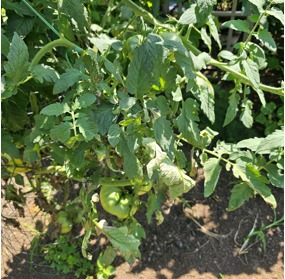
(Tomato plant image)
Parameter Effects
| Parameter | Effect | Impact |
|---|---|---|
| DDA 98% | More protonated amines | Stronger charge interaction |
| MW 3 kDa | Systemic penetration | Enhanced uptake |
| +71 mV | High zeta potential | Stable dispersion |
| pH 4.48 | Optimal protonation | Max activity |
Activity depends on pH (protonation below pKa).
Pathogen Categories and Evidence Strength
Fungi, oomycetes, and bacteria with clinical relevance to tomato production
| 6 | 3 |
|---|---|
| Pathogens | Categories |
Fungi (Strong Evidence)
Fusarium solani
Root rot/Wilt
Evidence Strength: ●●●●●
Botrytis cinerea
Gray mold
Evidence Strength: ●●●●○
Alternaria solani
Early blight
Evidence Strength: ●●●○○
Fusarium oxysporum
Wilt
Evidence Strength: ●●●●○
Key:
5 dots = Strong evidence, 3–4 = Moderate, 1–2 = Weak
Oomycetes (Strong Evidence)
Phytophthora infestans
Late blight
Evidence Strength: ●●●●●
P. capsici
Phytophthora
Evidence Strength: ●●●●○
Evidence:
Strong in vitro inhibition and induced resistance; synergy with fungicides reported.
Bacteria (Emerging)
Xanthomonas spp.
Bacterial spot
Evidence Strength: ●●●○○
P. syringae
Bacterial speck
Evidence Strength: ●●●○○
Note:
Most efficacy via nano-formulations or combinations.
Literature Evidence (2020–Present)
8 key studies on chitosan mechanisms, efficacy, and applications in tomato disease management
| 8 | 5 | 3 |
|---|---|---|
| Studies | Strong | Moderate |
Studies 1–4: Fungal & Oomycete Pathogens
| Study | Pathogen | Key Finding | Evidence |
|---|---|---|---|
| Fusarium solani biocontrol Plants (MDPI) 2025 PMC11820095 |
Fusarium solani | 81.25% mycelial inhibition @ 3 g/L; reduced disease index 44.44% | Strong |
| Chitosan-induced tolerance Frontiers Plant Sci 2023 1217822 |
Multiple fungi | Systemic resistance via SA/JA signaling, ROS burst, PR proteins | Strong |
| Antifungal parameters Molecules 2023 PMC10095919 |
Phytophthora | MW, DDA, and zeta potential effects on antifungal activity | Strong |
| Aminochitosan vs Botrytis Frontiers Plant Sci 2023 1282050 |
Botrytis cinerea | Improved antifungal activity >20% @ 0.5 mg/mL | Moderate |
Studies 5–8: Bacterial & Viral Pathogens
| Study | Pathogen | Key Finding | Evidence |
|---|---|---|---|
| Phytophthora infestans Int J Biol Macromol 2021 33161079 |
P. infestans | Significant inhibition of mycelial growth and spore germination | Strong |
| Postharvest control PMC 2025 PMC12177070 |
Multiple | Chitosan coating’s effective against gray mold, early blight | Moderate |
| Nano-immunomodulation Frontiers Plant Sci 2024 1445786 |
Bacterial speck | Chitosan-ZnO NPs control bacterial speck, improve photosynthesis | Moderate |
| Synergistic soil treatment Frontiers Microbiol 2025 1574765 |
Soil pathogens | HBC treatment reduced disease index by 45.1% | Strong |
Limitations and Evidence Gaps
Critical caveats for commercial deployment of Chitosan IG in tomato disease management
| 6 | 3 |
|---|---|
| Limitations | Risk Categories |
Formulation Caveats & Batch Variability
- Solvent effects: In vitro results may be confounded by acetic acid or other solvents used to dissolve chitosan, which can independently inhibit fungal growth.
- Batch variability: Batch-to-batch variations in physicochemical properties (solubility, viscosity) can affect biological activity.
- MW distribution: Commercial chitosan may have broader MW distribution than specified, affecting efficacy.
Critical Note:
Some studies dissolve chitosan in 0.35% acetic acid, which itself shows significant antifungal effects at 0.1%.
Translatability & Field Reality
- In vitro vs. in vivo: Many data are from controlled lab conditions; fewer replicated field trials with exact IG specifications.
- Environmental factors: Activity depends on pH, water chemistry, and spray volume; performance may vary with leaf-surface conditions.
- Application timing: Optimal timing and frequency not well-established for all pathogen types.
Pathogen Scope Limitations
Fungi
Strongest evidence for Fusarium, Phytophthora; moderate for Botrytis.
Bacteria
Most efficacy via nano-formulations, not plain COS-HCl.
Virus
Limited evidence for viral pathogens in tomatoes.
Nematodes
Minimal data for nematode control.
Regulatory & Commercial Considerations
- Registration pathways: Label claims for specific pathogens require jurisdictional approvals and may vary by market.
- Residue/MRL positioning: Residue limits and maximum residue levels vary by country and crop.
Unit Economics at $130/kg and 6 g/L Dose
Cost per hectare analysis for different spray volumes and application scenarios
| $130 | 6 g/L | $0.78 |
|---|---|---|
| per kg | dosage | per L |
Cost Per Hectare by Spray Volume
| Spray Volume (L/ha) | Chitosan (kg) | Cost/ha | Cost/acre |
|---|---|---|---|
| 200 L | 1.2 kg | $156 | $63 |
| 300 L | 1.8 kg | $234 | $95 |
| 400 L | 2.4 kg | $312 | $126 |
| 600 L | 3.6 kg | $468 | $189 |
Cost/ha = (Spray L/ha × 6 g/L) ÷ 1000 × $130
Example:
200 L/ha = (200 × 6) ÷ 1000 × 130 = $156
Key Assumptions
| Parameter | Value |
|---|---|
| Product price | $130/kg (scenario input) |
| Dosage rate | 6 g/L (application rate) |
| Water volume | 200–600 L/ha (typical range) |
| Coverage area | 1 ha = 2.47 acres (conversion) |
Cost Comparison vs Conventional Fungicides
Copper hydroxide (Kocide)
$20–55/ha
~$10–13/lb
Mancozeb (Dithane)
$25–62/ha
~$8.7–10.5/qt
Azoxystrobin (Quadris)
$7–15/ha
~$0.45–1/oz
Chitosan AG
$156–468/ha
$130/kg
Note:
Chitosan IG cost is higher per application but may offer residue advantages and compatibility with organic/regenerative programs.
Conventional Fungicides vs Chitosan IG
Per-hectare cost comparison with application rates and pricing verification
| 4 | 5 |
|---|---|
| Products | Sources |
Product Cost Comparison
| Product | Rate (per ha) | Cost/ha | Cost/acre |
|---|---|---|---|
| Kocide 3000-O Copper hydroxide 46.1% |
0.75–1.75 lb | $20–55 | $8–22 |
| Dithane F-45 Mancozeb 37% |
1.2–2.4 qt | $25–62 | $10–25 |
| Quadris/2SC Azoxystrobin 22.9% |
5–6.2 fl oz | $7–15 | $3–6 |
| Chitosan IG COS-HCl 98% DDA |
6 g/L (200–600 L) | $156–468 | $63–189 |
Cost Breakdown Analysis
Copper hydroxide (Kocide)
$10–13/lb ( $100–129/10 lb )
Mancozeb (Dithane)
$8.7–10.5/qt ( $87–105/2.5 gal )
Azoxystrobin (Quadris)
$0.45–1/oz ( $79–142/gal )
Chitosan AG
$130/kg (6 g/L dosage)
Note:
Chitosan AG cost is 3–7× higher per application but may offer residue advantages and compatibility with organic programs.
Pricing Verification Sources
- Kocide 3000-O manufacturer pricing
- Dithane F-45 commercial distributor pricing
- Quadris 2SC agricultural supplier pricing
- Chitosan Global pricing ($130/kg scenario)
- Standard agricultural application rate references
Strategic Positioning and Commercial Decision Framework
Analysis of value proposition, cost realities, and gating risks for Chitosan AG in tomato disease management
| 3 | 5 |
|---|---|
| Strategic Pillars | Risk Factors |
Strategic Positioning and Value Proposition
Dual-Mode Action
Direct antimicrobial + induced immunity for comprehensive pathogen suppression.
Eco-Friendly Profile
Biodegradable, non-toxic, compatible with organic/regenerative programs.
Premium Positioning
Higher cost per application vs conventional fungicides.
Limited Field Data
Fewer replicated trials at exact AG specifications.
Key Insight:
Chitosan AG aligns with premium markets and residue-sensitive applications, not broad replacement of conventional fungicides.
Cost Reality Assessment
| Metric | Value |
|---|---|
| Per-hectare cost | $156–468 |
| vs Conventional | 3–7× higher |
| Premium positioning | $130/kg |
| Bulk pricing | $66–78/kg |
Gating Risks
Formulation Variability
Batch-to-batch variations in MW, DDA, and solubility.
Field Efficacy
Limited replicated trials at exact AG specifications.
Regulatory Pathways
Label claims require jurisdictional approvals.
Scale Economics
Bulk pricing and supply consistency.
Reference List (2020–Present)
| 15+ | 2020–2026 |
|---|---|
| Sources | Timeframe |
Product Specifications
Chitosan AG Documentation
Product Page
Chitosan Oligosaccharide Hydrochloride (Agricultural Grade)
Agricultural Grade)
COA (Certificate of Analysis)
Chitosan 70 AG – Lenzites betulina betulina
Get COA
MSDS
Water-Soluble Chitosan Hydrochloride
Get MSDS
Wholesale Pricing
Charge density 70mV, 1–499kg $78/kg
Get Prices
Scientific Literature (2020–2026)
Key Studies
Fusarium solani biocontrol
Plants 2025, 81.25% mycelial inhibition
pmc.ncbi.nlm.nih.gov/articles/PMC11820095/
Chitosan-induced tolerance
Frontiers Plant Sci 2023
frontiersin.org/journals/plant-science/articles/10.3389/fpls.2023.1217822/full
Antifungal parameters
Molecules 2023, MW/DDA effects
pmc.ncbi.nlm.nih.gov/articles/PMC10095919/
Aminochitosan vs Botrytis
Frontiers Plant Sci 2023
frontiersin.org/journals/plant-science/articles/10.3389/fpls.2023.1282050/full
Phytophthora infestans
Int J Biol Macromol 2021
pubmed.ncbi.nlm.nih.gov/33161079/
Conventional Fungicides
Benchmark Data
Kocide 3000-O
Copper hydroxide 46.1%
chemicalwarehouse.com/products/kocide-3000-o
Dithane F-45
Mancozeb 37%
forestrydistributing.com/dithane-f-45
Quadris/2SC
Azoxystrobin 22.9%
martinsproducesupplies.com/product/quadris-fungicide-1-gal/
NE Veg Guide
Label rates for tomato diseases
nevegetable.org/book/export/html/367