
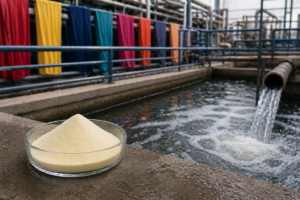
Still Struggling with Color Removal, High COD & Rising Treatment Costs?
Textile wastewater is one of the most challenging industrial effluents to treat.
If your system is dealing with:
- Persistent dye color after treatment
- High COD / BOD levels
- Excess sludge generation
- Increasing chemical consumption
- Pressure to meet discharge regulations
Then your current treatment process is likely inefficient and expensive.
Most textile mills still rely on alum, PAC, and synthetic polymers. However, these systems often:
- require higher dosages
- generate toxic sludge
- struggle with complex dye chemistry
- increase long-term operational costs
Upgrade your system with high-performance chitosan for water treatment and improve efficiency today
What Is Chitosan for Textile Wastewater Treatment?
Chitosan is a natural cationic biopolymer used for coagulation, flocculation, and dye adsorption.
In textile wastewater systems, it works by:
- neutralizing negatively charged dye molecules
- binding suspended particles
- forming dense flocs that settle quickly
This results in:
- faster clarification
- improved color removal
- reduced chemical dependency
Discover how advanced chitosan flocculant systems can improve your wastewater treatment performance
Why Textile Manufacturers Are Switching to Chitosan
1. Superior Dye Removal Efficiency
Chitosan is highly effective against:
- Reactive dyes
- Acid dyes
- Direct dyes
- Disperse dyes
Its strong cationic charge allows it to bind dye molecules efficiently, delivering:
- rapid color removal
- clearer effluent discharge
- improved filtration results
Improve dye removal performance using targeted chitosan solutions for dye removal applications
2. Reduced Chemical Load & Operating Cost
Compared to traditional coagulants like alum and PAC:
- lower dosage is required
- fewer chemicals are needed
- overall process becomes more stable
This directly reduces operating costs and improves treatment efficiency.
Reduce chemical costs and optimize your system by switching from alum-based treatment
3. Lower Sludge Volume & Safer Disposal
One of the biggest advantages of chitosan is sludge reduction.
It produces:
- lower sludge volume
- biodegradable residue
- easier and safer disposal
Switch to natural coagulants that reduce sludge and improve sustainability in your plant
4. Eco-Friendly & Compliance-Ready Solution
Chitosan supports:
- environmental compliance
- sustainability targets
- green manufacturing standards
Unlike synthetic polymers, it is biodegradable and environmentally safe.
Adopt biodegradable polymer solutions to meet regulatory and sustainability goals
How Chitosan Works in Textile ETP Systems
Chitosan can be integrated into multiple stages of a textile effluent treatment plant (ETP):
Primary Treatment
- coagulation of suspended solids
- initial dye binding
Secondary Treatment
- floc formation and settling
- COD/BOD reduction
Tertiary Treatment
- final polishing
- improved water clarity
Enhance your treatment process using water-soluble chitosan for faster dispersion and dosing efficiency
Industrial Chitosan Solutions for Textile Wastewater
We provide application-specific grades based on system requirements:
Industrial Grade Chitosan Powder
- high adsorption capacity
- strong coagulation performance
Request bulk industrial chitosan for large-scale wastewater treatment systems
Water-Soluble Chitosan
- instant dispersion
- ideal for automated dosing systems
Upgrade your system with water-soluble chitosan for improved operational efficiency
Chitosan Oligosaccharide (COS)
- low molecular weight
- enhanced reactivity
Explore advanced chitosan derivatives to boost treatment performance in complex wastewater systems
Advanced Modified Chitosan (Quaternary Systems)
For enhanced antimicrobial and binding performance:
Use quaternary chitosan solutions for high-performance industrial wastewater applications
Key Applications in Textile Industry
Chitosan is widely used in:
- dyeing and finishing units
- effluent treatment plants (ETP)
- water recycling systems
- industrial processing operations
It helps improve both treatment efficiency and water reuse potential.
Improve your textile wastewater system using proven chitosan-based treatment solutions
Performance Benefits
Using chitosan in textile wastewater treatment can help:
- reduce COD and BOD levels
- improve TSS removal efficiency
- enhance dye removal performance
- lower total treatment cost
- stabilize plant operations
These improvements directly impact both compliance and profitability.
Who This Solution Is For
This solution is ideal for:
- textile mills
- dyeing and finishing plants
- effluent treatment operators
- environmental engineers
- water treatment companies
- industrial chemical distributors
Supply & Commercial Options
We offer flexible supply options for industrial buyers:
- 25 g laboratory sample
- 1 kg standard packaging
- bulk supply for industrial use
- custom specifications available
- COA and technical datasheet provided
Request samples, pricing, and technical data tailored to your textile wastewater application
Why Choose Chitosan Global
We specialize in industrial-scale chitosan solutions designed for real applications.
Our advantages include:
- multiple grades for different systems
- consistent product quality
- application-focused supply
- technical understanding of wastewater treatment
- global logistics support
Partner with a reliable chitosan supplier for scalable wastewater treatment solutions
Running a Textile Effluent Plant?
Contact now to optimize your treatment process with the right chitosan grade.