
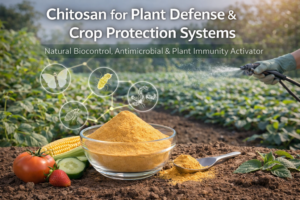
Advanced Chitosan-Based Solutions for Crop Protection, Disease Control & Sustainable Agriculture
Crop protection is no longer just about applying pesticides.
Modern agricultural systems are shifting toward biological defense activation, where plants are enabled to protect themselves against pathogens, stress, and environmental pressure.
Traditional crop protection methods face major limitations:
- increasing pathogen resistance to chemicals
- regulatory restrictions on pesticides
- environmental and residue concerns
- reduced long-term soil and plant health
Chitosan-based plant protection systems provide a different approach.
Instead of killing pathogens directly like synthetic chemicals, chitosan works by:
- activating plant immune responses
- inhibiting microbial growth naturally
- strengthening plant defense structures
If you are looking to:
- buy chitosan for crop protection formulations
- source a chitosan supplier for plant defense systems
- develop biopesticide or biostimulant products
this is one of the most scalable and scientifically validated solutions available.
What is Chitosan in Crop Protection Systems?
Chitosan is a cationic biopolymer derived from chitin, widely used in agriculture as:
- a plant defense elicitor
- a natural antimicrobial agent
- a biostimulant for crop resilience
It is recognized for its biodegradability, non-toxicity, and compatibility with sustainable farming systems.
Unlike traditional pesticides, chitosan functions as a plant signaling molecule, triggering internal defense mechanisms instead of external chemical control.
Scientific Mechanism of Plant Defense Activation
1. Induced Systemic Resistance (ISR Activation)
Chitosan acts as an elicitor, triggering plant immune signaling pathways (pattern-triggered immunity).
This leads to:
- activation of defense genes
- production of phytoalexins
- strengthening of plant cell walls
Plants become more resistant to pathogens without relying on chemical pesticides.
2. Enzyme Activation and Defense Compounds
Chitosan stimulates defense-related enzymes such as:
- chitinase
- peroxidase
- polyphenol oxidase
These enzymes help plants fight fungal and bacterial infections and enhance overall resistance.
3. Antimicrobial Action
Chitosan has broad-spectrum antimicrobial properties, helping:
- inhibit fungal pathogens
- reduce bacterial infections
- control post-harvest diseases
4. Antioxidant and Stress Response Activation
Chitosan enhances antioxidant enzyme activity, improving plant tolerance to:
- drought
- salinity
- temperature stress
This directly supports crop survival and yield stability.
5. Structural Defense Enhancement
Chitosan increases lignin formation and strengthens plant tissues, creating a physical barrier against pathogen penetration.
Why Chitosan Outperforms Traditional Crop Protection Methods
| System | Limitation | Chitosan Advantage |
|---|---|---|
| Chemical pesticides | resistance, toxicity | natural and sustainable |
| Fungicides | single-target action | multi-pathway defense |
| Fertilizers | no protection | growth + defense |
| Biostimulants | limited immunity | full immune activation |
Chitosan provides both protection and performance, not just disease control.
Applications in Plant Defense Systems
Foliar Spray Crop Protection
- activates plant immunity
- reduces pathogen infection
- improves leaf-level defense
Seed Treatment & Coating
- protects seeds from soil-borne pathogens
- improves germination and early growth
- enhances seedling survival
Soil and Root Protection
- reduces root infections
- improves soil microbial balance
- enhances root defense systems
Post-Harvest Protection
- reduces fungal decay
- extends shelf life of fruits and vegetables
- improves storage stability
Hydroponic & Greenhouse Systems
- supports disease control in controlled environments
- compatible with precision agriculture
Integration with Advanced Agricultural Systems
Chitosan is widely used in:
- biopesticide formulations
- plant defense stimulants
- integrated pest management (IPM) systems
- organic farming programs
It is also combined with:
- beneficial microbes
- bioactive compounds
- advanced nutrient systems
Chitosan Derivatives for Crop Protection
Different derivatives enhance specific applications:
Chitosan Oligosaccharide (COS)
- rapid absorption
- strong immune activation
→ chitosan oligosaccharide for plant growth enhancement
Quaternary Chitosan
- enhanced antimicrobial properties
- used in advanced coatings and sprays
Carboxymethyl Chitosan
- improved solubility
- used in soil and hydrogel systems
Alginate Oligosaccharide (AOS)
- enhances plant metabolism and stress resistance
→ alginate oligosaccharide fertilizer for crop yield optimization
Commercial Use Cases
Chitosan for plant protection is used by:
- agrochemical manufacturers
- biostimulant brands
- fertilizer companies
- greenhouse operators
- agricultural distributors
It is a core raw material for next-generation crop protection products.
Formulation Compatibility
Chitosan can be integrated into:
- foliar spray formulations
- liquid fertilizers
- biopesticide systems
- seed coatings
- drip irrigation systems
Compatible with:
- NPK fertilizers
- micronutrients
- biological inputs
Bulk Supply & Procurement
We supply chitosan for agricultural plant protection systems at commercial scale.
Supply Capabilities
- consistent batch quality
- COA (Certificate of Analysis) available
- scalable bulk production
- global shipping support
- formulation assistance
For buyers searching:
- chitosan supplier for agriculture
- bulk chitosan price per kg
- biopesticide raw material supplier
we provide customized supply solutions.
Why Choose Our Chitosan for Crop Protection
- high bioactivity and performance
- strong antimicrobial and defense activation
- suitable for modern agricultural systems
- scalable and reliable supply
- designed for commercial formulations
To build a complete system, integrate with:
- chitosan for agriculture and plant protection systems
- chitosan oligosaccharide for plant growth enhancement
Frequently Asked Questions
Can chitosan replace pesticides?
It can significantly reduce dependency and act as a natural alternative.
Is it safe for crops?
Yes, it is biodegradable and non-toxic.
Does it work against fungal diseases?
Yes, it has strong antifungal activity and enhances plant immunity.
Upgrade your crop protection systems with high-performance chitosan solutions.