
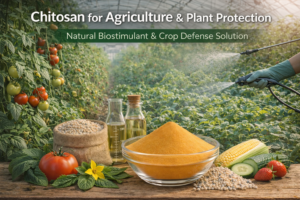
Advanced Biopolymer for Sustainable Agriculture, Crop Protection & Yield Optimization
Modern agriculture is facing increasing pressure to:
- reduce chemical pesticide usage
- improve soil health and sustainability
- increase crop yield under stress conditions
- comply with stricter environmental regulations
Traditional agrochemicals are becoming less effective due to resistance development, environmental concerns, and regulatory restrictions.
Chitosan offers a scientifically validated solution.
It is a natural, biodegradable biopolymer derived from chitin, widely used in plant protection systems, crop enhancement, and agricultural biostimulant formulations.
If you are looking to:
- buy chitosan for agriculture applications
- source a chitosan supplier for plant protection systems
- develop biostimulant or bio-pesticide formulations
chitosan is one of the most versatile raw materials available.
What is Chitosan in Agriculture?
Chitosan is a cationic polysaccharide obtained by deacetylation of chitin, typically sourced from marine or fungal origins.
Key Functional Properties
- biodegradable and non-toxic
- antimicrobial and antifungal activity
- film-forming capability
- plant immune system activation
- chelating ability for nutrients and metals
Unlike conventional fertilizers or pesticides, chitosan works by activating plant biological systems rather than acting as a direct chemical input.
Scientific Mechanism of Action in Plant Protection
1. Plant Immune Activation (Induced Resistance)
Chitosan acts as an elicitor, triggering plant defense responses such as:
- production of phytoalexins
- activation of pathogenesis-related (PR) proteins
- strengthening of cell walls
This results in enhanced resistance against pathogens.
2. Antimicrobial and Antifungal Activity
Chitosan directly inhibits:
- fungal pathogens (e.g., Fusarium, Botrytis)
- bacterial infections
- post-harvest decay organisms
Its positive charge interacts with microbial cell membranes, disrupting their function.
3. Growth Promotion and Hormonal Effects
Chitosan influences plant growth by:
- stimulating auxin and cytokinin activity
- improving root development
- enhancing plant vigor
4. Nutrient Uptake Enhancement
Chitosan improves:
- nutrient chelation and transport
- absorption efficiency of N, P, K
- soil microbial activity
5. Stress Resistance Activation
Helps plants tolerate:
- drought stress
- salinity
- temperature fluctuations
Chitosan Derivatives for Agriculture
Different derivatives are used depending on application:
Chitosan Oligosaccharide (COS)
- low molecular weight
- rapid plant absorption
- ideal for foliar spray and hydroponics
→ Explore: chitosan oligosaccharide for plant growth enhancement
Alginate Oligosaccharide (AOS)
- plant metabolic activator
- improves yield and stress resistance
Quaternary Chitosan
- strong antimicrobial activity
- used in crop protection formulations
Carboxymethyl Chitosan
- high solubility
- used in hydrogels and soil conditioners
Applications in Agriculture and Plant Protection
1. Crop Protection Systems
- natural fungicide and bactericide
- reduces reliance on chemical pesticides
- improves plant resistance
2. Foliar Spray Applications
- enhances plant metabolism
- improves nutrient uptake
- increases crop uniformity
3. Soil Treatment and Root Development
- improves root structure
- enhances soil microbial activity
- increases nutrient availability
4. Seed Treatment
- improves germination rate
- protects seeds from pathogens
- enhances early plant growth
5. Post-Harvest Protection
- edible coatings for fruits and vegetables
- reduces spoilage and extends shelf life
Performance Benefits
- improved crop yield and productivity
- enhanced plant immunity and disease resistance
- increased nutrient uptake efficiency
- improved root development and plant growth
- reduced chemical pesticide usage
- better crop quality and shelf life
Chitosan vs Traditional Agrochemicals
| Input Type | Function | Limitation | Chitosan Advantage |
|---|---|---|---|
| Chemical pesticides | disease control | resistance & toxicity | natural antimicrobial |
| Fertilizers | nutrient supply | no protection | growth + defense |
| Biostimulants | growth support | limited protection | dual function |
| Chitosan | growth + protection | — | multi-functional |
Formulation Compatibility
Chitosan is compatible with:
- NPK fertilizers
- micronutrients
- biostimulants
- organic farming systems
- drip irrigation and foliar spray
It can be integrated into:
- liquid fertilizers
- plant protection formulations
- hydroponic systems
Commercial Use Cases
Chitosan is widely used by:
- fertilizer manufacturers
- agrochemical companies
- agricultural input distributors
- greenhouse and hydroponic operators
- organic farming systems
Bulk Supply & Procurement
We are a chitosan supplier for agriculture and plant protection systems, supporting global buyers.
Supply Capabilities
- multiple grades (powder, oligosaccharide, derivatives)
- consistent batch quality
- scalable bulk production
- global logistics support
Why Choose Chitosan for Agriculture
- natural and biodegradable solution
- multi-functional (growth + protection)
- compatible with modern agriculture systems
- reduces chemical dependency
- supports sustainable farming
Frequently Asked Questions
Is chitosan safe for crops?
Yes, it is non-toxic and biodegradable.
Can chitosan replace pesticides?
It can reduce dependency and act as a natural alternative.
What crops benefit most?
All major crops including vegetables, fruits, grains, and greenhouse crops.
Contact:
steve@chitosanglobal.com
Switch to chitosan-based agriculture and plant protection systems for sustainable, high-performance farming.