

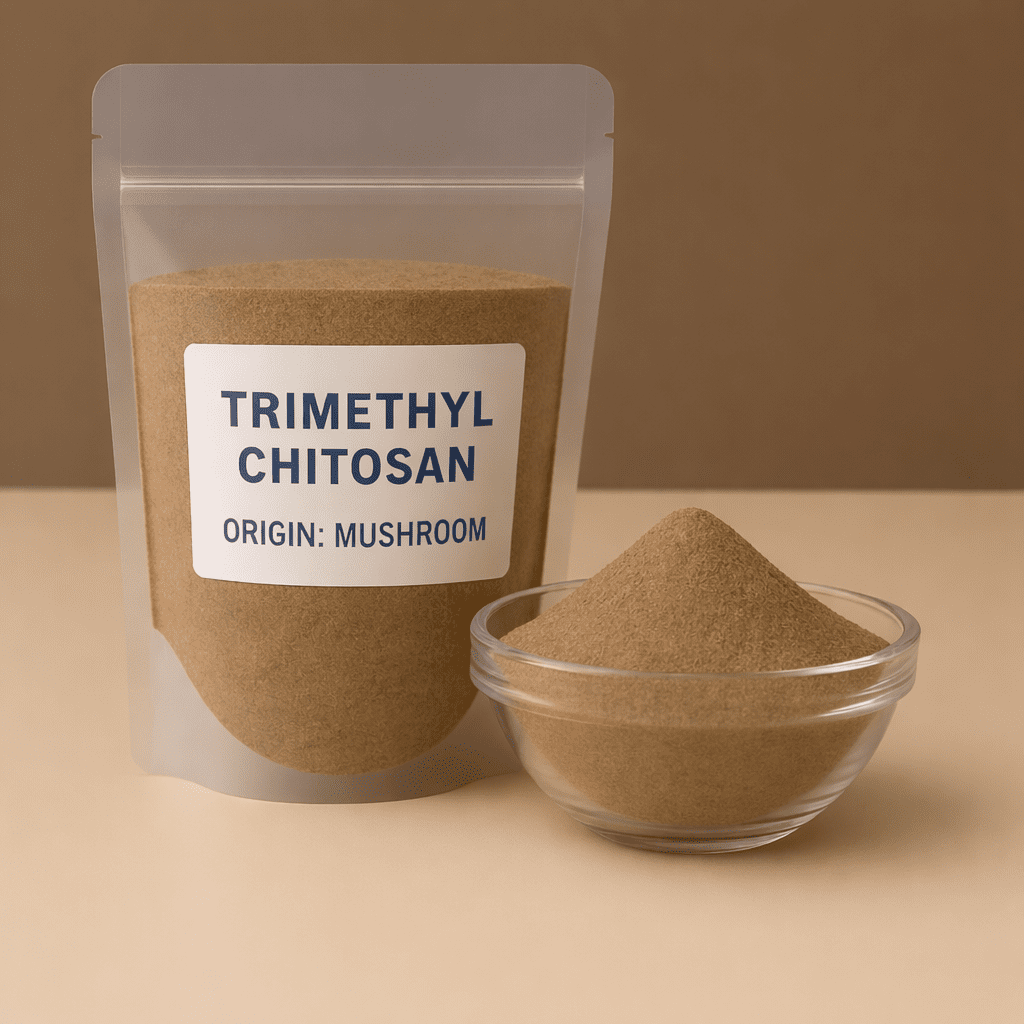


Description
Trimethyl Chitosan (TMC) — Mushroom Source | Pharmaceutical & Biomedical Grade
CAS 52349-26-5 | N,N,N-Trimethyl Chitosan Chloride | DQ 30–70% | pH 1–14 Soluble | Vegan & Crustacean-Free | COA Included
Trimethyl Chitosan (TMC) from mushroom origin is the most advanced permanently cationic biopolymer available for pharmaceutical, biomedical, and nutraceutical research applications. As a chemically quaternized derivative of fungal chitosan (CAS 52349-26-5), TMC maintains full water solubility and permanent positive charge across the entire physiological and industrial pH range from strongly acidic (pH 1) to alkaline (pH 14) a property that standard chitosan cannot achieve. Derived exclusively from oyster mushroom (Pleurotus ostreatus) mycelium, our TMC is crustacean-allergen-free, vegan-compatible, and suitable for formulations where shellfish-derived materials are excluded. Available in research samples (25 g), standard units (1 kg), and industrial bulk (up to 1 metric ton), with full Certificate of Analysis (COA), MSDS, and Technical Data Sheet (TDS) for every batch.
What Is Trimethyl Chitosan (TMC)? The Science Behind the Polymer
Trimethyl chitosan, formally known as N,N,N-Trimethyl Chitosan Chloride (TMC), is produced by the controlled N-methylation of chitosan using iodomethane (methyl iodide) in N-methyl-2-pyrrolidone (NMP) as solvent under alkaline conditions. The reaction introduces three methyl groups (-CH₃) onto the primary amino group (-NH₂) at the C-2 position of each glucosamine unit in the chitosan backbone, converting it into a permanent quaternary ammonium group (-N⁺(CH₃)₃).
This quaternization achieves something standard chitosan cannot: the resulting positive charge is PERMANENT it does not depend on environmental pH. Standard chitosan carries a pH-dependent charge that disappears above pH 6.5, rendering it insoluble and inactive in neutral physiological and most industrial environments. TMC remains fully soluble, fully charged, and fully functional from pH 1 through pH 14.
The Degree of Quaternization (DQ%) is the defining quality parameter. DQ% expresses the proportion of amino groups that have been successfully methylated:
- Low DQ (20–30%): Improved solubility, milder charge density, lower cytotoxicity suitable for chronic-use formulations
- Medium DQ (40–60%): Optimal balance of charge density, mucoadhesion, and biocompatibility most widely used in drug delivery research
- High DQ (70%+): Maximum charge density, strongest permeation enhancement, strongest antimicrobial activity suitable for targeted delivery systems
Our standard grade supplies DQ 30–70% (confirmed by ¹H-NMR spectroscopy per COA). Custom DQ% available on request for precision pharmaceutical research.
Learn more about quaternization chemistry: Quaternary Chitosan — Full Chemistry & Derivatives Guide
Full Technical Specifications
| Parameter | Specification |
| Product Name | N,N,N-Trimethyl Chitosan Chloride (TMC) |
| Synonyms | Trimethyl Chitosan; Chitosan Trimethyl; Quaternized Chitosan; TMC Chitosan |
| CAS Number | 52349-26-5 |
| Molecular Formula | (C₉H₁₈ClNO₄)ₙ |
| Molecular Weight | Low (20–50 kDa) | Medium (50–150 kDa) | High (150–500 kDa) — specify at order |
| Degree of Quaternization (DQ%) | 30–70% standard | Custom DQ% available (30%, 50%, 70%) |
| Counterion | Chloride (Cl⁻) |
| Water Solubility | Completely soluble pH 1–14 (no acid required) |
| Appearance | White to off-white free-flowing powder |
| Purity | High-purity per COA heavy metals within pharmaceutical limits |
| Source | Oyster mushroom (Pleurotus ostreatus) mycelium vegan, non-shellfish |
| Allergen Status | Crustacean-free | Shellfish-free | Vegan compatible |
| Characterization | ¹H-NMR confirmed DQ%; FTIR identity verification |
| pH Stability | pH 1–14 — complete solubility and charge maintained |
| Storage | Sealed container, cool dry conditions, away from moisture |
| Documentation | COA | MSDS/SDS | TDS available per batch |
The Mechanism of Action: How TMC Outperforms Standard Chitosan
1. Permanent Cationic Charge & Tight Junction Modulation
The most scientifically significant advantage of TMC over standard chitosan is its ability to function as a permeation enhancer at physiological pH (7.0–7.4) exactly where drugs need to be absorbed but where standard chitosan is inactive.
TMC’s permanent positive charge interacts with the negatively charged proteins of tight junction complexes specifically the ZO-1 (Zonula Occludens-1), occludin, and claudin proteins that form the paracellular seals between epithelial cells. By temporarily opening these junctions, TMC creates a paracellular pathway for drug molecules including large, hydrophilic macromolecules like insulin, heparin, and peptide drugs that would otherwise be impermeable across gastrointestinal, nasal, and ocular epithelia. Published literature documents 3–15x improvement in drug permeation across Caco-2 intestinal cell monolayers using TMC at physiological pH versus chitosan controls.
2. Mucoadhesion & Extended Mucosal Residence
TMC’s quaternary ammonium groups form strong electrostatic bonds with negatively charged mucin glycoproteins that coat mucosal surfaces throughout the GI tract, nasal cavity, and ocular surface. This mucoadhesion dramatically extends TMC formulation residence time at the absorption site, increasing the window for drug uptake and improving bioavailability. Mucoadhesive force is proportional to DQ% higher quaternization produces stronger mucin binding.
3. pH-Independent Nanoparticle Formation
Unlike chitosan-based nanoparticles (which require acidic preparation conditions), TMC nanoparticles form readily by ionic gelation with tripolyphosphate (TPP) at neutral pH 7.4 — matching the physiological environment of the GI tract, nasal mucosa, and bloodstream. TMC/TPP nanoparticles typically achieve:
- Particle size: 200–800 nm (optimal for mucosal uptake and endocytosis)
- Zeta potential: +20 to +40 mV (stable colloidal suspension; bioadhesive)
- Encapsulation efficiency: 70–90% for protein and peptide drugs
- Drug loading capacity: 10–30% w/w depending on API characteristics
See application in dietary supplement delivery: Chitosan in Dietary Supplements — Bioavailability Enhancement
Applications: Where Trimethyl Chitosan Delivers Decisive Performance
Pharmaceutical Drug Delivery Systems
Oral Drug Delivery — The Insulin Problem & TMC’s Solution
Oral delivery of peptide drugs (insulin, GLP-1 agonists, heparin, cyclosporine) remains one of pharmaceutical science’s greatest unsolved challenges. The GI epithelium’s tight junction barrier and enzymatic degradation environment make large hydrophilic molecules nearly impossible to absorb after oral administration. TMC addresses both barriers:
- Tight junction opening at intestinal pH 7.0–7.4 creates paracellular drug passage
- Nanoparticle encapsulation protects drugs from enzymatic degradation in gastric and intestinal fluids
- Mucoadhesion extends residence time at intestinal absorption sites
TMC/γ-PGA nanoparticles encapsulating insulin have demonstrated 73.8% loading efficiency with stable pH-responsive release characteristics across the GI pH gradient (stomach pH 1–3 → intestine pH 6–7.4). TMC40 (DQ ~40%) formulations showed superior stability and controlled release versus standard chitosan controls.
Nasal Drug Delivery & Vaccine Adjuvants
Nasal delivery offers direct access to systemic circulation while bypassing first-pass hepatic metabolism. TMC nanoparticles are among the most extensively studied nasal drug delivery systems, particularly for:
- Intranasal influenza subunit vaccines: TMC-coated antigen particles showed stronger total IgG, IgG1, and IgG2a/c responses than antigen alone in murine models
- Peptide hormone delivery: nasal insulin, calcitonin, and vasopressin formulations
- CNS-targeted delivery: nasal-to-brain pathway using TMC nanoparticles for neurological drug delivery
The optimal DQ% for vaccine adjuvancy is 22–55%; higher DQ% (>60%) may over-charge particles and reduce immune cell uptake. Influenza TMC-WIV (whole inactivated virus) nanoparticle formulations have demonstrated dose-sparing immunogenicity — a critical advantage for pandemic vaccine manufacturing.
Related: Chitosan in Personal Care — Mucosal Delivery Mechanisms
Ocular Drug Delivery
The corneal epithelium’s tight junctions, rapid tear-fluid washout, and blinking substantially limit conventional eye drop bioavailability to less than 5% of the applied dose. TMC-based ophthalmic formulations address all three barriers: mucoadhesion to the corneal mucin layer increases pre-corneal residence time, tight junction modulation improves corneal penetration, and the controlled-release nanoparticle architecture reduces dosing frequency. TMC ophthalmic formulations for glaucoma, dry eye, and ocular infection treatment are an active pharmaceutical development area.
Gene Delivery & Nucleic Acid Therapeutics
TMC is emerging as one of the leading non-viral gene delivery vectors, driven by mRNA therapeutics development following COVID-19 vaccine technology. Its advantages over viral vectors and synthetic lipid nanoparticles:
- Non-viral — eliminates immunogenicity risks associated with adenoviral and AAV vectors
- Biodegradable — unlike synthetic cationic lipids (DOTAP, DOPE); safer toxicity profile
- pH-stable polyplex formation — TMC/DNA and TMC/siRNA polyplexes form at neutral pH; N/P ratio 6:1 to 14:1 recommended
- Endosomal buffering — TMC’s amine groups buffer endosomal acidification, facilitating nucleic acid escape before lysosomal degradation
- Transfection efficiency: TMO-40 (DQ 40%) showed 26–131x increased transfection efficiency vs unmodified chitosan in COS-1 and Caco-2 cells depending on N/P ratio
Active research areas include TMC-siRNA delivery for cancer gene silencing, mRNA vaccine formulation, and CRISPR-Cas9 component delivery. For gene delivery, high molecular weight TMC with DQ ≥40% is recommended.
Tissue Engineering & Regenerative Medicine
TMC-based hydrogels and scaffolds are used in tissue engineering because TMC’s permanent positive charge promotes cell adhesion — most cell types carry a net negative surface charge and adsorb strongly to cationic substrates. TMC scaffolds provide:
- Controlled biodegradation rate adjustable by MW and DQ%
- Cell adhesion matrix supports fibroblast, chondrocyte, osteoblast, and stem cell attachment
- Growth factor loading and sustained release from hydrogel matrices
- Antimicrobial protection against infection at the scaffold site
Applications include bone tissue engineering (TMC/hydroxyapatite composites), cartilage scaffolds, and TMC hydrogels for diabetic wound healing. High MW TMC with medium DQ (40–60%) is recommended for most scaffold applications.
Related application: Quaternary Chitosan in Fiber Manufacturing — Bicomponent Scaffold Systems
Wound Healing & Antimicrobial Dressings
TMC wound dressings combine three synergistic mechanisms:
- Broad-spectrum antimicrobial: the permanent cationic charge disrupts gram-positive and gram-negative bacterial membranes; active at wound site pH (typically 7.2–8.0) where standard chitosan has minimal activity
- Moist wound environment: TMC hydrogels maintain optimal moisture balance; prevent desiccation and over-hydration
- Hemostatic activity: TMC’s positive charge accelerates red blood cell aggregation and platelet activation, supporting rapid hemostasis
Cosmetics & Personal Care Formulations
TMC functions as a high-performance conditioning polymer in hair and skin care formulations, offering advantages over conventional polyquaterniums:
- Hair conditioning: strong substantivity to negatively charged hair cuticle; superior wet-combing and frizz reduction vs polyquaternium-10
- Skin film-forming: creates a flexible, breathable cationic film on skin surface; increases moisturiser retention
- Preservative booster: antimicrobial activity allows reduction of conventional preservative concentration in eco-certified formulations
- Full biodegradability — meets COSMOS, ECOCERT, and NATRUE requirements for natural cosmetics
Full cosmetics application depth: Chitosan in Cosmetics — Green Beauty & Clean-Label Formulations
Why Mushroom-Sourced TMC? The Vegan Advantage Explained
Standard TMC is produced from shellfish-derived chitosan (shrimp and crab shell chitin). Our TMC is derived exclusively from Pleurotus ostreatus (oyster mushroom) mycelium — the first and critical distinction for pharmaceutical, nutraceutical, and cosmetic buyers who require:
| Requirement | Shellfish TMC | Mushroom TMC (This Product) |
| Crustacean allergen-free | No — shellfish proteins possible | Yes — zero crustacean inputs |
| Vegan-compatible | No | Yes — plant kingdom source |
| Clean-label nutraceuticals | Problematic in vegan/vegetarian products | Fully compatible |
| Religious dietary compliance (Halal/Kosher) | Complex — shellfish status varies | Simpler — fungal source |
| Batch consistency | High but dependent on seasonal shellfish supply | High — controlled fungi fermentation |
| ESG procurement requirements | Animal-derived inputs | Non-animal, sustainable fermentation |
Our mushroom source explained: Vegetal-Origin Chitosan — Oyster Mushroom Source
Compare all source origins: Chitosan by Source — Shellfish vs Mushroom vs Insect
TMC vs Standard Chitosan vs Carboxymethyl Chitosan — Which Polymer Is Right?
| Parameter | TMC (This Product) | Standard Chitosan | CMC |
| Charge type | Permanent cationic (pH 1–14) | pH-dependent cationic (pH <6.5) | Anionic |
| Water solubility | Complete at any pH | Acid only (pH <6.5) | Neutral–alkaline |
| Permeation enhancement | Strong — tight junction opening at physiol. pH | Limited (active only at acidic pH) | Minimal |
| Nanoparticle formation | Neutral pH — ideal for biologics | Acidic pH required | Yes, neutral pH |
| Gene delivery | Excellent — pH-stable polyplex | Poor at neutral pH | Not typical |
| Mucoadhesion | Very high | Moderate (pH-dependent) | Moderate |
| Wound/tissue engineering | Excellent | Good | Good |
| Cosmetics conditioning | Excellent — permanently cationic | Moderate | Not cationic different function |
| Vegan (mushroom grade) | Yes | Yes (mushroom) | Yes (mushroom) |
See Carboxymethyl Chitosan: Carboxymethyl Chitosan (CMC) — Anionic Derivative for Cosmetics & Wound Care
Pricing, Packaging & Ordering
| Quantity | Price (USD) | Shipping (USA) | Lead Time |
| 25 g Sample | $67.25 | Free | In stock |
| 1 kg | $185/kg | 15% tariff + $60 FedEx | 1–2 weeks |
| 100–500 kg | $168/kg | Custom quote | 2–8 weeks |
| 500 kg–1 Metric Ton | $150/kg | Custom quote | 4–12 weeks |
Custom DQ%, molecular weight grade, or sterility specifications: contact steve@chitosanglobal.com with your formulation requirements. Minimum 72-hour response for B2B qualification orders.
Full wholesale & volume pricing: Chitosan Global Wholesale Pricing — All Products
Documentation & Quality
- Certificate of Analysis (COA): Provided per batch — confirms DQ%, appearance, solubility, heavy metals
- MSDS / SDS: Available for regulatory and safety compliance
- Technical Data Sheet (TDS): Formulation guidance and handling procedures
- Batch traceability: Every batch traced to source mushroom chitosan lot number
- Manufacturing: Produced in registered FDA food facility; pharmaceutical-grade documentation available for qualifying orders
Download current batch COA: Trimethyl Chitosan COA Download (PDF)
Contact for pharmaceutical-grade documentation: Request GMP Documentation
Why Source From Chitosan Global?
- Mushroom source exclusively — the only TMC supplier to lead with vegan, non-shellfish fungal chitosan
- Transparent bulk pricing published — no NDAs required to get volume pricing information
- Research-to-industrial scale: 25 g through 1,000 kg from the same supply chain
- COA with DQ% confirmation — ¹H-NMR characterization per batch
- Direct technical support from Steve Nice — formulation consultation available; no call center
- ESG-aligned supply chain — non-animal inputs; sustainable mushroom fermentation; responsible sourcing policy
Our supply chain ethics: Responsible Supply Chain & ESG Strategy
Meet the team: Chitosan Global — Our People & Expertise
Frequently Asked Questions
What is trimethyl chitosan (TMC) used for?
Trimethyl chitosan (TMC) is a permanently cationic biopolymer used primarily in pharmaceutical drug delivery systems (oral, nasal, ocular, and transdermal), nanoparticle formulation, gene delivery and siRNA/mRNA therapeutics, vaccine adjuvant systems, tissue engineering scaffolds, wound healing materials, and cosmetic conditioning polymers. Its defining advantage over standard chitosan is full water solubility and permeation enhancement at physiological neutral pH (7.0–7.4), where standard chitosan cannot function.
What is the CAS number for trimethyl chitosan?
The CAS number for N,N,N-Trimethyl Chitosan Chloride (TMC) is 52349-26-5. This is the IUPAC-registered identifier used in procurement documentation, regulatory filings, and scientific literature. Note: Some sources cite CAS 101200-48-0 for the free base form; 52349-26-5 is the correct number for the commercially supplied chloride salt form. Always verify the counterion (chloride vs free base) when sourcing.
What is the degree of quaternization (DQ%) and why does it matter?
The degree of quaternization (DQ%) is the percentage of chitosan’s primary amino groups (-NH₂) that have been successfully converted to quaternary ammonium groups (-N⁺(CH₃)₃) during TMC synthesis. DQ% is confirmed by ¹H-NMR spectroscopy and is the most critical quality specification for drug delivery applications. Higher DQ% produces stronger permanent charge density, better water solubility across wider pH ranges, stronger tight junction-opening activity, and stronger antimicrobial potency but also slightly higher cytotoxicity risk. For most oral/nasal drug delivery research, DQ 40–60% is optimal. DQ 30% is used for gentler chronic-use applications; DQ 70%+ for maximum permeation enhancement.
Is trimethyl chitosan fully water soluble at neutral pH?
Yes — this is TMC’s defining advantage. TMC dissolves completely in aqueous media at any pH from 1 to 14, including physiological neutral pH (7.0–7.4) and alkaline conditions. Standard chitosan requires acidic media (pH below 6.5) for solubility and loses its charge and biological activity at physiological pH, severely limiting its pharmaceutical utility. TMC’s permanent quaternary ammonium groups maintain full solubility and cationic charge regardless of environmental pH.
What is the molecular weight of trimethyl chitosan and which grade should I choose?
Trimethyl chitosan is commercially available in three molecular weight grades: low MW (20–50 kDa), medium MW (50–150 kDa), and high MW (150–500 kDa). The appropriate grade depends on application: low MW TMC is preferred for gene delivery (smaller polyplexes, higher cellular uptake efficiency); medium MW is standard for oral and nasal drug delivery nanoparticles; high MW is preferred for hydrogel formation, tissue engineering scaffolds, and textile applications where film strength and viscosity are important. Specify your required MW grade at time of order.
How do you make TMC nanoparticles with tripolyphosphate (TPP)?
TMC nanoparticles are formed by ionic gelation: TMC (positively charged) is dissolved in water at neutral pH 7.0–7.4, and sodium tripolyphosphate (TPP, negatively charged) solution is added dropwise under magnetic stirring at room temperature. The electrostatic interaction spontaneously forms nanoparticles without organic solvents or elevated temperatures. Key parameters: TMC:TPP weight ratio typically 5:1 to 8:1; TMC concentration 0.5–2.0 mg/mL; TPP concentration 0.1–0.4 mg/mL. Resulting nanoparticles typically achieve 200–800 nm size and +20 to +40 mV zeta potential. Drug or antigen loading is achieved by mixing the API with the TMC solution before TPP addition.
What is the difference between TMC and HTCC (N-hydroxypropyl trimethyl ammonium chitosan)?
Both TMC and HTCC are permanently charged quaternary chitosan forms. TMC (N,N,N-Trimethyl Chitosan, CAS 52349-26-5) is synthesized by direct N-methylation of chitosan; HTCC (N-(2-Hydroxypropyl)-3-trimethylammonium Chitosan Chloride, CAS 112879-37-5) is produced by reaction with glycidyltrimethylammonium chloride. For mucosal drug delivery and vaccine adjuvancy, TMC is more extensively studied and documented. HTCC has slightly better nanoparticle formation efficiency and is preferred for gene delivery and antimicrobial coatings. For most pharmaceutical research, both are suitable; TMC is the preferred choice when literature precedent is important.
Is mushroom-derived TMC suitable for vegan and allergen-sensitive formulations?
Yes. Our trimethyl chitosan is derived from Pleurotus ostreatus (oyster mushroom) mycelium a non-animal, plant-kingdom fungal source that contains no shellfish, crustacean, fish, dairy, egg, tree nut, or soy ingredients. It is fully compatible with vegan product claims, vegetarian formulations, Halal and Kosher considerations (verify with your certifying body), and clean-label supplement formulations. For nutraceuticals, cosmetics, or pharmaceutical products marketed to vegan consumers or individuals with shellfish allergies, mushroom-source TMC is the correct specification.
What is the difference between trimethyl chitosan and standard quaternary chitosan?
‘Quaternary chitosan’ is the general category; trimethyl chitosan (TMC) is one specific form of quaternized chitosan. The category also includes HTCC, HACC, and pyridinium quaternary forms. TMC is specifically the N,N,N-trimethyl form three methyl groups on the nitrogen and is the most extensively studied quaternized chitosan in pharmaceutical and biomedical literature with 1,000+ peer-reviewed citations. When researchers or procurement teams specify ‘quaternary chitosan for drug delivery,’ TMC is typically what is intended. When specifying ‘antimicrobial quaternary chitosan’ without drug delivery requirements, HTCC or HACC may be equally appropriate.
Can TMC replace synthetic permeation enhancers like EDTA or surfactants?
TMC can partially or fully replace conventional chemical permeation enhancers (EDTA, sodium lauryl sulfate, bile salts, cyclodextrins) in many mucosal drug delivery formulations. Its key advantage is mechanism specificity: TMC opens tight junctions through targeted protein interactions (ZO-1, occludin) rather than through non-specific membrane disruption, resulting in a better safety and reversibility profile. TMC’s permeation enhancement is reversible tight junctions reclose once TMC is removed, unlike some chemical enhancers that cause sustained membrane damage. For sensitive mucosal tissues (ocular, nasal), TMC’s safer profile makes it preferable to detergent-type enhancers.
What N/P ratio should I use for TMC gene delivery polyplexes?
N/P ratio (the molar ratio of polymer nitrogen to nucleic acid phosphate groups) is the critical parameter for TMC/nucleic acid polyplex formation. Literature recommends N/P ratios of 6:1 to 14:1 for optimal transfection efficiency. At N/P 6:1, polyplexes form but some free nucleic acid may remain uncomplexed. At N/P 10–14:1, complete nucleic acid complexation is achieved with positive zeta potential (+15 to +30 mV) and optimal cell interaction. Note that increasing N/P ratio beyond 20:1 may increase cytotoxicity without further improving transfection. For TMO-40 (DQ ~40%), studies showed 26–131x transfection efficiency versus unmodified chitosan across N/P 6–14 in Caco-2 intestinal cells.
Is trimethyl chitosan FDA approved or GRAS?
Trimethyl chitosan itself does not have direct FDA GRAS designation, but is derived from chitosan which holds FDA GRAS status (21 CFR) for specific food applications and is FDA-approved for wound dressings. TMC produced from GRAS-status parent chitosan and used as a pharmaceutical excipient falls under the ‘generally recognized as safe as an excipient’ framework when used within established safety concentration ranges. For pharmaceutical applications, a full excipient safety dossier should be submitted to the relevant regulatory authority (FDA, EMA, Health Canada) as part of the IND/NDA/ANDA process. We can provide supporting safety documentation for regulatory submissions on request.
What solvents and storage conditions are required for trimethyl chitosan?
TMC dissolves readily in deionized or distilled water at any pH without requiring acid addition a major practical advantage over standard chitosan. For concentrated stock solutions (5–20 mg/mL), gentle warming to 30–40°C accelerates dissolution. TMC powder should be stored in a sealed container at room temperature (15–25°C), protected from moisture and direct sunlight. Properly stored TMC powder has a shelf life of 2–3 years. Avoid prolonged exposure to strong oxidizing agents or strongly alkaline conditions (pH >12) which may cause degradation. Reconstituted TMC solutions should be freshly prepared for nanoparticle work, or stored refrigerated (2–8°C) for no more than 2 weeks.
How does TMC compare to PEGylated polymers for nanoparticle drug delivery?
PEGylation (polyethylene glycol coating) is the conventional approach to improve nanoparticle circulation time and reduce immune recognition. TMC nanoparticles offer a complementary alternative: where PEGylated systems excel at long-circulation systemic delivery, TMC nanoparticles excel at mucosal delivery due to mucoadhesion a property PEGylation actually reduces. For oral, nasal, and ocular delivery applications, TMC’s mucoadhesive surface is advantageous over PEGylated systems. Hybrid systems combining TMC with PEG chains are an emerging strategy that captures both mucosal adhesion and systemic stealth properties. We offer standard TMC; PEG-TMC conjugate synthesis is available as a custom derivatisation service contact us to discuss.
What is the minimum quantity available and how do I request a custom specification?
Our minimum order is a 25 g research sample at $67.25 with free USA shipping sufficient for initial nanoparticle formulation screening and in vitro permeation studies. Standard 1 kg units are available at $185/kg. For custom specifications specific DQ%, molecular weight grade, sterility, pharmaceutical documentation, or large-scale bulk contact Steve Nice at steve@chitosanglobal.com or call +1 423-202-6145. B2B qualification orders (100 kg+) include complimentary formulation consultation. Lead time for custom specifications: 4–12 weeks.
Related Products & Resources
→ Quaternary Chitosan Shellfish — Industrial Grade TMC/HTCC
→ Quaternary Chitosan — All Grades & Sources Overview
→ Carboxymethyl Chitosan (CMC) — Anionic Derivative
→ Chitosan Oligosaccharide (COS) — Low MW Bioactive Polymer
Chitosan Hydrochloride — Water-Soluble Chitosan Salt
→ Mushroom-Origin Chitosan — Vegetal Source Overview
→ Chitosan in Dietary Supplements — Absorption Enhancement
→ Chitosan in Personal Care — Formulation Guide
Order TMC or Request a Bulk Quote
Select your package above to add to cart, or contact us for custom specifications, bulk pricing, or formulation support.
Email: steve@chitosanglobal.com | Phone: +1 423-202-6145
