

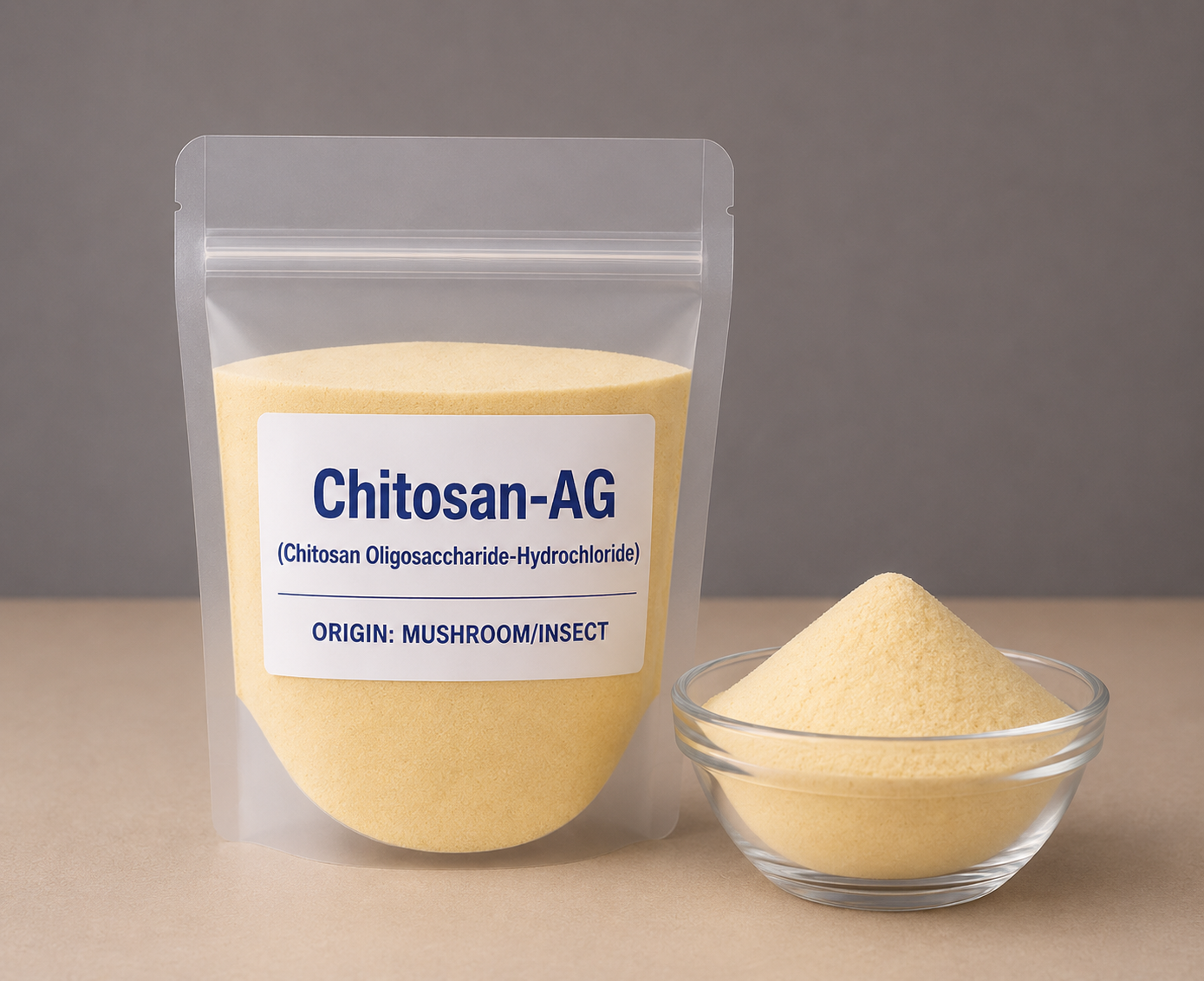

Description
What Is Chitosan Oligosaccharide Hydrochloride?
Chitosan Oligosaccharide (COS) is produced by depolymerising chitosan typically from shellfish chitin or fungal/insect sources down to oligomeric chains of 2 to 20 glucosamine units (degree of polymerisation, DP 2–20) with a molecular weight below 3,000 Da. The hydrochloride salt form (COS·HCl) is produced by reacting COS with hydrochloric acid, which stabilises the compound, enhances solubility, and improves shelf life compared to the free base form.
This modification produces several key advantages for agricultural use:
- Complete water solubility: dissolves instantly in water at any pH without acidification
- High positive charge (+70 mV zeta potential): enables strong electrostatic interaction with negatively charged plant cell membranes and pathogen surfaces
- Small molecule size (< 3,000 Da): enables rapid absorption through leaf cuticles, root cell walls, and seed coats
- High bioactivity: triggers plant defence gene expression at low application rates (50–100 ppm)
Explore the full COS hub page: Chitosan Oligosaccharide — Overview & Applications.
Technical Specifications
| Parameter | Specification |
| Product Name | Chitosan Oligosaccharide Hydrochloride (COS-AG) |
| Common Name | Chitosan Oligosaccharide, COS, COSH |
| CAS Number | 148411-57-8 |
| Molecular Weight | < 3,000 Da (monomer unit) |
| Degree of Polymerization (DP) | 2 – 20 (oligomeric chains) |
| Degree of Deacetylation (DDA) | ≥ 95.0% |
| Zeta Potential | +70 mV (approx.) — high positive surface charge |
| pH (1% aqueous solution) | 5.0 – 6.5 |
| Appearance | Off-white to pale yellow free-flowing powder |
| Solubility | 100% water-soluble — no acid required |
| Moisture Content | ≤ 10.0% |
| Ash Content | ≤ 1.5% |
| Insoluble Substance | ≤ 1.5% |
| Grade | Agricultural (COS-AG) |
| Available Sources | Mushroom (Vegetal) | Insect (BSF) |
| COA Available | Yes — batch-specific, on request |
| MSDS Available | Yes — on request |
| Storage | Cool, dry, well-ventilated; avoid light, heat, and humidity |
| Shelf Life | 24 months when properly stored |
| Organic Certification | EU 2021/1165 compliant — suitable for organic farming |
How Chitosan Oligosaccharide Works: The Science of Plant Immunity
Understanding how COS-AG activates plant defence is critical for formulators and agronomists. The mechanism is well-documented in peer-reviewed research and distinguishes COS from conventional fertilisers or synthetic crop protection agents.
COS as a MAMP — Microbe-Associated Molecular Pattern
COS is recognised by plants as a Microbe-Associated Molecular Pattern (MAMP). When applied, COS binds to pattern recognition receptors (PRRs) on plant cell surfaces, triggering a signalling cascade that primes the plant’s immune system. This process is known as Pattern-Triggered Immunity (PTI) and leads to rapid, broad-spectrum defence activation without requiring actual pathogen presence.
Salicylic Acid (SAR) and Jasmonic Acid (ISR) Pathways
COS activates two distinct plant hormone signalling pathways:
- Salicylic acid (SA) pathway — Systemic Acquired Resistance (SAR): Upregulates Pathogenesis-Related (PR) protein genes, particularly PR1. SAR provides long-lasting, systemic protection against fungal and bacterial pathogens.
- Jasmonic acid (JA) pathway — Induced Systemic Resistance (ISR): Activates defence against insect herbivory, necrotrophic pathogens, and abiotic stress. Increases activity of defence enzymes CAT, POD, SOD, and PAL.
Research published in Scientific Reports (Nature Publishing Group) confirmed COS pretreatment at 50 mg/L applied 1 day before inoculation provided the strongest resistance to Tobacco Mosaic Virus in Arabidopsis, operating primarily through the SA signalling pathway. This priming effect means plants treated with COS are faster and stronger in their defence response to subsequent pathogen attack.
Antimicrobial Mode of Action
COS also exerts direct antimicrobial effects. Its high positive zeta potential (+70 mV) enables electrostatic binding to negatively charged microbial cell membranes, disrupting membrane integrity and inhibiting growth of a wide range of fungal and bacterial pathogens including:
- Botrytis cinerea (grey mould)
- Fusarium oxysporum (Fusarium wilt)
- Pythium spp. (damping-off)
- Alternaria alternata (early blight)
- Pseudomonas syringae (bacterial speck)
- Tobacco Mosaic Virus (TMV) and Cucumber Mosaic Virus (CMV)
Key Benefits of COS-AG for Agricultural Applications
1. Promotes Faster Germination and Vigorous Early Growth
Seed treatment with COS-AG (0.2–0.5% solution) significantly improves germination rate and seedling vigour. COS activates metabolic pathways that increase seed respiration rate, enzyme activity (amylase, protease), and energy mobilisation — giving seedlings a stronger start and more uniform stand establishment.
2. Enhances Root Development and Nutrient Uptake
COS stimulates root elongation, lateral root branching, and root hair formation, dramatically increasing the root surface area available for nutrient and water absorption. This supports sustainable agriculture goals by improving fertiliser use efficiency (FUE) — meaning lower input costs for the same or better yield.
3. Activates Natural Plant Immunity (ISR + SAR)
As detailed in the mechanism of action section above, COS-AG triggers both ISR and SAR pathways, providing broad-spectrum, systemic disease resistance. This reduces reliance on synthetic fungicides and bactericides while maintaining or improving crop health — a key benefit for organic and integrated pest management (IPM) programmes.
4. Improves Stress Tolerance (Drought, Salinity, Temperature)
COS improves plant tolerance to abiotic stresses including drought, high salinity, and temperature extremes by:
- Stimulating accumulation of osmoprotectants (proline, betaine)
- Reducing oxidative damage through increased antioxidant enzyme activity (SOD, CAT, POD)
- Improving stomatal regulation and water-use efficiency
- Enhancing chlorophyll content and photosynthetic efficiency under stress
5. Boosts Crop Yield and Produce Quality
Multiple field trials demonstrate that COS application improves yield across a wide range of crops. Results reported in peer-reviewed literature include:
- Rice: 8–15% yield increase with COS foliar spray at heading stage
- Wheat: improved grain filling rate and grain weight
- Tomato: 12–18% improvement in fruit set and marketable yield
- Maize: faster germination, greater root biomass, improved stress recovery
- Grapes: improved berry quality, reduced Botrytis incidence
6. Soil Microbiome Enhancement
COS improves soil health by stimulating beneficial microbial communities. It promotes populations of plant growth-promoting rhizobacteria (PGPR) and mycorrhizal fungi, improving nutrient cycling, organic matter decomposition, and long-term soil structure.
Application Methods, Dosage, and Use Rates
| Application Method | Recommended Rate / Protocol |
| Foliar Spray | 50–100 ppm (mg/L) — apply every 7–14 days during active growth |
| Seed Treatment (soaking) | 0.2–0.5% w/v solution — soak seeds 4–12 hours before planting |
| Seed Coating | Mix COS with binder (CMC or starch); coat at 1–3 g COS per kg seed |
| Soil Drench / Irrigation | 1–2 kg per hectare in adequate irrigation volume |
| Hydroponic / NFT | 10–50 ppm in nutrient solution — monitor EC and pH |
| Biostimulant Formulation | 0.5–2.0% active in final product formulation |
| Pre-plant Soil Amendment | 1–2 kg/ha broadcast and incorporate 2–4 weeks before planting |
Note: Application rates may vary by crop type, growth stage, and local conditions. Contact us for crop-specific guidance: steve@chitosanglobal.com
Crop-Specific Dosage Guide
| Crop | Application | Recommended Rate | Timing |
| Rice | Foliar spray | 50–100 ppm | Tillering, heading |
| Wheat | Foliar spray + soil | 50 ppm foliar; 1 kg/ha soil | Seedling, jointing |
| Tomato | Foliar + soil drench | 75 ppm foliar; 1.5 kg/ha soil | After transplant, flowering |
| Maize / Corn | Seed treatment + foliar | 0.5% seed soak; 50–75 ppm foliar | Pre-plant + V3–V6 |
| Grapes | Foliar spray | 75–100 ppm | Bud break, pre-flower, fruit set |
| Lettuce / Leafy veg | Foliar + drip | 50 ppm / 1 kg/ha | Weekly during growth |
| Tea | Foliar spray | 50–75 ppm | New flush emergence |
| Flower / Horticulture | Foliar + substrate | 50 ppm foliar; 1 kg/ha substrate | Biweekly |
| Organic systems | All methods | Approved rate per local certifier | As needed |
COS-AG vs. Standard Chitosan
| Feature | Chitosan Oligosaccharide HCl (COS-AG) | Standard Chitosan |
| Molecular Weight | < 3,000 Da — oligomeric | 50,000–500,000+ Da — polymeric |
| Water Solubility | 100% — no acid required | Requires acetic acid (pH < 6) |
| Plant Absorption | Rapid — penetrates cuticle & cell walls | Limited — large molecular size |
| Bioavailability | High — fast systemic distribution | Low — surface effect only |
| Application Concentration | 50–100 ppm (very low rate) | 1,000–5,000 ppm (higher rate) |
| ISR/SAR Activation | Strong — documented in peer-reviewed studies | Moderate — less mobile in plant tissue |
| Seed Coating | Excellent — forms uniform thin film | Good — may clump at higher MW |
| Organic Compliance | EU 2021/1165 compliant | Compliant (source-dependent) |
| Price per Application | Lower effective cost (lower use rate) | Lower price per kg, higher use rate |
Source Comparison: Mushroom Origin vs. Insect (BSF) Origin
| Feature | Mushroom (Vegetal) Origin | Insect (BSF) Origin |
| Raw Material | Oyster mushroom mycelium | Black Soldier Fly (Hermetia illucens) pupae |
| Vegan / Non-animal | Yes — 100% plant-based | No — insect-derived |
| Allergen Status | No shellfish / no insect allergen risk | Insect-derived; check local regulations |
| Batch Consistency | Excellent — controlled fermentation | Excellent — controlled rearing conditions |
| Heavy Metals | Very low — no marine contamination risk | Very low — BSF has excellent detox profile |
| Sustainability | Circular — uses agri-waste feedstock | Circular — upcycles organic waste streams |
| Best For | Organic, vegan, EU / US market | High-performance, cost-effective, industrial |
| Certifications | Vegan-certified available | Traceable, COA-backed |
Learn more about Mushroom (Vegetal) origin chitosan and Insect (Black Soldier Fly) origin chitosan.
Core Agricultural Applications
Biostimulant Formulation Development
COS-AG is a premier active ingredient for manufacturers developing biostimulant products. Its water solubility, high charge density, and low application rate make it ideal for suspension concentrates (SC), soluble liquids (SL), water-dispersible granules (WDG), and soluble powders (SP). Learn more about chitosan in agriculture — benefits, functions, and dosages.
Seed Coating and Seed Treatment Products
COS forms a uniform, bioactive film on seed surfaces when used with appropriate binders. Seed-applied COS improves germination uniformity, seedling vigour, and early disease resistance reducing the need for fungicide seed treatments in integrated systems.
Organic Agriculture Inputs
COS-AG is compliant with EU Regulation 2021/1165 for use in organic production. It is a clean-label, natural-origin active that satisfies the increasing market demand for organic and residue-free crop protection solutions. Suitable for OMRI-listed product development (verify with certifying body for specific formulation).
Post-Harvest Treatment
COS is effective as a post-harvest treatment to reduce decay and extend shelf life of fresh produce. Its antimicrobial activity and elicitation of plant defence genes slow senescence and pathogen progression. See our chitosan edible coating page for formulation guidance on produce coating applications.
Water Treatment — Supporting Role
COS can also be utilised as a flocculant aid in agricultural water treatment and irrigation water purification. Its cationic charge assists coagulation of suspended particles and colloids. Learn about chitosan in water treatment.
Tank-Mix Compatibility Guide
| Product / Input Type | Compatibility with COS-AG | Notes |
| NPK liquid fertilisers | Generally compatible | Test at recommended rates before bulk mixing |
| Humic / fulvic acids | Compatible | Enhances nutrient complexation |
| Amino acid-based biostimulants | Compatible | Synergistic — nutrient + immunity action |
| Biological fungicides (Trichoderma) | Compatible | Combine for enhanced disease suppression |
| Biological bactericides (Bacillus) | Compatible | COS + Bacillus = strong synergistic effect |
| Copper-based fungicides | Use with caution | Potential chelation — buffer pH to 5.5–6.5 |
| Sulfur-based fungicides | Not recommended | pH incompatibility — apply separately |
| Strong alkaline products (pH > 8) | Not recommended | Degrades COS at high pH |
| Adjuvants / wetters | Compatible | Improves leaf coverage and absorption |
Always conduct a jar test before large-scale tank mixing. Contact us for technical support: steve@chitosanglobal.com
Pricing, Ordering, and Bulk Supply
| Package | Price | Shipping (USA) |
| 25 g Sample | $75.00 | Free delivery to USA |
| 1 kg (Mushroom or Insect) | $176.00 | Product + $8 import tariff + $90 shipping |
| 5 kg – 25 kg Bulk | Contact for quote | Custom freight — email steve@chitosanglobal.com |
| 25 kg + Industrial | Contact for quote | Global logistics, FOB and CIF options available |
- Every order ships with a batch-specific Certificate of Analysis (COA)
- MSDS available on request for all orders
- OEM and white-label supply supported for biostimulant manufacturers
- Custom specifications (MW range, DDA, DP) available for large orders
- Global shipping — USA, EU, India, Asia, Middle East, Latin America
View wholesale pricing and volume discount structure | Email: steve@chitosanglobal.com | Call: +1 423-202-6145
Why Source COS-AG from Chitosan Global?
- Dual sustainable sourcing: Mushroom (vegan) and Black Soldier Fly origin — chosen for sustainability, not just cost
- Batch-specific COA: Every shipment includes a Certificate of Analysis verifying MW, DDA, zeta potential, moisture, and ash content
- FDA-registered facility: All products manufactured in an FDA-registered food facility with full batch traceability
- Technical support included: Free formulation consultation with purchase — we help you optimise COS application rates for your specific crop system
- Transparent total-cost pricing: All import tariffs and shipping costs itemised — no surprises at checkout
- Reliable supply: Consistent batch-to-batch quality from controlled production — not spot-market sourcing
Read about our responsible supply chain commitment, environmental health & safety standards, and ESG strategy.
Frequently Asked Questions — Chitosan Oligosaccharide Hydrochloride (COS-AG)
What is the CAS number for Chitosan Oligosaccharide Hydrochloride?
The CAS number is 148411-57-8. This is the registered identifier for Chitosan Oligosaccharide Hydrochloride (COS·HCl). The free-base form (chitosan oligosaccharide) has a different CAS number.
What does ‘COS-AG’ mean?
COS-AG stands for Chitosan Oligosaccharide Agriculture Grade. The ‘AG’ designation indicates the product is formulated and quality-controlled for agricultural applications including foliar sprays, seed treatments, and soil applications, as distinct from food or pharmaceutical grades.
What is the difference between chitosan oligosaccharide and standard chitosan?
Standard chitosan is a high molecular weight polymer (50,000–500,000+ Da) that requires acidic conditions for dissolution. Chitosan oligosaccharide has a much lower molecular weight (< 3,000 Da), is fully water-soluble at neutral pH, and is absorbed much more rapidly by plants. At the cellular level, COS triggers immune responses at much lower concentrations (50–100 ppm vs 1,000–5,000 ppm for polymer chitosan).
What is zeta potential and why does +70 mV matter in agriculture?
Zeta potential measures the surface electrical charge of particles in suspension. A value of +70 mV indicates a strongly cationic (positively charged) molecule. In agriculture, this high positive charge enables COS to bind tightly to negatively charged plant cell membranes, pathogen cell walls, and soil particles, maximising biological interaction and efficacy at very low application rates.
Is Chitosan Oligosaccharide Hydrochloride approved for organic farming?
Yes. COS-AG is compliant with EU Regulation 2021/1165, which governs substances permitted in organic production. It is a natural-origin, biodegradable compound. For OMRI listing or NOP (USDA Organic) compliance, the specific formulated product must be assessed by the certifying body. contact us for documentation to support your certification process.
What is the recommended foliar spray concentration?
The standard foliar spray rate is 50–100 ppm (mg/L). To prepare a 100 ppm solution: dissolve 100 mg of COS-AG powder in 1 litre of clean water and mix thoroughly. Apply with standard spray equipment, targeting complete coverage of leaf surfaces. Repeat every 7–14 days during active growth or at key crop development stages.
Can COS-AG be tank-mixed with fertilisers?
COS-AG is generally compatible with NPK liquid fertilisers, humic acids, amino acids, and biological agents such as Trichoderma and Bacillus. Avoid tank-mixing with strong alkaline products (pH > 8) or sulfur-based fungicides. Always conduct a jar compatibility test before large-scale application.
What is the shelf life of COS-AG?
Shelf life is 24 months from the date of manufacture when stored in a sealed, moisture-proof container in a cool (below 25°C), dry, well-ventilated area away from direct light and heat. Avoid humid environments as COS powder is hygroscopic.
What is the difference between Mushroom origin and Insect origin COS-AG?
Both sources produce COS-AG with equivalent technical specifications (MW, DDA, zeta potential). The key difference is the raw material: Mushroom (Vegetal) origin is 100% plant-based and suitable for vegan-certified formulations, while Insect (Black Soldier Fly) origin offers excellent batch consistency from a highly traceable, sustainable circular economy feedstock. Choose Mushroom for vegan/non-animal product claims; choose Insect for cost-performance and sustainability credentials.
How does COS compare to carboxymethyl chitosan (CMCS) for agriculture?
COS-AG and Carboxymethyl Chitosan (CMCS) are both water-soluble chitosan derivatives but serve different primary functions. COS-AG is the preferred choice for plant immunity activation and biostimulant applications due to its small molecular size and high positive charge. CMCS is amphoteric (both positive and negative charge) and is more suited to seed coating formulations, post-harvest edible coatings, and soil moisture retention. Many formulators use both in complementary roles.
Do you offer custom molecular weight or deacetylation specifications?
Yes. For orders of 5 kg and above, we can work with our manufacturing partners to provide COS-AG within a specified MW range or DDA window. Custom specifications are subject to lead time (2–12 weeks) and minimum order quantities. Contact steve@chitosanglobal.com with your technical requirements.
Can I request a sample before placing a bulk order?
Yes. A 25 g sample is available at $75.00 with free delivery to the USA. This allows you to test dissolution, compatibility with your formulation system, and biological activity before committing to a bulk purchase.
Is a Certificate of Analysis (COA) available?
Yes. A batch-specific COA is available for every order, verifying molecular weight, degree of deacetylation, zeta potential, moisture content, ash content, and insoluble substance. An MSDS is also available on request. Download links are provided on this product page and emailed with every order confirmation.
Related Products & Resources
Explore other Chitosan Global products that complement or compare with COS-AG:
- Chitosan Oligosaccharide — Hub Page — Full educational overview of COS across all grades
- Chitosan in Agriculture — Benefits, Functions, Dosages — Comprehensive application guide
- Mushroom (Vegetal Origin) Chitosan — Vegan, allergen-free chitosan source overview
- Insect Origin (Black Soldier Fly) Chitosan — BSF sustainability story and product range
- Carboxymethyl Chitosan (CMCS) — Amphoteric derivative for seed coating and edible films
- Quaternary Chitosan (HTCC) — Permanently cationic derivative for antimicrobial fibre and textiles
- Chitosan Hydrochloride — Water-soluble polymer for biomedical and agricultural use
- Chitosan Edible Coating — Post-harvest coating for fresh produce
- Wholesale Pricing — Volume discounts and bulk supply terms
- Frequently Asked Questions — General chitosan product questions
Reviews
There are no reviews yet.