

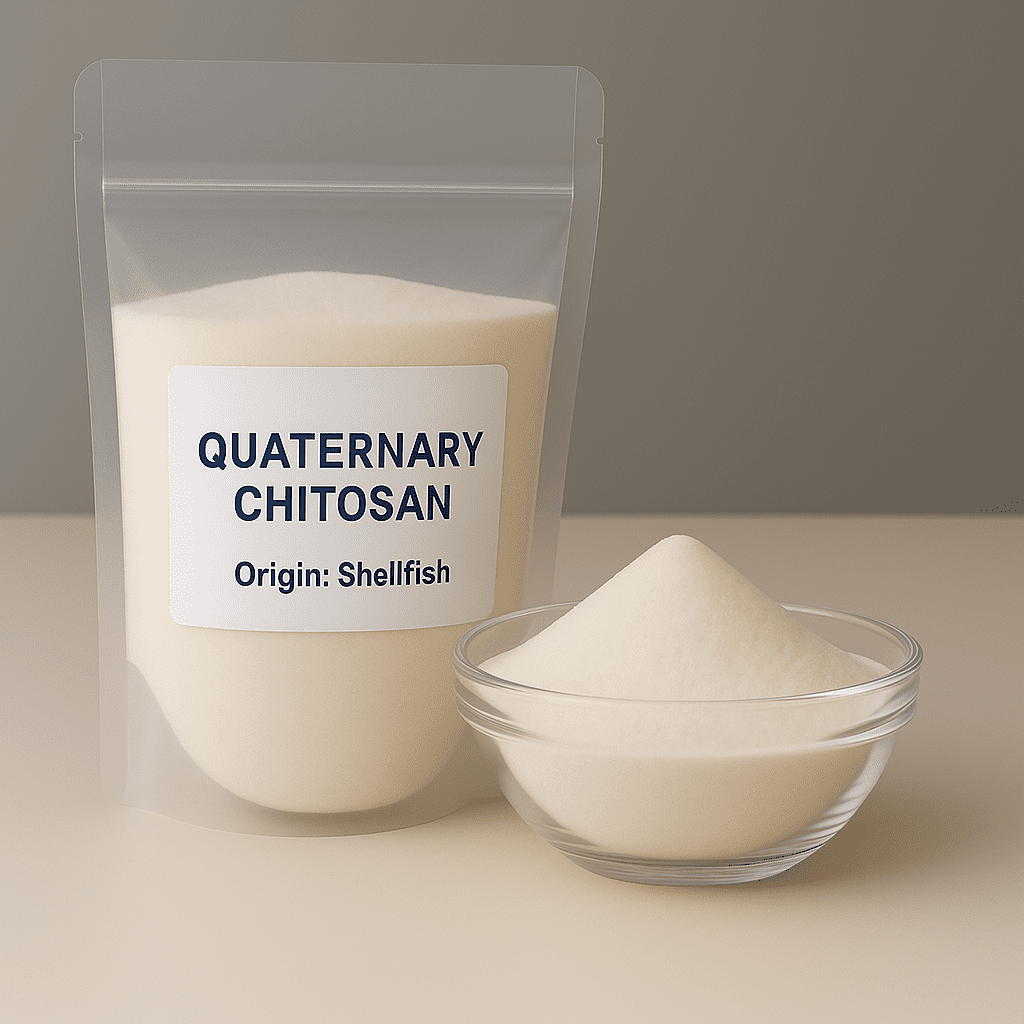


Description
Quaternary Chitosan — Shellfish Origin | Bulk Supplier
TMC / HTCC | CAS 101200-48-0 / 112879-37-5 | pH 1–14 Soluble | Permanent Cationic Charge | Pharma, Fiber & Industrial Grade
Quaternary Chitosan (Shellfish Origin) is an advanced permanently charged cationic biopolymer produced by quaternizing shellfish-derived chitosan through controlled chemical modification. Unlike standard chitosan which carries a pH-dependent charge and loses solubility above pH 6.5 quaternary chitosan (QCS) maintains full water solubility and permanent positive charge across the entire pH range from 1 to 14. This makes it the material of choice for pharmaceutical drug delivery systems, antimicrobial fiber manufacturing, textile finishing, cosmetic formulations, and industrial coatings where standard chitosan underperforms. Available in 25 g samples ($45) and 1 kg units ($205), with bulk industrial supply on request.
What Is Quaternary Chitosan? TMC vs HTCC vs HACC Explained
‘Quaternary chitosan’ is a family of chitosan derivatives produced by introducing a permanently positively charged quaternary ammonium group onto the chitosan backbone. The three main commercial forms are:
| Form | Chemical Name | Best Known For |
| TMC | N,N,N-Trimethyl Chitosan Chloride (CAS 101200-48-0) | Oral/nasal/mucosal drug delivery; tight junction opening |
| HTCC | N-(2-Hydroxypropyl)-3-trimethylammonium Chitosan Chloride (CAS 112879-37-5) | Nanoparticle drug carriers; gene delivery; wound care |
| HACC | 2-Hydroxypropyltrimethyl Ammonium Chloride Chitosan | Antimicrobial coatings; biomedical devices; textiles |
This product is shellfish-sourced quaternary chitosan supplied to pharmaceutical, textile, and industrial-grade specification. The exact quaternization form (TMC or HTCC) can be specified at time of order contact us for technical discussion.
Compare all chitosan types: Types of Chitosan — Full Range
The Chemistry: Why Quaternization Makes Chitosan Permanently Cationic
Standard chitosan carries amino groups (-NH₂) that become protonated (-NH₃⁺) only in acidic conditions (pH < 6.5). Above this threshold, the charge is lost and the polymer becomes insoluble — severely limiting its use in physiological, neutral, or alkaline systems.
Quaternization permanently replaces the primary amino groups with quaternary ammonium groups (-N⁺(CH₃)₃). Because the positive charge is permanent and not pH-dependent, the resulting QCS polymer:
- Remains fully water-soluble at any pH from 1 to 14
- Maintains strong cationic charge density regardless of formulation pH
- Delivers superior mucoadhesion by binding tightly to negatively charged mucosal surfaces
- Provides broad-spectrum antimicrobial activity at neutral and alkaline pH where standard chitosan is inactive
- Enables stable nanoparticle formation by electrostatic interaction with anionic polymers at any pH
The degree of substitution (DS%) the proportion of amino groups that have been quaternized is the critical quality parameter. Higher DS% means stronger charge density, better solubility, and more potent antimicrobial activity. Our product is supplied at controlled DS% per batch, confirmed by COA.
Technical Specifications
| Parameter | Specification |
| Product Name | Quaternary Chitosan (QCS / TMC / HTCC) |
| Source | Shellfish (Shrimp/Crab-derived chitosan) |
| Common Forms | TMC (CAS 101200-48-0) | HTCC (CAS 112879-37-5) |
| Appearance | Off-white to pale yellow powder |
| Solubility | Completely water-soluble across pH 1–14 |
| Charge Type | Permanently cationic (quaternary ammonium) |
| Degree of Substitution (DS%) | Controlled batch specified per COA |
| Degree of Deacetylation (DDA) | ≥ 85% (base chitosan before quaternization) |
| Molecular Weight | Variable low / medium / high MW available |
| pH Stability | Stable pH 1–14 (solubility maintained) |
| Antimicrobial Activity | Broad-spectrum: bacteria, fungi, some viruses |
| Film-Forming | Yes , forms coherent, flexible films |
| Mucoadhesion | High strong affinity to mucosal surfaces |
| Grade Available | Industrial | Pharmaceutical | Food Grade |
| Documentation | COA provided per batch; MSDS/SDS available |
Quaternary Chitosan vs Standard Chitosan vs Carboxymethyl Chitosan
| Property | Quaternary Chitosan (QCS) | Standard Chitosan | CMC |
| Water Solubility | pH 1–14 always soluble | Acid only (pH<6.5) | Wide pH (CMC, anionic) |
| Charge Type | Permanent cationic (+) at all pH | pH-dependent (+) | Permanent anionic (−) (CMC) |
| Antimicrobial | Strong at all pH including neutral & alkaline | Moderat only in acid | Weak (CMC) |
| Drug Permeation | Excellent — opens tight junctions | Limited | None |
| Mucoadhesion | Very high | Moderate | Moderate |
| Film Formation | Yes, flexible, oxygen-barrier | Yes | Yes |
| Preferred Uses | Drug delivery, fiber, antimicrobial coatings | Agriculture, food, water treatment | Cosmetics, wound care |
| pH Range for Use | Any universal formulation tool | pH < 6.5 only | pH 3–10 |
See Carboxymethyl Chitosan: Carboxymethyl Chitosan — Anionic Derivative
See Standard Chitosan: Chitosan — Base Polymer Overview
Core Applications — Where Quaternary Chitosan Delivers Decisive Performance
1. Pharmaceutical Drug Delivery Systems
Quaternary chitosan particularly TMC is one of the most extensively studied natural polymers for drug delivery. Its permanent positive charge enables three mechanisms critical to pharmaceutical performance:
- Tight Junction Opening: TMC temporarily opens the tight junctions between epithelial cells in nasal, oral, and intestinal mucosa, allowing macromolecular drugs (peptides, proteins, vaccines) to cross biological barriers that they would otherwise be unable to penetrate.
- Mucoadhesion: The permanent cationic charge creates strong electrostatic bonding with the negatively charged glycoproteins of mucosal membranes, prolonging residence time and improving drug absorption.
- Nanoparticle Formation: QCS forms stable nanoparticles (100–500 nm) by electrostatic complexation with anionic polymers like sodium tripolyphosphate (TPP). These nanoparticles encapsulate hydrophilic and hydrophobic drugs alike, providing controlled release profiles.
Documented pharmaceutical applications:
- Oral delivery of insulin, heparin, and GLP-1 peptide drugs
- Nasal vaccine delivery systems — TMC significantly improves mucosal immune response
- Ocular drug delivery — TMC eye drops improve corneal residence time
- Gene delivery — QCS/DNA complexes (polyplexes) for non-viral gene therapy
- Wound dressing matrices — HTCC nanofibers provide antimicrobial + tissue regeneration
TMC is referenced in hundreds of peer-reviewed pharmaceutical studies and is approved by the US FDA for use in food-contact and pharmaceutical excipient applications.
Related: Chitosan in Dietary Supplements — Nutraceutical Applications
2. Antimicrobial Fiber Manufacturing & Textile Finishing
Quaternary chitosan is widely used in antimicrobial fiber and textile applications because its permanent charge remains active after washing, dyeing, and high-temperature processing — unlike standard chitosan treatments which degrade in alkaline wash conditions.
Fiber applications:
- Core-sheath bicomponent fiber spinning — QCS forms the antimicrobial sheath layer around a structural fiber core
- Islands-in-the-sea fiber architecture — QCS provides distributed antimicrobial islands within a PET or PLA fiber matrix
- Surface padding and exhaust application to cotton, wool, nylon, and polyester
- Anti-odour sportswear and medical textile production
- Wound dressing nonwoven fabrics with sustained antimicrobial release
Critical advantage over standard chitosan in fiber manufacturing: QCS remains positively charged at the alkaline dyeing pH (pH 8–11), maintaining antimicrobial bonding with fiber substrates throughout processing. Standard chitosan loses charge and effectiveness at this pH.
Deep dive: Quaternary Chitosan in Bicomponent Fiber Manufacturing — Full Technical Guide
3. Cosmetics & Personal Care Formulations
In cosmetics, quaternary chitosan functions as a conditioning polymer, preservative booster, and antimicrobial active simultaneously. Its performance advantages over conventional cationic conditioners (polyquaternium series):
- Biodegradable — full environmental breakdown vs. persistent synthetic polyquaterniums
- Biocompatible — low cytotoxicity; suitable for sensitive skin and leave-on formulations
- Film-forming — creates a moisturising, flexible film on hair and skin
- Antimicrobial — reduces formula preservative load; supports eco/clean-label certification
Specific formulation uses:
- Shampoo and conditioner: cationic conditioning for hair smoothing, detangling, and frizz control
- Skincare serums and creams: antimicrobial active + humectant barrier function
- Hand sanitisers and surface sprays: broad-spectrum antimicrobial without alcohol
- Oral care (mouthwash, toothpaste): anti-plaque and anti-gingivitis activity
- Preservative booster in natural/organic certified formulations
Full cosmetics application guide: Chitosan in Cosmetics & Personal Care — Green Beauty Formulation
Personal care applications: Chitosan in Personal Care Products — Full Overview
4. Industrial Antimicrobial Coatings & Surface Modification
QCS provides durable, wash-resistant antimicrobial surface coatings for industrial substrates through electrostatic self-assembly. The permanently charged polymer adsorbs tightly to negatively charged surfaces glass, metal, plastics, ceramics forming a biocidal surface layer.
- Food packaging films and surfaces — reduces surface microbial counts; extends packaged food shelf life
- Medical device coatings — catheter and implant surfaces; reduces hospital-acquired infections (HAIs)
- Paper and cardboard coatings — antimicrobial food-contact packaging
- Membrane modification for water treatment — QCS-coated filtration membranes with anti-fouling properties
- Agricultural seed coatings — QCS protective layer reduces seedling pathogen load
Water treatment applications: Sustainable Water Treatment with Chitosan — Applications
5. Agricultural Crop Protection
In agriculture, the permanent cationic charge of QCS delivers advantages over standard chitosan for foliar and soil applications:
- Foliar spray retention — QCS adheres to the negatively charged waxy cuticle of leaves at any spray pH, improving coverage and persistence versus rain washoff
- Antifungal soil drench — inhibits Fusarium, Pythium, and Botrytis species in rhizosphere at neutral soil pH
- Seed coating — thin QCS film provides germination-phase protection from fungal and bacterial soil pathogens
- Post-harvest fruit coating — antimicrobial barrier at neutral-to-alkaline fruit surface pH
Full agriculture guide: Chitosan in Agriculture — Benefits, Functions and Dosages
Recommended Dosage Guide by Application
| Application | Recommended Use Level | Delivery Method |
| Pharmaceutical — nasal/oral drug delivery | 0.1–2.0% w/v in aqueous formulation | Solution or nanoparticle suspension |
| Pharmaceutical — nanoparticle formation | 0.05–0.5% QCS + ionic crosslinker (TPP) | Ionic gelation; spray drying |
| Fiber manufacturing — surface padding | 0.5–3.0% w/v bath concentration | Exhaust or padding process |
| Textile finishing — antimicrobial | 1.0–5.0% w/v; pH 5–7 | Immersion or spray finish |
| Cosmetics — shampoo/conditioner | 0.1–1.0% w/w in formulation | Direct incorporation |
| Cosmetics — skincare / film-forming | 0.2–0.8% w/w | Homogeneous dispersion |
| Industrial antimicrobial coating | 0.5–2.0% w/v solution | Dip, spray, or spin-coat |
| Agricultural foliar spray | 0.05–0.5% w/v; pH 5.5–7.0 | Dilute in water; spray to runoff |
| Seed coating | 0.5–2.0% solution; allow to dry | Drum coating or spray application |
Dosage recommendations are starting points for formulation development. Optimal concentrations depend on molecular weight, degree of substitution, substrate properties, target organism, and processing conditions. Technical support available from our team.
Shellfish Source — Quality, Provenance & Allergen Considerations
Our Quaternary Chitosan is derived from shellfish chitin — primarily shrimp and crab shells sourced from commercial seafood processing facilities. This provides:
- High molecular weight base chitosan — shrimp/crab chitin delivers consistently high MW raw material, important for controlled quaternization
- Established supply chain — shellfish chitin is the most commercially mature and characterised chitin source globally
- Strong batch-to-batch consistency — well-understood raw material enables tight control of DS%, DDA, and MW parameters
Allergen note: Shellfish-derived chitosan contains residual shellfish proteins at trace levels. This product is not suitable for formulations claiming shellfish-free or crustacean allergen-free status. For allergen-free applications, see our mushroom-origin or insect-origin alternatives.
Shellfish-free alternative: Quaternary Chitosan — Mushroom Origin (Vegan / Allergen-Free)
All source options: Shellfish-Origin Chitosan — Shrimp, Crab & Lobster
Pricing, Packaging & Shipping
| Pack Size | Price (USD) | Grade Available | Shipping (USA) |
| 25 g | $45.00 | All grades | Free shipping (USA) |
| 1 kg | $205.00 | All grades | 15% tariff + $125 FedEx |
| > 1 kg | Contact for quote | All grades | Custom quote required |
For bulk industrial orders above 1 kg, or for orders outside the USA, contact steve@chitosanglobal.com for a custom shipping and pricing quote. Lead time 2–12 weeks for most bulk orders.
View full wholesale pricing: Chitosan Global Wholesale Pricing Page
Why Source Quaternary Chitosan from Chitosan Global?
- CAS-referenced, documented material: TMC (101200-48-0) and HTCC (112879-37-5) — traceable and procurement-ready
- COA provided per batch — DS%, DDA, MW, and purity confirmed
- Multiple grades: industrial, pharmaceutical, and food grade available
- Reliable shellfish supply chain with consistent raw material quality
- Samples from 25 g for formulation development before bulk commitment
- Expert technical support: Steve Nice, +1 423-202-6145
- Global shipping: export-ready documentation for all major markets
Our supply chain: Responsible Supply Chain & Sustainability Policy
Frequently Asked Questions
What is quaternary chitosan used for?
Quaternary chitosan (QCS) is used in pharmaceutical drug delivery systems (oral, nasal, transdermal, gene delivery), antimicrobial fiber and textile manufacturing, cosmetic conditioning and preservative systems, industrial surface coatings, agricultural crop protection, and wound care materials. Its defining advantage over standard chitosan is full water solubility and permanent cationic activity across pH 1–14.
What are the CAS numbers for quaternary chitosan?
The two main commercial forms are N,N,N-Trimethyl Chitosan (TMC) with CAS 101200-48-0, and N-(2-Hydroxypropyl)-3-trimethylammonium Chitosan Chloride (HTCC) with CAS 112879-37-5. Always request the specific CAS number from your supplier to confirm the quaternization form being supplied.
What is the degree of substitution (DS%) and why does it matter?
Degree of substitution (DS%) refers to the percentage of chitosan amino groups that have been successfully quaternized. Higher DS% means stronger permanent charge density, better water solubility across all pH values, and greater antimicrobial potency. Typical commercial DS% ranges from 30–90%, with pharmaceutical applications generally requiring higher DS% (≥60%) for effective tight junction opening and drug permeation. DS% is confirmed per batch in the Certificate of Analysis.
Is quaternary chitosan soluble in water at neutral pH?
Yes, this is its primary advantage over standard chitosan. Quaternary chitosan maintains complete water solubility across the entire pH range from 1 to 14, including neutral (pH 7.0) and alkaline conditions. Standard chitosan requires pH below 6.5 for solubility and loses effectiveness at physiological and textile processing pH levels.
What is the difference between TMC and HTCC?
Both TMC and HTCC are permanently charged quaternary chitosan forms. TMC (N,N,N-Trimethyl Chitosan) is the classical, most-studied form, widely used in mucosal drug delivery for its tight-junction-opening properties. HTCC (N-(2-Hydroxypropyl)-3-trimethylammonium Chitosan Chloride) has a slightly different quaternization structure that improves nanoparticle formation efficiency and is preferred for gene delivery and nanocarrier applications. For most antimicrobial and fiber applications, both perform comparably.
Is quaternary chitosan shellfish allergen-relevant?
Yes. This product is derived from shellfish chitin and may contain trace shellfish proteins. It is not suitable for applications where crustacean allergen-free claims are required. For allergen-free formulations (vegan, shellfish-free, clean-label), see our mushroom-origin quaternary chitosan.
Can it replace synthetic quaternary polymers like polyquaternium-10?
In many cosmetic and textile applications, QCS provides comparable or superior conditioning and antimicrobial performance to synthetic polyquaterniums, with the significant advantage of full biodegradability. It is increasingly used as a sustainable alternative in formulations targeting eco-certification (COSMOS, ECOCERT, NATRUE). Application-specific performance testing is recommended before full reformulation.
What documentation is provided?
Each batch ships with a Certificate of Analysis (COA) confirming DS%, DDA, molecular weight, solubility, appearance, and heavy metal compliance. MSDS and TDS are available on request. COA download available on the product page.
What is the minimum order quantity?
Minimum order is a 25 g sample at $45 with free USA shipping ideal for formulation screening and compatibility testing. Standard 1 kg units are $205 (plus 15% tariff and $125 FedEx for USA delivery). Bulk industrial quantities above 1 kg are quoted separately.
Related Products & Resources
→ Quaternary Chitosan — Full Grade Overview (All Sources)
→ Carboxymethyl Chitosan — Anionic Derivative for Cosmetics & Wound Care
→ Chitosan Hydrochloride — Water-Soluble Cationic Chitosan
→ Chitosan Oligosaccharide (COS) — Low MW Derivatives Overview
→ Shellfish-Origin Chitosan — Shrimp, Crab & Lobster Source
→ Quaternary Chitosan in Fiber Manufacturing — Bicomponent Process Guide
→ Chitosan in Cosmetics — Green Beauty Applications
→ Chitosan in Agriculture — Crop Protection & Yield Benefits
Order Now or Request a Bulk Quote
Select your package size above to add to cart, or contact us directly for bulk orders, grade specification, degree of substitution requirements, or custom formulation support.
Email: steve@chitosanglobal.com
Phone: +1 423-202-6145
Contact Us for Custom Pricing |

Reviews
There are no reviews yet.