


Description
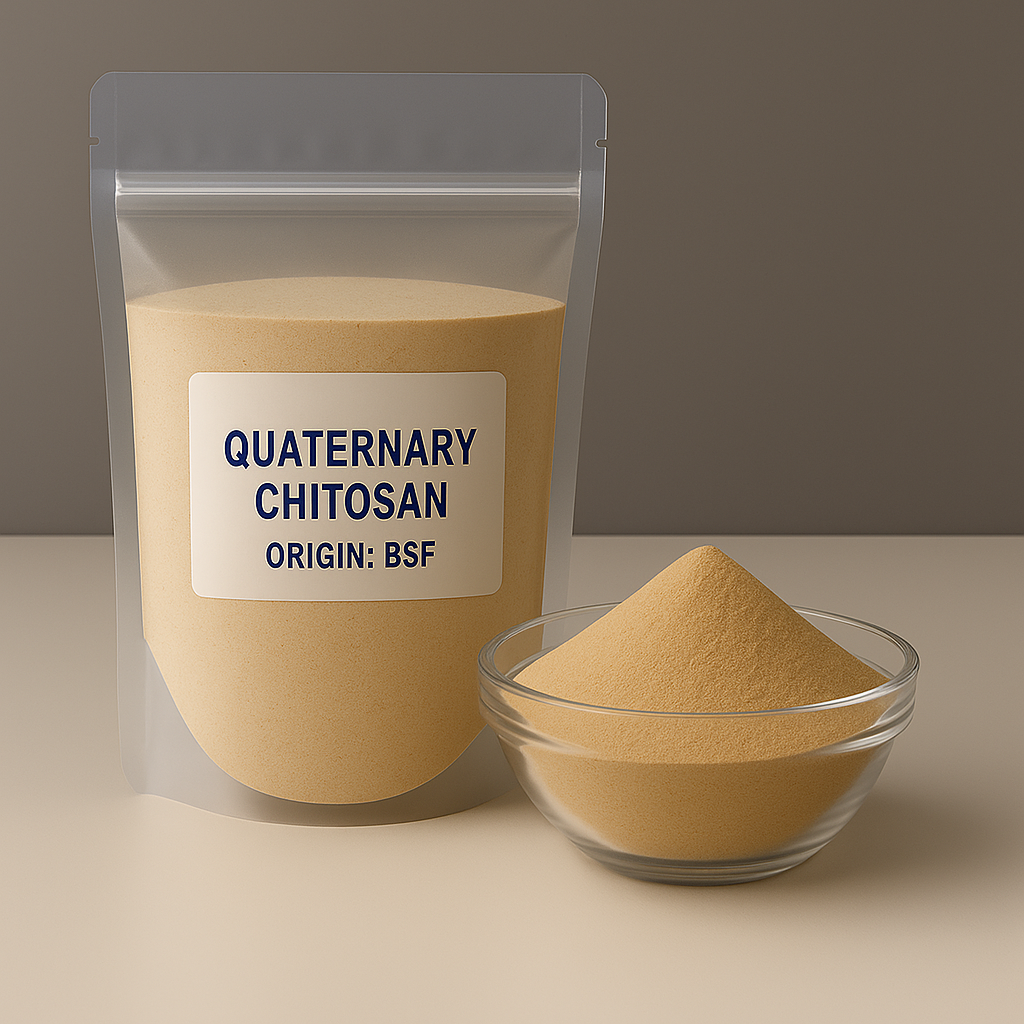
Quaternary Chitosan Black Soldier Fly (HTCC) — Permanently Charged Bulk Supplier
Quaternary Chitosan from Black Soldier Fly (HTCC) is a next-generation, permanently cationic biopolymer derived from the chitin of Black Soldier Fly (BSF) larvae one of the most sustainable and traceable insect-based chitin sources available. Unlike standard chitosan, which requires acidic pH to carry a positive charge, quaternary chitosan black soldier fly (HTCC) is permanently, irreversibly charged at ALL pH levels acidic, neutral, and alkaline making it the highest-performance chitosan derivative for antimicrobial coatings, cosmetics, pharmaceutical drug delivery, and antimicrobial fibre manufacturing.
- Focus keyword: Quaternary Chitosan Black Soldier Fly (HTCC) — insect-sourced, permanently charged
- 100% water-soluble at all pH levels — no acidification required
- Antimicrobial efficacy >90% | MIC < 50 µg/mL against broad-spectrum pathogens
- DDA > 90% | Moisture retention up to 400% | Biodegrades in 21–28 days (compost conditions)
- Shellfish-free, allergen-safe, cruelty-conscious insect origin
- INCI name: Hydroxypropyltrimonium Chitosan — cosmetic-grade compliant
- COA supplied | Bulk 25g → 1 tonne | Free 25g sample shipping
Explore the full range of quaternary chitosan products and applications and compare with all chitosan types and derivatives.
What Is Quaternary Chitosan Black Soldier Fly (HTCC)?
Quaternary chitosan also known as HTCC (N-(2-hydroxypropyl)-3-trimethylammonium chitosan chloride) is produced by reacting chitosan with glycidyltrimethylammonium chloride (GTMAC) to introduce permanent quaternary ammonium groups (–N⁺(CH₃)₃) onto the chitosan backbone. The BSF source material is Black Soldier Fly (Hermetia illucens) larvae and puparia, from which chitin is extracted and converted to chitosan before quaternization.
The defining feature of quaternary chitosan black soldier fly is the permanent positive charge introduced by quaternization. This is fundamentally different from standard chitosan’s pH-dependent cationic character:
- Standard chitosan: cationic only at pH < 6 (protonated amino groups). At neutral or alkaline pH, it loses charge and becomes essentially insoluble and inactive.
- Quaternary chitosan (HTCC): permanently cationic at ALL pH levels due to fixed quaternary ammonium groups. Full antimicrobial activity and solubility regardless of environmental pH.
This permanent charge is the reason quaternary chitosan black soldier fly outperforms all other chitosan derivatives in applications where neutral or alkaline pH environments are unavoidable including pharmaceutical mucosal drug delivery, personal care formulations, and industrial antimicrobial coatings.
See our detailed comparison: Carboxymethyl Chitosan vs Quaternary Chitosan in Personal Care.
Why Black Soldier Fly (BSF) as the Source for Quaternary Chitosan?
The Black Soldier Fly (BSF) insect origin is not simply a marketing choice it represents a fundamental improvement in chitin supply chain quality, sustainability, and traceability over shellfish or mushroom sources for high-performance derivatives like HTCC:
- Controlled, standardised feedstock: BSF larvae are reared on consistent organic waste streams (food processing by-products), ensuring the same chitin quality batch after batch unlike shellfish processing, where shell composition varies by season, geography, and species mix.
- Shellfish-free and allergen-safe: No crustacean-derived material means no shellfish allergen risk critical for cosmetic, pharmaceutical, and nutraceutical applications where shellfish labelling is a compliance or marketing barrier.
- Traceable circular economy: Every batch of BSF quaternary chitosan is traceable to a specific rearing facility and production run, with full chain-of-custody documentation.
- Lowest environmental footprint: BSF larvae upcycle organic waste into high-value chitin, producing minimal greenhouse gas compared to marine harvesting or conventional agriculture. The BSFL industry is projected to grow at 40.4% CAGR through 2033 (Waste and Biomass Valorization, 2025).
- Consistent DDA and MW: BSF-derived chitosan shows excellent batch-to-batch consistency in degree of deacetylation and molecular weight the foundation of reproducible quaternization chemistry.
Compare all available sources: Vegetal (Mushroom) Origin | Shellfish Origin | Insect (BSF) Origin.
Technical Specifications — Quaternary Chitosan BSF (HTCC)
| Parameter | Specification |
| Product Name | Quaternary Chitosan Black Soldier Fly (HTCC) |
| Chemical Name | N-(2-Hydroxypropyl)-3-trimethylammonium chitosan chloride |
| Common Abbreviation | HTCC / QC-BSF |
| INCI Name (Cosmetic) | Hydroxypropyltrimonium Chitosan |
| Source | Black Soldier Fly (Hermetia illucens) larvae/puparia |
| Appearance | Light tan to beige free-flowing powder |
| Molecular Weight | 200 – 500 kDa |
| Degree of Deacetylation (DDA) | ≥ 90.0% |
| Degree of Quaternization (DQ) | Available in multiple DQ ranges — specify on order |
| Charge Type | Permanently cationic at ALL pH levels |
| Solubility | 100% water-soluble — neutral, acidic, and alkaline pH |
| Antimicrobial Efficacy | > 90% (MIC < 50 µg/mL — broad-spectrum) |
| Moisture Retention | Up to 400% (w/w) |
| Biodegradability | 21 – 28 days (industrial composting conditions) |
| pH Stability (1% solution) | 5.5 – 7.5 |
| Allergen Status | Shellfish-free | Insect-derived — declare on label |
| Grade | Industrial | Pharmaceutical | Cosmetic |
| COA Available | Yes — batch-specific on every order |
| Storage | Cool (<25°C), dry, sealed — away from light and humidity |
| Shelf Life | 24 months from manufacture |
Degree of Quaternization (DQ) is available in customised ranges for orders of 1 kg+. Higher DQ = stronger antimicrobial activity and improved solubility. Contact steve@chitosanglobal.com with your application requirements.
How Quaternary Chitosan (HTCC) Works: The Permanent Charge Advantage
Mechanism of Antimicrobial Action
The quaternary ammonium group (–N⁺(CH₃)₃) on HTCC carries a fixed positive charge that does not depend on pH. When quaternary chitosan black soldier fly contacts a microbial cell, this permanent cationic charge binds electrostatically to the negatively charged bacterial or fungal cell membrane, causing membrane depolarisation, disruption of the proton gradient, leakage of cytoplasmic contents, and ultimately cell death.
Studies confirm that HTCC with a higher degree of quaternization shows improved antibacterial action against both E. coli (Gram-negative) and S. epidermis (Gram-positive). HTCC has also demonstrated significant antiviral inhibition against SARS-CoV-2 at non-cytotoxic concentrations (6 mg/mL), operating through cationic charge-mediated interaction with viral envelope proteins (Journal of Functional Biomaterials, 2026).
Why Permanent Charge Beats pH-Dependent Chitosan
| Property | Quaternary Chitosan BSF (HTCC) | Standard Chitosan | Chitosan Hydrochloride |
| Positive Charge at Neutral pH | Yes, permanent quaternary N⁺ | No, protonated only at pH < 6 | Partial salt dissociates at pH > 6 |
| Positive Charge at Alkaline pH | Yes, permanent regardless of pH | No, neutral/insoluble | No, loses charge |
| Water Solubility | 100% at all pH | Requires pH < 6 acid | Good but pH-limited |
| Antimicrobial at pH 7–8 | Full activity permanent charge | None, uncharged | Reduced activity |
| Cosmetic Formulation pH | Works in pH 5–8 serums/creams | Cannot be used at neutral pH | Limited to acidic formulations |
| Drug Delivery (mucosal pH) | Excellent mucosa pH 6–8 | Not effective | Limited |
| Fibre Manufacturing | Ideal — retains charge after spinning | Loses charge in alkaline spin bath | Not recommended |
| BSF Source Available | Yes, Chitosan Global | Yes, Chitosan Global | Yes, Chitosan Global |
Key Performance Benefits of Quaternary Chitosan Black Soldier Fly
1. Broad-Spectrum Antimicrobial at All pH Levels
The permanent positive charge of HTCC makes quaternary chitosan black soldier fly the most consistently antimicrobial chitosan derivative across the full industrial and biological pH range. It inhibits Gram-positive bacteria (S. aureus, B. subtilis), Gram-negative bacteria (E. coli, P. aeruginosa), fungi (C. albicans), and has demonstrated antiviral activity without requiring acid pre-treatment or pH adjustment.
2. Superior Cosmetic Performance — INCI Registered
With the INCI name Hydroxypropyltrimonium Chitosan, quaternary chitosan black soldier fly is the preferred form of chitosan in high-performance personal care formulations. Explore quaternary chitosan in cosmetics and personal care.
- Hair conditioning: Quaternary ammonium groups bond with anionic keratin fibres in hair, reducing static, improving combing ease, and leaving a conditioning film confirmed in multiple patent records (Henkel AG, 1980s; recent cosmetic patent literature)
- Skincare moisture retention: Retains up to 400% moisture superior to hyaluronic acid at equivalent concentrations in film-forming models
- Antimicrobial preservation: HTCC in cosmetics reduces or eliminates the need for synthetic preservatives (parabens, phenoxyethanol) a key claim for ‘clean beauty’ formulations
- Film-forming skin barrier: Forms breathable, antimicrobial barrier film on skin that supports wound healing, reduces transepidermal water loss (TEWL), and inhibits surface pathogen colonisation
3. Pharmaceutical Drug & Vaccine Delivery
Quaternary chitosan black soldier fly (HTCC) is one of the most studied biopolymers for pharmaceutical mucosal and systemic drug delivery:
- Nasal and pulmonary drug delivery: Permanent positive charge and mucoadhesivity enable tight binding to negatively charged mucus glycoproteins, greatly extending drug residence time and improving bioavailability at mucosal surfaces
- Oral drug delivery: HTCC’s water solubility at intestinal pH (6–8) makes it superior to standard chitosan for oral controlled-release matrices that must survive gastric acid and then deliver at neutral pH
- Vaccine adjuvant: QC acts as an efficient vaccine adjuvant to adsorb antigens via hydrogen bonding from unoccupied amino groups enhancing immune response in mucosal vaccination systems
- Gene delivery: HTCC forms stable polyelectrolyte complexes with negatively charged siRNA and plasmid DNA for non-viral gene delivery an active area of cancer therapy and genetic medicine research
4. Antimicrobial Fibre and Textile Manufacturing
Quaternary chitosan black soldier fly is the derivative of choice for incorporating permanent antimicrobial functionality into fibres. See the full guide: How to incorporate quaternary chitosan into bi-component fibre manufacturing.
- Core-sheath bi-component fibres: HTCC in the sheath component provides durable surface antimicrobial activity that survives washing and dry-cleaning used in medical textiles, sportswear, hygiene products
- Cotton finishing: HTCC-treated cotton shows almost 100% bacterial reduction even at low concentrations (Kim et al., PMC review) suitable for Oeko-Tex and GOTS-compliant antimicrobial fabric production
- Synthetic fibre blending: Compatible with PLA, polyester, and nylon in alkaline spin baths where standard chitosan would precipitate and lose function
- Non-woven antimicrobial materials: Used in medical masks, surgical drapes, and wound dressings where sustained antimicrobial activity is required
5. Biodegradable Active Packaging
Quaternary chitosan black soldier fly is used as a functional antimicrobial film-forming agent in sustainable food and pharmaceutical packaging. Learn about chitosan in bioplastics and PLA packaging.
- HTCC-blended films provide permanent antimicrobial protection of packaged food without synthetic additives
- Compatible with PLA, starch, and cellulose-based biodegradable packaging substrates
- Biodegrades in 21–28 days under industrial composting conditions confirmed zero-waste profile
Recommended Application Concentrations — Quaternary Chitosan BSF
| Application | Recommended Concentration / Protocol |
| Hair conditioning (shampoo/conditioner) | 0.5–2.0% w/w in final formulation |
| Skin moisturiser / serum | 0.5–1.5% w/w |
| Antimicrobial wound dressing coating | 1.0–3.0% w/v aqueous solution; spray or dip |
| Oral drug delivery matrix | 1.0–5.0% w/w — adjust by release target and MW |
| Nasal / mucosal spray | 0.1–0.5% w/v — viscosity-adjusted for spray device |
| Vaccine adjuvant formulation | 0.05–0.5% w/v — application-specific; consult formulator |
| Textile antimicrobial finishing (pad-dry-cure) | 1.0–4.0% w/v at pH 5–6 |
| Active food packaging film | 2.0–5.0% w/v casting solution |
| Industrial antimicrobial coating | 1.0–3.0% w/v — brush, spray, or dip application |
| Water treatment (antimicrobial+flocculant) | 5–50 mg/L depending on microbial load |
Optimal concentration depends on molecular weight, degree of quaternization, substrate type, and performance target. Contact steve@chitosanglobal.com for application-specific formulation support.
Pricing, Ordering, and Bulk Supply — Quaternary Chitosan Black Soldier Fly
| Quantity | Price (USD) | Shipping |
| 25g Sample | $62.25 | Free shipping worldwide |
| 1 kg | $175.00 / kg | 15% tariff + $60 FedEx shipping |
| 100 kg – 500 kg | $160.00 / kg | Custom freight — contact for quote |
| 500 kg – 1 ton | $145.00 / kg | Custom freight — contact for quote |
| Custom volume / contract | Contact for pricing | Global logistics, FOB / CIF options |
- Batch-specific COA on every order
- MSDS and TDS available on request
- Custom DQ specification available for 1 kg+ orders
- OEM and white-label supply supported
- Global shipping: USA, EU, UK, India, Asia, Middle East, Latin America
View full wholesale pricing and volume tiers | Email: steve@chitosanglobal.com | Tel: +1 423-202-6145
Why Source Quaternary Chitosan Black Soldier Fly from Chitosan Global?
- Direct BSF sourcing: We supply quaternary chitosan black soldier fly direct from FDA-registered, BSF-specialist production facilities not via spot-market brokers
- Batch COA guaranteed: Every order ships with a batch-specific Certificate of Analysis confirming DDA, DQ, MW range, solubility, and antimicrobial performance
- Custom DQ specification: Need a specific degree of quaternization for your pharmaceutical, cosmetic, or fibre application? We work directly with the production facility to deliver it
- Application expertise: Free technical consultation with purchase our team has deep experience in HTCC formulation for cosmetics, pharma, and fibre manufacturing
- Transparent pricing: All tariffs and freight costs itemised no surprise charges at checkout. Bulk pricing locked in for long-term supply agreements
- Traceability: Full chain-of-custody from BSF rearing facility to your lab COA includes batch number, production date, and raw material traceability code
Learn about our responsible supply chain, ESG strategy, and environmental health & safety commitments.
Frequently Asked Questions — Quaternary Chitosan Black Soldier Fly (HTCC)
What is quaternary chitosan black soldier fly (HTCC)?
Quaternary chitosan black soldier fly (HTCC) is N-(2-hydroxypropyl)-3-trimethylammonium chitosan chloride derived from the chitin of Black Soldier Fly (Hermetia illucens) larvae. The quaternization reaction introduces permanent quaternary ammonium groups onto the chitosan backbone, giving it a fixed positive charge at ALL pH levels unlike standard chitosan which is cationic only in acidic conditions. This makes it the most consistently antimicrobial and water-soluble chitosan derivative available.
What does HTCC stand for?
HTCC stands for N-(2-Hydroxypropyl)-3-Trimethylammonium Chitosan Chloride the full chemical name for quaternary chitosan. It is also listed under the INCI name ‘Hydroxypropyltrimonium Chitosan’ for use in cosmetic ingredient declarations.
Why is ‘permanently charged’ important for quaternary chitosan?
Standard chitosan is cationic (positively charged) only below pH 6, because its amino groups are protonated by acid. At neutral or alkaline pH, it becomes uncharged, insoluble, and loses antimicrobial activity. Quaternary chitosan HTCC has fixed quaternary ammonium groups that carry a permanent positive charge regardless of pH ensuring full solubility and antimicrobial activity in neutral cosmetic formulations, mucosal drug delivery at intestinal pH, and industrial coatings in alkaline environments.
What is the CAS number for quaternary chitosan / HTCC?
The most commonly cited CAS number for HTCC (N-(2-hydroxypropyl)-3-trimethylammonium chitosan chloride) is 91036-75-8. This is the registered identifier for the quaternary ammonium-modified chitosan salt. Additional related CAS entries exist for different DQ ranges. Always confirm the specific CAS number on the COA provided with your order.
What is the INCI name of quaternary chitosan for cosmetic products?
The INCI (International Nomenclature of Cosmetic Ingredients) name is Hydroxypropyltrimonium Chitosan. This name should appear on your cosmetic product INCI ingredient list when BSF quaternary chitosan is used in personal care formulations in the EU, US, or internationally.
What is the degree of quaternization (DQ) and why does it matter?
The Degree of Quaternization (DQ%) is the percentage of amino groups on the chitosan backbone that have been converted to quaternary ammonium groups. Higher DQ means a stronger permanent positive charge, better water solubility across the full pH range, and stronger antimicrobial activity. Lower DQ retains more free amino groups, making it suitable for applications that need hydrogen-bonding activity (such as vaccine adjuvant formulations). We offer custom DQ ranges for orders of 1 kg and above.
How does BSF quaternary chitosan compare to shellfish-derived HTCC?
Both sources produce HTCC with equivalent functional performance when DDA and DQ are matched. The key advantages of BSF over shellfish are: (1) shellfish-free no allergen risk; (2) controlled, consistent feedstock more predictable batch-to-batch quality; (3) lower environmental impact circular economy sourcing; and (4) full traceability from rearing facility to COA. For high-purity pharmaceutical and cosmetic applications, BSF is increasingly preferred precisely because of supply chain control.
Is quaternary chitosan black soldier fly safe for use in cosmetics?
Yes. HTCC (Hydroxypropyltrimonium Chitosan) is widely used in personal care products globally. It is non-toxic, biocompatible, and biodegradable. It is REACH-compliant and suitable for use in EU and US cosmetic formulations. As with all insect-derived ingredients, appropriate labelling (insect-derived) is recommended. No specific safety restrictions apply under EU Cosmetic Regulation (EC) 1223/2009 for chitosan derivatives at standard cosmetic use concentrations.
Can quaternary chitosan replace synthetic preservatives in cosmetics?
HTCC has shown strong antimicrobial efficacy against common cosmetic pathogens (S. aureus, P. aeruginosa, C. albicans, E. coli) at low concentrations (MIC < 50 µg/mL). In combination with other mild preservatives or as a primary preservative in low-challenge formulations, HTCC can support reduced reliance on synthetic preservatives appealing to ‘clean beauty’ formulations. Full challenge testing (ISO 11930) is required before any preservative system claim.
What fibre manufacturing processes is HTCC suitable for?
Quaternary chitosan black soldier fly is suitable for core-sheath, side-by-side, and islands-in-the-sea bi-component fibre manufacturing processes. Because HTCC retains its charge in alkaline spin baths (standard for PLA and polyester processing), it can be incorporated into the sheath or island component to deliver permanent surface antimicrobial functionality. For detailed process guidance, see: How to incorporate quaternary chitosan into bi-component fibre manufacturing.
What is the shelf life and how should HTCC be stored?
Shelf life is 24 months from the manufacture date when stored in a sealed, moisture-resistant container in a cool (below 25°C), dry, well-ventilated area away from direct light and heat. HTCC is hygroscopic — reseal immediately after use and avoid storing in humid environments.
Can I request a sample before bulk ordering?
Yes. A 25g sample is available at $62.25 with free worldwide shipping. This allows you to test HTCC in your formulation, fibre process, or application before committing to a bulk purchase. Contact steve@chitosanglobal.com to place a sample order.
Are COA, MSDS, and TDS available?
Yes. A batch-specific Certificate of Analysis (COA) is provided with every order, verifying DDA, DQ range, MW, solubility, antimicrobial efficacy, moisture content, and appearance. MSDS (Material Safety Data Sheet) and TDS (Technical Data Sheet) are available on request for every order.
Related Products and Resources
- Quaternary Chitosan Hub Page — Full overview of HTCC chemistry, properties, and all applications
- Black Soldier Fly (BSF) / Soldier Fly Chitosan — Full BSF insect origin story and product range
- Insect Origin Chitosan — Overview of insect-derived chitin and chitosan sustainability profile
- Bi-Component Fibre Manufacturing with Quaternary Chitosan — Full process guide for antimicrobial fibre production
- CMCS vs Quaternary Chitosan in Personal Care — Formulator’s guide to choosing the right derivative
- Chitosan in Personal Care Products — Full guide to chitosan in cosmetics and skincare
- Chitosan in Cosmetics — Application overview for beauty formulations
- Carboxymethyl Chitosan (CMCS) — Amphoteric derivative for edible coatings and pharmaceutical use
- Chitosan Oligosaccharide (COS) — Low MW derivative for agriculture and dietary supplement applications
- Types of Chitosan — Full Range — Compare all derivatives and grades
- Wholesale Pricing — Volume discounts and bulk supply terms
- Frequently Asked Questions — General chitosan product questions
Reviews
There are no reviews yet.