 Chitosan Oligosaccharide-Hydrochloride – The Premier Agricultural Biostimulant
A Science-Based Comparative Assessment
Publication Date: March 2026 | Authors: Chitosan Global Research Team | White Paper ID: CG-WP-2026-03
Executive Summary
The global agricultural sector faces an unprecedented convergence of challenges: a growing population demanding higher yields, stringent regulatory mandates to reduce synthetic chemical inputs (such as the EU Farm-to-Fork Strategy), and the accelerating impacts of climate change. In this critical context,
Chitosan Oligosaccharide-Hydrochloride (COS-HCl) emerges as a pivotal biostimulant technology. This white paper presents a comparative assessment positioning
Mushroom-Derived (from
Lenzites, Agaricus, Pleurotus) and
Black Soldier Fly (BSF) Insect-Derived (from
Hermetia illucens) chitosan as the dual premier solutions for modern sustainable agriculture.
Our analysis demonstrates that both sources, when processed via a proprietary
green enzymatic process, achieve identical, superior molecular specifications: a
Degree of Deacetylation (DDA) >98%, a precision
Molecular Weight (MW) of 2–3 kDa, and a potent
Zeta Potential of +70 mV. These specific parameters are critical for activating Pattern-Triggered Immunity (PTI) via the CERK1 receptor and for direct electrostatic disruption of pathogen membranes.
Unlike conventional crustacean-derived chitosan—plagued by allergen risks, heavy metal contamination, and variable molecular weights—or expensive “nano-chitosan” formulations, Chitosan Global’s mushroom and insect-derived products offer a naturally superior, consistent, and sustainable alternative. By valorizing agricultural and insect protein waste streams into high-value biopolymers, these solutions not only enhance crop resilience and yield but also close the loop in the circular bioeconomy.
Abstract
Sustainable agriculture requires innovations that simultaneously enhance productivity and reduce environmental impact. This white paper introduces
Chitosan Oligosaccharide-Hydrochloride (COS-HCl) derived from two sustainable, non-marine sources: edible mushrooms and the Black Soldier Fly (BSF). We establish that the bioactivity of chitosan is strictly governed by three structural determinants: Degree of Deacetylation (DDA), Molecular Weight (MW), and Zeta Potential. Through the application of a proprietary green enzymatic process, both mushroom and BSF sources yield a COS-HCl product with a DDA >98%, a native MW of 2–3 kDa, and a surface charge of +70 mV.
Comparative analysis reveals that these specifications significantly outperform traditional crustacean-derived chitosan (typically 75–85% DDA, 100–400 kDa) and engineered nano-chitosan in both antimicrobial efficacy and plant immunity elicitation. The dual mechanism of action—direct electrostatic lysis of pathogenic cell membranes and systemic activation of plant defense pathways (MAPK cascade, ROS burst)—provides broad-spectrum protection against fungi, bacteria, and viruses. Furthermore, the absence of shellfish allergens and heavy metals renders these products safer for workers and consumers. This paper synthesizes data from 2024–2026 peer-reviewed literature to validate Mushroom and Insect-Derived COS-HCl as the new gold standard in agricultural biostimulants.
1. Introduction
Agriculture stands at a crossroads. The dual imperatives of feeding a population projected to reach 10 billion by 2050 while restoring degraded ecosystems require a fundamental shift in crop protection and nutrition strategies. Conventional agrochemicals, while historically effective, are increasingly restricted due to pathogen resistance, soil toxicity, and consumer health concerns. Initiatives such as the European Union’s Green Deal and Farm-to-Fork Strategy aim to reduce pesticide use by 50% by 2030, creating an urgent market vacuum that effective biostimulants must fill. Consequently, the global biostimulant market is projected to grow at a CAGR of 12.3% from 2024 to 2030.
Among biostimulants, chitosan—a deacetylated derivative of chitin—has long been recognized for its potential. However, its adoption has been hindered by inconsistency. Traditional commercial chitosan, derived largely from shrimp and crab shell waste, suffers from high molecular weight variability, low solubility at neutral pH, and contamination risks. Furthermore, “nano-chitosan” products, engineered to overcome these limitations, often carry prohibitive costs and regulatory hurdles associated with nanomaterials.
This white paper posits a paradigm shift: the sourcing of Chitosan Oligosaccharide-Hydrochloride (COS-HCl) from
fungal mycelium (Mushroom) and
insect cuticles (Black Soldier Fly). Unlike marine sources, these terrestrial origins allow for controlled, clean production environments. When combined with advanced enzymatic processing, they yield a polymer that naturally occupies the “Goldilocks zone” of bioactivity: small enough to penetrate plant tissues (2–3 kDa), highly charged to disrupt pathogens (>98% DDA, +70 mV), and completely soluble. We present the scientific evidence validating these two sources as the premier choice for the next generation of sustainable agriculture.
Structural Determinants of Bioactivity
The efficacy of chitosan is not generic; it is strictly defined by its physicochemical architecture. Three parameters dictate its performance in the field: Degree of Deacetylation (DDA), Molecular Weight (MW), and Surface Charge (Zeta Potential).
Degree of Deacetylation (DDA)
The Degree of Deacetylation refers to the percentage of acetyl groups removed from the chitin backbone to expose free amino groups (-NH₂), which protonate to form -NH₃⁺ in acidic environments. This positive charge is the engine of chitosan’s bioactivity.
Research by Park et al. (2011) and recent studies (2024) established a linear relationship between DDA and biological activity. Chitosan with 100% DDA demonstrated nearly double the antimicrobial and elicitor activity of chitosan with 85% DDA. Most commercial crustacean chitosans stall at 75–85% DDA due to the limitations of chemical hydrolysis. In contrast, ChitosanGlobal’s mushroom and BSF-derived COS-HCl consistently achieves
>98% DDA. This maximizes charge density, ensuring the strongest possible electrostatic interaction with negatively charged pathogen membranes and plant receptors.
Molecular Weight (MW)
Size matters. High Molecular Weight (HMW) chitosan (>100 kDa) cannot effectively penetrate the plant cuticle or cell wall, limiting its action to the surface. Conversely, extremely small oligomers (<1 kDa) may lack the structural complexity to trigger receptors.
The optimal window for bioactivity lies between
1 and 5 kDa. In this range, chitosan oligomers are recognized by the
Chitin Elicitor Receptor Kinase 1 (CERK1) on plant cell membranes, triggering the immune response. Furthermore, low-MW chitosan (2–10 kDa) has demonstrated superior antimicrobial kinetics compared to HMW counterparts (Liu et al., 2004; PMC10073797). Chitosan Global products are manufactured to a precise
2–3 kDa specification, ensuring maximum cellular uptake and receptor activation without the need for additional degradation in the field.
Surface Charge (Zeta Potential)
Zeta potential is a measure of the effective electric charge on the chitosan particle surface. It is the critical predictor of colloidal stability and antimicrobial lethality.
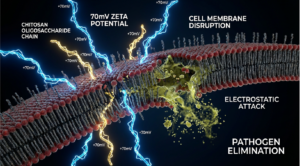 Figure 1: Mechanism of Action – The +70 mV Zeta Potential of COS-HCl creates a devastating electrostatic gradient against the negatively charged (-30 to -50 mV) pathogen membrane, leading to irreversible disruption.
Pathogen cell membranes typically carry a net negative charge of -30 to -50 mV. Chitosan Global’s COS-HCl carries a remarkably high
+70 mV zeta potential. This creates a massive electrostatic potential difference (~100–120 mV) that drives the chitosan molecules to bind aggressively to the pathogen surface. Conventional nano-chitosan formulations often achieve only +20 to +45 mV, which provides significantly weaker binding energy. The +70 mV charge results in rapid membrane poration, leakage of intracellular components, and cell death, a mechanism against which pathogens cannot develop resistance.
Source Comparison: Mushroom, Insect, and Crustacean Chitosan
Mushroom-Derived Chitosan (Lentinus, Agaricus, Pleurotus)
Fungal chitosan is extracted from the cell walls of edible mushrooms. Recent analysis of
Pleurotus ostreatus chitosan (PMC12693451, Frontiers Mater. 2025) reveals a natural predisposition for high bioactivity. It possesses a lower crystallinity index than crustacean chitin, rendering it more soluble and reactive. Structurally, it naturally occurs in lower molecular weight ranges or is easily processed into them without harsh degradation. Crucially, mushroom chitosan is 100% free of tropomyosin, the primary shellfish allergen, and is cultivated in controlled substrates, eliminating the risk of heavy metal accumulation common in marine sources.
Black Soldier Fly (BSF) Chitosan (Hermetia illucens)
The Black Soldier Fly represents the frontier of circular agriculture. BSF larvae convert organic waste into protein and fat, leaving behind chitin-rich exoskeletons (exuviae). Research published in
Carbohydrate Polymers (2024) and
ScienceDirect (2024) confirms that BSF-derived chitosan exhibits biocontrol efficacy comparable to or superior to commercial standards.
Like mushroom sources, BSF chitosan processed via the Promecens method achieves the elite specifications of
2–3 kDa MW and >98% DDA. It has a naturally lower mineral content (calcium carbonate) than crustacean shells, allowing for milder extraction processes that preserve polymer integrity. Sourcing chitosan from BSF valorizes a waste stream, creating a truly sustainable, closed-loop product that competes directly with mushroom sources in quality and performance.
Crustacean (Marine) Chitosan – The Legacy Limitations
While historically dominant, crustacean chitosan faces mounting challenges. It is typically HMW (100–400 kDa) and requires harsh chemical hydrolysis to reduce size, often damaging the polymer. The extraction process involves aggressive alkali (>40% NaOH) at high temperatures (120°C) to remove proteins and minerals, generating hazardous effluent. Seasonal fluctuations in catch, combined with oceanic pollution (heavy metals, microplastics), create variability in purity and safety.
Comparative Analysis Table
|
Feature |
Chitosan Global Mushroom COS-HCl |
Chitosan Global BSF Insect COS-HCl |
Conventional Crustacean Chitosan |
Typical Nano-Chitosan |
|
Source |
Fungi (Pleurotus, etc.) |
Insect (Hermetia illucens) |
Shrimp/Crab Shells |
Engineered (Marine origin) |
| Molecular Weight |
2–3 kDa (Optimal) |
2–3 kDa (Optimal) |
100–400 kDa (High) |
Variable / Engineered |
| Degree of Deacetylation |
> 98% |
> 98% |
75 – 85% |
80 – 90% |
| Zeta Potential |
+70 mV |
+70 mV |
Low / Variable |
+20 to +45 mV |
|
Allergen Status |
None |
None |
High (Shellfish) |
High (Shellfish) |
| Heavy Metal Risk |
None (Controlled) |
None (Controlled) |
High (Bioaccumulation) |
Variable |
| Production Method |
Green Enzymatic |
Green Enzymatic |
Chemical (Harsh) |
Chemical / Mechanical |
|
Sustainability |
High |
Very High (Circular) |
Low (Pollutive) |
Low (Energy Intensive) |
Green Enzymatic Production Process
The superiority of Chitosan Global’s products is not just in the source but in the science of extraction. The proprietary green deacetylation process is applied equally to both mushroom and BSF biomass.
Unlike conventional methods that boil chitin in concentrated sodium hydroxide (>40%) for hours, we utilize a
dual-enzyme cascade operating at mild temperatures (<60°C) and near-neutral pH. This preserves the delicate glucosamine backbone from random hydrolysis. Integrated membrane ultrafiltration allows for real-time fractionation, isolating the specific 2–3 kDa molecular weight cut-off (MWCO) with precision.
The process is a closed-loop system, recovering over 95% of water and catalysts. It uses zero petrochemical reagents and generates no hazardous waste. This results in a carbon footprint
approximately 70% lower than conventional chemical extraction, delivering a pharmaceutical-grade biopolymer with verified batch-to-batch consistency. More details at:
Promecens Process.
Dual Mode of Action in Agriculture
The 2–3 kDa COS-HCl delivers a two-pronged attack on crop threats: direct antimicrobial action and systemic immune elicitation.
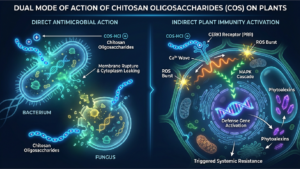 Figure 2: Dual Mode of Action – Left: Direct lysis of microbes by COS-HCl. Right: Activation of CERK1 receptor, calcium influx, ROS burst, and defense gene expression in the plant cell.
Direct Antimicrobial Activity
The +70 mV charge of COS-HCl acts as a “molecular knife.” Upon contact with fungal or bacterial pathogens, the positively charged polymer binds to the anionic components of the cell membrane (phospholipids, lipopolysaccharides). This binding disrupts membrane integrity, leading to poration.
INTACT PATHOGEN
ELECTROSTATIC
BINDING 7OmV
MEMBRANE
PORATION
STRUCTURAL
COLLAPSE
Figure 3: Five stages of pathogen elimination. 1. Intact Cell 2. Electrostatic Binding 3. Membrane Poration 4. Leakage 5.
Lysis.
Studies (PMC11434819) indicate MIC values as low as 0.25–4.5% against major pathogens including
Fusarium,
Botrytis,
Cercospora, and
Ralstonia. Specifically, BSF-derived chitosan has been shown to reduce bacterial wilt (
Ralstonia solanacearum) incidence in tomatoes by over 30% and severity by nearly 23% (PMC8780822).
Induced Systemic Resistance (ISR)
Beyond killing pathogens, COS-HCl “vaccinates” the plant. The 2–3 kDa oligomers function as Pathogen-Associated Molecular Patterns (PAMPs). They bind to the CERK1 receptor kinase on the plant cell surface (Plant Communications, 2025). This binding initiates a MAPK signaling cascade, resulting in:
- ROS Burst: Rapid production of reactive oxygen species to halt
- Ca²⁺ Influx: Intracellular signaling triggering defense
- Callose Deposition: Reinforcing cell walls to prevent pathogen
- Phytoalexin Synthesis: Production of natural antimicrobial
Plant Growth Promotion
The benefits extend to physiology. COS-HCl acts as a potent biostimulant, enhancing seed germination, stimulating root architecture development, and chelating micronutrients to improve uptake. The result is increased chlorophyll content, robust biomass accumulation, and improved tolerance to abiotic stresses like drought and salinity.
Scientific Evidence Base
Key Research Validation (2024-2026)
Emerging Nanochitosan for Sustainable Agriculture (IJMS 2024, PMID 39596327): Validates that nanometric chitosan enhances yield and immunity. ChitosanGlobal’s 2-3 kDa product meets these “nano” performance metrics naturally without engineering.
Chitosan from BSF Larval Cuticles (Carbohydrate Polymers 2024): Confirms BSF chitosan as an effective biocontrol agent with comparable efficacy to commercial standards.
Mushroom Chitosan Superior Properties (Frontiers Mater. 2026): Highlights
P. ostreatus chitosan for its high porosity, solubility, and lack of allergens.
Oligosaccharide Elicitors in Plant Immunity (Plant Communications 2026): Establishes the specific 2-5 kDa MW range as optimal for CERK1 receptor binding and immune activation.
Biocontrol Potential of BSF Chitosan (PMC8780822): Empirically demonstrates significant reduction in tomato bacterial wilt using BSF-derived chitosan.
Product Specifications & Applications
Chitosan Global offers this premium biopolymer in two distinct, sustainable source options with identical pharmaceutical-grade specifications.
A. Mushroom-Derived COS-HCl
- Source: Lentinus, Agaricus, Pleurotus
- Specifications: MW 2-3 kDa, DDA >98%, Zeta Potential +70 mV
- Purity: >99.5%, White Powder, Instant Water Solubility
- Safety: Allergen-Free, Heavy Metals <10 ppm
B. Black Soldier Fly (Insect) COS-HCl
- Source: Hermetia illucens
- Specifications: Identical to Mushroom source (MW 2-3 kDa, DDA >98%)
- Sustainability: High waste valorization impact
- Performance: Bioequivalent to mushroom source
Pricing & Availability: Both Agriculture Grade (+70 mV) options are competitively priced at
$117 USD/kg, with volume discounts available. See
Wholesale Pricing.
Agricultural Application Rates
- Foliar Spray: 3 – 0.9% solution
- Soil Drench: 5 – 1.0% solution (Root zone application)
- Seed Treatment: 1 – 0.25% coating (1–2 g/kg seed)
Superiority Over Nano-Chitosan
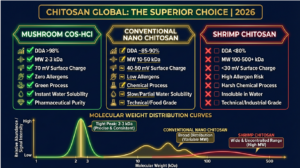 Figure 4: Comparative Infographic – Chitosan Global’s COS-HCl (Mushroom/BSF) vs. Engineered Nano-Chitosan vs.
Standard Crustacean Chitosan.
Figure 4: Comparative Infographic – Chitosan Global’s COS-HCl (Mushroom/BSF) vs. Engineered Nano-Chitosan vs.
Standard Crustacean Chitosan.
“Nano-chitosan” is often marketed as a high-tech solution, but it typically involves top-down engineering of bulk crustacean chitosan, adding cost and energy. Chitosan Global’s COS-HCl is
intrinsically nanometric (2–3 kDa is effectively macromolecular nano-scale) without the need for artificial comminution. This natural configuration offers better stability, no aggregation issues, and regulatory status as a natural polymer rather than a nanomaterial.
Environmental & Economic Benefits
Switching to Mushroom or BSF-derived COS-HCl offers profound benefits. Economically, farmers can realize cost savings of 40–60% compared to synthetic fungicide programs while reducing chemical residues. Environmentally, the production process saves water and eliminates toxic waste. The BSF source specifically diverts organic waste from landfills, reducing methane emissions. Both sources support soil health by feeding the beneficial microbiome rather than sterilizing the soil.
Regulatory & Safety Profile
Both Mushroom and BSF-derived COS-HCl are recognized as safe. They carry no Maximum Residue Limit (MRL) restrictions, allowing for application right up to harvest (zero PHI). They are non-toxic to pollinators and farm workers. Being allergen-free (unlike shellfish chitosan), they eliminate cross-contamination risks in the food supply chain. Their biodegradable nature ensures they leave no persistent environmental footprint.
Conclusion
The future of agriculture lies in high-performance sustainability. Chitosan Global’s
Mushroom and Insect-Derived Chitosan Oligosaccharide-Hydrochloride represent the pinnacle of this evolution. By harnessing fungal and BSF sources and refining them with a Green
Manufacturing process, we deliver a biostimulant with stringent specifications:
2–3 kDa MW, >98% DDA,
and a
charge> 70 mV. Whether you choose a mushroom or insect source, you are choosing a scientifically superior, safer, and more sustainable solution than conventional marine or nano-chitosan.
© 2026 Chitosan Global. All rights reserved.
Have a Question? Book a Call
If you don’t know what type of chitosan is best for your situation, Book an appointment. we will offer you an initial 30-minute consultation and product quotation at no charge.